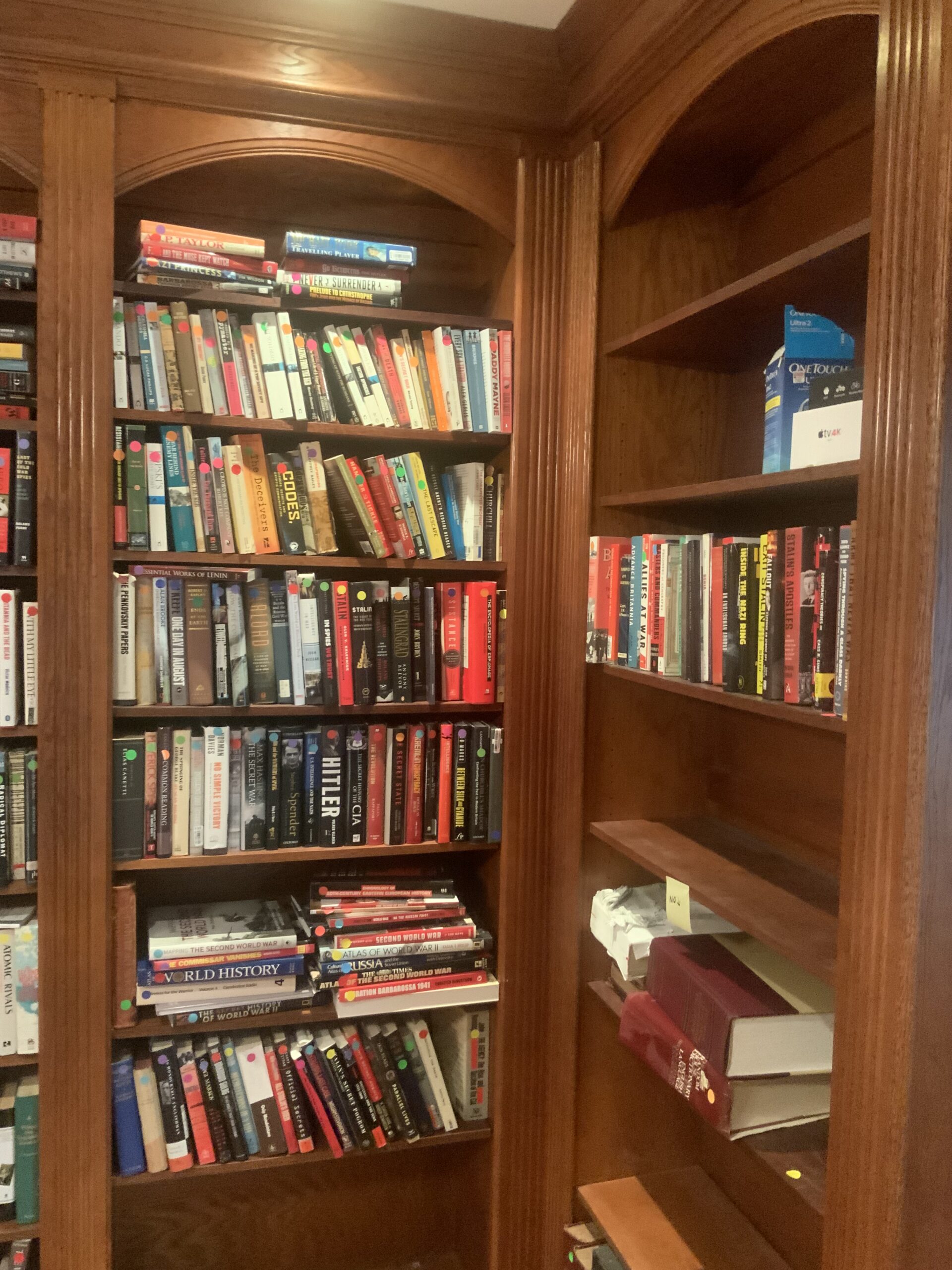
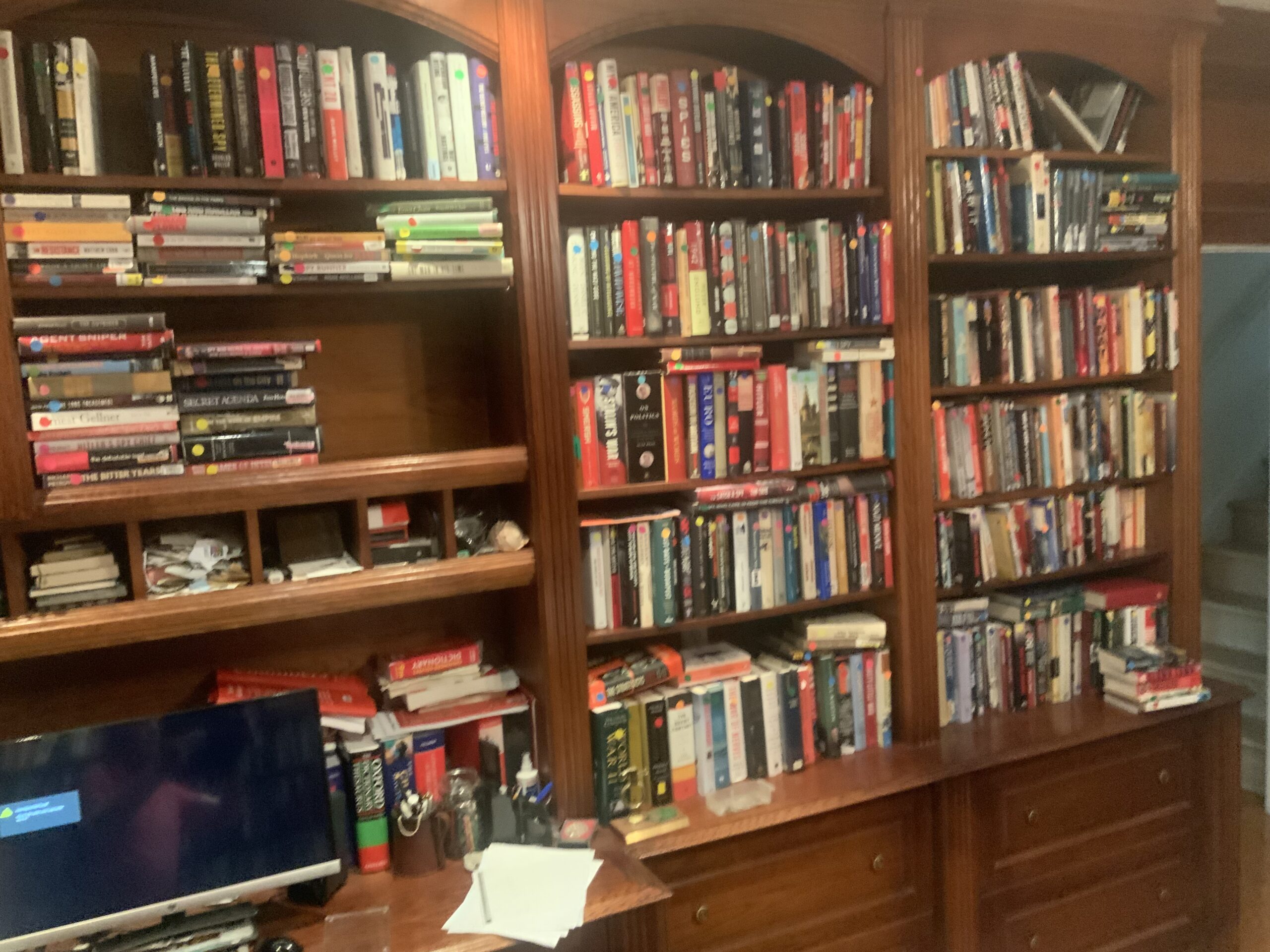
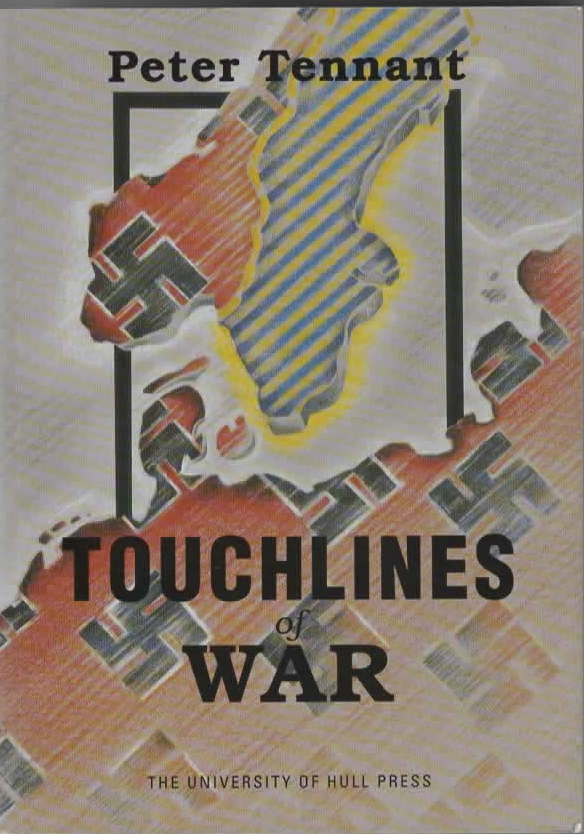
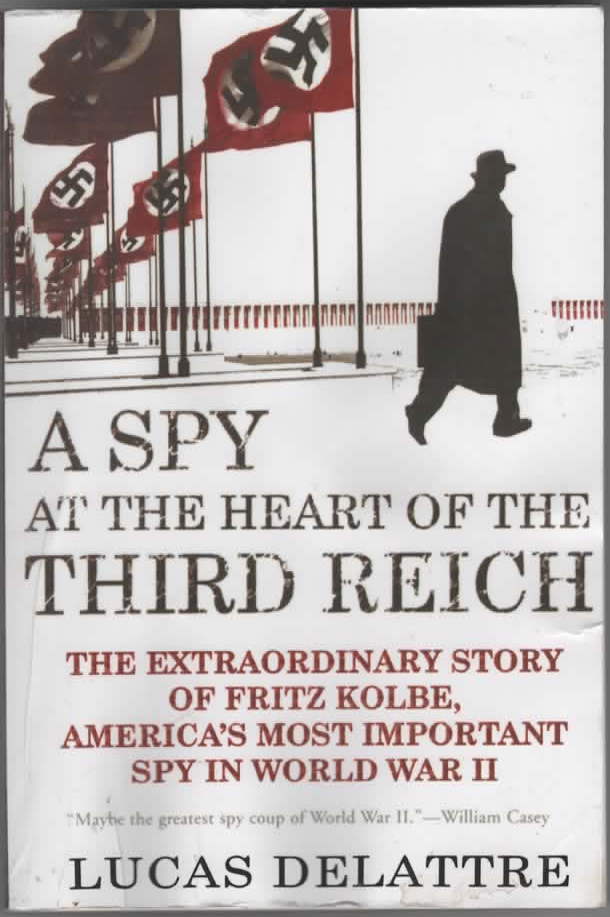
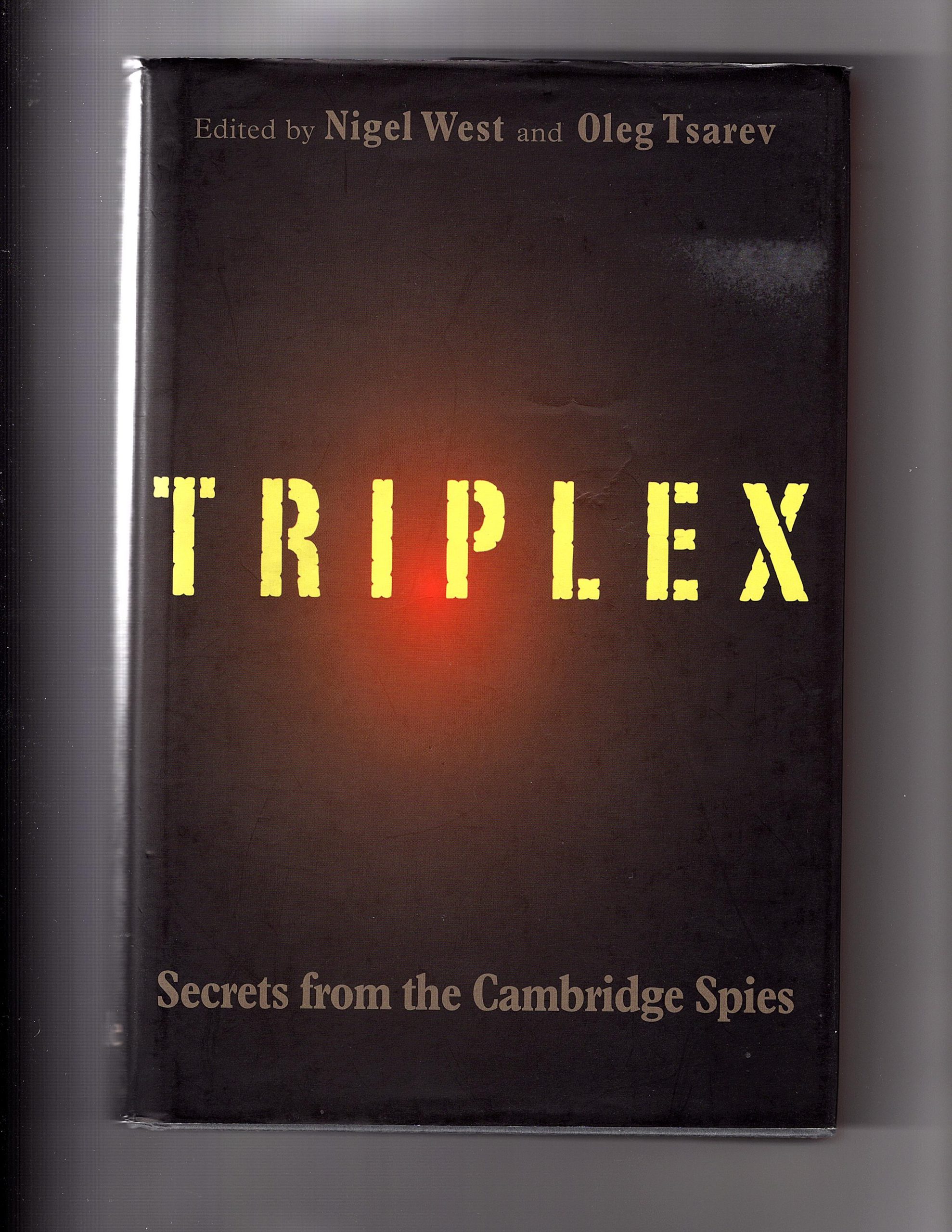
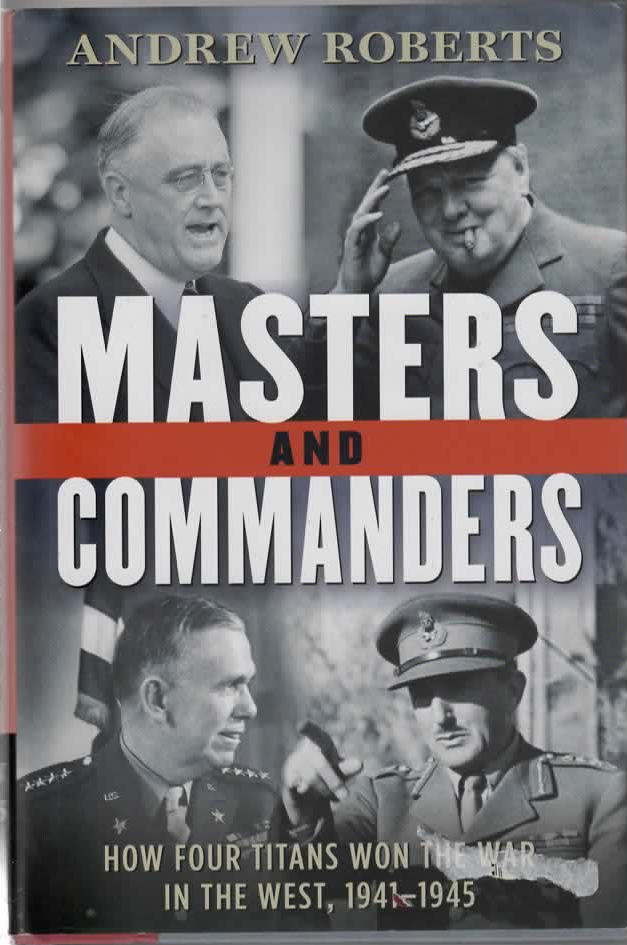
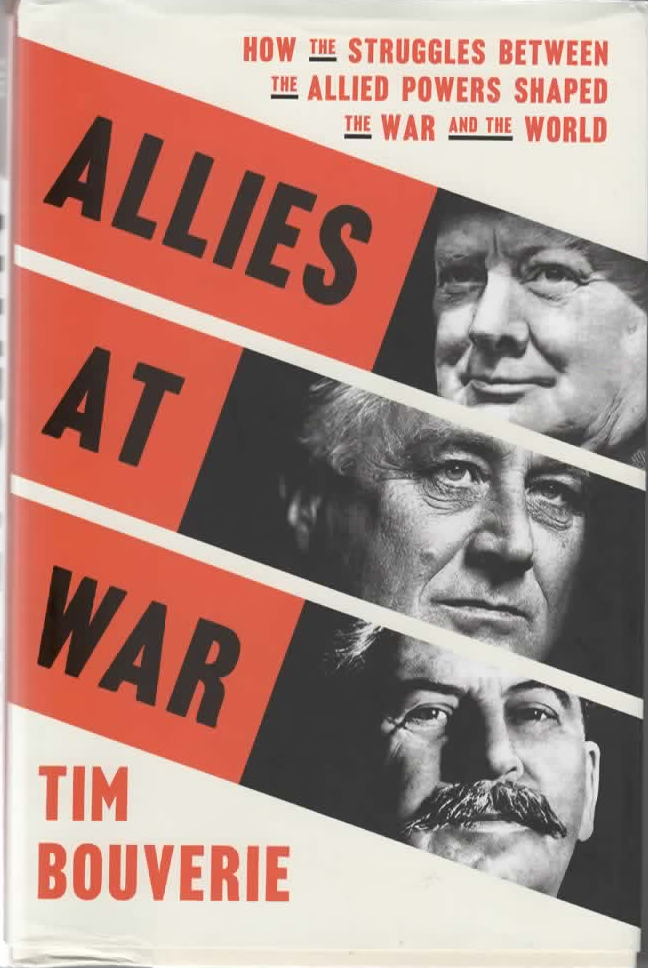
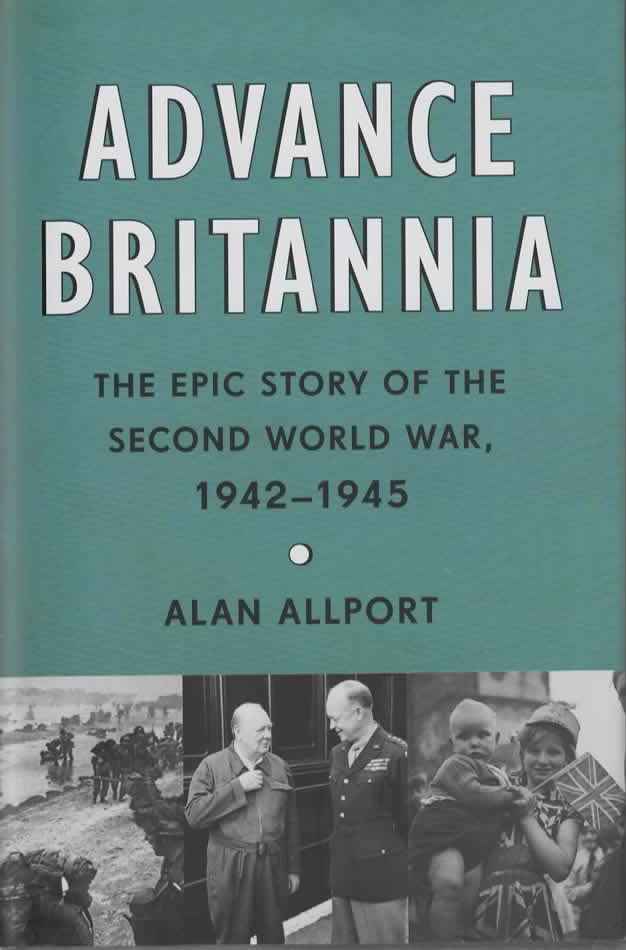
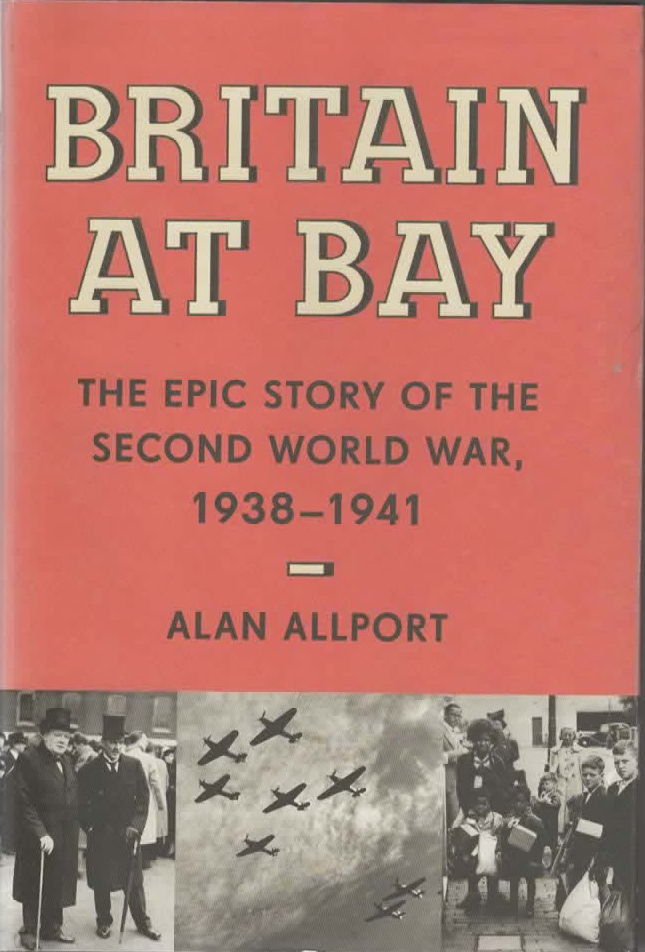
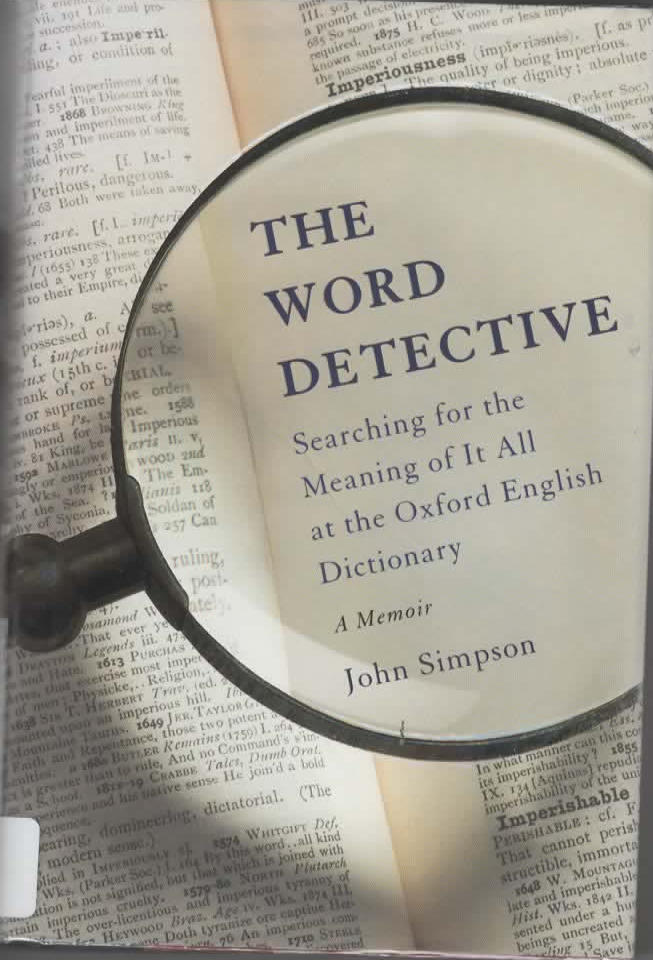
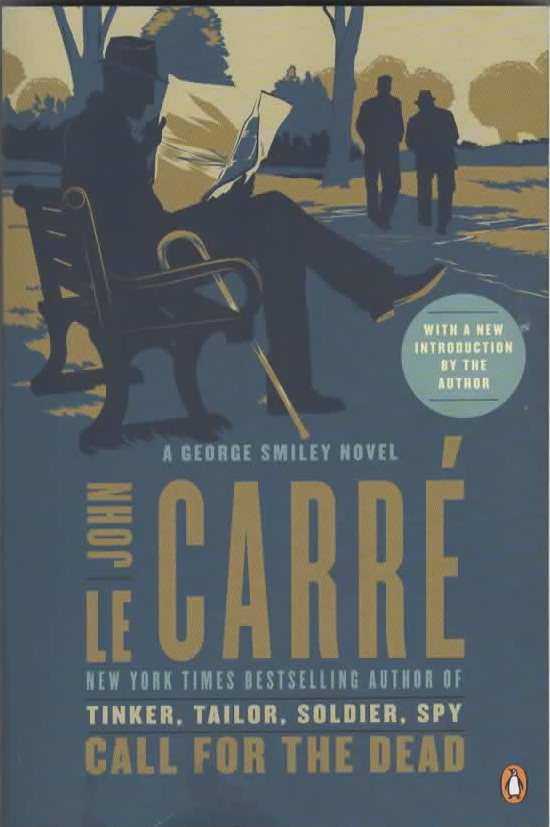
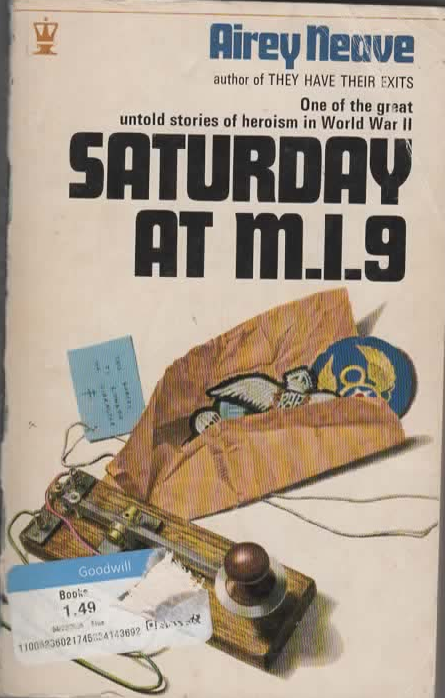
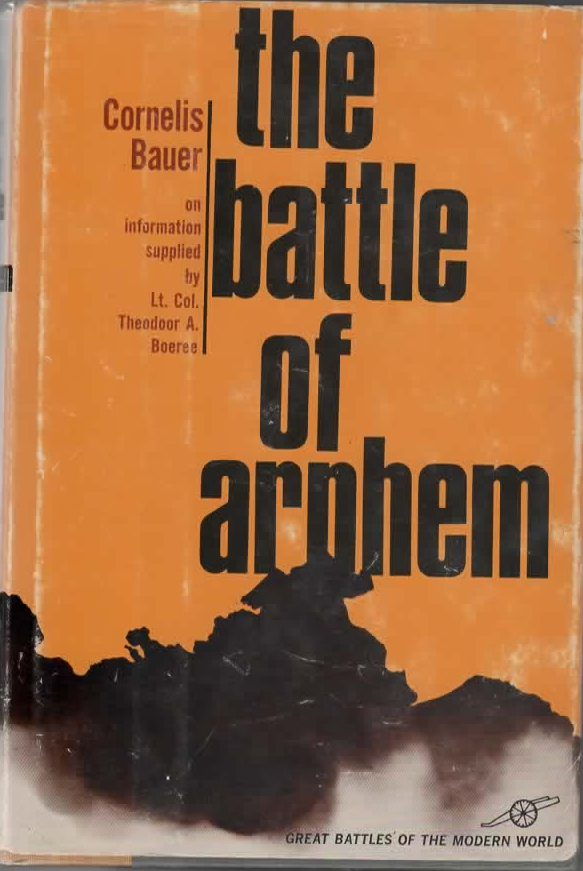
“The room, yes, was smaller than the O.B.’s study, the rows of shelves packed more closely together. Not the exact configuration, then, but unnervingly similar, and as he stepped towards the books, he found himself remembering their titles, or, at least, finding the touchstones when he looked for them – there was Churchill, there was Beevor, there, among newer volumes, were Macintyre, Andrew and Aldrich. Biographies and histories and analytical studies, with the occasional frivolity thrown in, in the shape of a smattering of paperbacks kept low down, where the casual gaze wouldn’t encounter them – not an embarrassment, but a private pleasure: Deighton, Ambler, Price, Littell. The le Carrés in hardback on a shelf above, next to Dickens.”
(from ClownTown, by Mick Herron, p 40)
‘Clown Town’
The key driver in the plot of Clown Town, the latest in the series of Slough House novels by Mick Herron, is the discovery that a book is missing from the library of David Cartwright, a now deceased former big honcho in MI5, who was affectionately known as ‘the Old B.’, and who is probably modelled on Herron’s literary hero, David Cornwell. (I bought the book a few weeks ago, when it came out in paperback.) River Cartwright, David’s grandson, who had been largely brought up by his grandparents, had fortunately taken a video of his grandfather’s library before it was packed up and shipped to an Oxford college, a very thinly disguised St. Antony’s, ‘the spooks’ college’. The archivist at the college has been checking inventory against River’s movie, and notices that a volume has disappeared. By using a motion-capture program, she can discern that its title is Secret Voices: A Hidden History of Deep Cover Lives, by one M. H. Leggaty. Yet no such book exists, and the author is untraceable.
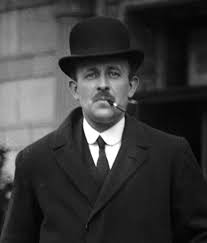
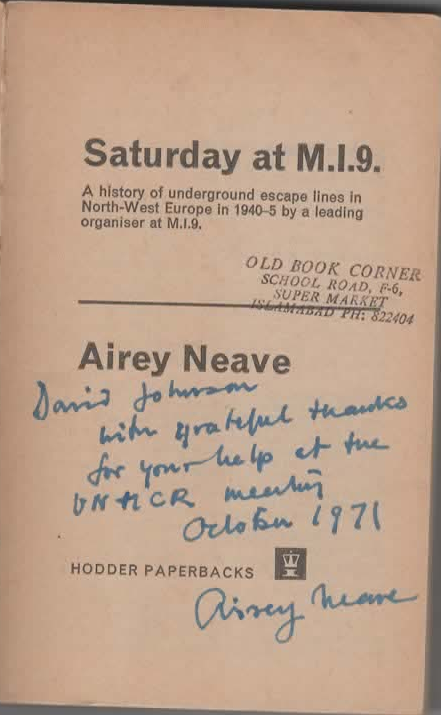
Readers of this column will have to turn to Herron’s book to learn what the ‘O.B.’ was doing placing a dummy volume among all his genuine articles. (I have to admit that I guessed what the mystery was all about from reading the short, macabre Preface to Clown Town, since I had read Secret Soldiers, by Peter Harclerode, while I was in California in August.) If you inspect any of the embedded photographs published here, however, and can decrypt the pixels of those whose titles are not well-focussed, I guarantee that you will not find any fake titles. A few rare ones – and many familiar items, too. My library resembles in many ways the collection that Cartwright assembled, although I have to say that the works of espionage fiction (I considered including My Silent War and Sonja’s Report in that category, especially after Alexandra Pringle’s declaration) are stored upstairs in our daughter’s bonus room, where dwell all my paperback fiction, classics, Pelicans, and various assorted works that are properly not to be regarded as the ‘core’ of my espionage/intelligence/history/literature Library.
The Library (1)
I have registered 7,308 books at the website LibraryThing. Nearly all my books on history, Oxford reference books and companions, multiple volumes of the DNB, and relevant biographical items, as well as a vast and probably unmatched array of poetry and humorous verse, have already been boxed up and stored at the Percy Family Collection within the Center for Southeast North Carolina Archives and History at the University of North Carolina in Wilmington. For the last few months I have been exploiting as much as possible the remaining 2,000 or so books that constitute the beating heart of my library, using them on my last two major projects, namely the identity of JOSEPHINE, and the strange case of the SOE Swedish Section (the report on which will appear here at the end of October). On September 24, the personnel from UNCW moved in to box up this remaining set. It was day of mixed emotions, obviously.
The Library (3)
I have held back on several dozen items that could have gone: books that I shall want to treasure and re-read, like my P.G. Wodehouse anthologies, or important items that I have somehow not yet read. Most of the latter will find their way to the Collection in due course. I shall hold on to my Encylopaedia Britannica set, purchased in the late nineteen-sixties, and various other reference works useful for crossword-compilation. My collection of humorous volumes, books on bridge and chess, and on other games (which sits in another room), will remain. What it does mean, however, is that my conventional research, which relies heavily on rapid access to a vast range of historical and bibliographical sources, has effectively come to an end. I still have projects that I want to pursue that can be accomplished without such access (such as a detailed analysis of the PEACH and Maclean archives at Kew, either already downloaded or currently being photographed by my London-based researcher), but any access to a vital book will require my driving into Wilmington, thirty-five miles away, and being well-prepared to inspect what I want. Thus my vague ambitions for writing more about the Illegals, or trying to resolve the conundrums surrounding Alexander Foote, or digging more into the Dick Ellis story, will probably have to be abandoned.
The Library (4)
There is much work still to do. I have to register and describe a large number of paper archives: pamphlets, letters, newspaper and magazine clippings, bound volumes of nineteen-thirties magazines (predominantly The Listener, Atlantic Monthly,and Life), as well as several other loose and important issues of Life, scholarly articles and book reviews, a complete set of Purnell’s History of the Twentieth Century (from the late 1960s), and various miscellanea. I have a large electronic archive to sort out from a chaotic existence on my computer, including (for example) notes taken on hundreds of books, dossiers on key intelligence matters, correspondence, notes on documents from the National Archives, reviews and reports sent to me by enthusiastic supporters, and spreadsheets containing such analysis as the evolving organization of MI5 and a list of Personal Files owned by MI5 (but including dozens not acknowledged openly by the Service). The crown jewels of my archive – a four-hundred-and-fifty page Chronology of Events covering mostly 1930 to 1963 –has to be edited and properly indexed. Then I have to design and implement – alongside an archivist at UNCW (who was supposed to have arrived by now, but whose appointment has regrettably been put back to 2028) – a portal to the whole coldspur archive, and the library and artifacts that support it, so that future scholars may browse its contents on-line, and plan a visit to exploit them. For I firmly believe that the combined electronic and paper-based collection will be the premier source of intelligence and espionage information for the years 1930-1980 (primarily) in the nation, probably in the world.
The Library (5)
The day of the last exfiltration was an important and symbolic date. It was also the day of our fiftieth wedding anniversary.
* * * * * * * * * * * * *
‘The Secrets Behind the Atom Spies’
Osher Lifelong Learning Institute
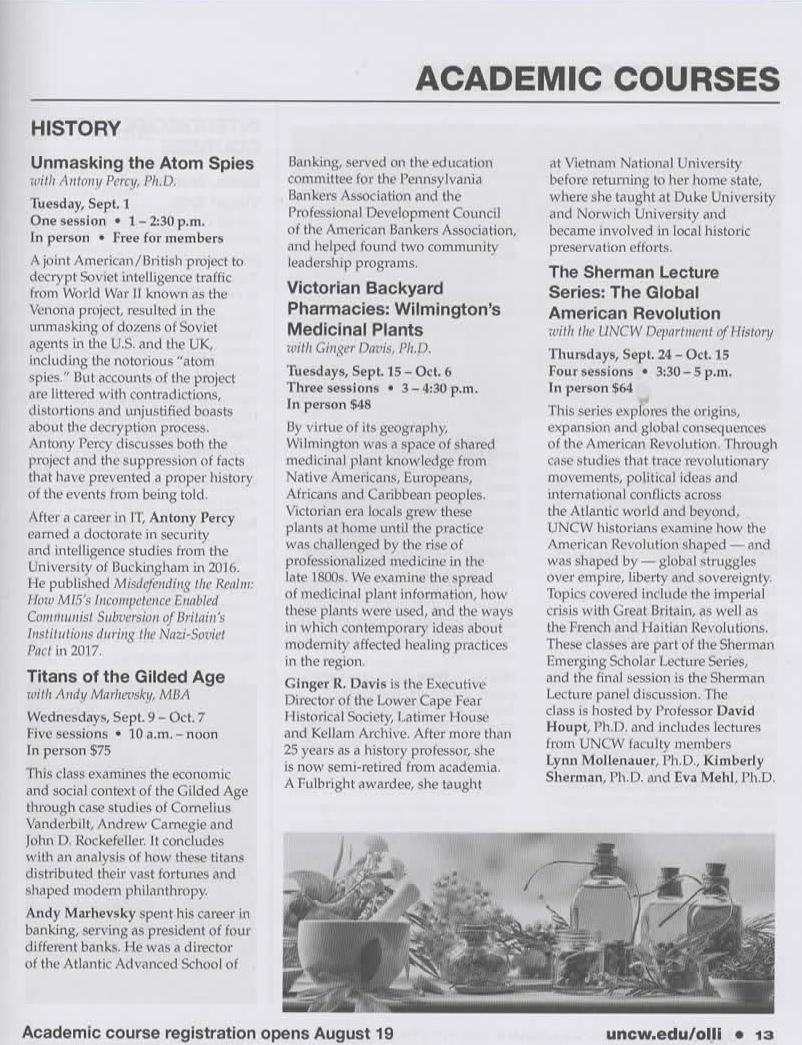
On September 1, I delivered a presentation at the Osher Lifelong Learning Institute (OLLI) at UNCW in Wilmington. The institute’s promotional materials describe it as follows: “OLLI at UNCW is a membership organization that seeks to foster lifelong learning opportunities, individual growth and social connection. Funded in part by the Bernard Osher Foundation, we are part of a national network of 125 lifelong learning institutes on college and university campuses in each of the 50 states and the District of Columbia.” I was delighted to have been invited to speak, and it did not take long for me to select a subject that had an Anglo-American theme, one that would allow me to showcase some of my recent original research.
‘Unmasking the Atom Spies’
While the title became a little distorted during the process, the essence remained the same – a fuller account of how VENONA allowed some critical spies to be unmasked, and how the full story has often been misrepresented. My session attracted a full house, in an excellent setting, liberally provided with television screens. I spoke for about an hour (a bit longer than I believe is probably appropriate), but the audience seemed engrossed, and I entertained some excellent questions afterwards. Before the event, a few correspondents who had read about it asked whether a recording of the presentation would be made. I replied that I did not think that the audio-visual record of an intimate, interactive event would make for a suitable podcast, but I did commit to providing a transcription – not a literal one, but one giving the essential story – and publishing it on coldspur. Thus it appears below.
It was over seventy-five years ago when the spurt of revelations about illegal disclosure of atomic secrets to the Soviets came to public notice, soon after Stalin surprised the world by detonating a nuclear device. What secrets could still remain undescribed after all these years? After all, a number of spies were detected, and some prosecuted, with varying outcomes. Yet a few escaped attention, such as Theodore Hall, who refused to admit his guilt, and ended up living out his days working at Cambridge University in England. There were some over whom a cloud of suspicion hung, but who were never named. A final aspect of the secrecy, however, relates to the process by which the spies were identified. The official historians have distorted the truth for reasons of aggrandizing the achievements of the institutions that harboured them, and of concealing the depth of infiltration that may have occurred.
My talk today focusses on a cluster of four agents, two of them a married pair, namely Julius and Ethel Rosenberg, Klaus Fuchs, and Donald Maclean. Each had a very different background, very singular approaches to the task of espionage, and vastly different outcomes driven by the authorities that pursued them. The Rosenbergs came from families who had escaped tsarist oppression in Rusia, and who saw communism as an egalitarian creed that abolished such discrimination and persecution. Witnessing the Depression, they were drawn to Stalin’s cause, but, having been enmeshed in the Soviet spy web, were detected, and then executed in the land of their birth. Fuchs, a German, fled to Britain from Hitler’s anti-communist purges in 1933, and, despite his open communist leanings, was recruited to the Tube Alloys project that explored the development of atomic weaponry. Fuchs was even granted naturalization, and was in 1943 sent to the USA to assist in the Manhattan Project, the US operation to construct an atomic bomb. After returning to the UK after the war, his espionage was detected, he confessed, and he was sentenced to a long prison sentence in his adopted country. Maclean, an upper-class Briton, wheedled his way into the Foreign Office despite a questionable ideological track-record at Cambridge University. His espionage was also detected, but, shortly before interrogation, he escaped without punishment, fleeing to the state that had recruited and supported him, and that had demanded a dreadful loyalty out of him – the Soviet Union. The fact that the conclusions of their individual experiences were so totally out of proportion to the significance of their espionage reveals a great deal about differing political cultures, and the dynamics of international relationships at the time.
Yet a fascinating aspect of the whole enterprise was the timing. The atomic bomb was dropped on Hiroshima on August 26, 1945. The USSR successfully tested its version of the bomb on August 29, 1949 – to the great surprise of the Americans, who did not expect them to be ready for at least another five years. Klaus Fuchs was sentenced on March 1, 1950. Donald Maclean escaped on May 25, 1951. The Rosenbergs, having been arrested in 1950, were executed on June 19, 1953. How was it that the British and the Americans were so ignorant of the espionage being carried out in their midst, and how did the culprits manage to stay undetected until well after the events? The answer is that all four shared a common fate: they were betrayed by a flawed Soviet wartime communication system that should, by any analysis, have provided watertight intelligence concerning the Soviet Union’s project to replicate the USA/UK’s joint nuclear weapons project – what the Russians called ENORMOZ.
How far back should we look back for causes for this secrecy and betrayal? In August 1945, the Soviet Union was still an ally of the western democracies. Yet that compact had been an often shallow and tenuous relationship. August 1939 is a good starting-point for understanding the political tensions that endured throughout the temporary alliance against the Axis powers. In recent years, Germany had been steadily spreading its tentacles over European territory (Austria, the Sudetenland of Czechoslovakia) while the Soviet Union had for the whole decade been promoting the role of Communism as the only force capable of resisting Fascism. At the end of August 1939, however, it announced a non-aggression pact with Hitler’s Germany (the so-called Ribbentrop-Molotov agreement), accordingly shocking many of its adherents, some of whom abandoned the Leninist/Stalinist creed immediately. Two weeks later, Germany invaded Poland (and the Soviet Union took the opportunity to invade the Baltic States), prompting Great Britain and France to declare war on Nazi Germany. The Soviet Union was not an enemy of Great Britain, but for the next eighteen months or more, it was a hostile force, providing matériel to Germany to help it wage what became known as the Battle of Britain. Great Britain, which had for most of the preceding twenty years considered the Soviet Union as its primary adversarial threat, had good reason for resenting Stalin’s assistance to its declared enemy. Fortunately, Britain held out and, with the prospect of invasion extinguished, Hitler changed his attention to the conquest of the Soviet Union. Yet the resentment endured.
When the attack occurred (Operation BARBAROSSA) on June 22, 1941, Winston Churchill, Britain’s prime minister, made an unauthorized and over-emotional gesture to Stalin, promising him every support Britain could give to help the Soviets beat the Nazis. Many senior politicians were shocked by the excess of Churchill’s overtures, conscious of how Communism had been viewed as an existential threat for so long. They were critical of Stalin’s behaviour, especially his hypocrisy and his brutality in the Baltics. Moreover, Stalin immediately started exploiting Churchill’s naivety, requesting within days that Britain open a ‘Second Front’, when the country – alongside the dominions of the Empire – was already stretched across several worldwide fronts, trying to beat back the Germans. (The United States were of course not participants in the war yet.) Thus began a very difficult four-year period in which Stalin took advantage of Churchill’s continuing timidity regarding the Soviet Union, with Churchill always fearing that, if he did not appease the Generalissimo, Stalin might resuscitate his pact with Hitler, and the two of them might then turn against the western powers.
After the USA entered the hostilities in December 1941, Hitler having declared war on it after Pearl Harbor, Great Britain and the USA engaged upon a deeper level of intelligence sharing, recognizing the threat represented by Hitler’s plans to develop an atomic bomb. The results of the British MAUD Committee, and its Tube Alloys project, were conveyed to the emergent US programme, which led to the establishment of the Manhattan Project in July 1942. The USA took the lead role in January 1943. Security was a vital concern: the Americans and the British obviously had to keep the details of the project secret from the Germans and the Japanese, but President Roosevelt decided not to involve the Soviet Union, or confide in it. The military recognized that it would probably be a hostile force when the war was over. Unfortunately, government institutions on both sides of the Atlantic were riddled with Soviet sympathizers and spies, with the result that Moscow learned of the work as early as August 1941, primarily from the group in England known as the ‘Cambridge Five’ (Philby, Burgess, Maclean, Blunt and Cairncross). Information concerning the development of the bomb flowed freely to Stalin via his clandestine channels, and the fact that he was not informed of the project by Churchill and Roosevelt (nor of other highly secret endeavours such as the ULTRA decrypts) served only to increase his suspicions about the trustworthiness of his new allies.
The essence of this story concerns the methods by which Stalin’s agents passed their intelligence back to Moscow. In Britain, intermediary couriers were a straightforward way of getting information to the Soviet Embassy, which had a wireless link to Moscow. Wireless activity by agents (such as SONIA) was minimal. In the USA, the situation was different. Private wireless links were hazardous and unreliable from the USA to Moscow, as was diplomatic wireless traffic, and a system of couriers was used to send messages to the consulates and embassies of San Francisco and Washington. Thereafter, commercial cable links were used by the Soviet Embassy to send information to Moscow: according to regulations, the government was authorized to keep copies of all traffic transmitted in this way. The possible exposure of interception was recognized by the NKVD, which therefore had to deploy a proven watertight encipherment system to guarantee that the Americans never discovered what intelligence their spies were picking up, and who their sources were. The process of encryption involved two stages: the replacement of common words and phrases with items looked-up in a codebook (a type of dictionary), and a rigorous system of One-Time Pads (OTPs) – sheets of meaningless numbers that were used to modify texts mathematically. As their name implies, each pad was to be discarded once it had been used, thus providing an unbreakable level of encryption.
Under wartime stress, the system failed. In 1942, a duplicate set of OTPs was shipped out to all Soviet stations abroad. A sharp-eyed analyst at Arlington Hall, where the Signal Security Agency (SSA) had established its headquarters, noticed that certain messages appeared to be reflecting familiar text. The VENONA project, designed to decrypt Soviet diplomatic traffic, took off. Yet it was still an arduous process: fragments of messages might be created, but they lacked vital context. The use of the codebook meant that the terms used, and the identities of the sources, remained a mystery until further decryption, complemented by inspired guesswork, could bring some coherence to the overall story. That is why many of the key items of intelligence were not revealed until after the first bomb was detonated. Even so, the cryptologists were aided by such elements as stolen cribs, and codebooks retrieved from the battlefield in Finland in 1940. The historians have severely underplayed such activities, preferring to attribute the breakthroughs to the sweat and imagination of the cryptanalysis team of the SSA (and in 1945, the Army Security Agency).
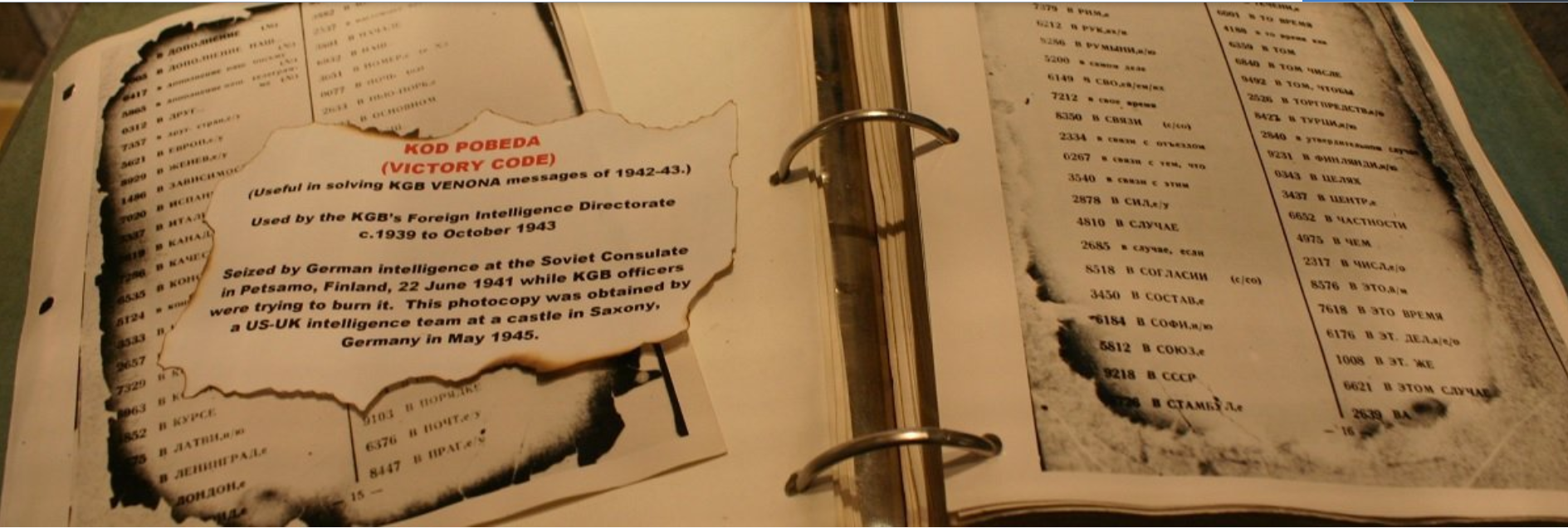
Two persons played a significant part in this effort, the American language expert Meredith Gardner, employed at the SSA, and an expert British cryptologist, John Tiltman, who visited the USA in 1942 and 1944, and built up a strong relationship with Gardner. I call them ‘the Two Gentlemen of Venona’. It was Tiltman who had retrieved the Soviet code-book from Petsamo in Finland in 1940, and Gardner displayed fragments of it in his office. Yet the contribution made by this pair – as well as the assistance that they gained from FBI raids on the Soviet trade mission in Washington – have been largely diminished in the accounts by the historians. With the aid of such techniques and ‘cribs’ (raw texts alongside encrypted versions), Gardner was able to make progress in decrypting the flawed transcripts.
Attitudes towards the Soviet Union among Americans were diverse, and changed quickly. There were diehard communists, mostly Jews, and their offspring, who had emigrated from Russia and saw communism as the antidote to racial discrimination, like the Rosenbergs. Others joined the movement as Fascism advanced, impressed by Moscow’s ability to present Communism as the only force capable of resisting it. They and were not deterred by the Nazi-Soviet Pact, seeing it as a temporizing measure. And then there were Stalin’s agents, under great pressure to deliver secrets, knowing what the penalty of inertia might be. The public at large had no knowledge of the Manhattan Project, but saw the ‘Russians’ as gallant allies. Roosevelt’s naive hope of post-war partnership with the Soviet Union through the United Nations was echoed by the British Foreign Office’s desire for ‘co-operation’ with the country when hostilities ended. While Germany’s potential to deliver an atomic bomb was still a major threat, scientists were supportive of the bomb project. Albert Einstein encouraged Roosevelt to accelerate development in order to pre-empt the Nazis.
Yet the environment quickly changed when Hiroshima was bombed. Germany had now been defeated. When Einstein realized the results of the explosion, he implored Roosevelt to impose a moratorium, and called for international surveillance of all development of atomic weaponry. General Leslie Groves, the Manhattan Project chief, did not help matters by telling his scientists that the real enemy, and target, was now the Soviet Union. In Britain and the United States, the military was ahead of the politicians on the Communist threat. A further twist in the plot occurred in September 1945, when a cypher clerk with Soviet Military Intelligence in Ottawa, Canada, Igor Gouzenko, defected with intelligence that showed that dozens of Canadians and Britons were involved in espionage, especially of atomic secrets. That resulted in the swift confession and conviction of Allan Nunn May, who had debunked in haste back to his native UK. Despite the hesitancy on the part of the Canadian administration to confront the Soviets, these events effectively marked the beginning of the Cold War.
The VENONA project made slow but steady progress. The movements and activities of possible spies came into sharper focus. The first to succumb was Klaus Fuchs. As an open communist, Fuchs had escaped to Britain from Nazi Germany in 1933, where he made no secret of his beliefs. When war broke out, he was interned, but after release he was assigned to work with Rudolf Peierls, who had collaborated with Otto Frisch on the potential of Uranium-235, and was working on the Tube Alloys project. Fuchs became a British subject: his communist background was forgiven in the frantic search for competent scientists. He passed on secrets to the courier ‘Sonia’ – Ursula Beurton, as she was at the time. In 1943 he was sent – in breach of the requirements of protocol – to the United States, where he ended up working at the Los Alamos Laboratory. He continued his espionage there, using couriers. After the war, he returned to Britain, where he headed up the Theoretical Physics Division at the Atomic Energy Research Establishment at Harwell. In 1947, he resumed his practice of passing on confidential information to the Soviets.
When an item in the VENONA transcripts pointed to a visit made by an agent with the cryptonym ‘REST’ to see his sister in Boston, the FBI rapidly worked out that it must be Fuchs, and passed on the information to MI5. After a long period of surveillance, Fuchs was encouraged to confess to officer Jim Skardon, and shortly afterwards he was put on trial. On March 1, 1950, he was sentenced to fourteen years in prison. Fuchs later said that he expected the death penalty, but his crime was an offense against the Official Secrets Act, not treason, since the Soviet Union had never been a declared enemy. There were further ironical elements: Fuchs had begun to appreciate the benefits of living in England, and he had been enjoying an affair with the wife of a colleague. Moreover, archival material hints that Fuchs may have been passing confidential US secrets to the British since his return. The McMahon Act of 1946 had forbidden sharing of technical information on atomic matters with any other country, including the UK.
Meanwhile, the FBI was trying to identify Fuchs’s courier, known by the name ‘RAYMOND’. The British agreed that the agency could send a representative to London, to show Fuchs photographs, in the hope that he might be able to identify the person. After some reluctance, Fuchs identified Harry Gold as the courier. The FBI tracked down Gold, and caught him in a lie about his travel to Los Alamos. He confessed, revealed the name of David Greenglass, for whom he had also acted as courier and whose sister was Ethel Rosenberg. She and her husband were arrested in 1950, and charged with espionage. Both Gold and Greenglass gave testimony as prosecution witnesses against the Rosenbergs, never believing that they would be facing the death penalty. The Rosenbergs were stubborn, declined to co-operate, and were sent to the electric chair on June 19, 1953. For decades, protests were made on behalf of their innocence, and it took the VENONA releases of 1995 to prove that they had been guilty. Guilty indeed they were, but they did not deserve the death sentence.
Donald Maclean was identified through a similar mistake, although the process was quite separate from that of Fuchs and the Rosenbergs. The source ‘HOMER’ had been noticed as far back as September 1947, when a September 1944 message informing Stalin about an upcoming meeting between Churchill and Roosevelt in Quebec spelled out an obvious danger. Yet Maclean was not formally recognized as being HOMER until the end of March 1951 – three-and-a-half years later, a period longer than that between the entry of the USA into the war and VE-Day. Why did it take so long? A reluctance to face the truth, a bewilderingly bureaucratic process of going through the profiles of the thousands of employees at the Washington Embassy, but mostly a deliberate effort to decelerate the whole exercise because of the embarrassments it might cause. Indeed, Dick White, the Chief of B Division of MI5, attempted to convince his colleagues early in 1950 that the whole project should be abandoned.
What gave Maclean away? According to the records, another telegram from the summer of 1944 era referred to a visit that HOMER was making to New York to visit his pregnant wife. This message was reputedly not decrypted until March 1951, when a shortlist of five candidates could quickly be reduced to one. Yet that snail’s pace should have been accelerated. Another of the Cambridge Spies, Kim Philby (who of course guessed who HOMER was soon after he arrived in Washington at the end of 1949), not only warned his Soviet masters, but even went so far as to draw London’s attention to Maclean as a possible suspect, in order to deflect interest away from any connection he had with his fellow-agent. He even reminded MI5 of the fact that the defector Walter Krivitsky had in early 1940 urged his interrogators to investigate the ‘Imperial Council spy’ who had passed on proceedings of that body. At the time, MI5 had strangely decided not to pursue that very direct clue pointing to Maclean, or the ‘journalist in Spain’ hint that should have directed the service unswervingly at Philby.
The long and short of it was that Maclean was put under immediate (but not very disciplined) surveillance. He had inexplicably been appointed head of the American desk at the Foreign Office in November 1950, after being sent home from Cairo for grossly irresponsible behaviour, which his bosses generously attributed to overwork and stress. (He had no doubt heard about the dangers emanating from Washington.) The third Cambridge Spy Guy Burgess, who had similarly been inexplicably posted to Washington after similar outrageous behaviour, was sent back to London, and joined his colleague with assistance from Anthony Blunt, the fourth of the Cambridge Spies. MI5, the domestic Security Service, believed that Blunt was working on its behalf when he was in fact acting as courier and facilitator for the NKVD. The escape of Burgess and Maclean on May 25, 1951, by steamer from Southampton to Le Havre, was engineered and abetted by MI5 itself, since Dick White believed that the best solution would be to allow the spies to escape rather than to pursue a messy interrogation of Maclean. He convinced his colleagues in the Foreign Office of that. The procedure might have induced a confession, but the secrets that would have come out in a trial would have been devastating both for MI5 and for White’s career.
Several entanglements followed. MI5 and the Foreign Office claimed that they had no idea where the ‘Missing Diplomats’ had gone. Rumours circulated in the press that a ‘tip-off man’ had aided their escape. It was not until 1954, when the NKVD (now KGB) agents, the Petrovs, defected in Australia, that further facts came to light about the Soviets’ role in the flight of Burgess and Maclean. The FBI dropped hints about Philby as the ‘Third Man’, but he was able to deflect accusations deftly, even though his career with MI6 was ruined by then. He eventually absconded himself, in 1963, and shortly afterwards Anthony Blunt was granted a full pardon on the condition that he told his interrogators everything – something he predictably failed to do. The truth came out in 1979 when Blunt was unmasked.
Did the espionage of the atomic spies, by accelerating Stalin’s development of the atomic bomb, seriously increase international tension? The late forties were a critical period. Hawks in the USA and the UK considered a pre-emptive strike against the USSR before it acquired the bomb. Fortunately, wiser heads prevailed, even though Stalin’s cruel suppression of democratic movements in the satellite states of eastern Europe proved that he still maintained aggressive goals for destroying his enemies. Defectors warned the West that ‘Stalin meant war’, and the events of 1949 provided a stark reinforcement of that judgment. In way, it could be said the spies may have accelerated the arrival of the stand-off that held both adversaries back. Yet the betrayals of the spies went beyond atomic weaponry. They gave Stalin a regular insight into Anglo-American strategy, and allowed him to understand completely the real objectives of Roosevelt and Churchill, and to know in advance their negotiating positions to be held at such critical conferences as Yalta, in 1944. Thus the vozhd could make preparations for his control of the eastern satellite states at the end of the war – including, of course, Poland, for whose independence Britain and France had originally declared war back in 1939.
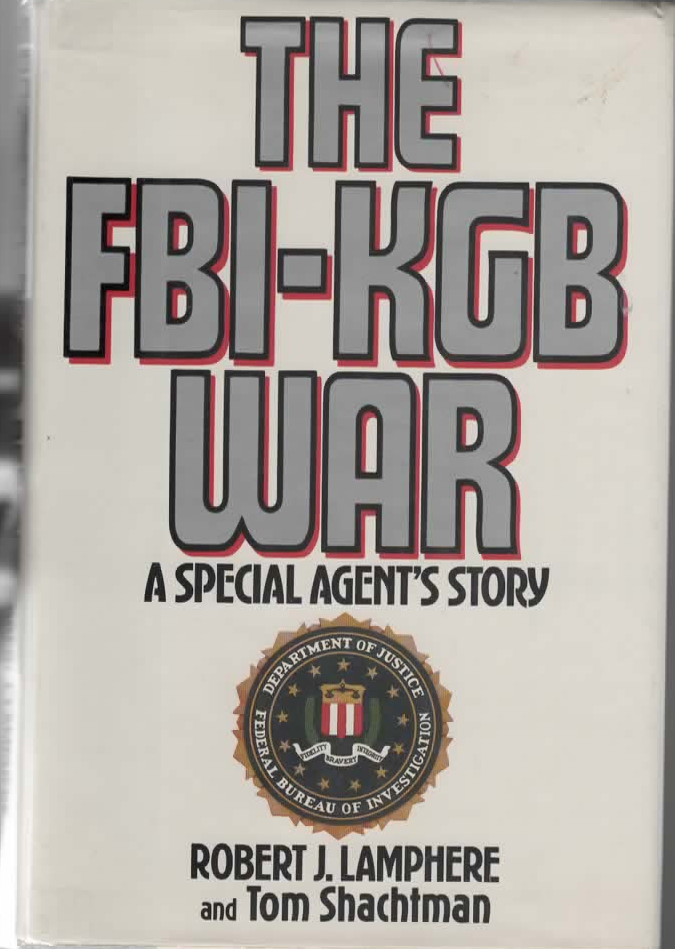
Yet little more happened with the VENONA project – as far as we can tell. Some occasional expansion of partially decrypted texts may have occurred, but there is no trail. It took until 1995 until the VENONA program was formally admitted, after hints had appeared in books by David Martin, Nigel West, Robert Lamphere, Chapman Pincher, and Peter Wright. The secret of the ULTRA project (decrypting German traffic, primarily from the ENIGMA) came out in the early 1970s, by which time the technology had become obsolete, and thus details represented no threat. So why so long with VENONA? The Soviets, slow to recognize that their system had been compromised, used the last duplicate OTP in Australia in 1948. They then switched back to authentic OTPs, and it is probably safe to say that their diplomatic systems have since been unbreakable. So why would the intelligence coup have to be concealed for so long? What it meant was that a generation of historians worked without the vital facts, while a new generation would have to re-acquaint themselves with the sequence of events from the late 1940s and early 1950s, when the accounts written in the following years were obviously not reliable.
The more ‘official’ histories that have appeared since are not trustworthy, concentrating more on the sagas of the spies uncovered rather than analyzing closely the processes that unmasked them. Why do they distort the facts, and engage in boastfulness? Why has there been no follow-up on adding substance to the partly fragmented messages and unidentified cryptonyms in the following decades? Why does there appear to have been no exploitation of vastly improved computer performance, including the latest AI techniques? And why is the archive of intercepted messages and their transcriptions in such a dire state – poorly organized and indexed, and incomplete, and left to independent agents to try and bring order to what is fragmented and chaotic?
Apart from the fact that, with the passing of time, and the deaths of the participants, much lore and knowledge have been lost, institutional pride has blocked the path to greater clarity. For decades, the backlash from the Rosenbergs’ execution put administrations on the defensive. At the same time, however there existed deep embarrassment at the level in which both American and British institutions had been penetrated – the naming of further persons who had been working for the Soviets would only emphasize the laxity that was embedded in their leadership and management. The shadow of the ‘Cambridge Five’ persists, and books are still written about them. In America, the NSA (the National Security Agency, which was formed in 1952) continues to bolster the feats of its heroes and heroines, and is reluctant to admit that they received massive help from cribs and captured codebooks. Moreover, its deep scorn for the OSS obliterated what contribution that the forerunner of the CIA made at the end of the war.
Inertia thus rules in picking up the pieces. Other projects are considered more critical. Yet the state of accuracy of much of the transcribed material is extremely poor, with many simple items that should be corrected lying unedited. That task is a simple one, achievable largely from reviewing the literature, and recent archival material. Exterior demand for action is slight (although the author of intelligence matters Ben Macintyre has recently picked up the gauntlet). Any current efforts on further cryptanalysis are dependent on non-official efforts by academies and university projects, although those endeavours seem to have trailed off considerably in the past decade.
Yet it is important. The stealing of industrial secrets by the Soviet Union was massive, and helped the country greatly in the Cold War. Such theft is echoed today in the actions of China, and we need reminding of that exposure. Government bodies and public officials should be held to account, and not allowed to obfuscate under the veil of institutional pride and false claims about ‘national security’. The participants and defaulters are all dead now: there is no risk of libel. There are no technological secrets that need to be kept unrevealed. Old archives (especially in the UK) should be made available. A historical exercise of great significance to shed light on how the Cold War began is roaring to be undertaken. The whole saga is representative of the ‘Missing Dimension’ – the fact that intelligence matters have been too smoothly excised from political and military histories.
(This month’s Commonplace entries can be viewed here.)
Sylvia (wife), coldspur, Julia (daughter), Michael (brother), Lien (James’s wife), Susanna (Michael’s wife), and James (son): Los Altos, August 2026Coldspur with Ashley, Alyssa and Alexis
Introduction:
At the beginning of this month, we (my wife, our daughter, and I) spent two weeks with our son James and his family in Los Altos, California. Sylvia and I had not seen our three grand-daughters for two years. The highlight of the visit was a party regally hosted by James and his wife, Lien, to celebrate, a little prematurely, our fiftieth wedding anniversary (actually September 24) and my eightieth birthday (December 16). Apart from several of the friends of James and Lien, attendance was boosted by the presence of my brother Michael and his wife Susanna, from London, who had arranged a tour of the San Francico area to coincide with our visit. It was a real bonus to get together with them again. Unfortunately, on my return, I started to experience more severe symptoms of extreme lethargy and shortness of breath that had started before my trip: my doctor summoned X-rays and blood tests, and diagnosed excess fluid in the heart – what is known as pericardial effusion. While the cause has not yet been determined, with medication, I am on the mend. (Within five days, I lost fourteen pounds in weight, primarily fluid from my heart area.) My lack of energy means, however, that I have not been able to dedicate myself to catching up with a backlog of research activities, including responding properly to emails from several on-line correspondents. My apologies.
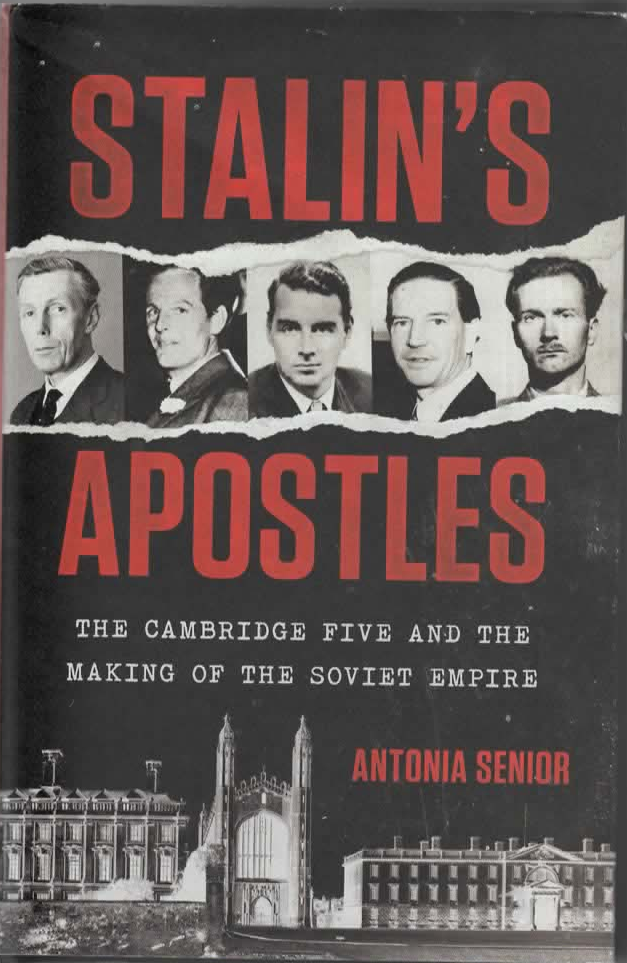
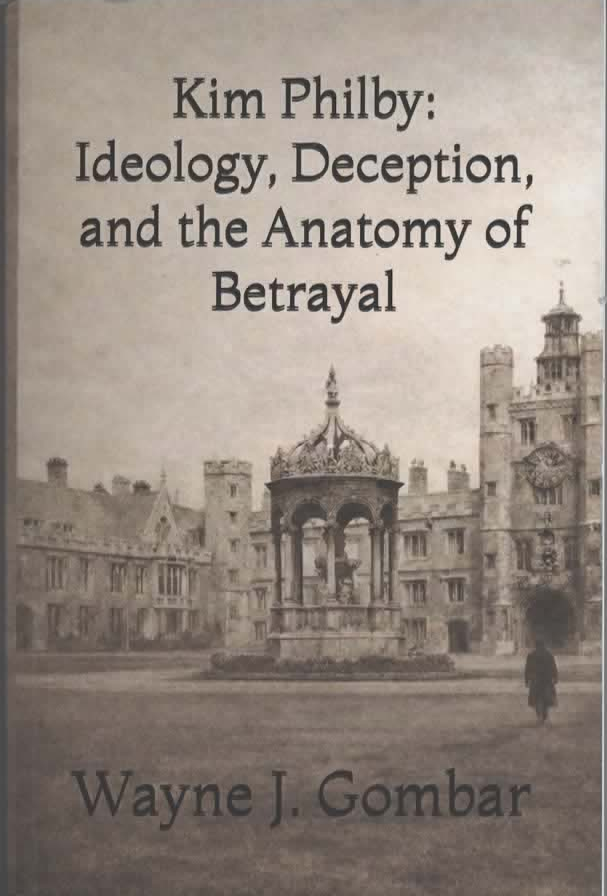
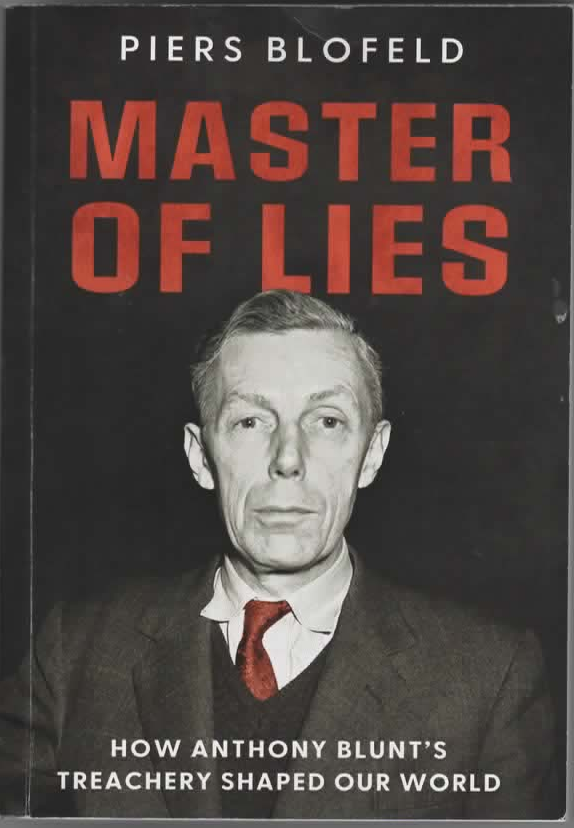
For my bulletin this month, I present a review of four new books about the Cambridge Five, all published this year, namely Stalin’s Apostles by Antonia Senior, Kim Philby: Ideology, Deception, and the Anatomy of Betrayal by Wayne J. Gombar, Master of Lies by Piers Blofeld, and A Woman Named Edith by Daria Santini. Strictly speaking, the last book is not about the Cambridge Five, but, since Anthony Blunt rather foolishly described Edith Tudor-Hart as ‘the mother of us all’, I believe that Ms. Santini’s biography belongs here. This is a Congenial (‘C’) offering, and should not put too much strain on the casual reader.
As I was putting the finishing touches to this piece, Steve Kippax of the Special Forces Club distributed a link to a Daily Telegraph article published on August 28, which I was able to access thanks to the assistance of my old friend Nigel Platts. The piece promoted a book titled The MI5 Archive: Official Secrets, by Kew archivists Mark Dunton and Stephen Twigge, to be published in September. (Of course, they are not ‘official secrets’ if they have been declassified.) The article strongly suggested that the pair was going to reveal some secrets concerning the Soviet spies (‘fresh details’, ‘previously unpublished files’), and it further claimed that Dunton and Twigge had ‘unparalleled access to the 6,000 files that MI5 has released since 1997’. That was a bit shocking. As employees of the National Archives, they may have found it easier to roam around the shelves, but the latter must have been available to everybody. I recall my critique of Dunton’s rather poor podcast from last summer (see https://coldspur.com/special-bulletin-a-house-of-ill-repute/ ). I did not identify him then, but he is confirmed as being that individual. I did, however, applaud him for his curation of the superb MI5 exhibition that I visited in September, which this book is surely designed to commemorate. Yet Dunton and Twigge are not experts on the subject. For example, Dunton repeats his previous error about Philby’s sending Burgess from Washington to London in early 1951 to warn Maclean. So do not expect much from their book, except for a chance to see some documents ‘published’ for the first time. Forty-five pounds seems a lot to pay for what is essentially a posthumous guidebook-cum-souvenir for last year’s exhibition.
‘Stalin’s Apostles’ by Antonia Senior
It is certainly timely for a fresh assessment of the Cambridge Five to be written. After all, the last comprehensive inspection of the quintet was undertaken almost a decade ago, by Richard Davenport-Hines, in Enemies Within. His book was vastly entertaining, but did not tread deeply into the murky ways in which their exploits developed, instead concentrating more on the effect that the revelations that the Establishment had spies in its midst had on Britain’s elite. He rightly disparaged the molehunters, but, was, in my opinion, far too indulgent towards, and protective of, the officials and officers in the Foreign Office, MI5 and MI6 who abetted or condoned the deeds of the Five. He also displayed some more dubious notions about gender bias, and suggested that the Cambridge Five were rebelling against the conditions of their schooling, ignoring the fact that a vast number of students in similar conditions resisted the Communist drumbeat.
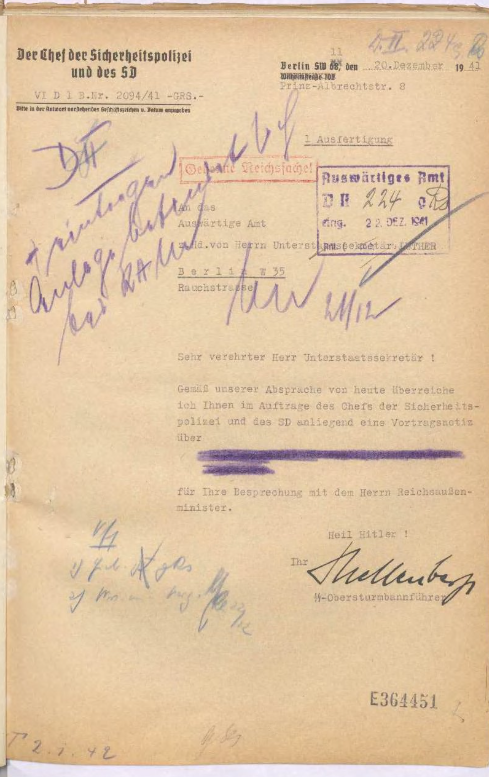
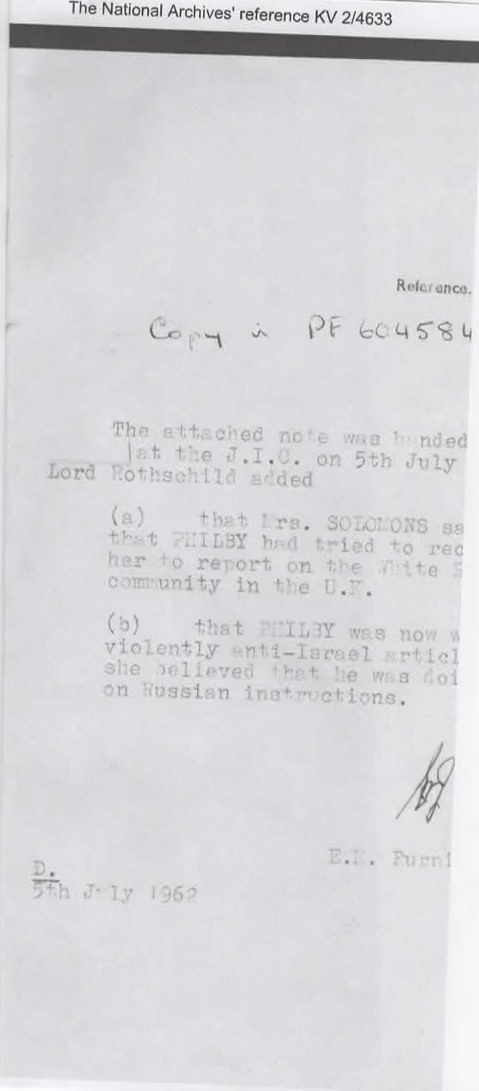
Moreover, a large number of files has since been released (on the Rothschilds, Flora Solomon, and others, as well as on the Five themselves, Philby – through the PEACH collection – Blunt, Maclean, Burgess and Cairncross) that must provide some fruitful new leads to pursue, and give a more truthful account of how the Five managed to escape the investigations of the Security Service unscathed. There is, of course, the coldspur archive as well, freely available for any historian to inspect, challenge, or reject. Shawnna Morris’s Cambridge Spy Ring, which appeared from the USA last year, cannot be treated as a serious contribution to the canon, as I explained when I gave it a brief review last December, at https://coldspur.com/2025-year-end-round-up/ .
Thus I would expect the eager author of such a work in 2026 to offer some penetrating analysis. He (or she) would no doubt cast a fresh eye on Philby’s ambiguous dealings in Vienna in the spring of 1934, and question the accounts of his return to the UK, which have been echoed so frequently, but have now been shown to be mendacious. He would study closely the following recruitment of Maclean, Burgess, and Blunt – and later Cairncross – and analyze how their activities were monitored by MI5. He might inspect the relationship between Philby and his Austrian bride, Litzy, and consider why, when they informally split up in 1940, they did not get divorced. He would turn a very close eye on the revelations of Krivitsky in 1939, and investigate carefully why MI5 appeared to ignore the defector’s specific warnings about the existence of traitorous individuals who should have been traced to Maclean and Philby, and why the lead and very competent officer who studied Krivitsky’s testimony was rapidly assigned to other duties.
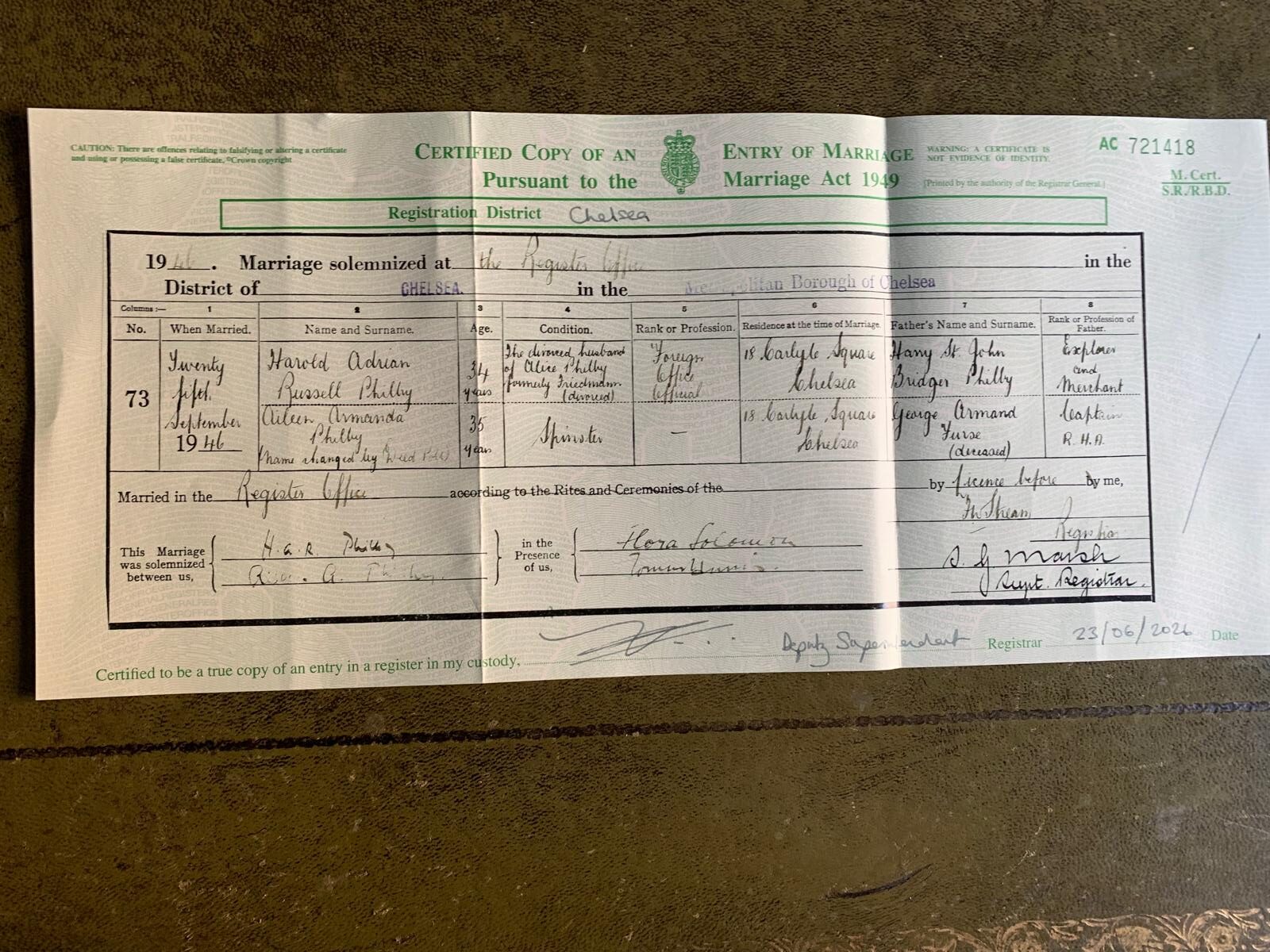
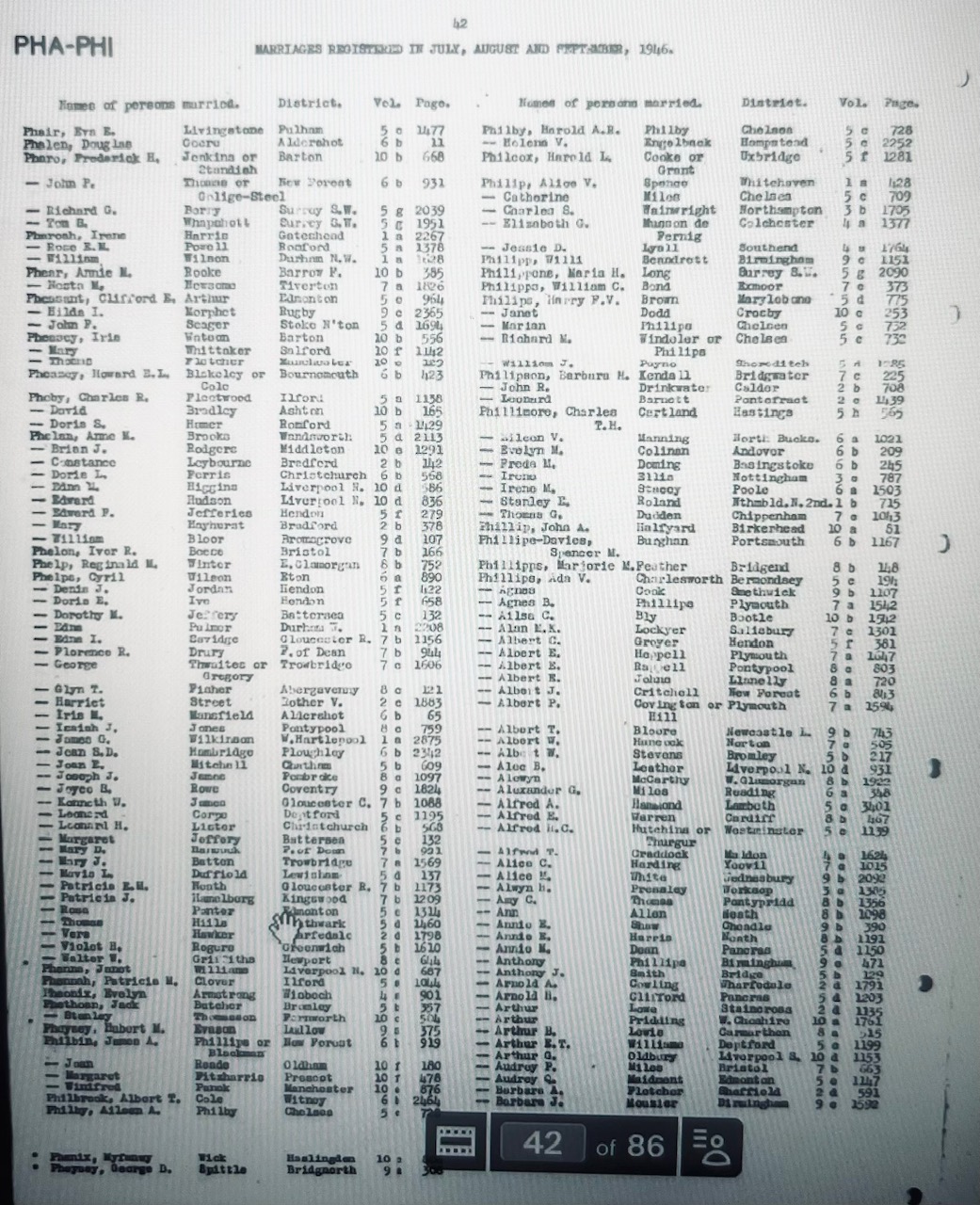
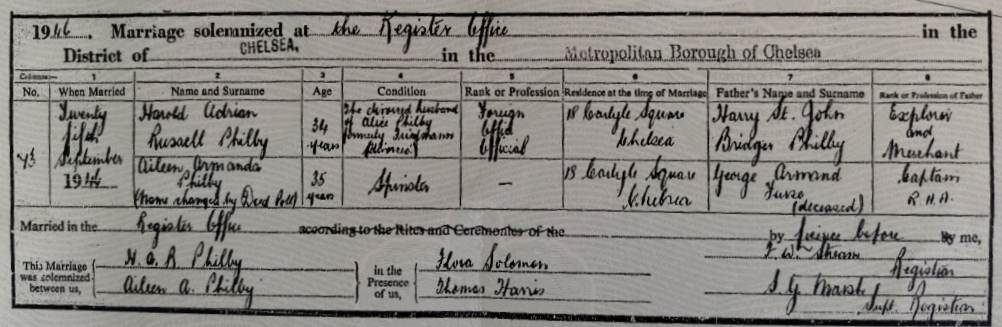
As the war progressed, the author would surely delve into the placement of the five in various positions of influence or access, and perhaps surmise why Blunt, despite his avowed communism, was recruited to an important position within MI5, and then given some other highly sensitive responsibilities. He would no doubt try to offer an explanation as to why Blunt was allowed to remain unchallenged after being discovered passing intelligence gathered by Leo Long in MI14 to Soviet contacts at the Embassy. He would follow the events of 1945 very closely, including the defection of Gouzenko in Canada, and the response of MI6 and MI5 to it, as well as the strained response to the Volkov incident, where Philby managed to stave off disaster by arranging to have the would-be defector returned home for torture and execution. The circumstances of Philby’s very panicky divorce from Litzy in the summer of 1946 (for which no evidence exists), and his overtly bigamous marriage to his long-time companion, Aileen, would come under scrutiny.
For the post-war period, our historian would pay close interest in the evolution of the VENONA project, analyzing why it took so long to identify HOMER, and perhaps reflecting on why Dick White tried to scupper the whole operation. He would attempt to explain why Blunt and Burgess were in 1948 and 1949 very bizarrely involved with Guy Liddell in handling the plans of the bacteriological scientist, Nikolai Borodin, to defect. He would surely ponder over the reasons why both Burgess and Maclean, who should have been fired for their disreputable behaviour, were respectively assigned to a post in the posh embassy in Washington, and head of the American desk in London. He would analyze why White, at the time when the ‘HOMER’ investigation climaxed, would deviously but successfully plant on the CIA a report strongly suggesting Philby’s guilt. He would also immerse himself in the mysteries of the escape of Burgess and Maclean in May 1951, correcting much of the deceptions surrounding the role of a so-called ‘Third Man’ who had tipped off the suspects about the investigation, and providing a more accurate account of how Burgess was perceived at the time. He would indubitably comment on the strange way in which MI5 and the Foreign Office appeared to connive at – or even abet – the eventual flight by the pair, and he would draw attention to the absurd outcomes in which the Security Service’s attempts at surveillance had resulted.
Our intrepid researcher would then surely investigate the bizarre events that took place after the defection, the hugely incompetent interrogation of Philby by White, the bizarre antics of Goronwy Rees, and the provocative evidence that White, holding deep suspicions about Blunt’s loyalty, in late 1951 wanted to offer him an amnesty if he confessed to espionage. He might wonder why Cairncross was allowed to retire from government service without penalty when incriminating evidence was found in Burgess’s flat. He would also study the various official statements about the ‘Missing Diplomats’, and attempt to explain why the defection of the Petrovs in Australia in 1954 caused such a ripple of dismay in Whitehall. He would carefully go through the events that led to Philby’s being challenged in the House of Commons as being the ‘Third Man’, followed by his denial, and his public vindication by the Prime Minister. The transcriptions of the multiple interrogations of Blunt (and others) that took place in the 1950s might lead him to suggest alternative scenarios to those that have appeared in the authorized history of MI5.
He would then go on to inspect closely the timeline following Michael Straight’s disclosure, in June 1963, that Blunt had recruited him to the Soviet cause while at Cambridge. Next, he would track carefully the chronology of succeeding events, such as Cairncross’s fortuitous interrogation by an MI5 officer on US soil, and the highly staged ‘confession’ by Blunt in April 1964, since shown to have occurred at the end of 1963. Our historian would also interest himself in the disclosures of the defector Golitsyn, who named Philby as a Soviet spy in 1962, and wonder why White and Rothschild went to such elaborate lengths to fake the record when they attributed their fresh conclusion that Philby was guilty to the dubious testimony of Flora Solomon. Lastly, he would carefully probe the record to determine why Philby was allowed to get away to the Soviet Union after being accosted by his friend Nicholas Elliott in Beirut in January 1963.
Antonia Senior has written a very engaging book in which she skillfully intertwines the careers of the Cambridge Five, and she gives an absorbing context for their misdemeanours. Yet she covers little of the ground that I have laid out above. Moreover, she has chosen a dreadful title for her composition. The whole point of the Cambridge Five was that they were not ‘apostles’ for Stalin. They engaged in subterfuge to conceal their ideological commitment, and to gain entry to the corridors of power to undermine their employers and their native land. (Yes, Burgess was perhaps an exception, ranting on about the benefits of Communism, and of life in the Soviet Union, but no one really took him seriously. It was part of his cover.) The true apostles were the fellow-travellers, Communist Party members, and apologists for Stalin who were allowed to speak openly in his favour, and to promote the political objectives of the vozhd.
The author has performed an impressive amount of research, and a distinctive and novel aspect of her work is her inspection of archives in Lithuania and Albania. I found these informative and occasionally terrifying, and they add a valuable perspective to the incomplete stories of how MI6 tried, alongside the CIA, to foment rebellion in the (primarily Baltic) states that Stalin had acquired (or ‘reacquired’, in his mind) at the end of the war, as well as questionable outliers like Albania. The main contributor to such hopeless forays was, of course, Philby, but the fact that he was involved with the planning of such exploits is nothing new. Thus Senior’s accounts do not extend our understanding of Philby’s motives and actions. In fact, recent scholarship suggests that the Albanian groups were so infiltrated with Hoxha’s spies that the operations were doomed without Philby’s passing on to Moscow the outlines of the plans.
Yet that is one of Senior’s important themes. In her Introduction she states that “This book is about the fate of the people of eastern and central Europe who were caught between two totalitarian regimes with dark imperialistic visions. It is about Stalin’s uninhibited ruthlessness. Above all, it is the story of how five students from Cambridge University helped Stalin to build a Red Empire”. To a degree, that is correct, and she emphasizes the political decisions that helped Stalin secure the territories and governments he wanted, intelligence that Maclean, especially, was able to pass on, this making Stalin’s negotiations easier. For an intelligent and insightful account of these aspects of the Cold War, Stalin’s Apostles offers you a very readable introduction, but it is hardly news. After all, if the Five were spies for Stalin, what other objectives would they have had in mind? Moreover, of all the thousands of documents that the Five handed over, we do not know (apart from some glimpses through VENONA) how many were translated, how many were trusted, how many were passed to Stalin, and which ones prompted him to make decisions he would not otherwise have considered.
Two of the blurbs on the back cover declare that Stalin’s Apostles is the ‘definitive work’ on the Cambridge Five. Even if such an entity were possible, this work is undeniably not it. Senior claims (in an Endnote on page 446) that her book ‘takes account of all the new material’ on the Five that the National Archives (and MI5) released in January 2025. I know from experience that studying and making sense of all those files, and integrating the resulting conclusions into one’s palette, would constitute a multi-year project. It is a vain and unnecessary boast that Senior makes, and she unwittingly undermines her case. In her Introduction, she writes:
There was a significant release of documents about them [Burgess and Maclean] from the United Kingdom’s National Archives in 2022, and in January 2025 a huge tranche of British intelligence files about the investigations into Blunt, Philby and Cairncross was released. The extent of these files makes clear that reports of establishment sloth in investigating Blunt and his peers have hitherto been greatly exaggerated. Plenty more is locked in the vault.
Apart from the fact that, if more files are locked away (as I have observed beforehand, noting some of the absurd embargoes put on some Burgess files), we must all wait for many years yet for a fuller – even ‘definitive’ – story to be told, the implication that Senior gives is that she had personally analyzed the ‘huge tranche’ in the few months between the release and the copy deadline for her book. Would an account of that fervent activity, countering the ‘sloth’ rumours, not have been a suitable case for treatment? Yet Helenus Milmo’s interrogation of Philby merits only a few paragraphs: there is nothing about White’s wanting to do a deal with Blunt in November 1951, or even about White’s disastrous ‘interrogation’ of Philby in June 1951, which revealed so much about Burgess. White, the epitome of the ‘Establishment’, one would think, merits only four entries in Senior’s Index: Menzies only a few more. Easton, the sceptic over Philby, none at all. It is an expectation raised by the author that she fails to fulfil.
Moreover, she indulges in some clumsy observations that reveal her uncertainty with some basic facts. “The Five inherited all the colonialist assumptions of their fathers,” she states on page 7, but on the next page she writes: “The Five were vehement anti-imperialists, steeped in the language of the Left that blamed society’s ills on an unholy alliance of capitalism and colonialism.” In describing the Parker’s Piece marches of November 11, 1933, her classification of Cambridge students is surely wrong: ‘the broad coalition of leftists, dominated by Marxists’ clashed with the ‘hearties’, whom she describes as the ‘rowers and the rugby boys and the officer-training corps’. Yet, on page 37, she presents Maclean as being asked to join the ‘hearties’, on the occasion when his family expressed a desire that he should join the Foreign Office. Senior illustrates this by quoting a poem that Maclean had written, lambasting the ‘hearties’ – the ‘hard-drinking, prank-playing, careless, right-wing tribe’. If that is who they were (and my guess is that true ‘hearties’ were not that interested in politics), they would certainly not have been candidates for the Foreign Office. It is all rather a mess.
I spotted some careless editing, some evidence of which I present here to help the second edition: ‘idealogues’ in one place, ‘ideologues’ later on. It should be ‘Nigel de Grey’, not ‘de Gray’ (p 167); ‘Kriegsmarine’, not ‘Kreigsmarine’ (p 290); ‘Kiel’ not ‘Keil’ (p 291). Senior is late on the collapse of Liddell’s marriage. She has Maclean informing his masters about the founding of the OPC (the Office of Policy Coordination), within a week, in September 1948, when she has already described Maclean leaving Washington in August. She very improbably has Blunt acting as a go-between for Philby to Yuri Modin in April 1951, when Philby was still in the USA. She describes Philby as an Apostle (of the Cambridge Society) when he was never a member. Like many authors, she writes ‘verbally’ when she means ‘orally’ (e.g. p 362). Yet the major flaw is that Senior has swallowed so many of the distortions and lies that have infected the archives and the memoirs.
In summary, this is still an admirable book, overall beautifully written, in which Senior shows she is mistress of the subject, can keep a solid grip on the overall chronology, and can weave a spell-binding tale by bringing in relevant factual context. She has many anecdotes that shed a sharp light on the antics of the Cambridge Five, and the world in which they operated. In the absence of any other more investigative work, it is an impressive introduction to the phenomenon of the Cambridge Five for a new general reader. Just bear in mind that Senior is too trusting of many of the sources she uses, does not challenge them, and has refrained from digging deeply into the contradictions and paradoxes that I listed at the start of this review.
‘Kim Philby’ by Wayne J. Gombar
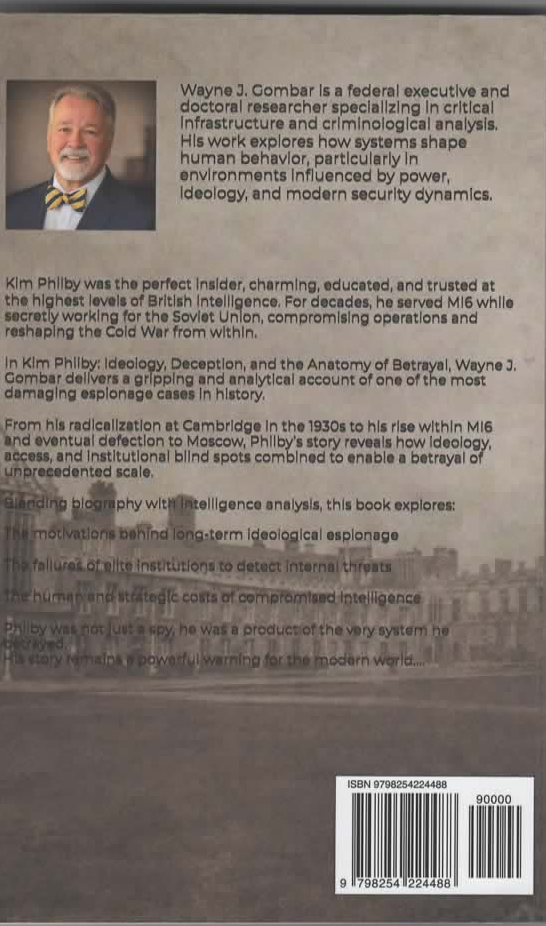
I was alerted to the existence of this volume by a coldspur correspondent, and, having read its blurb on amazon, determined that this was a book that I needed to read. The title suggested that Gombar had some fresh insights to bear on the psychology of Philby, and how he managed to evade suspicions. The author is described as ‘a federal executive and doctoral researcher specializing in critical infrastructure and criminological analysis’. That ‘doctoral researcher’ aspect intrigued me: was this text originally submitted as a doctoral thesis? And, if so, why has it been published already? Was the doctorate ever awarded? It seemed that events were happening in the wrong order.
Indeed, it is a self-published book, and manufactured to order. It is a very poor work, and has hardly enough substance to warrant even a short article. It is vastly repetitive, recycling tedious anecdotes about Philby (he drank, he let down Elliott and Angleton, he was lonely in Moscow and did the Times crossword when he could, etc. etc.) in chapter after chapter. It lacks an index (not that there is much worth indexing); it offers a sparse bibliography with the normal suspects listed (Andrew, Borovik, Cave-Brown, Hanning, Knightley, Seale and McConville, West, etc.), but surprisingly omitting Richard Davenport-Hines’s Enemies Within. He even mentions coldspur a couple of times (without any acknowledgment in the bibliography), but only to reinforce some points about Philby’s activities in Spain. It does not appear as if he has internalized or questioned any of the large amount of research that I have presented on Philby. Yet Gombar claims to have absorbed all the material on Philby that the National Archives released in 2025. I even wondered whether the book had been created by ChatGPT, but judged that no AI engine would hallucinate as badly as Mr. Gombar does.
Wayne J. Gombar
I am a great sceptic when it comes to psycho-analysis. First of all, I believe that most of it is pure charlatanry, based on questionable ideas that can never be verified scientifically. Second, I always thought that no one practiced in the ‘science’ should apply it retrospectively to dead persons, but restrict it to questioning live subjects under study. Third, the evidence of memoirs, biographies and archival material is so riddled with lies and prevarications that it would be seem to me to be very dangerous to attempt a study of what motivated Philby, why he betrayed, what made him ‘tick’, if ticking is in fact what he did. Sometimes Gombar recognizes this dilemma, but ploughs on anyway, and adds some socio-political commentary that is well-worn, and not very useful.
Moreover, it contains some egregious errors. For example, Philby was not a member of the Apostles. Gombar several times notes that Philby was recruited by Deutsch on the famous park bench in July 1934, but then observes (p 168) that Deutsch had already recruited him in Vienna. He gets the whole ‘Third Man’ episode wrong, and mistakenly claims that Burgess and Maclean were about to be arrested when they fled. Yet the prime blunder concerns Philby’s wives. In Chapter 19 he focusses on Philby’s marriages, naming his three wives (Litzi Friedmann, Eleanor Brewer, and Rufina Pukhova), and describes the way he treated them, and the methods by which they put up with his selfishness, alcoholism, and deviousness. (He does not tackle the bigamy issue.) Yet Aileen, with whom he had the most tortuous relationship, and whose behaviour and suspicions – and eventual demise – are absolutely critical to understanding Philby’s obsessions and heartlessness, is here completely overlooked. In an earlier Chapter on Beirut, however, Gombar had made a glancing reference to the fact that Kim left behind ‘his second wife Aileen and their children in England’. It is an astonishing oversight, not least because Gombar – or anyone who checked his text, if there was such a person – completely overlooked this massive textual faux pas, as well as the significance of Aileen to Kim’s story.
Gombar’s message is not overall new, or a breakthrough – yet it does harbour its own contradictions. He sets out (page 9) to declare that his ‘biography’ (a rather grandiose term for this slender work) ‘treats Philby as a product of his times and institutions rather than an inexplicable moral anomaly’. He presents his analysis as one that ‘illuminates the anatomy of betrayal’. The ‘system’ failed because the assumed mechanisms of trust could be easily subverted, and a strong ideology sustained long-term deception. He echoes the thesis of Ben Macintyre when he writes: “Elite trust, and institutional complacency enabled an ideologically driven insider to inflict damage far beyond what any lone actor could achieve through conventional espionage”. He hammers on this theme through most of the book, but then, in Chapter Twenty, on My Silent War, he switches to another theme, writing:
Subsequent scholarship, bolstered by declassifications and personal testimonies, has steadily dismantled the myth [of Philby’s ability to control the propaganda of his tightly-managed loyalty through his memoir], revealing Philby as neither a romantic anti-hero nor a master spy, but as a product – and ultimately a victim – of systemic trust failures, ideological seduction, and institutional complacency’.
Philby as victim, eh? And never a ‘master spy’? I am not aware of any ‘subsequent scholarship’ that makes those claims. And it all has a rather Marxist ring of individuals being defined by their inheritance and their background. Yet, once a critic starts explaining what factors drove an individual into a role such as treachery, he or she enters a quagmire. “Kim’s early years were shaped by the absence as much as the presence of his father”, writes Gombar (page 23). “The father’s contempt for bureaucratic rigidity and his history of independent action made Kim more open to critiques of the status quo” (page 25). “The systems of empire that produced both father and son – public school, Oxbridge, colonial service – equipped him with the social ease, linguistic facility, and insider knowledge that would later enable his remarkable deception.” (page 26).
Apart from the fact that Philby was never in the colonial service, this is still psychological claptrap. Gombar stirs it up even more by stating that the economic crises of the age caused Phiby’s continued leftward shift ‘from vague socialist sympathies to deeper engagement with Marxist ideas’, as if he had been a shrewd economic analyst. Yet he earned only a third-class degree in economics at Cambridge. Was that because he spouted Marxist propaganda in his exam papers, and found unsympathetic evaluators (not Maurice Dobb, presumably), or was it because he was actually not very smart? In his memoir, Philby never showed any understanding of Marxist economics in his ‘embrace of communism’, only a slavish devotion to Stalinist totalitarianism. It was not ideology that made him betray his country but the satisfaction he gained from joining ‘an elite force’ (something Gombar never mentions).
The other side of the coin is that many of his contemporaries who had experienced a similar background (though perhaps without the maverick father) did not follow the same course. Some may have had communist sympathies for a while, but dropped them as they matured, or when they learned about the realities of the Soviet Union. Others may have maintained communist ‘ideals’, but never would have considered betraying their country to aid a monster like Stalin. Some may have maintained the faith in the ‘anti-fascist’ story until the Molotov-Ribbentrop Pact, at which point they threw up their arms in disgust. Yet the majority may have rejected the whole leftist manifesto outright, seeing clearly that communism was just as evil as fascism, and that an anti-fascist assault by the Reds would lead to a bloodbath with the proportions of the October Revolution. The problem is that there are no controls in experimental ventures like this, and the theories are inadequate.
I suspect there was a simpler explanation. It must have seemed a good idea to Kim at the time, helping the oppressed in Vienna, and it was flattering when Deutsch (either in Vienna, or in London) asked him to join the team, working for ‘Peace’ – what Schiller in Don Carlos called ‘Die Ruhe eines Kirchhofs’. But once you were in, there was no way out, and you did what you were told. Otherwise, if you showed any sign of weakness, you might expect to be discovered in a remote hotel, dead with signs of a ‘heart attack’, a fate that befell so many apostates. And once set on his march, it was a sign of pride for Philby that he never repented or regretted what he had done. He told Nicholas Elliott in Beirut that he would ‘do it all again’. When in Moscow, he found it dreary, he was ignored and considered a spy, he was not given a proper job to do, he found the treatment of WWII veterans appalling, and he sat in his apartment looking at the cricket scores and doing the Times crossword when he could, no doubt enjoying his Chivers Olde English marmalade, and, of course, drinking himself to death. But never did he admit: “I got it wrong”.
Gombar has a line to sum it up: “Philosophically, Philby embodies the ambiguity of consequentialist ethics versus deontological duty.” I think this means that he judged that the end – a purely communist society – justified the means of eliminating anyone who stood in the path to progress, but that that inclination betrayed (as Gombar puts it) ‘the fundamental duties of loyalty, honesty and human solidarity’. Well, that would make Philby an out-and-out Chekist, a Dzerzhinsky, ready to execute purges of any non-proletarian, yet he would have been one of those first in line to be strung up or shot. Gombar comments: “This instrumentalization raises profound ethical questions about whether any ideology can justify the systematic deception and harm Philby inflicted.” In truth, these are not ‘profound ethical questions’ at all, and can be dismissed immediately. Nothing sanctions the slaughter of millions of innocent persons that became a routine by-product of the Communist ‘experiment’.
The final contribution Gombar makes is to draw lessons from the Philby experience to help today’s institutions protect themselves from the same phenomenon – the insider traitor who displays all the signs of fitting the cultural profile of a loyal servant. It is not just the intelligence betrayal that hurts, but the effect that the discovery of the snake in the grass has on trust and relationships. Elliott and Angleton were devastated by Philby’s flight and obvious guilt, and it drove the latter to paranoia about further Philbys everywhere – and infected Peter Wright, too. Gombar brings the challenge up to date. “Digital-age tools – behavioral analytics, continuous evaluation, zero-trust architectures, and AI-driven anomaly detection – have advanced detection capabilities far beyond the analog area,” he writes. That may be true, but Gombar ignores the fact (for example) that the FBI and the CIA ignored for too long obvious signs that Robert Hanssen and Aldrich Ames respectively were engaged in highly suspicious behaviour, and they thus failed to detect the espionage of the pair until tragically late.
What was the analogy in Britain? Were Blunt’s communism, Philby’s exploits with Volkov, or Maclean’s drunken hooliganism in Cairo not enough to raise suspicions, and for the authorities to take action? There were indeed enough signs that MI6 had a wrong-un on their hands well before Phiby escaped to Beirut, and Milmo and MI5 just failed to gain the confession they needed in December 1951. The fact that some diehards in MI6, even after that interrogation, still believed in their man is, of course, another story, one that unveils a conspiracy unthought of in Gombar’s meagre analysis.
A Woman Named Edith by Daria Santini
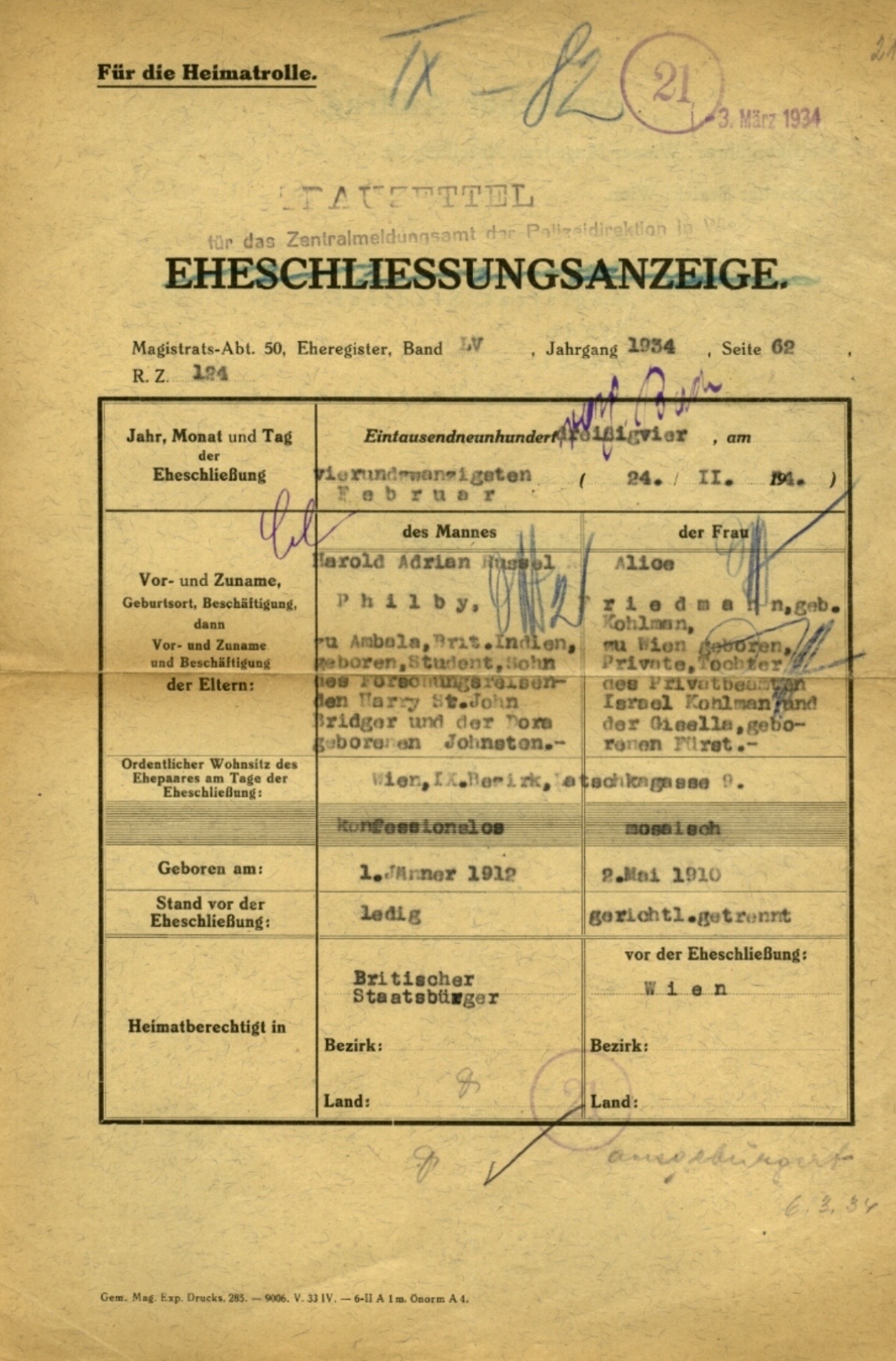
Daria Santini has written a very elegant biography of Edith Tudor Hart (née Suschitsky), the courier for Soviet agents in the late 1930s and during the Second World War, and renowned photographer. (For some reason, Ms. Santini has dropped the hyphen from the conventional form of the surname: I shall follow that practice in this review only.) I have been in communication with Ms. Santini, since I wanted to congratulate her on her stylish book, and also to introduce her to my research on Edith, which she had obviously not seen. We have had a very congenial exchange, and Daria pointed me towards the Austrian archive that holds an image of the Philby-Friedmann marriage certificate. We have respectfully agreed to differ on the significance of Edith’s life, and here I am going to explain her viewpoint (as I interpret it from her book), and to lay out why I think Edith’s influence and importance have been overstated. The subtitle of the book is Émigré, Photographer, Secret Agent – The Extraordinary Life of Edith Tudor Hart: if you acknowledge the fact that her role as an agent was hardly secret at all, and that her activities were known by MI5, the rest is not much to work on.
My disagreement thus concerns two main realms: a) Edith’s significance as an agent of the NKVD, and b) her contribution as a photographer. I shall summarize my high-level opinions first before analyzing Ms. Santini’s text. It is worth starting with the blurbs, as usual.
“ . . . Edith Tudor Hart was one of the most significant spies and agent-runners in history.” (Richard Crockett)
“At last Edith Tudor Hart emerges from the shadows to take her rightful place in the history of espionage.” (Stewart Purvis)
“Edith Tudor Hart’s life has been obscured behind her role as the ‘grandmother’ of the Cambridge Five.” (Helen Fry)
Apart from the frightfully poor taste shown in celebrating the recognition of someone who betrayed her adopted country for a destructive cause (Would Purvis, a biographer of Guy Burgess, describe his subject in such glowing terms? Is this fresh applause a side-effect of the feminist movement?), these claims are obvious nonsense. Edith was never a spy: she did not have access to confidential information. She was a courier, but not a very efficient one. She may have been a ‘spotter’ of potential agents for Arnold Deutsch, but, since she was a friend of Litzy Friedmann’s in Vienna, and Deutsch is recorded by some as already having recruited Philby there, the evidence is thin. Anthony Blunt’s much-quoted ‘grandmother’ assertion (in itself rather insulting, since Edith was born the year after Blunt came into this world) should not be taken too seriously: it was probably another of the lies and inventions that Blunt gave his interrogators as a distraction when he was having trouble recalling many basic facts about his dismal career.
The photography angle may be more one of taste. Alongside psychiatry (see above), I judge photography to be one of the most overrated of human pastimes. It seems to me that anyone with a camera may happen to encounter a startling event, and record it for posterity, although the artefact may not have precision or solid structure. Taking photographs professionally, however, requires some artifice, with attention to lighting, and content, and structure, and repeated shots may be required to produce an image that meets what the artist intended. Thus a quantum of distortion and deception may be inherent to the whole process. It is overall a dubious endeavour. As Alfred Stieglitz wrote in 1899: “The placing in the hands of the general public a means of taking pictures with but little labor and requiring less knowledge has of necessity been follows by the production of millions of photographs. It is due to this fatal facility that photography as a picture-making medium has fallen into disrepute.” (What Stieglitz would have thought of cameras on smart-phones is beyond me.)
Thus, when I read on the book’s inside cover: “Throughout her life, Tudor Hart was deeply committed to the ideals of communism, and she used her striking photography to highlight the urban deprivation and inequality she witnessed”, I squirmed. Most of these images were taken from her time in London, but I am never sure whether Edith’s staged portraits are designed to show the innate nobility of children who were exploited by an inhumane system, or whether they reflect the bitterness and preparation for revolution that the photographer presumably desired – and believed was imminent. (“There is something appalling about photographing people. It is certainly some sort of violation; so if sensitivity is lacking, there can be something barbaric about it”, wrote Cartier-Bresson.) And, if she hoped that such touching images might bring observers over to her cause, did she ever wonder what was going on in the Soviet Union at the time? Edith was, of course, not invited to take her camera to the Ukraine, where she could have recorded for her friends in England the horrors of the Kholodomor, with dead bodies in the street, and proof of cannibalism.
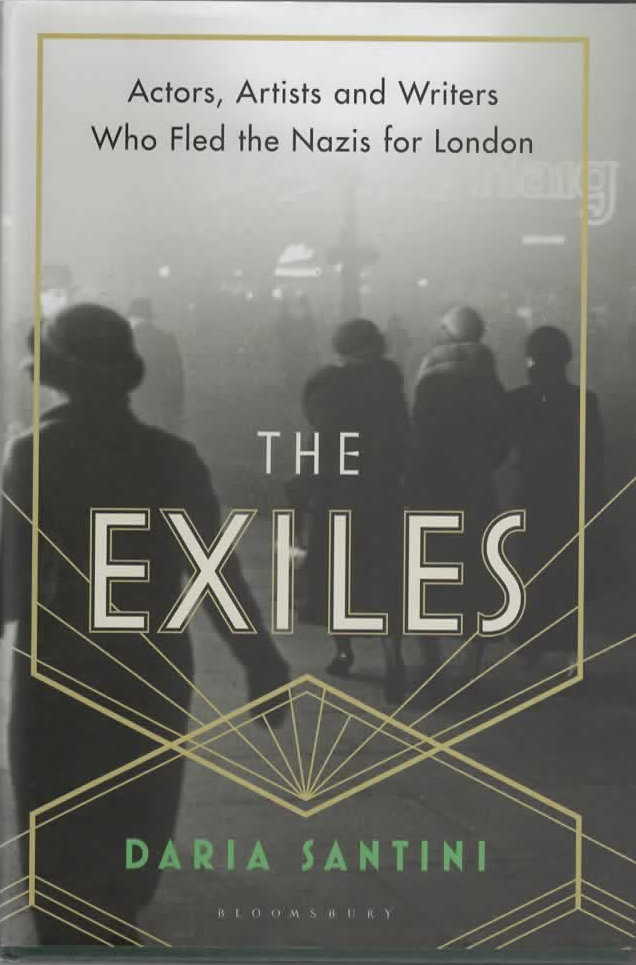
‘The Exiles’ by Daria Santini
Ms. Santini, the author of The Exiles, a fine 2019 study of actors, authors and artists who fled the Nazis for London, has done her homework. She shows that she is intimately familiar with the various groups that settled in London, the clubs to which they belonged, their affairs and divorces. Thus the reader can expect a thorough and accurate picture of Edith’s early life, and the milieu in which she operated in London. Yet her account is coloured by a far too indulgent attitude towards Edith’s political naivety, as well as by a personal absorption in her photographic art that makes too many assumptions that Santini’s personal, and very sympathetic, reaction will be automatically shared by her readers at large. I know that biographers tend to become too enamoured with their subject, but Ms. Santini sometimes goes over the edge towards unsubstantiated judgments, and even propaganda. I had felt uncomfortable when she introduced Edith in The Exiles in the following terms:
Edith Tudor-Hart’s [sic!] personal story is that of a courageous and independent woman. Seen in the context of the struggle against fascism, first in Vienna and then in England, her tireless political activity and her loyalty to her cause assume an admirable dimension.
Since Britain declared war of Fascist Germany shortly after the Nazi-Soviet Pact was signed, and Edith was then a citizen of the United Kingdom, I see nothing admirable about her commitment to an ignoble cause, and the betrayal of her adopted country.
Moreover, where the facts about Edith’s life are thin, Santini indulges in a lot of speculation. For example, in her Introduction, she writes: “Edith was considered the driving force behind one of the twentieth century’s most successful spy rings, the Cambridge Five, because of the uniquely convincing energy with which she had brought the right people into the Communist fold.” Why the passive voice? Who are these ‘considerers’? It is difficult for me to see this frail and socially awkward young lady as the ‘driving force’ behind anything, let alone an entity as influential as the Cambridge Five. Which people did she bring into the Communist fold? Were they not already committed? And the whole point of setting up a clandestine ring was to keep it away from the Communist Party, and have its members work under subterfuge. Further: “While her photographs still speak loudly, it can be hard for us to recapture that unique mixture of fanaticism and hope that led her to devote her life to the pursuit of an ideal which seemed to promise so much but was ultimately tragically corrupted.” Well, the photographs may speak loudly to Ms. Santini, but they may appear as phony to some of us. And yes, it is hard for the more level-headed of us to imagine that ‘mixture of fanaticism and hope’: what did Edith know of that ideal? Whatever it was, it was corrupted from the start. I dislike that weaselly ‘ultimately’, since murder and state terrorism were built into the Bolshevik regime from the first days of the revolution.
Yet I was soon (partially) disarmed by Ms. Santini’s full and fascinating account of Edith’s life. She provides some rich and engaging background about Edith’s early years: her visit to England as a teenager, her joining the Communist youth organization in Vienna, her (possible) love affair with Arnold Deutsch, her returning to Britain, where she mixed with the Tudor Harts, her communist activism that came to a halt when she was spotted demonstrating in Trafalgar Square on October 26, 1930, and her consequent expulsion, which she reluctantly accepted. Back in Vienna, she takes up her activism, is offered a job as photographer for TASS, and is eventually rejoined with her lover Alexander Tudor Hart. They marry quickly, under persecution, and Edith returns permanently to the UK as a British citizen. The narrative is coloured with much speculation and flimsy argument, however, such as:
“But Villa Seeblick is likely to have had lasting impact on Edith’s character . . .”
“It was almost certainly during this time that Edith, energized by political discussion with her colleagues at Troststrasse, felt drawn to communism, viewing it as a more militant and decisive solution to society’s ills.”
“It has sometimes been said that Edith and Arnold Deutsch were lovers and that he was the man to whom she lost her virginity.”
“She almost certainly joined the Communist Student Fraction . . .”
“Edith’s shadowy handlers probably felt that this keen, clever, well-connected young woman could be more useful there [in Britain] than in her native Vienna.”
“It is likely that, on Deutsch’s suggestion, she made contact with communist circles in Britain through the Tudor Harts.”
“There is no concrete evidence in accessible archives that she was a Comintern agent.”
“Edith’s appointment as TASS correspondent was a way of employing her as one of the Soviets’ secret agents in the West.”
And there is more of the same.
This analysis does not convince me. How Edith was supposed to further the communist cause of inspiring revolution in Britain is beyond me. Ms. Santini writes, apparently without irony: “Edith’s own scepticism about Britain’s sluggishness in the fight against imperialism was clearly reflected in her friends’ joint efforts – vigorously aided by the Comintern – to spread the communist message among British workers.” (Why would the custodians of the British Empire have fought to dismantle it in the 1930s?) But how would Edith have contributed to this mission undetected? Above all, if she had been a ‘secret agent’, she would have been instructed to stay out of trouble. And yet she was arrested after the 1930 demonstration in Trafalgar Square and expelled. MI5 and MI6 kept a watch on her, and, after her marriage to a notorious rabble-rouser in Vienna in the summer of 1933, she returned to the country, having reportedly been recruited by Arnold Deutsch shortly beforehand, and was immediately in the sights of MI5 again. What was ‘secret’ about all this?
And that surveillance pestered her for all her days thereafter, through the clumsy business with the camera invoices in the Percy Glading affair, and the photograph of Kim Philby, to the romantic liaison with Berti Broda (when she acted as a courier for atomic weaponry secrets), and the reports on her from the MI5 agent KASPAR (Joseph Laemmel). Santini tellingly describes KASPAR as ‘treacherous’ (page 221), overlooking the fact that Edith, now a UK subject, was, like Fuchs and Litzy Philby and others, the real treacherous one, betraying her adopted country. So why did MI5 do nothing? Perhaps it was partly a deliberate kind of mild persecution, letting her know that she was being watched, and thus acting as a deterrent for any more serious subversive undertaking. Perhaps it was just another brick in the wall of ‘keeping an eye on’ possibly dangerous elements, as it did with hundreds of the innocent and guilty, in the hope that eventually the subject might lead them to Mr. Big (or Mrs. Big), or to further contacts over whom they could shed their meagre tentacles. Having shown little enterprise in the business of the Glading camera, and having failed to catch Edith in the act of taking papers from Broda, MI5 missed its sole opportunity, and had little to justify arrest and trial.
Finally, there is the cavalcade of photographs that were designed to act as propaganda. “That autumn [1930] in London, she honed her photographic skills in the city in which poverty and social inequality were of a magnitude she had never encountered before”, she writes. Well, maybe. Edith had never been to Russia, of course, but the author adds that Edith wrote to Alexander that the standard of living was higher in London than in Vienna, despite the Depression. She writes that, when photographing scenes from life in the East End of London, Edith portrayed ‘a world full of dignity in the face of capitalist exploitation.’ The poor of the East End may well have been happier to be exploited by the capitalists than by the Bolsheviks – not that they received reliable information about the elimination of the kulaks as a class, of course, being more likely to learn of the nonsense that Sidney and Beatrice Webb were reporting about the ‘New Civilisation’ at that time.
Yet here is an opportunity for the author to insert her own sentimental and maybe not objective opinions of Edith’s photography into her text:
“Striking, however, is the fact that the photographer adds her own distinctive touch to this hopeless universe: something real and warm yet unsentimental at the same time, a human dimension that draws us in and makes us reflect.”
“Edith was convinced that the solution to the endemic misery exemplified by what she saw and recorded lay with the ideals and practices of communist Russia.”
“The photographer’s style is restrained, stark and unadorned. The eye behind the camera is showing us the way things are: there is no didactic drive behind these pictures, yet they grab your attention and we linger over them because they seem to be telling us a story. the political message is coupled with a genuine interest in people, in the small but telling details that make the photographer’s subjects profoundly human . . .”
“Perhaps Edith asked her subject to pose, but whatever she did to emphasise the contrast between deprivation and abundance, between the injustice suffered by starving children and a world of plenty, the photographer’s power is undeniable.”
So were her photographs didactic propaganda, or not? Santini never resolves this tension. And there is much of this type of commentary in the book. These are very personal observations, and Ms. Santini is surely wrong to hijack all her readers’ native reactions in order for her to exaggerate Edith’s significance, and to show her sympathies for Edith’s misguided convictions.
There was more to Edith’s life, and she stayed in Britain after the war. She had been delighted when her son with Alexander, Tommy, was born in 1936, but the child turned out to be severely autistic, and caring for him (or trying to find suitable care) took up a lot of her time, and exhausted her. Alexander was not a good absent father, and Ms. Santini covers Edith’s struggles with compassion and sympathy. Edith engaged in a series of unsatisfactory and unhappy affairs, including a quite inappropriate relationship with her psychiatrist, Donald Winnicott. She was obviously very ‘clingy’. She opened up an antiques shop in Brighton, and died there of cancer in 1973. It was rather a sad life – one with just enough pathos and topical political intrigue to warrant a biography, I suppose. I regret, however, that the fineness of Ms. Santini’s writing, and the originality of much of her research, cannot overcome her misplaced sympathies and misrepresentations. The claims about Edith’s significance are simply unsupportable, in my opinion.
Master of Lies by Piers Blofeld (2026)
Readers may recall my unpleasant experience in dealing with Piers Blofeld, the literary agent for Stephen Verkaik and the latter’s Traitor of Arnhem. Blofeld had sought me out, trying to promote an upcoming book of his about Anthony Blunt, and unwisely tried to flatter me by complimenting me on all that I had written about Blunt and his cronies on coldspur. He then sent me a proof copy of Master of Lies. Within two minutes of picking it up, I realized that Blofeld had not read a word of what I had written, since he neither referenced it, nor did he challenge my conclusions with his new theories. I was seriously annoyed with him for his ingenuous deception, and for wasting my time. After a somewhat heated exchange, we parted reasonably amicably, although I infuriated him a few weeks later, when, having at his request obtained a copy of John Costello’s autopsy after he had failed, I posted it on coldspur. He accused me of ‘stealing his research’, claiming rather absurdly that he should have exclusive use of the document for his own purposes, and he insulted me by calling me some unmentionable names. I continued with my research into JOSEPHINE, and concluded that both he and Verkaik were charlatans. No doubt Blofeld regards his experience with me as equally unpleasant.
I did not think much more about Master of Lies until I saw that Richard Davenport-Hines had reviewed it in the Times Literary Supplement of May 29, alongside Senior’s and Santini’s recent books, in a piece titled The Traitors: Cold War double agents, their lives and motives. (Yes, ‘double agents’ again.) What surprised me at first was that Davenport-Hines spent more column-inches on Blofeld than either of the other two authors, which in my opinion was disproportionate to their imagined worth. Of course, I had not yet read Master of Lies, but I did not have high expectations. Moreover, the critic (author of Enemies Within) was scathing about Blofeld’s methodology (or lack of it), his cheap criticisms and his obvious factual errors. His conclusion? “There is good stuff in Master of Lies, but overall it is a bedlam of hasty imprecision, rash postulates and prosecutorial animosity.”
I was thus not taken aback when, in its edition of June 12, the Supplement published a bitter riposte by Blofeld. He accused Davenport-Hines of getting his facts wrong in his ‘mean-spirited and ad hominem review’, and he offered a few counter-corrections to how Davenport-Hines had interpreted his text. Blofeld continued that the critic’s reading of Blofeld’s explanation of why Blunt became a traitor ‘shows the most unpromising levels of undergraduate reading comprehension’, which was perhaps an unworthy slur against a writer with a formidable record of scholarship behind him. Perhaps Blofeld spoiled his case by concluding his letter with the evidence that the late Queen’s private secretary had contributed a blurb for the book that hailed it as ‘rigorous, unsettling and startlingly readable’, as if the judgment of that civil servant proved that some of Davenport-Hines’s accusations of Blofeld’s vendettas could immediately be negated. This one could run and run, I thought. But Davenport-Hines wisely did not respond. Or, if he did, the Editor of the TLS called it a day.
What the exchange did convince me, however, was that I had to read the book, and it would seem to be an appropriate volume to fill out this quartet of reviews. I thus retrieved it from my shelf, and read it in a couple of evenings. I think Davenport-Hines’s assessment is overall correct, although my take is that he reacted a bit too hyper-sensitively about Blofeld’s attacks on intellectuals and the ‘Establishment’, and that he spent too little time on the extravagant claims made about Blunt’s role as a super-manipulator. The fact is that Blofeld has executed much original research (some of which I wish I had carried out myself, such as studying Fidrmuc’s Personal File and digging out the appearance of Patricia McCallum in a 1999 BBC Timewatch documentary), but it is all selected and massaged with such recklessness that no coherent story arises from it. In fact, I would have thought that Davenport-Hines would have enjoyed some of the obscure connections that Blofeld has brought to the surface, such as the acquaintances and relations of Guy Liddell’s disreputable wife, Calypso.
My copy is an ‘Uncorrected Proof – not for Sale or Quotation’, but I do not imagine that the text has changed much in the official publication. (For the integrity of my library, I might even buy it, but it is not yet available on amazon.usa. My on-line colleague Andrew Malec has informed me that my name does now appear under ‘Acknowledgments’, but I would rather be dissociated completely from this publication.) And there is much to enjoy in it. I was particularly taken by Blofeld’s suggestion that it was Blunt who carefully laid out Burgess’s correspondence to be ‘discovered’ by Arthur Martin & co. at Burgess’s apartment. I had suspected that Burgess was responsible for this himself, as a way of dragging all his contacts into the maelstrom. After all, if he had not cleaned out his flat, he must have known that much incriminating evidence would come to light. And maybe he plotted it all with Blunt: the exercise did provoke MI5 into much fruitless investigation, and distracted attention from Blunt. I thought that Blofeld rightly gave the appalling Victor Rothschild a real drubbing, and there were many fascinating vignettes of other characters who lurked in the Blunt background.
Yet the relentless promotion of Blunt as the arch-schemer who almost single-handedly changed the face of Europe is desperate and ill-begotten. Perhaps out of embarrassment, Blofeld soft-pedals the wily way that Blunt invoked the Luftwaffe to bomb Wormwood Scrubs, and thus destroy the records of Blunt’s communist past (which formed such an absurd role in Verkaik’s Traitor of Arnhem). Yet the incident is still there, undenied. Blofeld spends a lot of ink trying to convince his readers that Blunt was the Abwehr spy JOSEPHINE, who caused such havoc, and was even responsible for the deaths of thousands of GIs in the MARKET GARDEN fiasco. He also sets up his case that Blunt was also ELLI, the mysterious agent named by Gouzenko. He has Blunt as being the manipulator of not only Churchill (by virtue of the fact that he wrote up the monthly MI5 reports for the Prime Minister), but also Hitler and Stalin, for whom he packaged up intelligence reports, and which they (of course) unfailingly read. He was – according to Blofeld – ultimately responsible for Stalin’s rape of eastern Europe. Lastly, shortly before he was unmasked, he managed to secure the deaths of several of his contemporaries, who knew too much, and, despite their unhealthy lives, experienced a premature death.
The problem is that Blofeld has set his mind on showing that Blunt was an underestimated arch-villain, and plucks at any loose straw that might assist in his extravagant exploit. In that way, he ignores many of the facts about the events surrounding the Cambridge Five. Apart from the impossible logistics of the Wormwood Scrubs business (which I dismantled in https://coldspur.com/verkaiks-traitor-of-arnhem-part-1/), he does not appear to have considered the following: If Blunt was JOSEPHINE (a person who did not actually exist, incidentally), how did he pass his messages to the Abwehr? (Krämer referred to JOSEPHINE hundreds of times in his reports to Berlin.) Why does Blofeld think that a simple message about a possible attack in the Arnhem area caused a catastrophe of such proportions, when the message did not even arrive at the OKW desk in time to have any impact? Does he really believe that Montgomery’s plan for MARKET GARDEN was a masterstroke (when it was fatally flawed from the outset), and that it was scuppered only because of Blunt’s opportunistic insertion? Does he not question why the haughty and fastidious Blunt would (almost literally) risk putting his neck in the noose if he were to be discovered passing state secrets to the Germans?
Is he also not aware that the Admiralty and the London Controlling Section were carrying on a disinformation campaign, exploiting the Swedish attaches Oxenstierna and Cervell, in order to mislead the Germans about an attack on Scandinavia? Why has he ignored the fact that MI5 clearly abetted the escape of Burgess and Maclean, using the shady Blunt as an intermediary? And why does he overlook the fact that, just a few months later, Dick White and J. D. Robertson wanted to give Blunt a free pardon if he admitted all his misdemeanours in spying for the Soviets, proving that his skullduggery was well-known to the senior officers of MI5 at the time? Does he really think that the secret of Blunt’s confession would have been confided to such junior officers as Patricia McCallum, and that she would have even have referred to him in her report had she known about it? I could go on, but I believe this list is enough to show that, for all his industriousness and imagination, Blofeld should not be taken as a serious historian.
Another problem is that this nonsense gets lapped up by those who should know better, and then, of course, by the public at large. If you study the entry for Master of Lies on the publisher’s website, at https://www.quercusbooks.co.uk/titles/piers-blofeld/master-of-lies/9781529446609/, you will see a number of extravagant expressions of praise by some less than stellar names, e.g. Rod Liddle (a brilliant journalist who died earlier this month) and Nicky Haslam, as well as an actor, Damian Lewis, for some reason, and by the rather improbable Rt. Honorable Lord Young of Old Windsor (‘intelligence history as it should be written’), who all surely have no understanding of the topic at all. Yet, at the bottom, there appears a contribution from Dr Michael Reynolds, who was an assistant director in MI5 before founding and running the counter-terrorism unit in MI6. “In life, Anthony Blunt was the Cambridge spy who ‘got away with it’. Forty years after his death, this riveting book exposes the extent of his betrayals, of his country and his friends. A gripping narrative and a must read”, is Reynolds’s contribution. If this assessment is typical of the brains running the country’s intelligence services, what hope is there for you all? And why did Blofeld for a moment believe that I might be impressed by his nonsense?
Blunt was obviously a busy man – alongside his various intelligence duties, JOSEPHINE, ELLI, and then Keeper of the Queen’s Pictures and Director of the Courtauld Institute. He may also have been the Scarlet Pimpernel and the Creature from the Black Lagoon, for all I know. Blofeld does not say. But an arch-villain with overwhelming influence? It hardly goes along with his deferential tone to Edith Tudor Hart as ‘the Granny of us all’. And was Andrew ‘Granny’ Gow perhaps the Granddad of the whole rotten shower, mentoring them at Trinity College? Moreover, the multitude of transcripts of the interrogations conducted by MI5 show Blunt as a hesitant and ill-prepared individual, with his selective memory, contradictions in testimony, and feeble explanations. Hardly the brains of an evil enterprise on the lines of . . . whom should I say? But of course! Ernst Stavro Blofeld, the head of SPECTRE.
This is a complex and demanding report, definitely classed as ‘A’ (Advanced) material. (WordPress informs me that it is ‘136 minutes read time’.) It serves as a follow-up to my earlier investigation into JOSEPHINE (see especially my ‘Summary and Conclusions’ at https://coldspur.com/verkaiks-traitor-of-arnhem-part-2/). I set out with the goal of shedding light on the existence and identity of the putative Abwehr spy with that name, but I soon concluded that that was a pointless exercise, because of the statements made by Karl Heinz Krämer under interrogation. (Krämer had frequently referred to JOSEPHINE as a source in his wartime messages from Stockholm to Berlin). My attention quickly switched to the methods by which MI5 and MI6 learned about Krämer’s actions and messages, which expanded the area of my research. I fell upon the bewildering phenomenon of ISTOC, which sounded like a Bletchley Park abbreviation, but turned out to be a creation of MI5 used to describe intelligence from Stockholm. During that process, however, I encountered a raft of misleading material.
Thus I ask the reader to be patient as he or she follows my methodology. I started out by recording my analysis of the written sources concerning Krämer that I had identified as important, studying them in chronological order, and carefully assessing what information the authors had access to at the time they wrote their accounts. It turned out, however, that instead of tracking a steady clarification of a puzzling phenomenon, I was faced with some bewildering and contradictory stories. When I arrived at a tentative hypothesis to explain the anomalies, however, I had to set out on an entirely new line of research, focusing more on telecommunications and Britain’s relationship with the Swedes, and I identified previously unconsidered works to locate and read. I then had to insert my analysis of these items in the proper place, chronologically. I was, however, not aware of the total effect of those paradoxes until I came to the end of the exercise, took stock, and came to some conclusions that have not been expressed anywhere else (so far as I am aware).
I then decided that it was important to go back and annotate my analysis with further comments made with this benefit of hindsight, in order to put the various sources in better context, and to correct some early misapprehensions that, as a relative novice in this domain, I had expressed. This process, I hoped, would give my piece greater coherence, but the fact that so many of the accounts I read have turned out to have been a mixture of guesswork, bluff, and deliberate obfuscation has meant that my merging some immediate responses with my retrospective editorializing may occasionally make my thread difficult to follow. (There may still be passages that jar: please inform me of them.) I believe, however, that it is important that the process and results of my investigation are laid out comprehensively for the benefit of posterity. I start below with the original introduction that I wrote as I set out on his task.
Readers who are interested only in the conclusions may prefer to jump to that section, rather than follow this lengthy exegesis.
JOSEPHINE:
This month, I return to my investigation into JOSEPHINE, the codename used by the Stockholm-based Abwehr officer Karl Heinz Krämer to conceal the persona of one or more of his informants. I believe that the key to identifying the various sources attributed to JOSEPHINE is closely tied up with the term of duty in London of Johan Oxenstierna, Swedish naval attaché, and former gold medal winner in the pentathlon at the Los Angeles Olympics. That is because of the evidence that Oxenstierna was being manipulated by the British authorities, and also derives from the popular equivalence in some quarters (encouraged by one or two intelligence experts) that JOSEPHINE was actually Oxenstierna himself.
As I explain below, the sources on JOSEPHINE are notoriously unreliable: those on Oxenstierna only slightly less so. Yet the survival of two critical Foreign Office files makes up for the fact that Oxenstierna’s Personal File, maintained by MI5, was destroyed – an event that provokes even greater curiosity on the part of the historian. Thus a summary of his relatively short term of duty can be made, a spell in which the aristocratic, debonair, and popular official felt that his honour had been severely attacked by British movements against him.
The bare bones of the story (mostly discoverable in FO 188/412 and FO 371/37132) run as follows. Oxenstierna, as the naval intelligence representative of an overtly neutral power, who arrived in London in 1942, enthusiastically applied himself to gathering information from official and unofficial sources in the UK, taking care that nothing he undertook could be construed as espionage. Many UK officials – especially in the Admiralty – harboured doubts as to how neutral a power Sweden was, since it appeared to be assisting Nazi Germany in manners beyond mere trade, such as helping German troop movements across the country to occupied Norway. There were pockets of strong fascist sympathy in the Swedish government, especially in the Navy, since the country had in the past few decades been much more concerned about Soviet encroachments than Nazi threats. The Finnish War of 1939-1940 was fresh in their minds. Yet the Admiralty had a complementary naval attaché in Stockholm, Henry Denham, who was involved with some sensitive missions, and it understood how delicate the balance was.
Johan Oxenstierna
In the summer of 1943 Oxenstierna, in the eyes of the Admiralty, crossed the line, whether by harassing junior officers with persistent questions, or gaining access to sensitive technology information that should have been kept secret. Somehow, the British authorities (the Admiralty and the Foreign Office) learned that Oxenstierna’s reports had reached the Germans, and reacted with alarm, as if Oxenstierna had been responsible for the leakage. In September 1943, they requested that he be recalled, which led to some heated and not always very diplomatic exchanges between Victor Mallet, the Minister in Stockholm, and the Northern Department of the Foreign Office. Mallet had to negotiate with some irate Swedes without much help from London. The Swedish Foreign Ministry regarded the decision with amazement and disgust, not judging that anything confidential had been passed on, and treating Oxenstierna’s potential recall as a grave insult. It did mean, however, that the Swedes discovered a spy in the Ministry, who had forwarded Oxenstierna’s bulletins to Krämer. The Swedes demanded strict countermeasures as a tit-for-tat – namely Denham’s recall. Eventually, by December, a compromise was worked out, by which Oxenstierna was allowed to return to London for a few months more, while Denham stayed in place.
Of course, there was much more going on behind the scenes, and the exercise became more fraught because very few persons knew the full story. And the German spy in the Foreign Ministry was not the only penetration agent at work. For reasons of security, the British authorities could not furnish explanations that would have cleared up the whole business, because of fear of the Nazis getting hold of the story. In turn, this meant that minor functionaries blundered around in the dark. I shall return to this intriguing histoire after I provide an analysis of the major sources that have influenced the presentation of the JOSEPHINE affair.
The Sources
The Game of the Foxes by Ladislav Farago (1971)
In his 1971 work, The Game of the Foxes (subtitled The Untold Story of German Espionage in the United States and Great Britain During World War II), Ladislav Farago, a US intelligence officer, dedicated a whole chapter to JOSEPHINE. It is both a useful and an irritating book. The title is flabby: Farago provides a rich and long list of sources at the end of his text, but the text itself never indicates which sources contributed to any particular segment. The author is too often vague about dates (when dating is especially important), and he relies too much on interviews – such as when he tracked down Krämer himself, and succeeded in asking him many questions. But why did he believe that Krämer would tell him the truth? Thus Farago’s many valuable insights are interwoven with much hearsay evidence and incorrect assertions. Moreover, Farago knew nothing about ULTRA, the secret of which was revealed a few years later. Thus his work is a valiant effort for 1971, but by no means a reliable account.
Farago essentially starts his story with the reports sent from London by Major S. E. Cornelius, the Swedish air attaché. Since these reports primarily concerned the raids of the Battle of Britain, one can assume that they were sent as early as 1940. Farago claims that ‘a pro-German member of the Combined Intelligence Staff of the Swedish High Command’ pilfered the reports, and passed them on to Heinrich Wenzlau, who worked for the more scrupulous German air attaché, Colonel von Heimann, one who declined to stoop to skullduggery. Wenzlau was able to send the reports, enciphered, to Berlin by teletype, to Goering’s delight. Farago gives no dates for how long this scheme went on: we hear no more of Cornelius, who (according to Gilmour – see below) lasted in the post until he was replaced by Frank Cervell in 1943. Instead, Farago immediately switches to Krämer’s discovery of the ruse, and to the methods the new Abwehr officer used for exploiting the Swedish attachés in the United Kingdom (which was certainly over two years later). Yet the conclusion is clear: this set-up (pro-German spy in the Swedish Command, and teletype contact with Berlin) clearly antedated Krämer’s arrival.
Thereafter, Farago offers scattered glimpses of the JOSEPHINE operation that may resemble the truth. After his arrival in Stockholm at the end of October 1943, Krämer was allowed to use what Farago described as ‘GLYST, the scramble telegraph’ (or, more accurately, the ‘enciphered teleprinter system’) of the air attaché. Farago represents JOSEPHINE as ‘a vast espionage cartel’, that included HEKTOR, one of his major informants, and SIEGFRIED A, who worked for Lufthansa at Bromma airport. He claims that the British knew there were spies inside their institutions, but MI5 and MI6 could not identify the agents. When Oxenstierna showed an ‘avid interest’ in the Royal Navy in the summer of 1943, Cyril Tower, who was head of the Scandinavian Branch of Naval Intelligence, took offence. In a remarkably casual aside, Farago attributes Tower’s knowledge to the fact that the British had broken the teletype code used by Krämer, yet he does not explore the ramifications. In fact, as I shall describe later, the British never broke this particular cipher, known as Sturgeon of the Fish family: it had significantly been broken by the Swedes as early as 1940.
The analysis struggles a little after this. Farago glosses over the Oxenstierna-Denham retaliation issue, but then asks himself the question: ‘How did the Germans gain access to Oxenstierna’s despatches?’ He then reveals that Krämer had penetrated the Swedish Defence Staff by befriending girls who worked there. The girls were interviewed, but gave nothing away. On the other hand, Farago states that Krämer claimed he had agents in London, to whom he sent requests for information, and he even suggests that it might have been Onodera, the Japanese attaché, who maintained spies there. Information was passed through the London-Bromma [sic: actually Leuchars near Edinburgh-Bromma] air-routes. Here Farago runs out of steam, and wraps up his story – completely eliding over D-Day and Arnhem – by describing Krämer’s recall to Berlin for ‘consultations’ in the autumn of 1944, where he was able to convince Mueller of his genuineness.
ii) Bodyguard of Lies by Anthony Cave-Brown (1975)
Anthony Cave-Brown relied largely on Farago for his 1975 study of Operation Fortitude, but his main thrust was on the aspect of the operation (FORTITUDE NORTH) that provided rumours of a planned assault on Scandinavia, as a method of keeping Nazi troops away from the chosen area of re-entry into the European continent. In his research, Cave-Brown discovered what the German spy Fritz Kolbe had told Allen Dulles of the OSS during his visits to Switzerland. Kolbe worked for Ritter in Berlin, and thus had access to information on Abwehr officers. Dulles wrote in his memoir Secret Surrender that in November 1943 Kolbe told him about two important spies in the ‘British Command apparatus’, namely CICERO [in Ankara] and JOSEPHINE, citing reports that came to Berlin with the introduction ‘Josefine meldet’ [‘Josephine informs us’]. When Dulles approached MI6’s man in Switzerland, van den Heuvel, the latter begged Dulles to take no action, which suggested that both entities were being played in some degree by the British, but also betrayed that JOSEPHINE was considered a real personage by the Abwehr in Berlin, and that the ‘authorities’ in Britain were happy to sustain that fiction.
The author exaggerates the situation by stating that Krämer, without any Vertrauensleute in Britain, had been able to tap the secret services of other countries [sic, plural] that still maintained agents in Britain. He mainly follows the Farago line thereafter, emphasizing that Cornelius and Oxenstierna were the most valuable sources, but adding that the London Controlling Section (which had overall responsibility for deception operations) decided to keep that pair and others untouched. “Cornelius and Oxenstierna were not expelled; they were allowed to continue their visits to British military establishments. But at the same time their reports were deliberately seeded by LCS agents with false but plausible information designed to impress the Swedish government with the belief that the Allies would open land warfare in 1944 with a descent upon Sweden”, he wrote. That was obviously a misrepresentation: Oxenstierna’s reports could not be tampered with, as it would eventually become obvious, but he could have been fed disinformation, and an expert in Swedish could have inspected them to verify that the data had been incorporated. Cave-Brown was obviously wrong about Oxenstierna’s status, and knew nothing of Cervell, but he provided another arrow in the quiver for the case that Krämer’s intelligence from England was a mixture of carefully massaged facts and deliberate disinformation.
iii) The Mirror of Deception by Günter Peis (1977)
‘The Mirror of Deception’ by Guenter Peis
Peis was a German journalist whose mission was to discover exactly what role Wulf Schmidt (agent TATE in the Double-Cross System) had played in the deception campaign. His work is somewhat haphazard, since he was frequently diverted from his track, and his statements are occasionally contradictory, but he did gain some useful interviews with former Abwehr and Wehrmacht officers that shed some fresh light on Krämer. For some reason Pies identified Krämer by his cover name Kahle (or Kahler), which is likely to confuse, as the real Hans Kahle was a German Communist who had been interned with Klaus Fuchs, and had built up a friendship with him.
He asserts that ‘Kahler’ was known to MI5 as early as 1940, since the interrogators of Gösta Caroli, another Abwehr spy parachuted into England, threw out his name as someone they knew was working in Hamburg for Nikolaus Ritter (Krämer’s boss in Berlin when he later operated in Stockholm). But Pies’s main contribution to the saga consists of three threads: i) the contention that the British carried out several disinformation exercises to support the notion of an invasion of Norway – including giving advance notice of the disastrous Dieppe Raid, in order to boost the credentials of their agents; ii) the idea that the ‘intelligence’ provided by Kahler and others was viewed with disdain by such as Zetsche in the Luftwaffe High Command, who told Pies that he threw out stacks of reports from ’our agents Hector, Josephine, Ivan and Ostro’ into the waste-paper basket, since their answers to the Luftwaffe’s purely invented catch questions proved that they must have been under enemy control, well before D-Day; and iii) rumours of a mysterious Soviet connection behind the affair, probably involving Philby in Lisbon and his interrogations at Nenndorf, as well, perhaps, as the German agent Vera Erikson (of Russian extraction), since Earl Jowitt had told Pies that she had been let off because she had already been recruited by MI6. This last thread may be purely fantastical, and may have been ignited in Pies’s mind by a confusion over the Kahle/Krämer mix-up.
One can understand Pies’s struggles. His bibliography is a useful guide as to what was available to the public at the time, including Masterman, Cave-Brown, Cookridge, Masterman, Muggeridge, Popov, Schellenberg, and even Ritter’s memoir, but it would have been a challenge to make sense of it all from such notoriously unreliable accounts. (So far as I can tell, Ritter’s memoir Deckname Dr. Rantzau, makes no mention of Krämer.)
iv) Hitler’s Spies by David Kahn (1978)
David Kahn
Kahn’s compendious study of German military intelligence allocates a few pages to Krämer and Josephine, but he struggles to frame them in a credible context. While largely dependent on Farago, he also uses German military records, as well as some US archival material. He introduces JOSEFINE [sic] in ‘legendary’ terms, so that the reader is not sure, when Kahn describes him as ‘an unwitting agent’, and states that he ‘did not himself realize that he was delivering information to Germany’, whether this is what the author thinks, or whether it was part of Krämer’s mythology ‘in army, air force, and OKW circles’. In a figure reproducing a cover sheet from a report by Krämer to the Auswärtiges Amt (Foreign Office) in August 1943 (page 309), Kahn describes JOSEFINE as ‘Germany’s most famous secret source in the west’, an assertion that does not clarify matters.
After spending time on other agents, such as SIEGFRIED A and SIEGFRIED B, Kahn returns to the identity of JOSEFINE, as the primary supplier of intelligence to Krämer. He answers his own rhetorical question ‘Who was JOSEFINE?’ by responding: “JOSEFINE . . . was not one man but several: the Swedish military and naval and air attachés in Britain”. He does not discriminate, nor does he provide any dates for these multiple persons, but records simply that they were able to collect quantities of information and pass it on to the Defense Ministry in Stockholm, after which Krämer was able to obtain it. Thus, having dispensed rather awkwardly with the notion of these innocent individuals as being part of Hitler’s Spy Team, Kahn moves on to the mystery of how Krämer accessed the intelligence, and presents the case that Krämer wined and dined three young women who worked in the Ministry, and that they were able to hand over secret documents at the trysts he set up. It is amazing that Kahn presents this whole tale as fact when it would have been more sagacious to simply admit that he did not know the background and details.
v) British Intelligence in the Second World War by F. Hinsley et al.: Volume 2 (1981) and Volume 3 (1990)
This multi-volume official history is an impressive feat of research, analysis, and synthesis. Yet its lead author, Professor Hinsley, could be very cautious and evasive at times. It is sometimes difficult to gauge whether his elliptical observations derive from ignorance or from a heightened sense of security. Nevertheless, in a few places he offers some vital insights concerning the Krämer story.
In Volume 2, Chapter 19, where Hinsley describes the war at sea in 1942, he adds a startling addendum to a sentence that relates how the Naval Attaché in Stockholm (Henry Denham, of course, but inexplicably unidentified) on June 18 sent the Admiralty a message that warned of German plans to attack the next Arctic convoy. That might itself be unremarkable, but the note ran as follows:
This was the first information obtained from a source subsequently graded A2 by the Admiralty (Enigma was graded A1) via the Naval Attaché Stockholm. He had succeeded at this point in obtaining via the Deputy Chief of the Swedish Combined Intelligence Staff decrypts of German operational orders passing from Berlin to the German naval commands by land-line, presumably in the Fish cipher (see above, p 29)
The Geheimschreiber
These sentences themselves generate further references. The description of Fish on page 29 reminds readers that Fish was the generic term used to describe the ciphers of the various models of the Geheimschreiber (a teleprinter with built-in cipher mechanisms). Fish was much harder to decrypt than Enigma. The second points to Morgan’s NID History 1939-1942 [the History of the Naval Intelligence Department, available at ADM 223/464] as the source of this intelligence.
This admission is remarkable for several reasons:
It shows that the Swedes were far advanced of the British in tackling Geheimschreiber machines.
It proves how important Denham was to the Admiralty, and why it was so determined to keep him in place when the Oxenstierna affair came to a head.
It provides shocking evidence that a senior officer in a neutral power broke the rules in passing on source intercepts derived from one combatant to its enemy.
It suggests that Denham might have been involved in passing on other intelligence that the Swedes had gained, and which would have been inaccessible to the British (such as messages passing over German land-lines in Sweden). [In this respect I anticipate a comment made by the historian Frode Weierud in an article in The Rutherford Journal of December 2005 (analyzed below): “It is not clear if BP had irrefutable evidence that the intelligence Captain Denham obtained from his Swedish sources came from German teleprinter traffic passing over Swedish telegraph lines. However, British Intelligence apparently knew or strongly suspected that the information came from codebreaking. In his book [see below] about his years in Sweden during the war Captain Denham mentions several times that the intelligence must have come from codebreaking.”]
In Volume 4, Chapter 12, Hinsley comments vaguely on the acquisition by the OSS in Switzerland of authentic telegrams sent to Berlin from Stockholm. Again, no mention of the background, no identification of Kolbe, or Dulles. He writes:
They were signed by Kraemer, an Abwehr officer who was known to have been posted under diplomatic cover towards the end of 1942 and who had been identified under three cover-names in the ISOS decrypts.
Too much in the passive voice. Who knew? Who identified? What cover names? Which ISOS decrypts? When and whence? Hinsley might have trusted that the telegrams were authentic, but, if he had checked the Krämer PF, he would have found that their content matched exactly what Cowgill informed White about at the same time. He continues: “Similar messages then appeared with increasing frequency among the ISOS decrypts.” That strongly suggests that Bletchley Park was soon able to intercept and decipher Krämer’s traffic from Stockholm to Berlin which would mean i) that that traffic would have had to have been pre-enciphered via Enigma, and ii) that it had been being picked up by wireless (since the land-line was inaccessible). But can we trust what Hinsley states when he offers no dates, and no evidence or supporting detail? It appears that Hinsley was not comfortable with these matters.
Lastly, Hinsley offers much commentary on Krämer’s activities after July 1944. He writes little about Arnhem, but does disclose that the incident of Krämer’s delayed message was first reported by the German defector whom MI6 recruited in January 1945, and who gave the service carbon copies of the Abwehr officer’s telegrams. Thus Hinsley provides a useful date for the spy’s recruitment (showing that he could not have been responsible for earlier leaks). He also draws attention to the fact that Krämer’s intelligence was looking very stale and derivative after that time.
vi) MI6 by Nigel West (1983)
Nigel West’s contribution to the story was a mishmash of vague rumours and mangled facts. Yet he has been much quoted. It is West, I believe, who first gave noise to the Falk-inspired stories about Krämer’s maid, the stolen key, the butter impression, and the (locally made) duplicate, all of which allowed the local MI6 battalion to gain access to original messages. For good measure, West declared that ‘much of J’s [JOSEPHINE’s] material was sent to Berlin via teletype/landline, which made interception impossible’, as if that phenomenon provoked and enabled the daring subversion of Krämer’s premises. (As I shall explain later, the switch from land/submarine cable to wireless, and Enigma-generated encryption, probably represented the start of Bletchley Park interception of Krämer’s traffic, but it occurred much later than the period at which Hinsley hinted.) That conclusion needs to be qualified, however: the traffic was not interceptible by the British, which is an important distinction. (Other sources do indeed indicate that the land/submarine link from Stockholm to Berlin was well-established by the time Krämer arrived.) While there had been a long gap in intense interception during 1944, it seems that the airwave-based process picked up again at the end of that year. Yet West gives the antics of Agent 3674 (the maid) as the only way for the British to tap into the Abwehr product. He ignores the fact that, while the British were obviously not able to intercept the Abwehr’s electronic material, that option was clearly available to the Swedes, and he offers no explanation for the messages that were received before Peter Falk sent in his infiltrators.
Thereafter, West also loses his way. He describes the alarm over the MARKET GARDEN leakages, and claims that MI5 was very concerned at the possibility of Krämer’s having agents in the UK. MI5 was quite blasé, in fact: it was MI6 who was the more credulous, and challenged MI5. He also alleges that Anthony Blunt was given the task of identifying who JOSEPHINE was, and that Blunt concluded that it was Oxenstierna – in September 1944 – who was responsible. Oxenstierna was reputedly given a ‘barium meal’ of traceable information, and then ordered home, after which Josephine ceased to operate. This is all nonsense, of course, since Oxenstierna had been recalled at the end of 1943. West also provided an intriguing story about William Strang and his possible involvement as HEKTOR, that eventually required MI5 to offer an apology to Strang. West might have been on to something with Strang’s connections (as I shall explain later), but I am confident that no one ever identified Strang as HEKTOR.
Incidentally, in his 2008 publication Historical Dictionary of World War II Intelligence (published by the Scarecrow Press), West sticks largely to the Oxenstierna/Falk story in his entry for ‘JOSEPHINE’, adding the problematic observation that Falk had ‘solved the mystery of JOSEPHINE and a subsource, HEKTOR’. He further implies that Frank Cervell had been suspected of being HEKTOR, and had been placed under surveillance. West thus reinforces the idea of JOSEPHINE as a real person: Krämer has no separate entry in the dictionary. In a companion volume, Historical Dictionary of German Intelligence, published by the same press a year later, however, the author Jefferson Adams offers a much more accurate and pragmatic summary of Krämer’s career, and reports that both MI5 and Krämer’s colleague in the Abwehr, Friedrich Busch, maintained serious doubts about the presence of any genuine spies in England, with Busch even stating that what Krämer delivered represented an ‘intelligence swindle’. JOSEPHINE does not therefore merit an entry in Adams’s work. MI5’s files on Krämer were released in 2000: it appears that Adams had studied them, while West had not
vii) Inside the Nazi Ring by Henry Denham (1984)
‘Inside the Nazi Spy Ring’
Henry Denham was the British naval attaché in Stockholm who, at the end of 1943, came close to being recalled in a retaliation exercise by the Swedes for the recall of Oxenstierna. He thus had a close connection to the Oxenstierna business, and he complemented his personal experiences with what Farago told him (maybe not reliable information) and with what the ‘wartime MI6 representative in Stockholm’ told him, shortly before he wrote his book. The informant could have been Cyril Cheshire, who was the nominal head of the station from 1942 to 1945, but that would be an unusual way of describing the head of station, and I suspect that Cheshire was deceased by 1984. It was more probably Peter Falk, who had been sent out on a special assignment in April 1943 to track Krämer. Given how Falk had apparently embroidered his account elsewhere with the 1943 shenanigans with the housemaid and the thefts, I found the representation of what Denham learned very significant, and I thus reproduce the bulk of the relevant paragraph:
According to him, a great part of what Kraemer reported to Berlin was of negligible value and consisted of thinly disguised information about British aircraft derived from articles in British publications, approved by our censor for export to Sweden. ‘Josephine’ continued to report almost to the end of the war, so that after Oxenstierna’s departure from London, the Swedish Ministry of Defence secretaries must still have found other reports, which they considered worth passing on. Some evidence strongly suggested that Kraemer had a source working in England and was able to communicate with him via the British courier plane. He also indicated to Berlin that he had other sources in Stockholm, to whom he referred in his correspondence by numbers only, but whom it was impossible to identify by their movements. It was extremely difficult throughout the investigations to distinguish between fact and fantasy in Kraemer’s reporting, but though this made the identification of his sources uncertain it was also of value to us. For the last six months of the war, we were in a position to see all his telegrams to Berlin and this traffic reached our command in Paris very soon after it reached the German High Command. The verdict from our side was that, while it revealed no leakage of information, it seemed to be valued by the Germans and so provided us with a useful warning of the way the enemy was thinking.
What to make of this? Did Denham really accept it all unquestionably? If his source was Falk, why did Falk write his ‘memoir’ and share it with Hugh Thomas for The Unlikely Death of Heinrich Himmler, published in 2001? (see https://coldspur.com/verkaiks-traitor-of-arnhem-part-1/). Falk was obviously acquainted with the facts about the secretaries at the Ministry of Defence who passed on messages to Krämer, but why did he claim that that the very vague ‘we’ were able to see all his telegrams to Berlin only in the last six months of the war? Krämer had been tracked since 1941 (although there is a very enigmatic gap in the record for almost the whole of 1944, a phenomenon that I shall return to later). It thus sounds as if Falk was hinting at other unorthodox ways of accessing Krämer’s messages for the whole period before December 1944, and that he was then starting to issue his variant explanations (see West, above). Either he held back from telling his tale to Denham (who might have challenged it immediately), or else Denham decided to withhold the picaresque tale. Or maybe Denham was really out of the picture, and had no idea what was going on. Yet Denham had earlier recorded (p 45) that, in the Oxenstierna era (1943), Bletchley Park was intercepting the messages that the German air attachés used, and was deciphering their content. While it appears that he was simply being careless and inattentive, it is more probable that he was simply writing deviously, in order to conceal his relationship with Swedish Intelligence. Codebreaking had occurred, and he wanted to suggest that the agency responsible was GC&CS. Up until the end of 1944, certainly, Bletchley Park had no direct access to Krämer’s messages to Berlin.
Yet Denham shed further light on the Oxenstierna affair, suggesting that the Swedish attaché was in fact used by the London Controlling Section (what he calls the ‘Deception Committee’). His reasoning was illogical, since he attributed the opportunity to the radio ‘breakthrough’ at the end of 1944, while the Oxenstierna affair was closed at the end of 1943. He claimed, however, that the Committee took advantage of the success to allow Oxenstierna to make his regular visits to naval and military establishments, while at the same time they gave him ‘plausible, but false’ information as a barium meal. “The main purpose was to impress upon the Swedish Government the startling news that the Allies intended to open a new front by invading Scandinavia in 1944”, he wrote.
Victor Mallet and Henry Denham
If the essence of the story is true, however, it clearly points to the fact that the whole Oxenstierna business was indeed a frame-up, that the deception exercise antedated Cervell, that Oxenstierna had a right to feel aggrieved, and – probably most important of all – that the LCS and the Admiralty wanted to show the Germans that, by expelling Oxenstierna, they had once and for all plugged a critical leakage in their wall of intelligence. In the summer of 1944, after the Normandy landings, the Foreign Office, when resisting the Swedes’ demand for Denham’s recall, issued threats about releasing information concern the improper behaviour of ‘Swedish Service attachés’ [note, plural]. The FO instructed Mallet to read a dispatch to the Swedish Foreign Minister, Dr Christian Günther, which described how these attachés were occupied ‘obtaining, and in seeking to obtain, information regarding forthcoming Allied operations, to which they were, for obvious reasons, not entitled’. How to handle the inquisitive Swedish ministries, in which both Allied sympathisers and pro-Nazi agitators served, without giving the game away, was a perennial problem for Whitehall.
viii) The Krämer Case: A study in three dimensions by C. G. McKay (Intelligence and National Security, 1989)
C G McKay
The author is the same McKay who helped Tennant write his comprehensive (but maybe flawed) account of the Krämer case [see below]. He uses the English-language sources above (i.e. Farago, West, Denham, Hesketh), as well as G. Peis’s Mirror of Deception and David Kahn’s Hitler’s Spies, and he exploits a few works written in Swedish. Unfortunately, McKay is not a rigorous investigative historian, and thus does not explore the numerous conflicts and contradictions that appear in these works, nor does he explain why he appears to trust them all as equally sound. Thus his paper is more useful as a means of picking up possibly accurate factoids rather than as a source of an overarching explanation of the events.
McKay, contrary to other writers, firmly states that Krämer arrived in Stockholm on permanent assignment as early as November 1941 (although he distorts the dates when describing Falk’s arrival in May 1943). He quotes some messages that Krämer sent in the first half of 1943, but the reader needs to inspect a Footnote to learn that the evidence for these came from German archives opened up in 1946. Regrettably, McKay is not very precise in following up and naming sources. He refers to further messages concerning leakages in London that were recorded in June and July, but he was obviously unaware at this time that the very first entries in MI5’s Personal File for Krämer show that Cowgill of MI6 was also receiving these telegrams from ‘a most unusual channel’, since he wrote to Dick White to that effect on September 11, and enclosed transcripts. Whether that channel (Kolbe-Dulles) provided much more, whether the pilfering of telegrams from Krämer’s flat became the main source, or whether the British gained access through another medium, should be a question of great importance. McKay reports that Krämer’s apartment had been penetrated as early as August, but he does not follow up the investigation.
The writer offers some useful observations about the BOAC air courier service between Leuchars (near Edinburgh) and Bromma, and reminds us of the shutdown in communications, and restrictions on travel, that were invoked on April 19, 1944 in the run-up to D-Day. He records the early challenges that Major Friedrich Busch, assistant to the air attaché, made on Krämer’s reliability, noting that they were ignored or deflected because senior Abwehr officers were concerned about a takeover by the Sicherheitsdienst should any flaws in the Abwehr’s policies or procedures come to light. Krämer was fortunate to have an ally and defender in the SD’s Schellenberg. But McKay echoes much of the muddle over the discovery of Krämer’s telegrams, trying to make sense of West and others, and does not pursue the question that he set himself: How did the British know that the information from Oxenstierna had reached the Germans?
Moreover, he places the arrival of the source in the German Legation shared with the British (presumably the unnamed Riga) not until 1944, thus contradicting Tennant – but gives no precise month in that critical year, attributing his information to the Swedish source Englich. Similarly, he cites Carlgren as the writer who had written that the British government, in connection with the Oxenstierna affair, had informed the Swedes of a possible leak, and had pointed out to them that information from the naval attaché had come into the hands of the Germans. “Although they did not admit the fact at the time”, McKay writes, “the Swedes were well aware of this leakage of information.” Thus what should have been a predictable action from the British, and a similar reaction from the Swedes, appear to be confirmed here for the first time.
His account of radio interception offers new twists, however. When Oxenstierna on November 15, 1942 reported on a large combined operation involving Norway that was underway, and followed up on January 23, 1943, the German Legation recorded it in a radio message of January 23 sent to Berlin. Yet the Swedes intercepted and decrypted the message themselves, showing that they were more advanced than the British in handling the traffic exchanged by the Siemens T52 machines (the Geheimschreiber) used by the Abwehr. (These were known to the British as ‘Sturgeon’: yet Bletchley Park struggled in their decipherment.). McKay then states that the Swedes assumed that the Germans had picked up Oxenstierna’s radio telegrams rather than considering that there might have been a leak with the Defence Staff. Yet, by all accounts, the Swedes had no authorized wireless facilities, and the messages would have been sent as cables by the GPO. It was indeed much more likely that a Nazi-sympathizer on the Defence Staff had passed on the information,
Did the Swedes thus change their codes, or insist that Oxenstierna’s intelligence should thereafter be carried by a courier? McKay asserts that new cipher keys were indeed distributed to all Swedish military attachés abroad. I still do not know what messages were sent by the air courier, and which by cable, and, if so, whether the British were routinely intercepting all Swedish communications from London. A wireless option seems very improbable, as the Swedes were not allowed diplomatic wireless transmissions, and any illicit transmissions would have been picked up by the RSS. That idea has not died, however, with Guy Liddell himself asking Stewart Menzies (perhaps disingenuously) whether the Swedish Embassy was deploying illicit radio.
ix) Touchlines of War by Peter Tennant (1992)
Peter Tennant’s official role in Sweden was Press Attaché, but he was in Stockholm representing the SOE. His account of the Oxenstierna incident and the disinformation exercises is again rather ingenuous. In a clumsily written passage, he wrote:
The object was to make them [the Germans] keep as many troops as possible in Norway in the belief that major allied landings were to take place. When I returned from a visit home in December 1943 I let the Germans know that I had instructions to start a propaganda campaign about British landings in Norway. Wagner [the local Abwehr chief] swallowed the bait hook, line and sinker and I have a Swedish intercept of one of his cipher telegrams reporting my preparations to the OKW.
Tennant should have used a different formulation from ‘I let the Germans know’, since it sounds as if he had been in direct contact with the Abwehr when a far more subtle approach was obviously undertaken, using Swedes as intermediaries. That there were sympathetic Swedes is clear from the successful activities of Denham. But why would Tennant have had to rely on Swedish interception if he believed that the Abwehr traffic was being picked up by Y Services and sent to Bletchley Park? That factoid would appear to undermine Hinsley’s assertions, suggesting that the British were still beholden to the Swedes at the end of 1943.
‘Touchlines of War’
He next asserted that Oxenstierna was recalled because the British discovered that Krämer was relaying his reports to the Germans [sic! Was Krämer not an obvious German?] under the cover name of ‘Josephine’. “He communicated with Berlin through the air attaché’s cipher which we intercepted and cracked”, wrote Tennant, finessing the obvious point that one might have expected the Swedes to inquire: “How do you know that Oxenstierna’s intelligence is being passed on to Berlin?” (He carelessly contradicted his implicit claim above.) The truth is that Bletchley Park was assuredly not ‘intercepting and cracking’ Krämer’s messages at this time, since the messages themselves were being transmitted by land-line, and GC&CS had also not cracked the cipher known as Sturgeon that was used by Krämer. Tennant was writing very deceitfully. Thus there were three supposed ‘puzzles’ to pursue: i) how was secret British information reaching the Swedish Foreign Ministry; ii) how confidential Swedish messages were getting into Krämer’s hands, and iii) how the British knew of the leakage before the Swedes learned of it. Tennant probably knew the answer to all questions, but danced around the issue.
Yet his explanation awkwardly combined two separate efforts: “Two girls in the Swedish General Staff slipped him (Krämer) copies of Oxenstierna’s reports unknown to Oxenstierna. All conceivable sources for these ‘Josephine’ reports were investigated, including one of Sir William Strang’s domestics.” The first aspect would have been of interest to the Swedes (although the fact that Oxenstierna would have been ignorant of the process is merely stating the obvious), since they had an internal leakage problem. The second referred to the possible revealing of unauthorized information in London, which might have been a disingenuous charade by the British authorities. At some stage, through traffic interception (but not their own – a subject Tennant finesses), they must have realized that harmless information was finding its way painlessly to Krämer, and they took advantage of the covert channel. Tennant does not explain here how the Swedes were encouraged to initiate their search, not does he enlighten his readers how Sir William Strang became involved as a possible source in the investigation.
After this taradiddle, it is questionable whether Tennant’s further disclosures can be trusted, but he next introduces a fresh coincidence. He takes responsibility for passing on to Peter Falk, the special MI6 representative, the name of a person code-named ‘Riga’ who worked in the German legation, but was an anti-Nazi. (Very oddly, he claims not to have met her in person until 1951.) Through Riga, they [unidentified, nor is any date given] penetrated the German Legation, obtaining valuable intelligence on the activities of the diplomatic and service defence staff. The latter fortuitously included details of Krämer and his contacts with girls in the Swedish General Staff. Tennant then goes on to write: “We continued to intercept Krämer’s so-called Josephine messages to Berlin long after Oxenstierna’s departure. Falk managed to get Riga to take an impression of Krämer’s key which Egil Rønne-Petersen [his source for Riga] had copied and future access to his papers was assured.”
This is a very unconvincing account. Under the noses of the Swedes, Falk’s team manages to contact a spy in the German legation, who, at a time convenient, helps uncover the presence of Swedes spying for the Germans in the Foreign Ministry. Tennant writes nothing of the Swedish investigation that must have taken place after the authorities were informed, the controversy that must surely have arisen afterwards, or why they let the subterfuge continue once it was discovered, and allowed the activities of the ‘girls’ to continue. He then jumps to the dubious tale concerning the assurance of future access to Krämer’s papers (not having disclosed how that access happened previously, or why it was necessary), and then he reintroduces Rønne-Petersen as the provider of a copy of Krämer’s key, after which Riga takes an impression of it. Why was an impression necessary if a copy was already in MI6’s hands, and how did the story of the maid in Krämer’s flat gel with the insertion of Riga into the account?
Lastly, Tennant makes another dubious claim that seems to contradict what he wrote earlier. He writes:
Craig Graham McKay has researched the Swedish wartime archives and has given me a copy of a Swedish decrypt of a secret telegram of 7 May 1942 from Doctor Wagner . . . to the Abwehr Division of the Oberkommando der Wehrmacht in Berlin. This disinformation I had planted on him through Riga. He reported my return on 4 May 1942 from London with full instructions for British propaganda in film and press for the Spring of 1943 in order to prepare for a British invasion of Norway.
This is a strange boast by Tennant. Mid-1942 would appear to be very early to be talking about plans for an invasion in Norway, and in any case was in advance of the Oxenstierna reports of November 1942. The Fortitude planning did not start until December 1943, and the absence of any military ability to carry out such a plan would have made the Germans very dismissive. And why would Wagner trust Riga as a source? Might it not have blown her cover? Moreover, did Tennant trust her to carry out the deception without having met her? And Riga was in place a full year before Falk arrived in Stockholm? Why was Tennant, of SOE, handling her? The anecdote about McKay and the Wagner message sounds genuine and authentic, but I’d like to see the original. And did Tennant learn at the time that his planting of disinformation had been successful? His text suggests that McKay recently showed him the evidence, but that may be a diversionary tactic. Yet an inescapable truth emerges from his comments: the Swedes were decrypting the Abwehr’s despatches from Stockholm.
x) From Information to Intrigue by C. G. McKay (1993)
McKay expanded on his previous paper by writing a study of Swedish Intelligence. It is a convoluted story, with threads unfinished, and an erratic chronology, but the author’s access to obscure sources (e.g. Denham’s unpublished memoir, American archives, Swedish insider reports) means that it offers some rare insights. He provides good Endnotes, for instance referring to the ‘microfilmed collection of Krämer telegrams in rolls T 120, 98 and T120, NA’ [Washington], as well as material in the Imperial War Museum that I have not seen. Both would be fruitful sets to inspect.
His coverage of Krämer is otherwise traditional, relying largely on Farago, Hesketh (to which he had privileged access), Kahn, and Tennant. He records how Krämer in November 1941 was installed in Stockholm with Ribbentrop’s firm support, which gave him privileged teleprinter access. The Washington archive offers good examples of his communications in 1942 and 1943. McKay is rather coy about the identity of the ‘Swedish information-gathering sources’ in Britain. Neither Oxenstierna nor Cervell appear in his Index. He reports how the assault by his colleague Busch on Krämer led to Busch’s own downfall. While not dabbling in the various infiltration exercises (despite collaborating with Tennant), McKay does offer a rather hesitant opinion about the manipulation of Krämer: “However, if Krämer was perhaps an indirect participant in British deception plans, in the sense that he may have embroidered reports to which he had access, he was certainly not an agent controlled by the British.” But who had suggested that?
He expresses uncertainty about the way in which the British authorities had been able to monitor Krämer’s reporting, citing in his Endnotes only the connection with the OSS in Switzerland. One might expect this controversy to have been central to his main text. He sits on the fence concerning Krämer’s main sources, superficially excluding the Swedish diplomatic bag and the Swedish airline, as well as illicit use of radio by the Swedes. He covers Krämer’s interrogations, and his evasive replies, but replies exclusively on Hinsley for his treatment. Again, he leaves provocative observations about Krämer’s real role (e.g. that he was helping the Russians) to an Endnote, which suggests that he was not comfortable with the more controversial aspects of Krämer’s role in Stockholm.
McKay is more enlightening on the Denham affair. He explains that, after the spring of 1942, Denham was able to counter the restrictions placed on him concerning cryptanalytical intelligence by the Swedish C Bureau when he built up a delicate relationship with the chief of the Foreign Section of military intelligence, Count Björnstjerna. He highlights the warnings about German attacks on the convoys, but suggests that there were many other important disclosures. These irregular activities resulted in Björnstjerna’s resignation in the autumn of 1942, but Denham was able to replace his ally quickly with Commander Daniel Landquist, the new Swedish Intelligence chief. McKay hints that that relationship landed Landquist into trouble as well, but he does not resolve the issue. The author does describe the embarrassment that occurred when Denham’s activities came to light after the British ‘in due course . . . called for the withdrawal of the Swedish naval attaché in London’ (all very vague), and he simply remarks that the Admiralty insisted that he stay. The matter was not as simple as the way that McKay presented it.
There follow some interesting observations on Denham’s relationship with the Danes in 1944, when a radio link between Copenhagen (under the Germans’ noses), and a cable link over the Sound permitted naval intelligence to be brought more rapidly to Denham in Stockholm, ‘who was then able to radio the Admiralty without delay’. The actual mechanics of all this sound a bit dubious to me (here McKay relies on an internal Swedish report supplied by one Berg), but in any event the antics help build up Denham as a more formidable character than he has been conventionally described. Again, in his Endnotes, McKay hints at fascinating stories to be unravelled, but fails to grab and analyze them in his main text. He leaves Denham hanging here.
xi) Fortitude by Roger Hesketh (2000)
I refer to my study of this work in a previous report at https://coldspur.com/verkaiks-traitor-of-arnhem-part-2/. I remind readers that, whereas the report was not published openly until 2000, it was available to internal researchers such as Pat McCallum when she wrote her report in the early 1970s.
xii) Swedish Signal Intelligence 1900-1945 by C. G. McKay & Bengt Beckman (2003)
This work, despite being poorly organized, provides some good insights into the Swedish efforts to crack Abwehr ciphers – crucial analysis for understanding why the source appeared to dry up in 1944. In May 1940, the task of monitoring German teleprinter traffic was handed over by the Telegraph Administration to the Codes and Cyphers Section of the Defence Staff. Thereafter, that group made steady progress. By December 1940, 7,100 telegrams had been solved and distributed, rising to a total of 41,000 in 1941. By December 1942, the number reached a peak of 100,000 decrypted and distributed. The process was abetted by poor disciplines among the Geheimschreiber operators.
On July 21, 1942, the Germans put a new model, the T52C, into service. At first, the Swedes were successful in understanding its characteristics, but the Germans, aware of security exposures, introduced new mechanisms and procedures that thwarted their efforts. More messages were being encoded using unbreakable One-Time Pads. During 1943, only 71,000 messages were successfully processed, and the German section of the Signal Traffic Division suffered a two-thirds reduction in staff. From February 3, 1944 German cable traffic was no longer broken on a routine production basis. It was not until November 1944, when a disillusioned teleprinter operator in the German air attaché’s office (who was also in touch with the British) handed over copies of the inner key settings of the T52D (Dora) model, that the project was resuscitated. Leading cryptanalyst Carl-Gösta Borelius was even able to inspect the machine at the attaché’s premises. Unfortunately, the account by McKay and Beckman fades away at this point, and they do not explain whether decryption of traffic resurged after these events.
xiii) A Spy at the Heart of the Third Reich by Lucas Delattre (2005)
‘A Spy at the Heart of the Third Reich’
The contribution by the French author Lucas Delattre (whose work first came out in French in 2003) exploits US sources, as well as personal papers from the heirs of Fritz Kolbe. Kolbe was an official in the German foreign ministry, a solid anti-Nazi who, starting in 1943, engineered visits to Switzerland, where he was able to pass on valuable information to Allen Dulles of the OSS. Among these were transcripts of Abwehr telegrams that referred to both HEKTOR and JOSEPHINE, thus alerting multiple parties to the probable existence of German spies in the United Kingdom.
Fritz Kolbe
Kolbe had been rejected when he approached the British Embassy in Bern, since the officials feared a plant, but he found a more enthusiastic response from the Americans. The dossier he had smuggled in contained many items of much value to them, but Kolbe also described a spy named Hektor ‘who had first-hand information coming from London’, including direct access to Stafford Cripps, the minister of aeronautic production. Now this gobbet was in itself contradictory: if Hektor received information from London, he was presumably based in Sweden (the origin of the relevant cable), and he thus could not have enjoyed personal access to Cripps, or any other official. That was an important hint that was not apparently picked up.
The Americans immediately shared the knowledge they had acquired with the British, since they were using the latter’s transmission lines between Bern and London as a more secure medium. David Bruce, the OSS chief in London, handed it to Claude Dansey of MI6, who was very dismissive, partly because he thought that the Americans had intruded on his patch, and partly because he was still burned over the Venlo incident. Yet one of the two messages he was shown was clearly attributable to intelligence from JOSEPHINE, dated June 24. Kim Philby was asked by his boss, Felix Cowgill to review the Kolbe dossier, and Philby of course nosed around to determine what might be useful to his Soviet masters. Delattre implies that Petrie of MI5 was brought in, although he is not explicit:
The heads of the British secret services had for their part decided that ‘George Wood’ [the codename for Kolbe] was an impostor, even if some of his information was noted with great interest. Who were Josephine and Hektor, they wondered, when they found out that important leaks had passed through Stockholm.
Delattre claimed to have resolved the issue by engaging in correspondence with Nigel West. In a notorious passage that has probably gained much friction, the writer lays out his conclusions, as guided by West, as follows:
In particular, Fritz Kolbe had provided material to help identify ‘Josephine’, a mysterious mole well placed in London who was providing high-class information to the Germans. Thanks to ‘Wood’ and the Ultra machine [sic], the British identified the spy, about whom they knew that he was supervised at a distance by the Abwehr office in Stockholm. The British secret services discovered that ‘Josephine’ was the Swedish naval attaché in London, Johann Gabriel Oxenstierna, a diplomat who was particularly well informed about the movements and preparations of the Royal Navy.
Of course this statement was a great distortion, and it does not perform justice to the exercise that the British (through the LCS) had already initiated. Yet Delattre applies his coup de grâce: Hektor was unveiled as Krämer; Oxenstierna’s recall was demanded in August 1943, and eventually took place in the spring of 1944. And ‘a certain number of high British officials who had been particularly talkative in their discussions with “Josephine” were disciplined’. In his endnotes, Delattre singles out one William Strange [sic: ‘Strang’], the assistant Undersecretary of State at the Foreign Office. According to Delattre, Kolbe continued to supply Dulles with cables until 1945.
This extraordinary – occasionally very technical – article contains a number of very illuminating insights. While it focusses on the struggle that Bletchley Park had with deciphering the Siemens T52 Geheimschreiber (the teleprinter machine used by Krämer in Stockholm), it provides some vital background material. I highlight the following points:
German teleprinter machines were on-line machines, containing their own embedded cipher mechanisms (unlike Enigma). They could be switched from land-line to wireless circuits.
Bletchley Park first noticed T52 traffic, generically named ‘Fish’, in the summer and autumn of 1942, and gave the name ‘Sturgeon’ to the Sicily-Libya link. Several other variants were found over the next eighteen months, but most turned out to be unbreakable until June 1944.
In early 1944, Bletchley Park decided to cease interception of Sturgeon traffic as it was too unprofitable.
In October 1942 the Germans mentioned that the new T52c model had inadequate security. Further concerns were raised in February 1943: an order was given that top secret messages had to undergo previous encipherment by Enigma.
The Germans learned in June 1942 that the Swedes had enjoyed success in breaking the T52a/b. They did not respond quickly enough, and the unaltered machines were deployed through 1944.
A Traffic Analysis review of Fish links by Bletchley Park in January 19 made no mention of a Stockholm-Berlin connection.
While Bletchley Park started working on Sturgeon traffic, it probably had no knowledge of the Swedish success.
British naval attaché Denham had regular contact with Colonel Carl Björnstjerna, the chef of Foreign Intelligence at the Swedish General Staff, as well as with the Norwegian military attaché, Roscher Lund.
Denham gained intelligence that came from German Geheimschreiber traffic, but Bletchley Park may not have known that it derived from German traffic passing over Swedish telegraph lines.
Hinsley reported in his history of British Intelligence [see above] that Björnstjerna had passed on to Denham ‘decrypts of German operational orders’ concerning attacks on convoys.
xv) Triplex by Nigel West and Oleg Tsarev (2009)
‘Triplex’
Triplex is a vital source of information on the management and distribution of an important source – what Nigel West in his Introduction describes as ‘material extracted illegally from the diplomatic bags of neutral missions in London’. The Swedish Embassy features largely in this operation, and the records show that Stockholm was one of the leading targets of disinformation as the Chiefs of Staff and the London Controlling Section started to plan how they might deceive the Germans on the various plans for re-entering Continental Europe. What is remarkable is that the documents collected in the book derive from the Russian (Soviet) archives, and have been translated back into English – a process that sometimes shows. They arrived in Moscow courtesy of Anthony Blunt, who was not only responsible for the whole exercise, but was also a member of the TWIST Committee, which was responsible for the implementation details of most deception plans.
The various reports show that it was considered a standard rule of business that neutral embassies would be exploited to carry disinformation to the enemy. In the reports that Blunt sent on concerning MI5 structure, the role of B1(b) is specifically described as follows: “Runs counter-intelligence operations based on radio intercepts. Also runs special operations for examining diplomatic bags and clandestinely removes documents from foreign missions. It also processes the take from Special Camps 020 and 020R, where the most important foreign intelligence agents are held. Run by [Herbert] Hart.” Blunt appears to have downplayed his role in this operation, since one of his descriptors is also ‘B1(b)’, and he is identified by this moniker in several places in the Triplex texts. He was the leading force in the interception of diplomatic bags.
One of Blunt’s reports carefully reproduces the minutes of a Joint Intelligence Committee (JIC) Meeting in September 1943, when the JIC decided to review security safeguards in the light of the Oxenstierna episodes – reinforced by incidents involving Cervell, which analysis seems very premature for a recent arrival. A very significant passage runs as follows:
The danger this represents is not that the attaché will pass the information on to the enemy directly, but that in being forwarded to his government, the information can leak to the enemy via German agents or through intercepts of neutral communications. There is, unfortunately, very clear evidence that information reaching Stockholm or Madrid reaches both the Germans and the Japanese.
Given that this channel was being positively exploited by the LCS at this time, this is either a very naïve, or a very disingenuous, observation. I favour the latter. Official minutes were being used to conceal what was approved policy.
Later in the specific report on MI5 (undated) appear the following damaging observations:
The British use a wide variety of techniques in operations against foreign missions: agents (foreign sources, agents on the mission’s staff), technical methods, external surveillance, telephone taps, bugging of embassy premises and of public places visited by foreigners and of their private homes, interception and reading of plain-language diplomatic mail, the clandestine removal and replacement of codes and other secret documents, deciphering of coded correspondence, radio intercepts, using agents to ‘honeytrap’, or compromise, individual foreign mission staff members, etc.
It was not a gentlemanly business. The report goes on to describe how the Swedish Embassy in London had been infiltrated, including both military attachés, von Rozen and Marlom, their secretary Miss Maxwell, the former [?] air attaché, and an employee named Dig.
The Swedes were considered one of the most important channels because of the need to keep German troops in Norway by the threat of an invasion there – which strategy clearly antedated Operation FORTITUDE (North). And that leads directly into the Oxenstierna affair. Nigel West describes Blunt’s report on the naval attaché as ‘Blunt’s first document’, but whether that means it was the first he delivered, or merely happened to be the first selected for publication, is not clear. West’s prose is occasionally very elliptical, and he follows up by writing:
Oxenstierna had been responsible for the leakage of secret information, but the Foreign Office was not prepared to be specific beyond a reference to his inquisitiveness about a naval stabiliser recently installed on destroyers. Certainly there was no mention of TRIPLEX, or the illicit copying of the naval attaché’s dispatches in the Swedish diplomatic bag, and the issue has remained a mystery to this day.
What are West’s sources here? The roles of the Admiralty and the Foreign Office are very opaque: the Foreign Office was presumably leading the charge over Oxenstierna’s recall. But why would West expect TRIPLEX to be mentioned in any documentary evidence? What does that ‘or’, which suggests a contrast between TRIPLEX and illicit copying, signify? What exactly was the ‘mystery’ of Oxenstierna’s recall, if an attaché had been found pursuing leads too energetically? It seems that West had not processed the relevant Foreign Office files that I analyzed above. Yet the phrase ‘illicit copying’ suggests that B1b was keen to get hold of original texts so that GC&CS could later use them as cribs when the intercepted ISTOC messages (German teleprinter traffic to or from Stockholm, relayed by the Swedes to the British, and possibly raw texts purloined form Abwehr premises) were analyzed.
In any event, Blunt offered a long and accusatory memorandum on Oxenstierna to his boss, Guy Liddell – undated, but probably submitted in late October 1943. The full text appears as the introduction to a quintet of Blunt’s documents, and presumably could have been found in the Oxenstierna Personal File before it was destroyed. (Maybe there was too much in it that would have had to be weeded.) The memorandum makes no bones about the TRIPLEX operation, naming it explicitly. Blunt coyly describes how ‘a considerable amount of TRIPLEX material consisting of reports by Oxenstierna to his Admiralty has become available to us’, as if it had casually fallen off a lorry driving down Whitehall. His indictment is in fact quite detailed, and points to behaviour where Oxenstierna might well have exceeded his remit in trying to access more confidential information. His conclusion is clear: “a. Oxenstierna is obtaining more information than we would wish, and b. he is duplicitous.” He adds that some of the evidence is not TRIPLEX-related (such as his breach of the export licence law), and could therefore be used openly as a reason for demanding the attaché’s recall.
The document looks genuine – but is it fully authentic? Why would Blunt take so much space to provide a full dossier for Liddell’s benefit? After all, he records what steps the Admiralty is already considering concerning Oxenstierna’s probable recall. It sounds as if the matter is out of Liddell’s hands, although Blunt ends his report with an observation that Liddell might want to protest officially ‘with the aim of warning the other attachés here’. Moreover, Blunt and his boss knew about the tampering of the Swedes’ diplomatic mail, and the fact (as indicated elsewhere) that disinformation was being passed overtly and covertly to the Swedes with the objective that the Germans would eventually receive it. The memorandum could thus have been placed in the archive as a defensible cover for intelligence leakages, although the explicit references to TRIPLEX rather undermine the campaign to show Oxenstierna’s guilt more publicly. The references also tend to reinforce the fact that the Swedish Embassy relied – if not exclusively, then predominantly – upon the diplomatic bag rather than wireless/cable telegraphy to convey the reports of their attachés. The TRIPLEX project would obviously not have been able to tamper with outgoing radio messages. Tracking down records of radio intercepts (known as BJs – Black Jumbos, in MI5 parlance), and ascertaining whether any wireless traffic between London and Stockholm was attempted, is a project for another day. [As I shall show later, Guy Liddell discussed with Stewart Menzies the possibility of the Swedes’ deploying illicit wireless without being detected.]
In any event, Swedish intermediaries were an important part of deception execution. In another report on deception campaigns from early 1943 (described as the minutes of a meeting of ‘The Committee for the Deception of the Enemy’, no doubt an NKVD formulation representing the LCS), the suggestion of using Iceland as a base for the invasion of Norway is raised. These plans were all very tentative, since they set out to convey the message that a cross-channel invasion of the Continent would be possible in the summer of 1943, a venture that was surely impossible. Hints to it would not have fooled the Germans. Blunt’s secretary, Mrs. A. W. Pitt, reports on the status of agents from all embassies, commenting that LEMON has been invaluable at the Swedish Embassy, but that ‘her situation may become less useful now that Karlson has left’. She adds that Servell [sic: the name was Cervell, and the error reflects the re-translation and lax editing] may be sent home to avoid a scandal. As I mentioned before, the identification of Cervell as a threat this early is surprising, since he did not arrive in London until 1943: I shall return to this point later.
The various reports made by the First Directorate of the NKVD, starting in May 1944 (when confidence in the reliability of the Cambridge Five had been restored) confirm the deception strategies used by the British, of which ‘neutral diplomats in Britain’ are identified as one of the primary channels for spreading disinformation. A further report indicates that, in February and March 1943, detailed ploys for misleading the Swedes about inroads into Norway were forged. Rather oddly, a deception plan for 1944 is included that suggests that the western allies were not ready for a summer assault, as opposed to being committed, but misleading the enemy about its location. In any event, the LCS minuted as follows:
The LCS to transit these legends to Lisbon, Madrid, Stockholm and Bern. Colonel Robertson and Major Blunt are to discuss measures for the dissemination of this paragraph through their channels in London and report to the LCS what has been done in this respect and what can be done in the future.
It all sounds very orderly and predictable, like ‘rounding up the usual suspects’.
Yet Norway reared its head again, and the minutes describe a proposed Anglo-American attack on Northern Norway in the spring of 1944, with co-operation from the Russians. All manner of tactics are laid out to abet the deception, including attempting to convince the King of Norway to take a friendlier attitude towards the Swedes, and determining the possibility of ‘generating a significant increase in diplomatic wireless traffic between Stockholm and Great Britain’. This was all long after the Oxenstierna incidents, of course, but the failure to take note of such manoeuvres earlier may have been due to the credibility problems of Moscow’s spies. One wonders what the NKVD analysts made of all this detail, and whether they were able truly to distinguish between what was deception and what was real.
xvi) Sweden, the Swastika and Stalin by John Gilmour (2010)
‘Sweden, the Swastika, and Stalin’
John Gilmour compiled an impressive volume on the Swedish experience in the Second World War, complementing familiarity with a broad set of British archival material with an intimacy with multiple articles and books written in Swedish. He offers one chapter (‘Security, Subversion, Spies and Sabotage’) that present several revealing insights into the plotting and conspiracies that characterized the interplay of the various missions in Stockholm. I highlight some of the main stories here:
Gustav Möller (social minister) and Gustav Bohemann (in the Foreign Office) showed their British sympathies by leading the way in concealing British sabotage efforts from the Germans. Generally the Swedish Navy supported the Nazis, while the Army favoured the Allies.
In the months before D-Day Mallet enthusiastically took part in Operation Graffham, a project designed to deceive the Germans into thinking that an attack would come through Norway. Quoting from Mallet’s unpublished memoir, Gilmour writes that, on the eve of D-Day itself, Mallet was instructed ‘to give the impression that this invasion is only one of several major assaults upon continent [sic]”.
Despite the Michael-Strandberg case of 1940, in which a Swedish Nazi was found passing intelligence to a member of the German legation, Swedish counter-espionage efforts slackened under German pressure, until the reversals of 1943 turned the Swedes more strongly against the Axis powers.
Intelligence chief Petersén approached Naval Attaché Denham in August 1944 offering to exchange valuable intelligence on V2 rockets for information on Allied plans for the re-entry into Norway.
While the Swedish Naval Attaché in London was suspected by the British of passing information to the Germans, the real source was a German agent who copied his reports in Stockholm and gave them to the ‘Press Secretary’ in the German Legation.
Swedish decryption of Geheimschreiber messages was advanced. Between June 1940 and May 1943, the Swedes deciphered almost 300,000 highly valuable messages (a number that corresponds to the estimate given by McKay and Beckman). But an agent leaked the fact to the Soviets [really?], who in turn informed the Finns. The news reached the Germans, who then changed all their codes. [‘Codes’? What does this mean? When did they do so?]
Despite this coverage, Gilmour never mentions Oxenstierna, Cervell, or Krämer, and the important figure of Nordenskiold (head of the Swedish Air Force, who features strongly in the Cervell affair) warrants only one short sentence.
xvii) Beyond Diplomacy: German Military Intelligence in Sweden 1939-1945 by Simon Olsson (International Journal of Intelligence and Counterintelligence, 2011)
Olsson’s contribution is relatively short, and sets out to exploit new Swedish sources. He reinforces McKay’s claim that Swedish intelligence was able to intercept Abwehr communications, and had done so throughout the war – a claim that should perhaps be tested. (If Bletchley Park had been able to decode the Lorenz transmitter, however, the Swedes had probably been able to do so as well – as Gilmour claimed above.) Perhaps Olsson’s most startling contribution is to introduce the character of Otto Robsahm, a Norwegian businessman who was recruited by the Abwehr in June 1940, and given the assignment of infiltrating MI6 in Stockholm. Apparently, the ill-fated ‘Pincher’ Martin, who preceded Cheshire as head of station, willingly recruited Robsahm, and gave him the task of leading an existing network of Allied agents in Oslo. Thereupon Robsahm gave false information to MI6, and returned to Oslo with intelligence that was highly useful to the Abwehr. Predictably, you will not find much coverage of Robsahm in the annals and memoirs of MI6 officers in Scandinavia, but Professor Tore Pryser wrote comprehensively about his career in a book published (in Norwegian) in 2009, which Olsson draws on.
The other major insight from Olsson’s paper is the disclosure that the spy in the German Legation was a woman named Erika Wendt, and that she had been Wagner’s secretary. (Olsson uses a book by Tore Forsberg published in Swedish in 2003.) She had been recruited in April 1942, after Helmuth Ternberg, an officer in Sweden’s military intelligence service, had ‘spontaneously’ stumbled into her on a Stockholm Street. They had met before the war in Berlin. She then reported all the legation’s activities to her Swedish contacts. How she achieved this without being spotted or suspected is not described. Yet her luck ran out when her name was mentioned in an intercepted conversation in December 1944 between two officials in the Swedish Immigration Commission who had been leaking information to the Germans, and she had to be whisked away to Northern Sweden to escape her formal bosses. Was Erika Wendt the same person as Tennant’s ‘Riga’? It doesn’t sound like it. And maybe she was not Wagner’s secretary: her Wikipedia entry, apparently drawn from Wendt’s memoir (published under her married name Erika Schwarze), claims that she was employed by August Fincke, the trade attaché, and a deeper profile, available at https://grokipedia.com/page/erika_wendt, suggests that she was recruited by Swedish Intelligence with the codename ‘Uncle’, and that Fincke worked for the Abwehr. Thus it would appear that there were two spies within the German Legation.
xviii) Intelligence liaison in practice; service attachés in the Swedish Legation in London 1939-45 by John Gilmour (Journal of Intelligence History, 2023)
John Gilmour
John Gilmour’s first paper (available through Open Access) provides a useful introduction to the set-up of the attachés in London, with names and (imprecise) dates of the tenures of the officers of the three branches. Unfortunately, Gilmour is erratic over chronology, and also rather vague about the methods of transmitting intelligence. When Oxenstierna was informed in May 1943 that the courier service (which Gilmour never explains in detail) would be suspended for four to six weeks, he indicates that the Legation’s diplomatic and cable links could have been used, but Gilmour does not state whether they actually were deployed. This aspect is important, because Gilmour informs us that the unreliability of surface [sic!] mail meant that telegraph was judged more appropriate by Minister Prytz, the ambassador (who had those sensitive meetings with R. A. Butler that I described in Misdefending the Realm). The Swedes believed that their cipher was secure, but the British had in fact broken it by 1939. A fascinating report by Alfred McCormack of the NSA, who visited Britain in 1943, claims that the British had abandoned attempts to decrypt the Swedes’ Hagelin machine by then, but that may be because the Swedes had improved their security in the intervening years. This is a topic crying out for more analysis, but Gilmour walks away from the challenge.
The author briefly covers the leakage of information to Krämer, calling out the women secretaries in the Foreign Ministry, but he does not appear to be alive to the subtleties and deceptions involved. He presents a useful note concerning a warning to Cervell in February 1944, which I shall follow up, but is disappointingly vague on other matters. He writes that ‘a reliable source’ had assured Oxenstierna that a large, combined Allied operation was planned for Norway on 10 December 1942 (presumably he means that was the day the leak occurred rather than the date of the military exercise). That certainly shows that Oxenstierna was being used as a disinformation channel early in his career – an important insight – but who was the ‘reliable source’? Is that all that Oxenstierna said about him? Overall, the paper is a rather disappointing chronicle.
xix) Asymmetries and instabilities: Attaché intelligence Liaison or ‘Legalised Spies’ in Stockholm and London during the Second World War? by John Gilmour (Journal of Intelligence History, 2024)
I include a mention of this second paper by Gilmour since its title superficially suggests that it might have something of value to contribute. Yet the verbose heading, and the question mark at the end of it, indicated to me that the author might be stirring an artificial controversy. The reader has to surmount some strangled syntax, dubious logic, and haphazard chronology before reaching the author’s rather tepid conclusions concerning attachés on both sides:
They required personal qualities of persistence, sociability, and expertise to provide useful intelligence with occasionally less than clear remits from their senior officers. Hey also had to contend with varying levels of support from administration, headquarters and diplomatic colleagues. Against this background, they were surprisingly successful in meeting expectations and exploiting intelligence gathering opportunities wherever possible. Despite the several asymmetries and instabilities, they shared more similarities than differences.
That is hardly an epic finding: was the investigation worthwhile?
The problem is that Gilmour has too much information to take in, and lacks a methodology to sort it all out. I thus trawled through the text, looking for nuggets. The author takes advantage of his Swedish language skills to refer to some Swedish books he has read, but they let him down on their coverage of attachés. He does mention Denham’s memoir, Inside the Nazi Ring [see above], but then tantalizingly informs us that Denham left an account of his wartime activities in the Churchill Archives Centre at Cambridge ‘which contain observations not made in his memoirs’ [see above]. But Gilmour does not disclose what they are! Moreover, he then adds that Denham’s assistant, Dan Harris, ‘no admirer of Denham’, also wrote his memoirs, Observed Secretly. Yet that work appears not to have not been published, and Gilmour has nothing else to say on it here.
Gilmour does offer some useful data about the various attaché appointments, and their terms of service, referring to the paper above (xviii) for more detail. He has also dug out a fascinating item from the Cabinet Office records at CAB 176/2/60, concerning the revised policy towards attachés issued by the Joint Intelligence Committee in 1943. That appears to be the same document No 3 leaked by Blunt, which appears in TRIPLEX, dated September 12, that I described above. The texts obviously differ, since the TRIPLEX version is a re-translation into English, but the essence is the same. Gilmour appears to accept this statement of policy literally, without considering that official minutes often serve to cover up sensitive policies and decisions, and that the report might have been issued to assure less important persons in intelligence and in the political arena (and for posterity) that no unseemly activities were going on. Hence the supreme security over the whole TRIPLEX operation. Yet Gilmour, through reading TRIPLEX, concludes that the Swedish attachés were targeted with well-organised and credible misinformation.
Summary of the Literature
Overall, a depressingly familiar pattern has evolved. Journalists, memoirists and amateur historians all take a selection of facts, anecdotes and observations, and carelessly slap them together in the hope that the resulting story sounds plausible. Sometimes they set out to deceive. They borrow items from each other without analyzing them properly, or fitting them into any scheme. Even the official, professorial historian is vague about dates and agents. In any event, it will be up to the reader to make sense of it all. Furthermore, much of the official archival material surrounding such highly confidential and controversial events was produced with the objective of concealment rather than enlightenment, which means all manner of contradictions and paradoxes remains.
The Kraemer Archive
A total of fourteen bulky folders (KV 2/144 to KV 2/157) constitutes the Personal Files of Karl Heinz Krämer, whose records are conjoined with those of his secretary Nina Anna Siemsen. They were released as long ago as 2000. All the folders are further broken down into two or three (and in one case, four) sections, each of which holds on average about seventy-five pages. Thus a total of about three thousand pages have to be studied – an exercise that I found occasionally very illuminating but frequently rather tedious.
Like many entities on this planet (but unlike Gaul), the set can be broken down into seven parts. Part 1 (KV 2/144 to 2/147-02) covers the intense analysis of Krämer’s activities from the time his name was notionally first picked up by ‘unusual sources’ in June 1943 to his closedown in April 1945. (MI5 in fact knew about him much earlier.) Part 2 (KV 2/147-01 – information is entered chronologically in reverse order) consists of an exhaustive appreciation of Krämer’s intelligence reports compiled by G2 in Washington. Part 3 (KV 2/148-02) covers the arrest of Krämer and Siemsen in Flensburg, Denmark, and their arrival in London in May 1945, with Siemsen going to Royal Holloway, and Krämer to MI5’s Camp020 in Richmond for interrogation. Part 4 (KV 2/148-02 to KV 2/154-02) includes the intensive interrogation of Krämer undertaken by Colonel Stevens’ team at Camp020, with co-operation from MI6 and CSDIC, ending with Camp020’s closing the case, and Krämer’s returning to Germany, in October 1945. As more facts come to light, further interrogation of Krämer by BAOR in Germany is required in Part 5 (KV 2/154-01 & 02), an exercise that carries on spasmodically up until July 1948. Part 6 (KV 2/155 to KV 2/157-03) contains a motley assortment of intercepted messages, many translated, with a few originals captured from the OKW. The final Part 7 (KV 2/157-03 to KV 2/157-04) contains the McCallum Report on the case, compiled in the early 1970s.
Before I embark on my analysis of the files, I want to make an important point concerning interpretation, and it has to do with what I call the Imbalance of Knowledge, arising from the sensitive question of ‘Who Needs to Know What?’. It may be reassuring for the general reader to imagine that all British services and ministries (MI5, MI6, SOE, the Foreign Office, GC&CS, the Ministry of Information, the Chiefs of Staff, etc. etc.) were working in harmony, sharing information and expertise in order to beat the Hun. Yet that was far from the case, because of secrecy constraints, personal and departmental rivalries, and frequent lack of trust. As we read the Krämer files, we may encounter situations that seem anomalous, and it may well be that many contributors and writers had a far from incomplete insight into what was going on. For example:
ULTRA was treated with utmost caution. Only senior intelligence officers would have known about it. It was sometimes referred to as ‘MSS’ (Most Secret Sources) in memoranda, but its true identity was heavily protected.
Disinformation campaigns, such as those managed by the TWIST Committee, were likewise heavily guarded. MI5’s Blunt, Masterman and Robertson, as members of TWIST, would not have passed on details of its activities to colleagues, and the same applies to MI6’s Foley. Their bosses would obviously have known about it.
The same applies to the highly secret TRIPLEX operation. It is probable that Blunt did not even inform his partner in B1B, Herbert Hart, of the full story.
The fact that disinformation was being planted on Oxenstierna as early as December 1942, and continued through the summer of 1943, would not have been known by junior officers in MI5. Likewise, except at the very top, MI6 would have been in ignorance of this scheme, which explains their suspiciousness and resentment when MI5 did not follow up leads to Hektor and Josephine assiduously.
The details behind the Oxenstierna affair (passing on disinformation, inspection of diplomatic mail, placement for the Germans, verification of receipt) were so sensitive that it is highly unlikely that the Admiralty, the Foreign Office representatives and the Ambassador in Sweden who negotiated Oxenstierna’s fate at the end of 1943 had been indoctrinated into them. They might, however, have seen the product.
MI6 (in the person of Cowgill) was very protective of its ownership of intercepted German traffic, as retrieved from GC&CS. Lack of access to source cables was a constant complaint by Liddell and his officers. It is still unclear to me how much of the ISTOC (Stockholm Abwehr traffic) was seen and kept by MI6 during the course of the project, and how much was shown to MI5 in order for the Security Service to verify that its disinformation was reaching the Germans. Of course, it may have had another origin . . .
Part 1
[I shall not attempt a comprehensive assessment of the files in this section, as I shall be discussing their implications when I investigate Part 7, the McCallum Report. I shall merely highlight some key events.]
The project begins with Cowgill, in MI6, on September 4, 1943 drawing the attention of Dick White to some Abwehr cables ‘which have come into our hands from a source other than usual’. They are obviously translations of the cables that Kolbe passed to Dulles, have dates of June 25 & 26, and July 14, 1943, and refer specifically to JOSEPHINE and HEKTOR. Three are in the form of summaries: the fourth consists of the actual (translated) text, and Cowgill shows interest in following up in order to determine the identities of JOSEPHINE and HEKTOR. In a memo to file, White is shown to have done his homework: he confirms the link with OSS in Switzerland, but he is suspicious that the ruse may be a deception exercise by the Germans. Nevertheless, he describes MI5’s interest as being confined ‘to the question of whether or not JOSEPHINE and HEKTOR messages represent a genuine leakage of information from this country’. Note that he specifically avoids suggesting that the two names may represent real German agents on British shores. Marriott of B1a becomes involved, and gives the game away when, while requesting the original German texts of the messages, states:
We should also be told whether it would be possible for an expert to decide if the texts of these three messages were correct deciphers of the ciphered versions, which might be assumed to be in our possession. It is appreciated that G.C. & C.S. have already stated that possession of these texts would not enable us to break the whole cipher, but they have not said whether they can be matched up with their own enciphered originals.
‘Might be assumed’, eh? Indeed. Marriott might well have been ignorant of what was going on.
Thereafter, MI5 junior officers assiduously track down leads, try to draw up hypotheses about the source of the stories, and check when the Swedish air courier medium was available. Meanwhile White and others try to maintain the charade. On September 11, Dick White writes to Cowgill, acknowledging now that MI5 should try to identify ‘JOSEPHINE or HEKTOR in this country’, and uses that objective as a means of getting Cowgill to hand over more information. On September 28, Hughes in B3B points out that SIS have ascertained that JOSEPHINE is actually based in Sweden. Hart dismisses the reports of both ‘agents’ as being nearly useless. On December 14, Cowgill comes up with the startling news that some papers have been ‘borrowed’ from Krämer’s flat in Stockholm. No one in MI5 appears to be surprised or impressed with this counter-intelligence feat. Translations of further Krämer cables to Berlin in November and December 1943 appear in the folder.
And so the operation carries on into 1944. No recognition of the whole Oxenstierna affair, now wound down, has appeared in the file. J. R. Stopford of B1L, who runs another agent called JOSEPHINE, suggests to White that the Germans may have selected that name for a ‘notional’ spy in the UK. Liddell archly writes to MI6 on March 30, informing his contact that ‘it was found possible [i.e. via Triplex] to abstract a copy of a letter from CARLBERG of the Swedish Legation to A.B.A. in Stockholm’, which revealed that Lord Beaverbrook’s personal assistant, James Stanton, had given Carlberg much confidential information. Beaverbrook summarily fired Stanton. Yet Hart and his MI6 colleague are starting to think that Krämer, aided by his books and newspapers, is making up most of his stories.
There follows the extremely dubious ‘key’ correspondence, when, on April 26, 1944, MI6 asks Hart to have three copies of a key made according to specifications given. The original belongs to Krämer, and MI6 impresses on Hart the urgency of the job. Hart passes the task on to Blunt: on May 3, Hart provides the duplicates to MI6. By the end of the month, Hart is gratified to learn that the key fits perfectly. Whether this whole episode is phony, I really have no idea, but I should not be surprised if the exchange of memoranda was inserted in the file for the sake of posterity, to distract from what actually happened. On the other hand, the exercise seems to have resulted in MI6 in Stockholm gaining access to Krämer’s passports, and to a collection of dollar bills.
In a revealing letter dated July 15, MI6 sends Hart some sample telegrams from the Stockholm-Berlin link. ‘Herewith a further list of what purport to be telegrams obtained by source. Telegrams A & B were apparently obtained from the Kulturabteilung as they were in a pouch belonging to this department,’ he writes. But MI5 is having none of this. Someone has inscribed ‘ISTOC’ above the word ‘telegrams’. The messages themselves were sent in June 1944: the German originals and the translations are on file. These extracts are highly significant, since records down the road show an absence of intercepted traffic between the 1943 and the end of 1944. The exercise prompts MI6 and Hart to investigate how that information may have reached Krämer, and Hart is able to confirm that, because of D-Day restrictions, the Swedish Airline to the UK was suspended for many weeks on either side of July 2. Since wireless traffic by neutral embassies was also forbidden during this period, the evidence strongly suggests that Krämer’s ‘sources’ are in Sweden.
By the end of the year, Naval Intelligence is starting to compare messages transmitted by Onodera, the Japanese attaché, with Krämer’s intelligence. Onodera told his masters that his October dispatch about Fleet Air Arm Squadrons came from “K” intelligence. Courtenay Young of B1B is brought in to provide a deep examination of Onodera’s traffic, and his report dated November 18 concludes by saying: “One is tempted to assume that the originator of such reports is the Swedish Air Attaché, Major Cervell, through apart from the place of origin of the material, there is no evidence, so far, to connect the “K” reports with such material as we receive [sic] from Major Cervell.” ‘We receive’ is a careless formulation, reinforcing the fact that Cervell’s reports are being picked up through TRIPLEX.
MI6 and MI5 certainly see links between the two. Some officers in MI6 are starting to have doubts about Krämer’s having a source in England, although Hart’s counterpart on December 6 still tells him that he thinks that HEKTOR and JOSEPHINE (and SIEGFRIED) are located in the UK. And then a German deserter named Peter Riedel informs MI6 in Sweden that most of Kramer’s ‘UK air information’ is obtained from a contact in the Swedish Foreign Office, as reported to Hart on December 26. The same MI6 officer then declares to Hart, on January 1, 1945, that ‘a reliable source’ has told them that Krämer’s informant in the UK is in the Swedish Military Attaché’s office in London. This leads to a fresh investigation into possible leaks, and the spotlight turns on to Cervell. The Air Ministry analyzes the recent JMAs, and provides comments on their accuracy to Blunt.
An amusing sideshow is provided on January 13, when MI6 informs Blunt that a Major CASLAVSKA of the Czech Legation in Stockholm has sent a report on Krämer to London. ‘According to Colonel HEIMANN [the relationship between Caslavska and Heimann is not described], Krämer ‘works at least as much for England as for Germany’. Furthermore, ‘his source of information is said to be an official in the Swedish Foreign Ministry, who gives him reports which come in about England’. Is that not shocking? That an apparent German spy in the Swedish Embassy would so casually accept Krämer’s probable treachery? One could almost conclude that the British had planted him there . . . In any event, Blunt has by January 18 been given the task of assessing the apparent leakages from the UK showing up in the “K” series, and he and Hart write to Cholmondeley in the Air Ministry, Montagu in the Admiralty, Marsden-Smedley in the Ministry of Economic Warfare, and Major Watts in Ops. for help in gauging their accuracy. Their comments are generally dismissive of the reports’ accuracy.
At the end of January, a long report on Onodera’s intelligence was compiled, which overall concluded that his native sources were far more reliable than what he gained through Krämer. That somewhat alarmed Hart, who noted to Liddell that the paragraphs relating to aircraft production and Air Force matters ‘seem to me the best intelligence derived from this country which I have seen in this office.’ This led to another intense examination of Krämer’s recent messages, although the range of coverage started only in December 1944. It is at this stage that Krämer’s possible acquaintance with Strang is raised, his identity confirmed by his description as ‘former Counsellor in Moscow’. The intelligence came to MI6 via a governess, Hedwig Seebacher, sometime employed by Strang in Moscow, who had witnessed Krämer visiting Strang there in 1934 or 1935. In any event, Guy Liddell was alarmed enough by the latest findings to consider recommending to the JIC that Cervell and Turner of the Swedish Embassy should be removed, and on February 9 he sought the advice of White and Blunt on this issue.
An anonymous proposal (by Blunt?) was made to Stewart Menzies about planting ‘hot’ information on Cervell. Meanwhile, Strang responded that he was not in Moscow in the years mentioned, but his secretary sealed his denial of acquaintance with the rather evasive: “He has never, to the best of his recollection, either met or heard of Herr KRAEMER either in London or in Moscow.” Yet the investigation was winding down fast. Major Hyde in B1A categorized Krämer’s ‘Special Agent’ reports as mostly nonsense. By February 1945, it was obvious to all that the war would be won soon, and that the matter of possible leakages from London was becoming irrelevant. The Americans’ analysis confirmed the assessment that Krämer was probably using local sources and published material, combined with some of his own invention.
In a desultory fashion, MI5 tried to follow up some leads (such as the identities of passengers on the flights to Bromma). By the end of March MI6 reported to Hart that the Swedes were intending to expel Krämer, but had held off pending MI5’s opinions. Using the now time-worn and unenforceable notion that ‘provided Krämer discloses all he knows, the Swedes should tell that he will not be expelled to Germany until the cessation of hostilities’, MI5 went along with the plan. On April 1, Ryde sent a long list of questions to be put to Krämer, including requests for the identities of JOSEPHINE and HECTOR, and how their reports reached Stockholm. And thus Part 1 comes to a close.
Part 2
Dozens of pages are devoted to an appreciation of Japanese reports (primarily based on information from Onodera), concerning their estimate of the Allied Order of Battle. This analysis was performed by G.2 Washington. It has little relevance to the JOSEPHINE investigation, apart from the fact that Washington was not very impressed with the accuracy of the reports.
Part 3
This section covers the hiatus between Kraemer’s arrest and his arrival at Camp020, when desultory investigations were still being caried out. It shows that MI6 was still rather slow on the uptake, with an officer (D. I. Wilson) using the interrogation of a POW to present to Hart, on May 2, ‘evidence’ that the identity of JOSEPHINE is not yet known, nor is his or her gender, nor whether he/she is based in Sweden or the UK. A long follow-up memo on Krämer’s sources from another MI6 officer (identified as Major P. G. Mason, since his secretary signs for him at the foot of the letter) prompts an annotation from Blunt for Hyde’s benefit: “I hope you can make more of this gibberish than I can.” Interest is shown in Siemsen again, since she has apparently confessed all, but has since escaped to Denmark. On May 16, Stamp reports that Siemsen and Krämer have been captured and would be sent immediately to Great Britain.
They arrived at Croydon Airport on May 17, with Siemsen being sent to Royal Holloway, and Krämer to Camp020. Mason provided some guidance to Hart on the subjects they should interrogate Krämer on (advice that MI5 probably did not need), and he confidentially pointed out that the source for some of their information was Krämer’s maid. ‘I would be grateful if every effort could be made to safeguard our source.”, he adds. Nevertheless, a long and useful report (at 312A in KV 2/148-02) discloses that a Swedish woman, Anna Eriksson, had on December 3, 1943, passed on to the MI6 station information on Krämer, information that she had gained from a friend, Helene Fiedler, who had been the Krämers’ maid. Then follows what sounds like a cock-and-bull story about the hunting for chocolate, and the chance discovery of ‘highly compromising secret documents’. Stamp provided a dossier to prepare for the interrogation by Colonel Stephens, which began on May 25.
Part 4
The records of the several interrogations are long-winded. Seven dense files appear in the record. I shall not attempt a comprehensive analysis, since so much of what Krämer offered up was clearly mendacious, and he revised his story several times. Yet perhaps some doubts could have been lain to rest on the first day? Flight-Lieutenant Beddard, in his report to Colonel Stephens, wrote in his first report, representing what Krämer had declared:
KRÄMER states that the main source of his military information was the Japanese military attaché in Stockholm (Lieut. General ONODERA). A mutual exchange of intelligence was established between ONODERA and KRÄMER. Furthermore, he had this to explain a couple of important cover names:
JOSEPHINE: name used to cover all reports concerning strategical and tactical information given by ONODERA. Later HANSEN sometimes alluded to KRÄMER himself as JOSEPHINE. (Hansen was a source in Berlin who died in July 1944.)
HEKTOR: Cover name for information obtained from ONODERA via Switzerland.
Yet doubts immediately set in. Conflicts were identified in what Krämer claimed and what other testimony showed, and on May 31 Stamp minuted that MI6 was willing to show Krämer some of the teleprints in its possession. When Krämer was presented with his appointments book, he started behaving evasively. Siemsen had revealed much, which took him by surprise. MI6 offered some good insights on June 6, when they pointed out that, according to ULTRA material (no longer MSS!), most of the Krämer-Onodera information flow originated from Krämer. Disagreements surfaced between MI6 and MI5 over the accuracy of Krämer’s testimony, and Ryde of B1A had a slightly testy exchange with Stamp of WRC1 over the delay in briefing Camp020 properly. Stamp was siding with MI6 in its positive analysis of Krämer’s reliability.
(Incidentally, the file includes a very provocative statemen from the WAR ROOM, advising caution before using information marked as any of the following:
ISOS, PAIR, RYDER ST. TRACES, MSS TRACES, TOP SECRET “U”, HART’S Material, SNIFF & SNOOP, “From (SIS) most secret and delicate source.”)
The prisoner started to change his tune, now (on June 16) describing HEKTOR as a ‘production-information source of the FULLEP-organization in England, connections to USA, centre in Madrid, Lisbon’. He was forced to admit to knowing Grundboeck (now deceased), showing that he had prevaricated beforehand. On June 22, Blunt complained about the teleprints received from MI6: the translations were seriously inaccurate, and he demanded that he be given the originals. Meanwhile, Krämer was claiming that HEKTOR and JOSEPHINE were indeed ‘types of intelligence’, not cover names for particular agents. His interrogators concluded that he was still concealing information, as he now claimed that most of his information had come from Grundboeck, via Fueloep [sic], not Onodera.
This charade went on for several months. Krämer’s relationship with Schellenberg was extracted, as well as that with the Finnish security chief, Hallamaa. On July 23, Blunt recorded that “S.I.S. have agreed that we can show the entire series of teleprint messages to KRAEMER and ask him to explain any points in them of interest.” MI5 clearly expected that they would come as a shock to him. An up-to-date report on the case was issued but, as it appears in the file, it is a mess, with pages out of order, and Appendices likewise strewn chaotically around. On August 24, the illustrious Helenus Milmo (also of B1W) was brought in, and he concluded that Krämer was still lying. On September 3, Mason complained to Blunt that the OSS had sent a copy of the interim report on Krämer to their agent in Stockholm, which was severely embarrassing. MI5 tried strenuously to follow up all leads they could.
One of these involved the notorious Busch, the Abwehr officer who had criticized Krämer openly, and had been removed by Ritter since he feared that Busch’s remonstrations would mean that the Sicherheitsdienst would step in if they smelled conflict. The Abwehr was not ready to admit that it had no genuine agents in the UK, and JOSEPHINE was a convenient fiction. Busch noticed similarities between Krämer’s reports, and those of OSTRO (Fidrmuc). In addition, Busch’s suspicions were raised when Krämer appeared to gain fresh intelligence from Britain even on days when the weather was too bad for flying. He saw similarities between Krämer and GARBO, (one of the Double-Cross system controlled agents). Busch had clearly been on to something, but had been ignored for political reasons. ‘Spielmaterial’ (‘toystuff’) he called Krämer’s reports, and Busch viewed JOSEPHINE as ‘nothing more than HEKTOR plus Allied and German official figures.’
Camp020 and MI5 generally struggled through the summer. Krämer made further statements, and then ‘corrected’ them. More names appeared, who had to be tracked down. The interrogators were becoming weary, and Krämer’s lawful period of detention was running out. On September 20, Krämer finally divulged what he knew about EISBERG, which he had not volunteered beforehand, describing it as a cover name for intelligence coming from Switzerland. He described the background to the infamous Arnhem Report on September 24, claiming that his information came from FULLEP (as I have shown, an unlikely story), as well as Onodera. The next day he admitted that he had provided statements that were not accurate, in order to protect living colleagues. Further reports were issued, such as on Krämer’s use of secret inks.
And then, following a series of original OKW intelligence reports, covering over one hundred pages, there appears at sn. 514b, dated October 19, 1945, under the name of Lt. Col. Stimson (of Camp020) the following terse announcement:
With reference to B.1.B’s (Major Blunt’s) memorandum of 27.8.45., the papers and teleprints concerning KRÄMER forwarded therewith are now returned, as the case is now closed.
Krämer was on his way back to Germany.
Part V
Whie Camp020 considered the case closed, it was not so for B Division. As interrogation of other captive Germans continued, Krämer’s name came up frequently. (We learn the name of another MI6 officer in Section V, J. B. Wood, since John Noble of B1B addresses a letter to him on October 20.) Krämer was one of four prisoners returned to the B.A.O.R. via Croydon Airport on October 26. The previous day, Captain Henderson of Camp020 issued a Summary Report of Krämer’s interrogation, responding to MI6’s recent inquiries concerning his relationship with Golcher and Brede. The report contains a ragbag of statements from Krämer, ranging from the source of his information concerning Arnhem to a denial that any of his information came directly from the Swedish Legation in London. Noble had to tell Wood that Krämer had left the country, and that any further questions would have to be submitted to Lt. Col. S. H. Noakes, who bore the title ‘C.I.B., G.S.I. (B) at the B.A.O.R. HQ.’. Noble referred to Henderson’s report in submitting a few on October 31.
This arrangement obviously led to some inefficiencies, since B.A.O.R. was not up to speed on Krämer, and needed to be refreshed with previous reports on him. Yet Mason of MI6 was still confused: he was still chasing for a real person in the JOSEPHINE hunt, and used an interrogation of Rittmeister Spiess to suggest that an agent who had supplied information on the Dieppe raid on 1943 might have been JOSEPHINE. A note indicates that it was the B1A ‘double agent’ [better: ‘controlled agent’] FATHER who had been responsible. An Assessment of the Reliability of V-Mann JOSEPHINE, dated September 10, 1944, was extracted from captured German Air Ministry files: it suggested that some of his intelligence may have been passed to him by the enemy. The Americans began to become more involved, and submitted questions based on their own interrogations: the Norwegians were interested, too.
And then Kim Philby enters the scene. On May 20, 1946, he sends to Miss Paine of B1A (with his secretary signing under his name) a further set of questions for Krämer. The first is quite stunning:
It would be of considerable assistance at this end if KRAMER could be shown the complete series of teleprints and asked to state the sources of each one, as it is apparent that his designation ‘Z V-Mann’ covered information derived from the GRUNDBOECK, TOGGENBURG and AARI networks. We would also like to know, for example, which of theFUELLOP reports came from FUELLOP and which from other Hungarian sources in Spain.
Why these inquiries had not been submitted while Krämer was still at Camp020 is unclear, but the suggestion that ‘the complete series of teleprints’ be shown to him is staggering, not only because of the volume, but because of the security exposure. What unsurprisingly happened next is that Brigadier Rydings of the Intelligence Bureau at GSI had to request, on June 17, a copy of the series from MI5. In turn, Vesey of B1 had to write, on July 3, to MI6 requesting that the series to be sent to him, so that he could pass it on.
By July 19, nothing had happened, and Rydings was getting impatient. There was a muddle at MI6. That same day (when he was probably thinking about the necessity of his upcoming divorce from Litzy), Philby issued the following astonishing memorandum to Vesey:
As I do not know Reed’s style and titles I am addressing this letter and enclosure to you. As you will see, the latter encloses two files of the KRAEMER T.P.s. As I told Reed, we have not been able to find the copies which were returned by you, and these are now our only copies. Will you please return them to us as soon as you have finished with them.
What chaos! And Philby is rapidly backtracking on his request concerning ‘the complete set of teleprints’. The lack of discipline concerning such valuable artefacts is utterly amazing. The casualness was echoed in Reed’s communication to Rydings on July 22, where he encloses the teleprints, requesting ‘special care’ as they are the only copy that is available. What the enclosure consisted of is not given.
There follows a lot of information on Fullop (which really does not belong here, since he has his own PF at KV 2/242, under FUELLOP), after which appear several pages listing teleprint messages emanating from Krämer, or from his colleague Wenzlau (PANDUR). (see 567A in KV 2/154-01.) They start at No. 486, and carry on consecutively to 1018 – with a few omissions, and some insertions of numbers from another sequence. Sadly, they are not individually dated, but an entry of ‘Jan 45’ before message 579 suggests that the mere hundred or so preceding all came from 1944. What is extraordinary, however, is that Krämer’s notes on the Source of each item of intelligence are comprehensive. The word ‘JOSEPHINE’ does not appear anywhere. A detailed examination of this astonishing list is an exercise for another time. Rydings returned the teleprints on October 26. On November 4, Miss J. Chenhalls of B2B sent to Philby the report (B.R.R.47) from CSDIC (WEA), expressing the hope that it cleared up all of the queries raised.
Philby thanked Chenhalls in a letter of November 22, opening his screed with: “Many thanks for your latest report on KRÄMER. I found him a most convincing liar both in speech and print!” What emerges from this letter is that Philby had already interviewed Krämer in Germany, since he had wanted to know what agents he had run in Sweden – something Krämer denied he had ever done. And then Philby cites earlier telegrams from February and March 1943, introducing them in a bizarre and probably dishonest fashion, describing the first as ‘a telegram that has just come to light’. How could that be? It sounds as if MI6 had been holding on to vast number of telegrams that anteceded 1944, and had concealed their existence in the previous correspondence. Why do they not appear in the dossiers maintained? Philby follows up with further telegrams from early 1944 – a phenomenon that has large consequences as this story unfolds. Chenhalls passes on Philby’s comments to B.O.A.R., but Lt. Colonel Short does not appear to notice the references to hitherto unseen telegrams, and concludes that Krämer is no longer trying to conceal any information. By January 2, 1947, the Intelligence Division of B.A.O.R appears to be getting wearied by the whole business, and Major-General Williams express the hope that the Krämer case ‘may now finally be considered closed’. By March 26, C.D. Roberts of MI6 declares that the service has no objection to Krämer’s release, and the German regains his freedom soon afterwards.
Part VI
This section is most frustrating. It is introduced as ‘EARLY ISTOC’, ISTOC (Information STOCkholm) being the codeword, one not included in any of the Working Ads which have been released by GCHQ, for the interception and decoding of Abwehr traffic from Stockholm, primarily but not necessarily exclusively, to Berlin. It is probable that ISTOC was a term created by MI5.
The first batch is described as ‘Outgoing Messages. Unnumbered & 400’. KV 2/155-01 is a jumble of messages from early 1945. KV 2/155-02 continues in this vein for about ten pages, and then is interrupted by a few fragments from September and October 1943. A page later, a Section titled ‘EARLY ISTOC. INCOMING MESSAGES FROM BERLIN’ appears. Some messages from late 1944 are visible, in German, presumably native intercepts, and they are followed by some English translations. The file carries on haphazardly like this for dozens of pages, describing messages from as early as May 1944, with hordes of questions for Krämer listed (including questions about Josephine and Hektor). Messages from PANDUR (Wenzlau) are listed. KV 2/155-03 carries on similarly, in a mess, although the distribution lists enclosed here are of value, since they show who had access to them, primarily Montagu in Naval Intelligence, Williams as Director of Intelligence, Watson in Military Intelligence, Hart in MI5, Marshall-Cornwall and Trevor-Roper in MI6, and Ryle in RSS. The disorder continues into KV 2/156 and 1/157: it is not clear where all the material comes from. Some of it may have been taken from overrun OKW offices.
The files are overall a disaster. There has clearly been no discipline in recording messages uniquely, or even dating them, and they have been assembled in an utterly slipshod fashion. Presumably MI6 is responsible for this, as the Service would have been the recipient and custodian of the material received from GC&CS, and Philby hinted at the chaos that probably dominated in the records department, with many telegrams ‘lost’. Yet no one has attempted to make sense of it all, and to bring any order to the archive before it was declassified. And of course, vast amounts of the intercepted messages have been withheld, with only smatterings of messages from 1943, and very little from 1944. We know that continuous monitoring interception, and decryption of Abwehr traffic took place from as early as 1941, but it definitely did not apply to communications from Stockholm to Berlin, which used land-lines and Geheimschreibers (instead of Enigma-ciphered texts and wireless) until a date that is difficult to pin down. I find it the muddle all rather shameful.
Part VII
‘The McCallum Report’ (from KV 2/157)
The final course is the most enticing – Patricia McCallum’s report, starting at page 45 in KV 2/157-03, and continuing or another seventy pages in KV 2/157-04. Its title is revealing: ‘The McCallum Report on the KRAEMER (or JOSEPHINE) Case’, suggesting an equivalence between the two, or at least an intense interest in the identity of JOSEPHINE, and how he or she might have been connected with Krämer. That supposition is reinforced by the first sentence of the report, where the author explains that the correspondence derives from ‘the cover-name he used for one of his supposed agents’.
Why did MI5 authorize this report at this time (probably in the early 1970s, as I declared in https://coldspur.com/spring-2026-round-up/ )? And why did the Security Service entrust it to an employee relatively junior in rank (not age)? The action may have been triggered by the appearance of Ladislav Farago’s largely anecdotal Game of the Foxes in 1971, when a corrective could have been deemed essential, if only for internal purposes. Remember that the early 1970s was still a time when the secrets of World War II were strongly protected. Masterman’s Double-Cross System appeared in 1972, after strenuous attempts to stop its publication in the UK. Frederick Winterbotham’s The Ultra Secret broke the mould in a major way in 1974. Blunt was still unmasked. Maybe institutional knowledge of the Krämer affair was too faint by then. It was surely not a training exercise on the lines of Stella Rimington’s investigation into the Flora Solomon case, which took place in 1971. Patricia McCallum would have been approaching seventy years of age at this time: maybe she was regarded as a safe pair of hands, and perhaps she even remembered aspects of the case when there was no one else around who had familiarity with them.
If she was given a brief, it must have been fairly tight. The only external source that she lists is Farago’s book. She used Hesketh’s work on FORTITUDE (not yet published, of course), and Guy Liddell’s Diaries quite extensively. Intriguingly, she had access to CERVELL’s PF, which has not been released by MI5, even today, but she notes that OXENSTIERNA’s file has been destroyed. She is apparently unaware of the Foreign Office files on Oxenstierna (and maybe MI5 did not know of their existence at the time). She has obviously not been encouraged to speak to any of surviving members of the British mission (SOE, MI6 or strictly diplomatic) in Stockholm during the war, such as Denham, Tennant, or Falk. Thus her interpretation is driven largely by what the files tell her, as well as some special knowledge that she lets slip from time to time. Yet her dedication to taking the archival evidence at face value means she overlooked the possibility that senior MI5 officers might have been withholding vital information from their juniors.
For example, McCallum claims that the whole affair started with Liddell’s diary entry for September 2, 1943, when Menzies tells him about the German visitor to Switzerland (Fritz Kolbe, unidentified, of course) who had been providing intelligence to Dulles (likewise anonymous). In that entry Liddell writes: ‘’C’ was evidently not aware of the fact that we had no official knowledge about the JOSEPHINE messages’, and McCallum does not pick up the point that Liddell thereby insinuated that MI5 had unofficial knowledge of the messages – namely via the mysterious intercepts that had been going on for a few years. Liddell added that Cowgill was doing everything he could to keep this information from MI5, much to Vivian’s embarrassment. That obviously raises the question – how was MI5 receiving its ISTOC traffic at the time, if not from MI6? No doubt the Swedes: Liddell was surely bluffing. Yet, through this analysis, McCallum severely postdates the start of the JOSEPHINE project, something that may well have pleased her bosses of course.
McCallum goes on to speculate on the origin of such messages that did not come from ‘usual sources’, that is they were not radio intercepts. While she reports that MI5 was generally of the opinion (mainly through Hart’s investigations) that Krämer was using names he had found in the press as ‘sources’ of his intelligence, and that his agents were fictitious, Section V was not so sure, and pressed for pursuing the leads to real spies. She cryptically mentions that Krämer’s name was appearing in Stockholm BJs (Japanese JMAs, perhaps?) by February 1944 (pointing incidentally to another vast gap in the telegram archive), but then faithfully records the Erikssen/Fiedler-chocolate incidents with full seriousness, as well as the follow-up with the key imprint and copying, thus releasing a large amount of information from Krämer’s passport, and hence his past travel.
The author also appears to have been taken in by the stories about MI6’s loss of access to Stockholm-Berlin traffic before December 1944. She writes:
The reason for this gap in the chain of communications was that KRAEMER had access to a teleprinter land-line from the Air Attaché’s office in the Stockholm Embassy to Berlin, and though a certain amount of his traffic was reflected in ISOS, by no means all of it came to hand.
This is weak and evasive. If the land-line was used exclusively, the British would have enjoyed no access to it: someone must have been spinning a yarn to McCallum. Moreover, the passage cries out for a fuller explanation of what ISOS (as opposed to ISTOC) revealed, and how, and when, and what McCallum means by ‘came to hand’. Did the Geheimschreibers switch to wireless at some stage in 1944, and thus became interceptible? She repeats the anecdote that, in January 1945, the local MI6 station was able to recruit an agent, a Czech subject employed in the German Embassy, who was able to collect carbon copies of the teleprinter messages. Not just that, but smuggle them out, and deliver them unnoticed to his MI6 contact. But that was very late in the cycle. McCallum asks no tough questions.
McCallum draws some lessons from the tensions. MI5 was acting casually since it believed (justifiably) that it controlled all the German agents in the country. MI6 was still suspicious since it had spent a large amount of time and money infiltrating Krämer, and did not want to hear the news that his ‘contacts’ were not worth investigating. Moreover, she refers to the rivalry between the two services as a factor increasing the division of opinion. An editor has annotated ‘Omit’ against that observation, but the latter endured. McCallum then turns to take a closer look at the contents of the traffic. Thereupon, she broadly follows the drift of the MI5 analysis, indicating that a local London-based agent was very unlikely, but suggesting that the leakage may have occurred via the Swedish Embassy to the Foreign Office or Air Ministry in Stockholm, and thence by Onodera or Grundboeck to Krämer. She attributes Krämer’s continuing to receive intelligence during the communications ban around D-Day to information coming from Fullop in Portugal.
She further makes several points. For example, she records the fact that the Japanese reports (JMAs) contained some accurate information, and may have been used by Krämer. McCallum quotes a large chunk of Hart’s report of February 1945 to cast fresh suspicions on Swedish (or even American) sources in Britain, and notes Liddell’s cautious response about taking action against Cervell. She states that the testimony of the deserter Riedel was wrong, since Krämer continued to receive reports on air information from Portugal, while the ‘steel curtain’ of prohibited communications was in force in the UK. And then matters begin to wind down when MI5 learns from MI6 about the plans of the Swedish Police to expel Krämer. Her narrative over the interrogations follows a predictable pattern, and, again, she emphasizes MI6’s ongoing suspicions about his native spies in England.
For some reason, a whole paragraph has next been redacted. By tracing the Endnote references (61 & 62) also excised, I have tried to reconstruct why this passage was so sensitive. Note 61 in fact consists of four disparate items: i) a report from Camp020 dated May 25, 1945, that indicates that JOSEPHINE was used to cover strategic and tactical intelligence coming from Onodera, while HEKTOR was a cover name for production information, and that Krämer himself was sometimes known as JOSEPHINE; ii) a seemingly innocuous memorandum from Mason to Ryde, dated June 5, that referred to the fact that Krämer’s OTTI was in fact Oberstleutnant Devitz, in charge of Eins C in Berlin; iii) the notorious longer letter by Mason of June 7 that debunked the notion that the majority of traffic flowed from Onodera to Krämer rather than vice versa, Mason showing how ULTRA intercepts confirmed that conclusion; and iv) a further memorandum from Mason, dated July 12, that refers to the fact that Krämer sent his reports directly to Olitz, following an interrogation of Berg and Gathen. Note 62 again refers to a letter from Mason (June 18), with further mentions of Dewitz, while he raises the possibility that Lagerfeldt was one of Krämer’s most expensive sources.
It is not clear to me why these passages had to be censored unless they reinforced an aspect of the story that was in some way uncomfortable to MI5. The fact that all the excerpts derive from Mason in MI6, and arose from interrogations of German prisoners undertaken at the end of the Camp020 cycle may be significant. It will require a thorough inspection of their content to draw any further conclusions.
McCallum then presents a tantalizing introduction to the Cervell case, when she attempts to debunk the Swedish claim that a Swede could never have been involved in a leak from the Foreign Office. In a footnote she observes:
Looked at closely this argument does not hold water. The Swedes had already been told categorically by the British that there was a leakage through their Defence Staff, when an emissary (Group Captain Plant) had been sent to Stockholm, in February 1944, to discuss the case of Major Cervell with General Nordenskold. (See Appendix II.)
I did not believe that this incident has been recorded outside the Cervell file, which, I remind readers, has never been released. I then discovered a significant Foreign Office file. I shall return to these matters when I arrive at Appendix II.
The twist and turns of the Camp020 interrogations are followed faithfully by McCallum – Toggenburg, Aari, Douglas, etc., until Krämer’s release on October 26. Her conclusions at this stage are significant (although the anonymity of her agencies is disappointing):
It is unfortunate that the last few papers should invalidate all the careful and painstaking investigations that had gone into the case by repeating parrot-fashion a bad-tempered letter from SIS [570A from Philby, dated November 11, 1946!], without any understanding of what had gone before. Undoubtedly SIS went on believing blindly in the existence of JOSEPHINE and HECTOR as real agents, in spite of all the evidence against the theory. They believed, and continue to believe, that KRAEMER was a liar and was protecting real sources. This was not the view of his interrogators either at Camp020 or Rhine Army.
Yet I believe that that judgment distorts the picture. Not all of MI6 believed that JOSEPHINE and HECTOR were real people, and MI5’s experience was that Krämer was indeed a liar. On the other hand, he was probably trying to protect his German colleagues rather than ‘real ‘sources. In addition, McCallum is scathing about the MI5 officer who was ‘in the end, able to get his views accepted, and repeated verbatim’. Her reference, however, points to Miss Joan Chennals of B2B who joined the case late in the day, but who refused to send the final report on Krämer to the Americans since ‘he was an inveterate liar’.
McCallum’s summary is disappointing, since she appears to want to come to Krämer’s defence over his mendacity, and she regrets the lack of evidence that led to the premature conclusions. (Why she regarded the full record of Krämer’s statements at Camp020 as inadequate is a mystery.) She then turns to Hesketh’s FORTITUDE Report to claim that much of the missing Krämer material came to light only in 1946, when it was written. That is, to me, a surprising assertion, since Hesketh had little to say about JOSEPHINE and HECTOR, footnoting only that they were probably ‘notional’ sources in Stockholm. McCallum picked up the fact that a good deal of the deception material that had been passed to the controlled agents was also appearing in the Krämer reports. (Her Appendix 1 covers the FORTITUDE angle in more detail.)
Thereafter McCallum speculates over where Krämer received his FORTITUDE material, concluding that much must have come from Fullop in Madrid – or even from GARBO. She states that the identity of HECTOR was cleared up by Fullop’s confession in 1946. She carries on, rather weakly, with the Arnhem affair (the fuller story appearing in Appendix 3). Again, she claims that Krämer ‘told substantially the truth’ – an odd verdict – while concluding that JOSEPHINE and HECTOR were types of information, not real agents. She sums up Krämer’s various sources, and concludes the main body of her report by pointing out, as an aside: “It was also suggested that he was a British double-agent which in view of the FORTITUDE material he was reporting, was not without its amusing side.” Was that the message that her bosses at MI5 wanted to promulgate?
Appendix 1: Kraemer and Fortitude
This is a brief four-page report. Its main disclosure is the fact that Hesketh ‘discovered a great number of JOSEPHINE messages which had never come to light in the wide investigation carried out by MI5 and Section V into Dr KRAEMER’s activities’. Furthermore, ‘These messages, which were very highly rated by the Germans, may have had a considerable influence on German military tactics.’ In an Endnote, McCallum describes these as appearing as Supp. A., Vol 4. of the Hesketh Report. An extensive Appendix XIV lists all the messages transmitted by controlled agents, complemented by an extensive column headed LBW, standing not for Leg-Before-Wicket, but for Lagebericht West of the German High Command. Unfortunately, it is not clear which of the items listed can be attributable to the corresponding controlled agent entry, which to unidentified other Abwehr sources (such as JOSEPHINE), and which to others, such as prisoners-of-war.
McCallum re-presents the role of Colonel Krummacher , who acted as a liaison officer between the Abwehr and OKW, making judgments about the relative importance of incoming telegrams. In her assessment , she appears to have access to information not published in the book, since she asserts that an inspection of Krummacher’s files after the war showed that OSTRO and JOSEPHINE ‘held the stage during the crucial first six months of 1944’. “Between 1 January and 6 June these files contained sixty-five messages from JOSEPHINE and twelve from OSTRO, while GARBO and BRUTUS only rated one each”, she continued. That is not what Hesketh’s Appendix implies. Yet she criticizes Hesketh for being misleading, stating that he emphasized JOSEPHINE’s access to the FORTITUDE story at a time when MI5’s knowledge of JOSEPHINE during 1943-1944 was ‘sparse’, and declaring that Hesketh wrote ‘with hindsight’. That is a bizarre judgment. The Appendix ends abruptly, with McCallum posing a number of questions – mostly irrelevant, in my opinion – that she judges still remain unanswered.
Appendix II: The Swedish Leakage
Frank Cervell
McCallum’s analysis of whether there was a genuine leakage of information to Krämer from London makes for absorbing reading, since so much of it derives from unavailable sources, namely the CERVELL PF. It is accompanied by some citations from Liddell’s diaries, but her story is essentially unverifiable, although if she followed her rather literal interpretation of the Krämer files, we can probably rely on her account. But in one aspect is her report severely at fault: she scarcely mentions Oxenstierna, although his case came to a close only a few months after Cervell arrived in London. Apart from some observations in reference to Plant’s visit to Stockholm, all that McCallum says about Oxenstierna is:
CERVELL was extremely lucky to survive being sent home, the Naval Attaché, Count OXENSTIERNA, was not so fortunate. It is difficult to discover what actually happened since his PF has been destroyed and the Farago account is patently untrue.
This was a deceitful action by McCallum’s bosses, deliberately concealing from her a significant precedent, and one can only assume that they wanted Cervell’s case to appear distorted and out of context.
I shall thus recapitulate the Cervell story briefly. He had arrived in London as Air Attaché in March 1943. B1B’s spy at the Swedish Embassy, LEMON, was able to report to Blunt how well-informed he was, and how he boasted of his contacts. He was accordingly watched, and his telephone tapped. MI5 concluded that he was exceeding his brief by sending on information that could help the Germans, knowledge that they gained through TRIPLEX (though the source has been redacted). The matter was raised at the JIC as an example of how all attachés should be more closely monitored. One complication was Cervell’s close relationship with General Nordenskiold, the head of the Swedish Air Force, whose protégé he was.
Cervell continued to ferret, and in January 27, 1944, he even started to speculate to his bosses on the probable dates for the re-entry into Europe – an outlandish move. B1B consequently wrote a brief for the JIC that recommended that Cervell be recalled. Here the case becomes foggier, since Liddell reported that Chairman Cavendish-Bentinck was against any drastic action against Cervell, instead deciding to restrict his movements. Steps were taken to brief Group Captain Plant before a visit to Stockholm to alert General Nordenskiold, but the local Air Attaché, Group Captain Maycock had already pre-empted him, in a move for which he was rebuked. Nordenskiold agreed to limit Cervell’s explorations, and his instructions were passed to him at the end of February 1944. Warnings were issued to his principal informants: Stanton was fired.
Yet Cervell continued to nose around, and drew fresh criticisms from MI5 in the summer of 1944, and McCallum lists some of his new contacts, including Colonel Milton in the US Embassy. MI5 complained that he had been treated too leniently, but the direction of the war was now certain, and the Air Ministry seemed beholden to the Swedes since the latter had given it information (and material) on V2 bombers. Cervell continued to play off the Americans against the British, and vice versa, and he returned to Sweden in 1946 without any official steps being taken against him.
Guy Liddell’s Diaries
For the record, I summarize the relevant entries from Liddell’s Diaries, up until D-Day, a few of which are cited by McCallum:
1943
September 2: Liddell reports on the meeting with Menzies and Cowgill concerning the disclosure by Kolbe (unnamed) to Dulles (also unnamed) of the JOSEPHINE messages.
September 7: Hart reveals false information circulated by the Abwehr from Lisbon and Madrid which purports to come from the UK. “All of it is fantastic and totally inaccurate.”
October 21: Liddell describes how Swedish Naval and Air Attachés have become more inquisitive, and he asks Blunt to present a paper alerting the JIC.
October 22: In a lecture, Liddell points out Abwehr’s failings in continuing with questionable intelligence to protect themselves.
October 28: The MAP leakages, and their relationship to the recent HECTOR report are discussed.
November 3: Jo Archer says that the Chief of the Air Staff has taken particular interest in the MAP case.
November 4: B5 has started an investigation into MAP case, and will present a report to Archer.
November 16: JIC holds a meeting to discuss curtailment of attachés’ visits to places of importance.
December 1: Liddell speaks to DMI about information disclosed in BJs as being sent from attaches. Care is needed for Swedish MA (Cervell).
December 2: The MAP case. Only a few people knew about Spitfire information, including FATHER. There are questions about FATHER’s loyalty. Liddell thinks information probably went via attachés to Stockholm or Madrid.
December 3: FATHER practically exonerated. “We have seen the contents of the letter go right through to Berlin.” (How this was achieved is not explained.)
December 6: Blunt shows that Cervell has been passing confidential information about engine construction. US Colonel Turner maybe a source. One hundred people must have known about Spitfire matter. Blunt and Liddell try to assuage Air-Commodore Buss over Cervell’s report. Buss ‘worried about more confidential information which is to go to Sweden about the middle of the month’. MI5 will try to intercept it. [!!] Liddell wants to refer the matter to the JIC.
December 14: Report came in from officer who conducted Cervell, Carlbom & Prince Bertil at Bristol aircraft factory. Cervell left alone: hopeless task to try and prevent leakage to enemy. [!!]
December 17: Pollock, consul in Sweden, knows about Cervell and Oxenstierna. Local Swedes in London seemed sympathetic. Archer to see Buss about Cervell. Liddell sanguine: he blames Turner. He suggests another paper to the JIC.
December 18: Buss thinks Inglis (A.C.S.I.) is taking Cervell case too lightly: “He does a good job”. Inglis must know that any information Cervell gets ultimately reaches the enemy. Archer wants to clamp down on factory visits.
December 21: Liddell discusses MAP case with Archer, and possibility of communicating with enemy from aircraft.
December 28: Inglis is convinced that Cervell and Turner are menaces. They conspire. Problems with trying to neutralize Turner. Inglis likes Cervell, but admits he is too efficient. Blunt reports that Cervell has succeeded in getting his most secret information away. “This comes out on special material.” (Again, a cryptical reference.)
1944
January 17: Cervell has written dispatch speculating on date of opening of Second Front. He has been friendly with Czech officer. Liddell says concerted action needed between British and Americans.
January 18: JIC discusses paper on attachés. Visits to factories will be refused. Turner to be warned.
January 24: Liddell discusses with Blunt and Stopford the suggested re-opening of the Swedish Air Line. Cervell has special means for getting special stuff to Sweden by fast motor-boat. They bring in ball-bearings: Cervell probably in on the racket. Laycock, air attaché in Sweden, has foolishly sent letter to Cervell saying he is under investigation.
January 26: Blunt has learned through LEMON that Bartlett is Cervell’s contact in Bristol aircraft company.
January 28: Cervell puts in account of his successful visit to American Maraude station. Cervell’s removal will have to be seriously considered.
January 30: Laycock sees Nordenskiold, who advises Cervell to hold back on his enquiries.
January 31: Paper sent to JIC recommending Cervell’s removal. Officer of high rank to go to Stockholm to explain. Confirmation of Cervell’s involvement with the motor-boats, even exporting parts of aircraft.
February 1: JIC meeting discusses papers on Cervell and on attachés in general. Liddell very equivocal: travel restrictions to be applied.
February 10: Liddell dines with LEMON, Robertson and Blunt. He is impressed.
February 17: Liddell does not want total stoppage of Swedish flights.
February 18: Complications of imposing restrictions on the Swedes, because of ball-bearings, etc.
February 24: The Spitfire case at MAP: Robertson to prepare a paper which will not disclose secret sources and will put case in its proper perspective.
February 29: Investigation of Czech Knorr, who had disclosed information to Cervell.
March 10: Nordenskiold has written to Cervell, telling him to watch his step, and Cervell is arranging to talk to Plant.
March 28: The case of Stanton, a journalist on Beaverbrook’s staff, who revealed information to Carlberg. Stanton, who had also been in touch with Cervell, was sacked. Liddell regrets opportunity to pass information through Stanton was missed.
March 30: Liddell describes friendly relationship that [redacted] in the office had with Carlbom, who is assistant to Cervell. Both very charming.
April 20: Liddell discusses with Menzies the possibilities of Swedes’ having an illicit wireless set. Cervell had remarked that there was a way around restrictions. Mobile units watching, but concern about reciprocal action.
Two later items should be noted:
August 22: Blunt informs Liddell that the attempt to get rid of Cervell has been stymied by the Air Ministry, who was influenced by the fact that Swedes have given it parts of the V2 that recently dropped in Sweden.
October 21: RSIC interested in generating XX traffic on Madrid-Berlin route, so that a crib may be obtained.
There may be other items in 1944 that I have overlooked.
Another Foreign Office file sets out, however, to whitewash the whole Cervell affair completely. It is FO 371/43510, belonging to the Northern Department. It starts only on February 11, 1944, when the FO writes to Mallet in Stockholm, expressing mild dismay about Cervell’s behaviour. since he had reported some ‘valuable and secret information’ in one of his dispatches. Yet the responsibility is clearly declared to have been that of persons who had freely communicated to him information, and these persons are going to be interrogated, and probably reprimanded. There is even talk of courts-martial. Cervell has done nothing wrong, it seems, but even so, the Foreign Office is trying to engineer Cervell’s recall. It all ends happily, nevertheless, since Group Captain Plant is sent out to assuage Cervell’s boss, General Nordenskiold. Nordenskiold is full of admiration for the British, respects their need for total secrecy concerning in invasion plans, and reassures Plant that Cervell should not be seeking information about such, and that his investigations should be restricted to gaining information about aeronautical technology that might be useful to the Swedes. The report takes on a farcical nature, since Nordenskiold reads from a letter from Cervell, ‘including a statement from Major C. that the officer who had accompanied him to the Bristol aircraft factory was an archaeologist and, not being a technician, probably thought that the information imparted by the company was more secret and important than was actually the case.’
Bengt Nordernskiold
In the light of McCallum’s report, this must be a colossal joke. Perhaps the Foreign Office thought that there would be no other record, and that Cervell’s PF would not survive in any form.
Appendix III: The ‘Arnhem’ Report
The third Appendix does not reveal anything of real significance. McCallum uses the Krämer files and the Hesketh report (with one selection from the Cervell PF) to describe the bizarre way that Krämer’s intelligence regarding Arnhem was received and then mysteriously delayed when it reached Berlin. She speculates that Cervell, who was in Sweden for six weeks from the beginning of August, may have passed on information, but no details about MARKET GARDEN would have been decided that early. She comments on the letter from M6 to Hart, of December 1m, 1944, which attaches the latest batch of messages obtained ‘from the usual sources’, while indicating that there had been an interval of about three months (September to December 1943) in intercepting his messages. No one seems to question why this was so; no one in MI5 appears to have asked MI6 to explain why the stream stopped.
Her account continues with Hesketh’s declared belief that Krämer must have seen the report by BRUTUS, and she observes that Hesketh was concerned ‘mainly with the BRUTUS ploy to cover Arnhem rather than investigating the KRAEMER traffic’. She describes the muddle in Berlin, according to several German sources, including the evidence of the sceptical Busch, from KV 2/152-01 (sn. 468b). She reports that Fullop denied having anything to do with it (understandably), but she then credits Krämer with receiving ‘a precise and accurate report of the pending Arnhem operation from the FULEP Organization in the Peninsula’, an assessment that completely ignores the chronology and logistics. She then adds to her muddle, however, by saying that Krämer probably received the information form Onodera, who likewise acquired it from the Hungarian contact in the Peninsula, rather than the Swedish General Staff. In fact she has to admit that the timing was impossible, and concludes that ‘two JOSEPHINE messages were run together’.
It is all very unhelpful, and sheds little light on the affair. Her last words were:
Probably because details about the ‘Arnhem Report’ were only fully disclosed by KRAEMER long after the event, and that in any case it was known that his message failed to arrive in time, no specific investigation sems to have been carried out.
She provides a brief footnote: “Or at least I have been unable to trace anything in either the MI5 or War Office Archives”. No doubt, Ms. McCallum.
Conclusions and Further Questions
I present a set of major conclusions from all this testimony. My breakthrough occurred when it became incontrovertibly clear to me that Bletchley Park had no access to the Abwehr signals from Stockholm, and no means of decrypting them. Everything fell into place: the role of Swedish Intelligence, the admissions from Hinsley, the cultivation of influential Swedish contacts by Denham, the cover-ups by Tennant and co., the ISTOC phenomenon known only to MI5, the appearance of transcripts in December 1944. The overarching conclusion is that British Intelligence and allied sympathizers in Swedish Intelligence collaborated in a highly clandestine and dangerous operation to exchange valuable information. JOSEPHINE was a sideshow. In detail:
The personification of JOSEPHINE existed in several guises – as Krämer himself, as a ruse to cover a variety of sources, and as a type of intelligence. It never represented a real unambiguous agent. The term HEKTOR was similarly deployed.
The London Controlling Section and the TWIST Committee used Oxenstierna as a channel for disinformation. That he passed on such intelligence was verified through TRIPLEX, leaked via the Swedish Foreign Office, and checked for further dissemination (to Berlin) through an interception process. Oxenstierna was innocent: the British used him as a scapegoat to suggest that they had closed a significant source of leakages.
MI5 half-heartedly pursued Cervell, who was also exploited to send disinformation. MI5 knew that there was no JOSEPHINE as an Abwehr agent in London. MI6 was generally more suspicious. The whole Cervell exercise was sanitized by the Foreign Office.
Krämer was a slippery and evasive customer. There was much German evidence (from such as Busch and Zetsche) that he was a tool of the British – if not a controlled agent, someone who was being manipulated. Senior Abwehr officers closed their ears to such notions so as not to show any weakness to the feared Sicherheitsdienst. Krämer’s interrogations have the appearance of being a charade. (See also my analysis in ‘Summary and Conclusions’ at https://coldspur.com/verkaiks-traitor-of-arnhem-part-2/.)
British awareness of Krämer’s messages after he arrived in Stockholm at the end of 1941 until the end of 1944 had remained a very puzzling phenomenon. British interception services did not have access to German land-line connections in Sweden, nor was Bletchley Park able to decipher traffic based on Sturgeon. Swedish Intelligence, on the other hand, was able to intercept the traffic, and had been able to crack the Geheimschreiber cypher. It is thus probable that Björnstjerna very clandestinely passed on many messages to the naval attaché Denham, including the confirmation of disinformation placed through the Swedish attachés. The alternate explanations (infiltration of Krämer’s dwelling, spies in the German Legation) are mostly fictions designed to cover Denham’s highly irregular exchanges with Swedish intelligence.
ISTOC may have been MI5’s codeword to describe its ‘unusual’ supply of Abwehr messages from Stockholm. It had occasional access (via MI6) to ULTRA transcripts derived from other sources in Europe, through ISOS and ISK, but there is no direct evidence of such traffic from Stockholm until the end of 1944. At some stage the Abwehr may have modified its deployment of Sturgeon teleprinter devices in Sweden to use Enigma and wireless, as it had earlier recommended, thus enabling Bletchley Park to start interception and decryption successfully. That would explain why the archive of transcripts starts from December 1944.
As a pattern, TWIST frequently disseminated accurate information, as well as disinformation, through its controlled and manipulated agents as a way of boosting their credibility for later occasions. Such exploitation of Swedish attachés had its parallels in the treatment of SOE agents, and with the MARKET GARDEN operation.
The existence of many of the secret projects (TRIPLEX, ULTRA, TWIST, XX) had to be withheld from junior officers in MI5 (and elsewhere) who did not ‘need to know’. This desire for secrecy led to some confusing archival material.
The threat of an attack on the Germans through Norway (and/or Denmark) was an enduring concern for the British, anteceding Operation FORTITUDE NORTH by a couple of years. Thus they encouraged this notion in order for a large number of German troops to be kept in Scandinavia.
Great Britain and Sweden maintained an intricate dance during the first few years of the war, with Britain highly critical of Sweden’s appeasement of the Germans, yet being reliant on it for such material as ball-bearings. The Admiralty and the Foreign Office wanted to protect the Naval attaché, Denham, who was providing such valuable intelligence gained from his Swedish contacts, but risked his recall when they prosecuted the Swedish attachés.
Further Questions
Yet a few puzzles remain, of which I highlight the following:
Deception Techniques:
The dominant part of the argument of the British concerning leakages of confidential information by the Swedes to the Germans was that they knew that it was getting through. (See Conclusion 2 above.) For them to make that case, even if the intentions of the supposed culprits had been innocent, they also had to point out to the Swedes that they were harbouring a leakage in the Foreign Office. The obvious proof of the verification (as it often appears in the sources) superficially lies in the supposition that Bletchley Park had intercepted radio messages that confirmed that Krämer was sending on the intelligence to Berlin. Yet it is now evident that British Y services could not pick up Krämer’s transmissions – let alone Bletchley Park decrypt them. They must have been reliant on Swedish interception.
That would explain why the Swedes never challenged the British Foreign Office on the method by which they made the claim. It also indicates that key personnel in the Swedish Foreign Office knew about the exercise, and that their secret was closely guarded. Moreover, the Germans knew by 1942 that the Swedes had cracked the Geheimschreibers. They presumably assumed that the Swedes, as a neutral power, would never share the results of their work with the British. That is why it was such a sensitive project for Denham and Björnstjerna, as well as their bosses. Indeed, one wonders, also, whether the so-called Nazi sympathizer in the Foreign Office had been planted with the connivance of the British, in order to ensure the transmission of the critical information to Krämer.
This is probably the most dramatic of my theories in the JOSEPHINE case, but I see no other explanation. I had originally concluded that MI5 had been receiving a very irregular set of telegram transcripts from MI6, with Cowgill being his normal niggardly self, through 1943 and 1944, and that they had unaccountably been lost, but I am now very confident that ISTOC was the highly confidential source of Henry Denham. To what degree his intelligence was transmitted to the UK by diplomatic bag by plane, or by wireless, I have no idea.
The Deployment of the T52
The late summer of 1943 shows a convergence of several events. Fritz Kolbe visited Dulles in Switzerland in June, bringing copies of Krämer’s telegrams that immediately gained the attention of Cowgill and White. Peter Falk of MI6 had arrived in the spring of that year specifically to watch Krämer, and by September he had reportedly managed to insert a spy in Krämer’s apartment. The Germans had begun to question the security of the T52 models, and were making plans to order that the Abwehr reject its built-in security mechanisms, and use Enigma encipherment and wireless transmission to achieve a process less likely to be intercepted. If they had done so, then the ULTRA programme would have captured a large amount of traffic passing between Stockholm and Berlin. Yet, for some reason, the Germans did not switch to that format, which meant that for more than a year, British Intelligence must have been reliant on Swedish co-operation to pick up Krämer’s traffic. It must have been dispatched to Britain via the Bromma-Leuchars link. That was an extraordinary long time to maintain such a perilous undertaking.
The delivery was probably erratic, and underwent delays, which meant that it was less than timely when it arrived. Scattered messages were indeed collected: the McCallum report refers to a few in September and October 1943 and Guy Liddell mentions in December 1943 that an important item of Krämer traffic was recorded as having recently arrived in Berlin. According to the Krämer Personal File, details of messages during the critical period of the Normandy landings and Operation Market Garden in 1944 were not gathered in real time, but were recovered from OKW files after the war. Whether MI5 kept a file of ISTOC messages from this period will probably never be known, but it is strange that so few have survived. Moreover, hints such as Gilmour’s suggest that German reactions to possible security breaches in early 1943 retarded the Swedes’ efforts to keep up with mechanical and procedural changes. McKay and Beckman reinforced this opinion by reporting the hiatus that occurred during 1944 when German efforts to improve the security of the machine, and enforce better operator disciplines, thwarted the energies of the Swedish cryptanalysts. The conundrum remains, of course, as to how many ISTOC messages were able to be exfiltrated through the enterprise of spies and infiltrators.
The Cervell Case:
The case of Major Cervell is highly enigmatic. The primary obstruction to determining exactly what happened is the fact that his Personal File has never been released. (It may have been destroyed, as was Oxenstierna’s, but it was obviously extant in the early 1970s, when McCallum wrote her report.) McCallum describes a very troubling series of events in the second half of 1943, when Cervell’s reputed inquisitiveness was leading to multiple demands for his recall, and also to the fierce controversies over whether Denham would be expelled in retaliation. Yet that account is in sharp contradiction to the story put out by the Foreign Office, when only in February 1944 were mild expostulations made about Cervell’s behaviour, and it was clear that he had not been at fault, and the matter was calmly resolved.
It is probable that the whole Cervell incident was partly a charade, that the TWIST Committee was ‘exploiting’ him, that Cervell himself knew about his role in disinformation, and that the Swedish Foreign Office knew what was happening. The slurs addressed to him that appear in the McCallum report may have been manufactured, as he was said to be a firm supporter of Britain, and indeed he received an award from the British for his services after the war. In the same way that the Oxenstierna case was concealed from McCallum, so have the nitty-gritty details of the Cervell case been locked away, apart from what McCallum herself re-presented.
The Infiltration of Krämer:
Perhaps the most puzzling aspect of the whole affair is the reported success of the local MI6 station in Stockholm in gaining entry to Krämer’s desk, and purloining valuable papers. It is unlikely that the true story will ever be known, but the anecdotes supplied by Peter Falk, and echoed elsewhere, have the aroma of true farce. Searching for chocolate, and taking moulds of keys with borrowed butter, belong more to the world of fiction. Yet, if the events were imagined, the archival material (the Personal File) contributed to the sense of authority by showing with all seriousness a presumed correspondence between Stockholm, MI6 and Blunt on the mechanics of creating a substitute key. Even this story, however, was contradicted elsewhere, when the key was supposedly manufactured locally in Stockholm. I continue to maintain that this unlikely business was a diversionary exercise
So how did MI6 and M5 gain ownership of Krämer’s old passports and his appointments book? There must have been some skullduggery, or perhaps Krämer obliged his pseudo-masters by providing them with useful information. Maybe some clarifying resource may turn up to explain it all, but I seriously doubt it.
Readers will by now be familiar with the three major arguments suggesting that Kim Philby’s marriage to Aileen on September 25, 1946 was bigamous. They consist of the following:
Logistics: In order to get a divorce from his first wife, Litzi, Philby had to leave the UK to contact her, gain her agreement, and then arrange for the divorce to be legalized. According to Valentine Vivian, his then boss at MI6, Kim did not divulge this plan until Litzi had already left the country, planning to join her partner Georg Honigmann in Berlin. Honigmann’s Personal File maintained by MI5 indicates that Litzi left at the end of August, and she was verified as being in Prague on September 5. Kim was quoted as stating that he had gone to Paris ‘in due course’ to gain the divorce. There is no record of Litzi’s going to Paris. The original marriage had taken place in Vienna in 1934, and that city would be the obvious location to pursue the divorce. A note on file indicates that Kim’s divorce was made absolute on September 17, yet no evidence is given. For a foreign divorce court to grant an absolute decree of divorce in such a short space of time seems utterly improbable. (One prominent historian has expressed to me in writing that she agrees that the marriage was bigamous for these reasons.)
Litzi’s Testimony: She never referred to any divorce proceedings, and did not marry Georg Honigmann. Litzi told her daughter, Barbara (Honigmann), that she regarded herself as married to Kim for the rest of her life. She did not admit to meeting Kim at this time. Babara Honigmann wrote a very contradictory and equivocal account of her parents’ relationship in her memoir. Genealogical records show that Litzi and Georg were only ‘partners’.
Dick White’s Testimony: In an exchange posted in the Personal File of Flora Solomon, Dick White (then head of MI6) in 1962 described the event of the Philby marriage at Chelsea Register Office as ‘alleged’.
I believe that the suggestion that Philby’s marriage to Aileen was bigamous was first made by Anthony Cave-Brown, in his biography of Sir Stewart Menzies, “C”.When Jack Easton (who was fairly new to MI6) returned to London at the end of July 1951, after having a meeting with Bedell Smith, the CIA chief, Valentine Vivian apparently showed him a document that Menzies had withheld from him. In 1987 Easton told Cave-Brown: “I encountered a document that showed that Philby’s marriage to Aileen Furse was bigamous . . .” Now that would be a curious artefact, one that proved that a divorce from Litzy had not taken place, and one can only imagine some kind of witness statement that refuted an affidavit that Philby must have made. Easton even went on to challenge Philby on his bigamous marriage (or so Easton claimed), but Philby was able to wriggle out of it.
Now the first two arguments imply that the marriage ceremony between Kim and Aileen did in fact take place, with witnesses present, but that it was illegitimate, the assumption being that Kim had somehow presented evidence that he had procured a divorce, or had made a sworn statement that to that effect, but had submitted false testimony. The fresher, third, argument, however, represents doubt concerning the ceremony’s ever taking place, and that official records had been falsified. Either case, if found to be true, has very alarming consequences. So what do the records say?
Summary Records for July-September 1946
The most common artefact, which comes up in searches on genealogical websites, is the Central Register of Marriages for the three months of July, August and September 1946 (see above). This clearly identifies Aileen Philby (who had changed her name from Aileen Furse to Aileen Philby by deed poll some years before) and Kim Philby as having been married at Chelsea Register Office during that period. A drill-down in the central archives comes up with a presumed copy of the certificate issued at Chelsea (see below).
Certificate from Central Registry
I note some salient points about this item:
It is a transcription of an original document. The writing is all by the same hand (that of F. W. Shears, the Registrar), and the number (73) has been inscribed by hand, suggesting that it is not any kind of photostat of the original.
This process leads to some questionable aspects. While the statement says that ‘This marriage was solemnized between us’, suggesting that the signatures of the participants should appear opposite, the names of Harold (‘Kim’) and Aileen have been entered by Shears himself. That pattern is repeated against the rubric of ‘in the presence of us’, where the names of the witnesses, Flora Solomon and Thomas [sic] Harris are likewise in Shears’s script.
Harris’s first name was actually ‘Tomás’, so Shears made a mistake in his transcription.
The appearance of the Superintendent Registrar, S. G. Marsh, has also been entered by Shears.
In his statement, Shears does not actually avow that he was responsible for officiating over the marriage himself. He declares that the couple were married ‘by license before me’. Google informs me, however, that “‘Married by licence before me’ is standard historical phrasing found on UK marriage certificates and church records. It indicates that the marriage was authorized by a special or common church licence (bypassing the need for traditional banns) and conducted by a member of the clergy.” The bypassing of traditional ‘banns’ in a church wedding in order to formalize the marriage quickly, or perhaps an equivalent reduction in the time between application for a civil marriage and the ceremony itself, may be significant.
This entry may be totally genuine and legal, and other records may confirm such practices. Yet, to this lay person, it does bear a smack of laxity and less than strict legal propriety.
Certificate from Chelsea Register Office
Some more resourceful delving allowed a copy of the original certificate from Chelsea to be acquired (see above). I make some observations:
This is a certified copy of the original entry in the register, and maintains the number ‘73’ in pre-printed format.
F. W. Shears uses the same formula to record the circumstances of the marriage.
Shears writes out the same words for listing the couple, with his spelling out of the fact that Alice (Litzi) was divorced from Friedmann appearing more clearly here in the original.
No evidence of Kim’s divorce from Alice is recorded.
S. G. Marsh has signed off his approval of the whole process himself.
In this original, the marriage couple and the witnesses have apparently applied their proper signatures, as the wording invites.
The signatures of Kim and of Flora Solomon can be verified as being genuine from other documents (see below).
Tomas Harris’s signature appears to be spelled correctly here, although without the ‘á’. That is perhaps a little surprising.
Aileen’s signature is a mess, however. The ‘A’s of ‘Aileen Armanda’ would appear to have been written by Shears. The ‘Philby’ part of her signature would seem to be in the hand of her partner.
Kim Philby’s SignatureFlora Solomon’s Signature
So how can this mess be explained? How was it that Aileen could not collect herself properly, and was allowed to enter some graphic lettering that does not represent a valid signature? Whether she stumbled with a faulty pen or was in some way incapacitated cannot be ascertained. One member of my Legal Advisory Board has suggested that she perhaps tried to use the Registrar’s pen, and it failed to flow with ink. But, in that case, why would she not have turned to Kim and used the pen that he had just deployed successfully? Why would the Registrars accept an inadequate signature? Yet a more devious thought occurred to me – perhaps Aileen was not at the ceremony? Could the licence have been pre-arranged (‘by licence before me’), with the Registrar just going through the motions? It sounds highly irregular, but I suppose political pressure could be applied to such adventures, with the formalities achieved in a private session beforehand. I do not see any other possibilities besides these two.
It comes back to an essential question, however. Why would the two security services (if indeed their representatives are the culprits) want to abet an illegal marriage? And it goes back further to the sequence of events. Why did Kim decide that he should get a divorce only after his wife had left the UK for the Continent? For that is what he told Valentine Vivian. Was he taking his matrimonial orders from Moscow, and did the NKVD instruct him to get a divorce only when Litzi was safely out of the country? I have always declared it absurd that Kim did not get divorced around 1940 or 1941, i.e. soon after he started living with Aileen, since a clear separation from Litzi would then have reinforced the notion that he had abandoned any sympathy with her politics as well. Yet for some reason they hung on, as if Moscow were concerned that its superior agent (Litzi, at the time) would have her citizenship and right to reside in the UK removed if she were divorced. Not so, of course. But could Kim not have explained that to his handlers?
Maybe Kim was under pressure from his superior officers at MI6 to regularize his domestic arrangements since they had plans for him, and moving to Ankara would require a more stringent examination of his marriage records. It is not as if they were unaware of his marriage to Litzi, or that MI5 was ignorant of her subversive activities during the war. Resorting to underhand methods, however, would have been a highly risky undertaking, and hardly worth the candle. Maybe, when the divorce issue came up, Vivian and co. were so concerned about the whole ‘double agent’ deal blowing up in their faces that they decided to assist in Moscow’s bidding, however erratic and irresponsible it was, in the belief that they needed to maintain the charade (in their view) that he was working for Moscow.
Of course, if Kim’s divorce was never granted, and his marriage to Aileen was in fact bigamous, then his marriages to Eleanor Brewer and Rufina Pukhova were likewise bigamous, since Aileen’s death in 1957 would not have changed anything, and he predeceased Litzi by three years.
Thus it is all very enigmatic. Can I call upon the coldspur Irregulars to contribute?
Does anyone have any evidence that Kim’s divorce from Litzi occurred?
Does anyone believe that it was logistically possible?
Has anyone come across the evidence that Hunter of MI5 claimed to have discovered that gave the date (September 17, 1946) of the final Kim-Litzi divorce decree?
Can anyone suggest why Roger Hollis would have become interested in the bigamy rumpours in August 1947?
Can anyone shed light on the processes behind the circumstances of a ceremony solemnized ‘by licence before me’ in a civil marriage in 1946?
Can anyone describe how much time would be required to inform a Register Office of an intent to marry, and what evidence would be required to prove a divorce had taken place (papers? affidavit?)
Can anyone offer a more convincing explanation of the fudged signature by Aileen?
Does anyone have a sample of a similar marriage involving a divorced participant at the time, and could thus show how certificates were normally completed? [This last item could, of course, be followed up by making an application to the Chelsea Register Office, based on the Central records.]
Does anyone have a convincing explanation for the behaviour of Valentine Vivian and Dick White?
Can anyone explain what Jack Easton was referring to in his statement that he saw a document ‘that showed that Philby’s marriage . . . was bigamous’?
I am a devotee of big books on World War II, although I sometimes wonder why. I am always hoping for some breakthrough material (especially on intelligence matters, such as the use of ULTRA, the handling of Stalin, the activities of the Cambridge Five, the secrets behind the PROSPER and Flight PB416 disasters, etc.), although inevitably a lot of familiar substance has to be digested to find what fresh few nuggets may exist. This month I turn my attention to three important books that I have read over the past year – and include an unrelated volume to make some points on language.
Given how much has been written on the subject already, why do historians pick up the challenge of writing such comprehensive texts? The primary reason must be the availability of new material, such as archives released at Kew – or probably even more relevant, documents discovered in foreign caches, often behind the former Iron Curtain, since the language barrier may have deterred all but the most capable or resourceful researchers. There may be fresh letters, private papers, or memoirs, released after a period of discretion, that shed light on hitherto cloudy affairs. Another driver may be more ideological: a fresh analysis of the actions from a specific perspective, whether Marxist/anti-imperialist, post-modernist, deconstructionist, critical race theory, or some other determinist approach. A third idea might be the tight interweaving of military history with social history, drawing attention to chronological coincidences, and exploiting personal diaries, local press coverage, etc. in a manner not performed adequately beforehand. A fourth conception might be to examine afresh the relationships between power centres, and the leaders who control them, using lessons from management theory or personal psychology to make conclusions as to why decisions were made, and who in the chain of control should hold responsibility for actions – both admirable and disreputable. Such ‘revisionist’ histories are probably the most fascinating to me.
Of course, several of these techniques may be combined in one project, and this is apparent in the trio I have chosen, which appear in the order I read them. Andrew Roberts’ Masters and Commanders was actually published in 2008, but I did not get around to reading it until last year. 2025 saw both Tim Bouverie’s Allies at War and Alan Allport’s Advance Britannia published: I shall consider aspects of Allport’s predecessor volume, Britain at Bay (2020) in my review of Advance Britannia.
Masters and Commanders by Andrew Roberts (2008)
‘Masters and Commanders’
These days, most books appear with a flourishing sub-title, crafted to ensure that the prospective buyer knows what he or she is getting into. Thus it is with Masters and Commanders – ‘How Four Titans Won the War in the West, 1941-1945’. Yet, before you start thinking about the ‘Big Three’ (Roosevelt, Churchill and Stalin), and wonder who the Fourth might be, the photographs of these Titans appear on the cover. Roosevelt and Churchill are illustrated, of course, but augmented by two perhaps not so well-known figures, General George Marshall and Field-Marshall Sir Alan Brooke, the Chiefs of Staff of the two political leaders. Yet that immediately had me guessing. ‘The War in the West’? What was that? Separate from ‘The War in the East’? And what was ‘The East’? If you asked the crusty and Anglophobic Admiral King, US Navy Chief, he would have answered ‘the Pacific’, and he was always pressing for more resources to be placed in that theatre of war. Yet Roberts surely intends to contrast the War in the West with that engaged in Eastern Europe, implying that that ‘War in the East’ was definitely not won, even though the Soviet Union was one of the Allies.
Yet that stance provokes a couple of counter-suggestions. The first is that the USA and GB supported the Soviet Union with a vast amount of matériel that helped them defeat Hitler in the East, and thus they should have been justified in claiming that they contributed to that victory. The second is that a closer inspection of how it would be appropriate to consider how the Western democracies allowed the Soviet Union to conquer so much territory in contravention of their presumed military goals. The submission of so many countries to post-war Soviet dominance because of the loss in the East is an enduring point of contention, especially since Great Britain had originally declared war on Germany because of the latter’s invasion of Poland. Presumably, in Roberts’s geographical conception, Poland is part of the East. Moreover, Great Britain (and the USA) let down the Poles on multiple occasions, from the Katyn Forest massacres, through Monte Cassino, the Warsaw Rebellion, the Battle of Arnhem, the Lublin Government and even the Victory Parades in London, so it shows some dubious judgment to praise the successes in the western theatre of battle and to appear to forget the fate of Poland, in particular.
I thus approached Roberts’ book with an initial large dose of scepticism, questioning his geographical precision, and wondering why Stalin had been left out of this tussle of the titans. For a tussle it certainly turned out to be, what with Brooke constantly fuming at his boss’s interference in strategy, and at his whimsical impulses; Marshall seething frequently at the arrogance and informality of Roosevelt, who would do deals behind his back, and prefer not to have decisions recorded; Brooke and Marshall often feuding, with Brooke diminishing Marshall’s strategic understanding, and Marshall becoming quietly infuriated with Brooke’s assumed superiority; and Churchill’s romance with Roosevelt under pressure from Roosevelt’s outspoken goal to bring the British Empire down to size, and his belief that he could handle Stalin better than Churchill could, and bring the Soviet Union into a post-war partnership. Roberts’s book is thus the account of how they overcame these tensions.
One of Roberts’ major coups is his exploitation of a large number of sets of private papers that either became available in the decade preceding, or had simply lain unexploited in archives in Britain and America. He lists over sixty such offerings from around the globe, which must have involved a research exercise of Stakhanovite proportions if, as he declares, he spent only three years researching and writing the book. Yet his methods are illuminated by a strange paradox: from the sixty sources mentioned above, he uses only twenty in his Abbreviations for his Endnotes, excluding the rather terse and imprecise ‘CAB’ for ‘Cabinet papers at the National Archives, Kew’ and ‘NA’ for ‘British National Archives’, the latter being completely ignored, so far as I can tell. So why were those other fifty-odd sets of papers not used? Were they useless? In which case, why bother to include them? Or, if they did provide insights, why were they not recognized in Roberts’ Endnotes? It is all rather perplexing.
Perhaps the most important were the papers of Lawrence Burgis, who was present at War Cabinet meetings, and took copious notes – all strictly against the rules, of course. Roberts makes much of the valuable point that the official minutes of meetings of congregations such as War Cabinets are designed more to conceal than inform, and to paper over cracks of wild disagreement. (I had experienced some of that puzzlement when I was investigating the PROSPER disaster and tried to detect exactly what the War Cabinet had resolved.) Thus Roberts is able to shed a brilliant light on what really happened, and his research is complemented by the fact that (for example) Brooke’s war diaries (which had appeared in a severely expurgated, but still abrasive, fashion while Churchill was still alive) had been published in full in 2002. (I recommend them: they are scintillating.)
The author’s main thesis is that, over the course of the war between November 1941 (when Hitler declared war on the USA), and D-Day in June 1944 (by which time the USA had effectively taken control), two – or more – of the foursome co-operated to try to undermine some of the more misguided aspirations of others. For example, Roosevelt and Marshall were pressing for an early offensive across the Channel in 1942, but Churchill and Brooke convinced them that a premature landing would be disastrous, and prohibit any further attack for a long time. In 1943, Churchill was still prevaricating, despite the pressures from Stalin, since he may have been too mindful of Dardanelles-type disasters in World War I. Brooke, meanwhile, was strangely supporting the notion of a move through the ‘soft underbelly’ of Europe, which would have turned out to be a lot tougher than he imagined. Roosevelt and Marshall were insistent that the timing was right for May or June 1944, and that the forces and landing-craft would be sufficient unto the D-Day. Brooke and Marshall appealed to Churchill and Roosevelt to be tougher with Stalin, but failed.
The other aspect of this dynamic is that Roberts considers that the wheeling and dealing that inevitably arose from this quartet (and all the accompanying rivalries and discords that emanated from Naval and Air Force pressures on both sides of the Atlantic) were part and parcel of a necessarily democratic policy for waging the war. Roosevelt was highly sensitive to public opinion (too much, one might say, what with his perennial concerns about ‘the Polish vote’, as if he were not confident of selling ideas without considering such factionalism), and the approach of presidential elections in 1944 dominated his thinking. In the UK, elections were suspended during the war, but Churchill faced regular challenges as head of the coalition government. All this meant that it took longer to take decisions than it would have done had more authoritarian leaders been in place. Roberts invokes Thucydides and the Peloponnesian War, but only to show how the severe inspection of strategies that took place by the complex layers of staff in the USA and Great Britain meant that the analysis ensured that desperate measures, with little chance of succeeding, were rarely undertaken. (Roberts does not write about Operation MARKET GARDEN.)
On the other hand, Hitler received little criticism from his staff and generals, lest they lose their jobs, or be punished for ‘defeatism’. Thus the Führer’s suicidal plans went ahead: it is no good having firm and single-minded leadership if the man at the helm is half-crazy, a messianist. (Roosevelt would have been a poor authoritarian leader, as he was notably weak on military strategy.) Yet Roberts is vague and minimalist when comparing such structures to those of the Soviet Union. All he writes is: “Even Stalin, as the war progressed, gave more and more autonomy to the members of the Stavka (High Command) in Moscow, as well as to commanders in the field” (p 576). He gives no source for this airy claim, and it seems to me that he would have been better served if he studied the development and execution of policy in the Kremlin a bit more carefully. In fact, Stalin tightened his grip over the military in 1944. As Amy Knight writes, in her biography of Beria (p 128):
Stalin himself had mastered military affairs sufficiently to become deeply involved in military strategy and, as chief of the Stavka and commissar of defense, presided directly over the Red Army’s war against the Germans. Now he set about putting the military in its place. In November 1944, Stalin removed Kliment Voroshilov as his deputy commissar of defense, replacing him with a political commissar – and also a former Chekist – Nikolai Bulganin. This was a blow to the prestige of the Red Army.
Stalin also moved against General Zhukhov, who started boasting dangerously about his victories, and Stalin used his brutal sidekick, Lavrenti Beria, to help cut Zhukhov down to size.
After all, Stalin, having already ordered the slaughter of millions of his own innocent citizens in the previous decade, was able to dispatch hundreds of thousands of soldiers against the Germans as the Red Army reclaimed Soviet territory, while having his commissars shoot any who showed any cowardice, and issuing edicts that declared that any POWs taken alive by the Germans should be treated as traitors. The G.I.s and Tommies who plodded through Europe to seal the war in the West, when, unlike the Soviets, they were not even defending their native lands, wondered why the Germans did not simply surrender since the war was obviously lost. They just wanted to get home. It was not a ‘contest’ of equals.
The relegation of Stalin (and the Soviet Union) to the sidelines was for me the most disappointing aspect of Masters and Commanders. There was no such entity as ‘the War in the West’, there was a World War against Nazi Germany and the other Axis powers. Stalin manipulated Roosevelt and Churchill superbly, ever since Churchill’s maudlin and sentimental promise of help after Barbarossa (in a statement of policy that had not been approved by Cabinet). Stalin exploited Roosevelt’s repeated beliefs that Stalin would listen to him, that he could handle him better than Churchill could (‘he likes me better!’), that the vozhd had no plans for dominating eastern Europe after the war, and that he himself could bring the Soviet Union into the community of nations embodied by the UN, at the expense, of course, of dissolving the British Empire, which had always been Roosevelt’s goal. Roberts writes nothing about the vast army of spies that Stalin maintained in gaining access to the thoughts and plans of the Masters and Commanders. Perhaps that was beyond his brief, but he could have performed better justice to the rival case that reinforces the less obvious message that the Four Titans lost the war in the East.
Allies at War by Tim Bouverie (2025)
‘Allies at War’
I was not very impressed with Bouverie’s first book, Appeasement, and I gave it a less than stellar review back in September 2019 (see https://coldspur.com/on-appeasement/). Allies at War is considerably better, Bouverie turning his attention to the sharp ideological and political differences that separated the USA, Great Britain and the Soviet Union during the time of their Alliance against the Axis powers. The author outshines even Andrew Roberts in his declared exploitation of private papers, yet I question whether this heat brings any dramatic new light on the proceedings, and Bouverie can be very vague and elusive when it comes to dissecting some really thorny issues.
First, those collections of private papers. Bouverie promotes the contribution that more than one hundred of such collections, in Britain and the United States, made towards his work, and, indeed, the archival sources are listed prominently before his extremely rich Primary and Secondary Sources of Bibliography (although how the distinction between the two sets was made is not explained). There is some overlap between Bouverie’s list and that of Roberts: Bouverie’s is dominated by British sources, while Roberts spent more time on papers in transatlantic locations. Like Roberts, Bouverie unfortunately does not list specific National Archive references, although such can be spotted liberally among his Endnotes (which are far more comprehensive than those of Roberts). He also provides no shorthand for the identity of collections, which makes it difficult to assess – without a deep trawl through all his Endnotes – which of the papers contributed the most breakthroughs (if any). Were they mostly anecdotes that reinforced a message, or were they disclosures of a Burgissian kind?
Overall, Bouverie displays solid mastery over his material, and the blurbs that adorn the back-cover, by such prominent historians as Antony Beevor, James Holland and Odd Arne Westad are accurate. They allude to the author’s ‘grand sweep of history’, the book’s ‘sweeping in scope’, and characterize it as ‘compellingly told, immensely wide-ranging’. I learned much that was new to me, and I was pulled effortlessly along by Bouverie’s strong narrative power. Bouverie offers many chapters that are excellent vignettes of a particular theme, such as Chapter 21, ‘The Special Relationship’, and he illustrates them by citing anecdotes and experiences at several layers of the subject under his attention. The book provides a very rich reading experience.
Yet the commitment to epic sweep, and an apparent desire to present an encyclopaedic analysis of the events, lead Bouverie to some reticence when it comes to addressing the major features of the conflicts between the Allies. For instance, take the ‘Second Front’ – a topic that has caught my attention before, and is one that I believe has been severely mishandled by the historians. In his Epilogue (which acts as a summing-up), Bouverie claims that ‘for the Soviets, the most important issue, between June 1941 and June 1944, was the opening of the second front.’ Well, maybe it wasn’t. Bouverie had not made that case beforehand. There was no such entity as ‘the Soviets’, representing the conclusions of a democratic give-and-take: Stalin made the decisions, and it was he who exploited the issue to its utmost. He knew that, if the re-entry to mainland Europe were undertaken prematurely, and failed, the pressures on the Soviet Union from the Nazis would be even more terrible. Yet there came a time (in 1943) when an assault could probably have been safely undertaken, and his forces would have gained much-needed relief when Nazi troops would have had to be moved to France. It was then that he became more aggressive about Churchill’s broken promises.
Bouverie rightly criticizes Stalin’s hypocrisy in appealing for a ‘second front’ as early as July 1941, just after Barbarossa, and he chronicles Churchill’s reproaches to the Soviet ambassador, Maisky, for the demands coming so soon after the Soviet Union was in an alliance with Nazi Germany, and assisting the latter’s campaign against the British and her allies. In September Churchill sent the diabolical Beaverbrook to Moscow, accompanied by Averell Harriman (the USA not yet in the war, of course), and the appeasement of Stalin began its ugly course. Roosevelt and Churchill later both made unwise commitments to Stalin about the timetable for the ‘Second Front’ (frequently omitting to mention that the Allies were engaged on multiple fronts against the Axis powers already), which led to distrust on Stalin’s part. In turn, the leaders of the democracies expressed concern that Stalin, unless he received encouraging help, might seek a separate peace with Hitler. (I consider that extremely unlikely, and I put it down to Stalin’s manipulative skills. Bouverie does not explore that possibility in depth, but does observe, on page 529, that, by 1943, ‘Stalin had no incentive for such a deal’.) Bouverie then moves on spasmodically to ‘popular opinion’ in Britain that applies pressure on opening the ‘Second Front’, but completely overlooks the fact that Stalin had an agent in the Ministry of Information, Peter Smolka (Smollett), who was allowed to have an utterly inappropriate influence on internal propaganda. Smolka has no entry in Bouverie’s Index, and the Cambridge spies barely feature, with Burgess, Philby and Maclean relegated to asides and footnotes, and Cairncross and Blunt not meriting any mention at all. And, despite what Stalin claimed, there was no ‘popular opinion’ in the Soviet Union.
Another example where I was disappointed in Bouverie’s unwillingness to stick his neck out concerns the stealing of Western technology and secrets. The breadth and depth of the Soviet effort to acquire capabilities that its own dysfunctional industries and academies could not supply were staggering. This was not just the stealthy insinuation into the Manhattan project for atomic weaponry (‘ENORMOZ’, in Soviet-speak): it also involved a massive and successful attempt to smuggle documents and samples of other advanced technology out of the USA, often under the Americans’ noses. Bouverie writes at some length about the tensions that in 1943 arose between the Americans and the British concerning post-war use of atomic power and weaponry, but analyses very superficially the progress of the Soviets to replicate the creation of the bomb.
Bouverie’s coverage is both paradoxical and casual. For example, on page 334, he writes: “For all his optimism about the Soviet Union, he [Roosevelt] never wavered in his determination to exclude the Russians from the secrets of the bomb, even if Soviet penetration of the Manhattan Project – of which he was aware – was already rendering this moot.” Really? What is the evidence that Roosevelt was aware of the Soviet penetration of the project? Bouverie offers nothing. And what were the implications for the USA, and the beginning of a policy to withhold information from Great Britain, if that indeed were true? I found this an astonishing abdication of responsibility by the historian. Moreover, on the previous page, Bouverie described the commitments made by Roosevelt and Churchill at the Quebec Conference of August 1943, where they resolved that ‘all information [on the bomb] would be limited to their two countries’. Thus the move to make a virtue of Roosevelt’s ‘determination’ to exclude the Russians, when an agreement with the British had recently been made, while at the same time claiming that Roosevelt was confidently reported as knowing what the Soviets were up to, appears to me as simply undisciplined.
Thus Bouverie fails to grab the nettle on some really important issues, while sounding authoritative on what he probably considers minor topics, but which also cry out for closer analysis. For instance, he records (on page 441) the death of the Polish Commander in Chief, General Sikorski, in a plane crash off Gibraltar in July 1943, adding a terse footnote: “Conspiracy theories claiming that Churchill or the Soviets were responsible for the crash are baseless.” If the author can be bothered to bring up the fact that conspiracy theories have circulated, he should explain them. Why should we trust his ex cathedra statement? He should not simply try to refute them through a simple denial, without showing what really happened, as if he were the established expert, and should be rusted unquestioningly.
Another example concerns his flimsy coverage of the Cambridge Spies. In his sole reference to Guy Burgess, he introduces the agent in a Footnote on page 181, where he is commenting on the summer 1939 negotiations before the Molotov-Ribbentrop Pact:
Although the British and French made plenty of errors during the Anglo-Franco-Soviet negotiations held in Moscow, their position was also undermined by SIS officer and Soviet spy Guy Burgess, who, during August 1939, provided his Soviet handler with a series of reports claiming that the British Government did not want an alliance with the Soviet Union since it was a ‘fundamental aim of British policy to work with Germany . . . and . . . against the USSR.
Apart from the fact that Burgess was not working for SIS at this time (he joined Section D in September), Bouverie offers no source for this release of opinion, nor does he offer any explanation as to whether the gobbet from Burgess was treated with any respect in the Kremlin, compared to all the other information that Stalin might have been processing. Was it significant? If Bouverie was keen on citing it, he should have explained more.
I could cite several other examples, where Bouverie’s tone is uncertain, or where he fails to interpret or put into context some very dubious statements. Duff Cooper’s justification for fearing Russia (page 462) is quoted at length (a totalitarianism ‘which appeals to the hearts of the people and which they have accepted with the enthusiasm with which men embrace a religious faith’) without commentary. Why bother to cite such nonsense, unless there is a broader and wiser lesson to be told about British naivety in general? Overall, he leaves the reader with the impression that the Soviet Union really mirrored the structure of British society, and that Stalin was subject to the same pressure from his citizens’ opinions as was Churchill or Roosevelt. He is inconsistent about the Soviet ‘liberation’ of eastern and central Europe at the end of the war, and, for my money, too forgiving of Roosevelt and his foolish admiration for Stalin, and too effusive about the legacy that Roosevelt left behind him, including the United Nations. Roosevelt’s avowed ambition to bring the British Empire to rubble – a vital component of ‘Allies at War’ – and replace it with an American model, is hardly covered at all.
His Epilogue serves a useful vade mecum to the tensions of his story, but for the educated reader really states nothing new. Moreover, it indulges in generalisations about what ‘the British’ and ‘the Americans’ were doing or thinking without doing justice to the varieties of opinions about Soviet intentions in the pluralist West. That there were alternative voices is confirmed by Bouverie when he cites George Kennan and Adolf Berle, but, while asserting that ‘the break up of the Grand Alliance was all but inevitable’, he leaves uninspected the political processes that might have allowed a more realistic assessment of the post-war Soviet Union. He does suggest that a firmer line with Stalin, taken at the outset, might have deterred the dictator – a point I made vigorously myself in my study of appeasement. So long as Roosevelt and Churchill were in charge, however, the die was cast until too late.
His judgment on the evils of communism is also questionable. He defends the alliance of the three nations against Hitler on ‘political and ethical grounds’, observing that ’the Soviet Union, despite the fact that it was responsible for millions more deaths than Nazism before 1939 (a point I strongly made in Misdefending the Realm) ‘was not attempting to subjugate an entire continent or exterminate an entire people’. Apart from the fact that that was exactly what Stalin’s objectives were, the truth that he set out to exterminate whole sections of his own people (‘the kulaks’, ‘the enemies of the people’) is overlooked by Bouverie. And then he corrects himself:
Not then, at any rate. Of course, this was no comfort to Stalin’svictims: to the millions of Poles, Estonians, Latvians, Lithuanians, Finns, Ukrainians, Belorussians, Romanians, Bulgarians, Moldovans, Georgians, Armenians, Azerbaijanis, Kazakhs, Turkmens, Uzbeks, Kyrgyz, Tartars and Russians who suffered and died under communism.
But most of that slaughter occurred before May 1941. So what is Bouverie’s point?
And he leaves one exceedingly important point to his last page – Stalin’s perceived requirement to have ‘a chain of proxy states along her frontier’, which was necessary for the security of the USSR. If such ‘buffer states’ existed, they could be relied on only if they were dominated and effectively controlled by the Soviet Union, and thus became part of the Soviet Empire. Moreover, Stalin built his own defensive pit when he signed the deal with Hitler: the strong Stalin Line that would have been a robust defensive shield was no longer relevant, and had to be replaced quickly by the new Molotov Line that was severely inadequate for purpose when Barbarossa took place. Why was this notion of exploiting satellite countries, and presumably allowing them to be sacrificed in the event of a western land invasion, in order to give Moscow time to defend itself, not more purposefully resisted by the democracies? And how soon would that notion become obsolete in an era of atomic weaponry? That dynamic could have been usefully explored by Bouverie.
In conclusion, it would have been a better book if Bouverie’s scope had not been so expansive, and he had concentrated on the few major themes that encapsulated his ideas of ‘Allies at War’ and had processed them deeply and innovatively. It is as if he hoped to hide behind his scintillating coverage of the war on all its fronts and thereby not have to put his head above the parapet, and thereby offer a more reflective and opinionated story that might get challenged. Above all, the ‘Missing Dimension’ rears its head again.
Advance Britannia by Alan Allport (2025)
‘Advance Britannia’
This work is a different animal. Allport is a British expatriate, who acquired his Ph.D. from the University of Pennsylvania, and is now the Dr. Walter Montgomery and Marian Gruber Professor of History in the Maxwell School of Citizenship and Public Affairs at Syracuse University – which must be quite a mouthful when he has to introduce himself at cocktail parties. This is not an institution with which I was familiar, and it puzzled me that History would be subsumed into this rather earnest-sounding faculty. What makes Maxwell different? “Maxwell is where diverse and collaborative problem solvers develop innovative solutions to move people, policies and communities forward” is the slogan that welcomes the visitor on the School’s website, offering a rather dreary 21st century business-speak to the domain of objective investigation. “Whither are they all moving forward?”, and “How is that mission different from those of many other similar institutions?”, one might ask. Yet the school enjoys good reviews, and Professor Allport appears to have had a supportive environment in Syracuse.
Allport is not afraid to break from the pack, speak his mind, and challenge some of the orthodoxies of his field of study. I like that. Advance Britannia follows on from his critically acclaimed Britain at Bay, published in 2020. One of the blurbs (by David Edgerton) claims that ‘there isn’t a better history of the Second World War than this remarkably fresh account’, which would appear to be a reckless assessment, implying that Edgerton has read them all, but also inappropriate, perhaps, because Allport’s focus is very much the effect that the war had on Britain, and the interchange of ideas and opinions between the citizens who experienced it, and the political leaders who managed it. Interestingly, a blurb for Britain at Bay (by Julie V. Gottlieb, in the Times Literary Supplement) observes that ‘the twist is that it is a tale of national decline on an epic scale’. That sounds on target, but then why would Allport showcase his follow-up with the progressive notion of Britannia in Advance? A crucial dialectic to be investigated.
‘Britain at Bay’
But first, the Sources, which are always a vital guide to determining in what fashion this work might be different and innovative, and the method by which an author parades his or her research. Allport informs us that Advance Britannia is the culmination of a ten-year writing project, so it must have overlapped with the production of Britain at Bay. And his effort is another in the Stakhanovite mould. Under Archival Sources, he lists, alongside the regulation Kew items (almost exclusively Cabinet Reports and a set of Home Intelligence Daily Reports from 1941 to 1944, in the INF/1 series), some valuable items with which I was not familiar – the reports from the Mass-Observation Archive held at Sussex University. He lists thirteen ‘Newspapers and Magazines’, undated, followed by almost one hundred ‘Article in Periodicals’. About fifty ‘Chapters of Books’ are tabulated, showing an unusual but useful discrimination, and then Allport piles on a further four hundred titles of books (all in English, so far as I could tell) that he has presumably studied from cover to cover. Moreover, while there is some overlap, this set is mostly different from his roster in Britain at Bay.
I really do not understand how such labours can be accomplished, especially if the author is carrying out a full-time teaching job as well. I can easily understand reading forty books a year (provided that they are in easy reach, or have to be bought), but I am not able to imagine the work required to annotate, extract, record, organize, and retrieve the critical passages necessary for the process of providing a fluid text. Perhaps all such authors have a photographic memory? And maybe not all those listed works provided material that was directly referenced through his Endnotes. (That is not a task I have attempted.) Allport does not explicitly refer to that notorious entity of ‘research assistants’, but he does acknowledge, over a list of names that ‘deserve special mention’, that some ‘provided assistance in obtaining primary source documentation’ – a rather elusive formulation. It would perhaps have also been useful to separate the Bibliography into ‘Critical Works’, and ‘For Additional Reading’. But I liked his joke when he goes on to write: “It goes without saying that any remaining errors of fact contained in Advance Britannia are entirely the responsibility of one or more of these people and not me.”
I had enjoyed Britain atBay, but sensed that this was a writer finding his way. There were too many errors. I judged that too many generalities were being drawn from individual testimonies. Allport explored the vital notion of pluralism, but understated both its strengths and its weaknesses. Much of what he wrote (for instance, about Dunkirk) was very familiar, while he overlooked some crucial events, especially concerning the USSR in 1939. Yet he showed some innovative traits, in wanting to discuss some of the issues involving personalities, such as the dynamics between Churchill and Dill, and the roles of such as Portal, Dowding, Waverly and Harris: all of that I found fascinating and refreshing. Yet I was vastly put off by Allport’s continual allusions to Tolkien’s ‘Shire Folk’, to which he dedicated (and titled) the first chapter of the book, making what I considered some arch and completely unjustified comparisons to what those entities were, and how the British related to them.
I dipped my toe into The Lord of the Rings over sixty years ago, and swiftly withdrew it, vowing never to waste any more time on such nonsense. I am sure I am not the only reader of history to carry that aversion. That is why I think Allport’s metaphors are completely out of place. In that shy-making Chapter 1 he wrote: “What made the Shire Folk narrative so persuasive to the British, whether it was told by a man of the left such as Priestley or a conservative patriarch like Churchill, was that it explained the nation’s early wartime failures, as well as its subsequent success”. And he went on, comparing Churchill’s writing about Dunkirk to Tolkien’s writing about Hobbits, and regularly resuscitating his trope through the book. There is no evidence for such a claim, and it was for me a childish deviation from scholarship. Moreover, The Lord of the Rings did not appear until the mid-fifties, so it was a bit premature to make allusions to ‘Shire-Folk’ narratives. Allport almost steps back from his myth-making at the end of the chapter, writing: “Because the British people who fought and defeated Hitler from 1939 to 1945 were not nearly as innocent as hobbits. Nor as unprepared for the viciousness of total war. Nor anything like as nice.” So what is Allport’s point? Were they any different from ‘ordinary’ Germans, who may have had their trollish counterparts, until they were infected with Prussian militarism?
Thus I hoped that someone might have persuaded Allport to drop all that Shire Folk business when he came to write Advance Britannia. No such luck: he returns to his theme, although his message is more to debunk it as inappropriate after 1942. He picks it up on page 179:
The British are deeply invested in the idea of themselves as innocents [‘we are?’]. In the first volume of this history, I called it the Shire Folk myth – the idea that the British are fundamentally a gentle, ‘little’, Hobbit-like people, modest in their ambitions, full of good-humoured common sense, with a knack for amateur initiative (and a genius for ‘muddling through’), a stubborn resolve beneath their superficially mild and indolent character and, above all, a deep revulsion at violence.
He goes on to describe how victory was snatched against the odds not through a native talent for killing, but by gumption, guile, inventiveness and sheer bloody-mindedness (presumably the latent ‘Shire Folk’ national character). Yet he diminishes it by asserting that ‘with a little shoehorning here and there, the first couple of years can be made to fit this interpretation of events’: what the ‘victories’ were in this period are not identified. And then came such tactics as mass aerial bombing of Germany, and the innocence was lost.
The key to Allport’s obsession with the Shire Folk idea is explained on page 464, where he writes: “It was during the Second World War that the bulk of Tolkien’s three-volume The Lord of the Rings cycle, perhaps the single most influential British cultural artefact of the second half of the twentieth century, was written.” Was Tolkien basing his novel on his observations of British character under siege, or were the beleaguered islanders anticipating Tolkien’s future fiction? Wherefrom Allport gained the thought of the pre-eminence of The Lord of the Rings in the literary heritage, I have no idea, but I think it shows lamentable judgment. And his conclusion on the whole business is also in poor taste, when he contrasts the myth that Shire Folk virtues were critical in winning the war with the reality:
It is that version of the war that remains overwhelmingly popular in British mass culture today: the war of the Bletchley Park boffins, SOE’s spies, the escapees of Colditz and the Special Air Service, rather than (say) the firebombers of German cities or the mass production of convoy escorts. Actually Britain won the Second World War not because its people were plucky and Hobbit-like but because they proved to be very good at the cold-blooded application of immense state-directed violence. It is understandable that they have never really wanted to dwell too much upon this.
Despite one or two insightful truths, the conflict in this summarization is so off-beam that I do not know where to start. The ‘boffins’ of Bletchley Park were indeed the dominant factor in Britain’s ability to wage war, and their feats remain deservedly popular. SOE is another story: yes, popular culture has concentrated on individual heroics, while overlooking the misguidedness of its mission, and its highly-flawed execution. Similarly with Colditz escapees and the SAS, but I doubt whether anyone seriously regards such activities as war-winners. But to link firebombing of German cities with mass production of convoy escorts seems singularly maladroit. What was Churchill supposed to do to maintain food supplies for Great Britain, and to protect the convoys going to Murmansk? Who are these ‘people’ who turned out to be ‘very good at the cold-blooded application of immense state-directed violence’? Not the pilots and navigators of Bomber Command, I suppose, who lost their lives in appalling fashion, and probably not to be compared with the state-directed violence of the concentration camps in the Reich, the mass-starvation of Soviet prisoners-of-war, or the slave-labour that contributed to the construction of the V-bombs?
Ironically, elsewhere in his text, Allport does pay timely attention to the saturation bombing of Germany – passages that I found most novel and imaginative. It would suggest that the Shire Folk did not dwell much on the firebombing of German cities, with vast civilian casualties, because they were not told the full story. It was not because they were complicit in ‘immense state-directed violence’. Moreover, Britain did not ‘win the Second World War’ off her own bat: she received a lot of help, both from the Commonwealth and from her allies. She was in harness with two superior forces, and Britain’s role was steadily diminished after the USA entered the fray. Allport at times appears to be swimming around in a murky pond of his own myth-making.
Yet when Allport sets his mind to inspecting the awkward aspects of the War, he can be very good. As an example, I point to his chapter on ‘Bomber’ Harris’s campaign for saturation bombing of Germany, Chapter 7, ‘States of Terror’. I have always been fascinated by the apparent power that Harris had in standing up to Churchill. By the middle of the war, Churchill had lost much of his enthusiasm for strategic bombing, but was reluctant to divert Harris’s Bomber Command elsewhere, or even to sack the Air Force Marshall. After the fire-storm of Hamburg in 1943, Attlee was required to declare in the House of Commons that German civilians were not being deliberately attacked. By then, the public was perhaps accepting of whatever damage had been caused, as recompense for what they had undergone. Allport’s chapter is searing, however, on the horrors of the practical impact, and the psychological and physical damage experienced by the bomber crews. Allport reports that Portal backed down from sacking Harris in January 1945, when Harris told him that, if he had ‘lost confidence in decision-making at Bomber Command HQ it was time to find a new AOC-in-C.’ Portal hid behind the excuse that sacking Harris at that stage would have been a political disaster. But was that true? Why did Churchill not stop it? He had felt free to sack his failing military commanders in Africa. Why not fire Harris, if he resisted orders?
There are many similar pieces of insightful analysis in Allport’s work. I liked such judgments as: “There was something frankly wrong with Montgomery, something that only a heroically dedicated psychiatrist might ever have figured out, and it is fortunate that the Allied war effort was not hindered too greatly by whatever Freudian turmoil was taking place inside his head.” He has a refreshing iconoclastic approach to many great figures. At times I wish he had been more outspoken, for example, concerning Churchill’s appeasement of Stalin: “History has been altogether more forgiving of Churchill’s appeasement of the Soviet dictator than of Chamberlain’s of the Nazi one. Whether that is fair or not the reader can judge, but it is perhaps worth noting that both British leaders committed much the same essential error by mistaking personal conviviality for sincerity of purpose.” Why not offer his judgment here? Allport is good on Operation MARKET GARDEN, however.
I found a sometimes amusing set of errors. Allport refers to ‘the peacetime principle of “Gubbins’s turn”’, accidentally echoing the title I used for my assessment of the head of the SOE, when it should be ‘Buggins’ turn’. He echoes popular culture by writing ‘to-the-manor-born’, when it should be ‘to the manner born’. He is wrong in using Bletchley Park as an example of the government’s requisitioning of country houses: it was personally acquired by MI6 chief Hugh Sinclair in 1938. He has a firestorm ‘reaching a crescendo’. Orde Wingate is described as ‘a Plymouth Brethren’. In introducing Sir Hartley Shawcross Allport represents him as ‘Shortcross’ later in the same sentence, perhaps subconsciously recalling the amusing ‘Sir Shortly Floorcross’ cognomen that later dogged the politician. I found his switch from ‘Shire Folk’ to Thermopylae and Leonidas jarring: it is difficult to deploy references to popular culture and classical allusions on a broad audience these days.
So where does that leave the ‘Advance’? I really do not know, and neither does Allport, it appears. There is no Epilogue or summing-up. This is of course a book about Britain. Was it simply that Britain won the war – although not on its own? (Yet it was bankrupt and exhausted by 1945.) Or was it that it led to a breaking down of traditions and class barriers in Attlee’s Welfare State? Or to the more natural Conservative administrations in the 1950s? Sometimes Allport suggests the first, sometimes the latter. I do not understand whether his extracts from Mass Observation are intended to highlight a theme, or reinforce it, or are simply background music. After all, how representative are those scattered opinions? Overall, I think Allport fell in love with his Shire Folk idea, but then struggled with it, and did not have the guts to drop it. Yet, as I pointed out earlier, The Lord of the Rings did not appear until the mid-fifties. Those who experienced the war would have known nothing about those reputedly worthy creatures. Maybe it doesn’t matter, and we can just regard Advance Britannia as an innovative chronicle that is prepared to kick up the ashes covering some deeds that have lain undisturbed for too long.
Conclusions
What might a future historian produce by exploiting the sources of all three books? The prospect is quite frightening, in a way. It would simply be unreadable. I believe that all three volumes already show the flaws of trying to write new histories about the totality of such an epic conflict. Roberts’s work falls down over the misguided concept of ‘the War in the East’. Bouverie has the best theme, but is too tentative in his conclusions, and does not take into account the intelligence aspects, and the nature in which the Soviet Union was so different from the democracies. Allport fell in love with a metaphor, realized that it was perhaps not suitable, but could not disentangle himself from it. It all reinforces my belief that future histories of the war should take a thin slice, and drill down deeply, exploring all its aspects – say The Atlantic Charter, the Katyn Massacre, the Second Front, Bomber Command, the Battle of Arnhem, the PROSPER betrayal, without attempting to be encyclopaedic about the background. As examples that I have read, I have commended John Lukacs’ The Duel (1991), and Five Days in London (1999), but both topics need to be re-addressed because of recent archival releases. Jane Rogovskaya did a good job on Katyn in Surviving Katyn (2020), yet it could be expanded to cover the political tensions in the west; Walter Scott Dunn’s book Second Front Now (2009) was weak. My friend Patrick Marnham’s War in the Shadows (2020) could benefit from a refreshment, but the changes would be minor, and such an event would probably be too soon after publication. There is still much useful stuff to be written!
The Word Detective by John Simpson (2024)
‘The Word Detective’
As a bonus on another subject, I offer a brief review of John Simpson’s Word Detective. I have (had) a large number of books on language in my library, including multiple dictionaries of quotations, slang, proverbs, idioms, catch-phrases, etymology, etc. etc., and I enjoy reading various authors explorations into the world of words. I was not actively seeking out Word Detective, but I happened to see it prominently displayed on a shelf at the New Hanover Public Library in Wilmington, so I decided to borrow it. ‘Searching for the Meaning of it All at the Oxford English Dictionary’, the subtitle, sounded a mite pretentious, but the memoir by the former chief editor at the OED promised to reveal some interesting insights and anecdotes.
The book turned out to be a largely diverting experience, although I could have done without the regular insertion of vignettes on the histories of certain words, which really had no place there, interrupted the flow, and consisted in a mild form of padding. Simpson turned out to be an engaging character, mild-mannered and industrious, and was responsible for the mammoth task of taking the dictionary on-line. I recognized some similarities with the lexicographer’s task of trying to determine the history of a word, and exactly when it entered the language, from what source, and that of a historian of intelligence, trying to follow clues in not always reliable archives. Indeed, Simpson himself makes this comparison, writing in his Introduction: “The lexicographer is the historical word detective trying to identify and explain these puzzles. If you don’t find the answer now, just set it aside and wait for more information to present itself later. But if you do latch on to a clue, then pursue it until the truth is revealed.”
Yet Simpson’s love of words had an odd exclusion zone. While noting that many of his friends and colleagues were crossword constructors/compilers, he baldly states at one point that he doesn’t like crosswords. As one of that breed, I should have imagined that the games that cluesmiths play with double meanings, and allusions, would have been of utmost fascination to him. He never explains why he has that antipathy, although the statement that he does not like them suggests that he has attempted them, but somehow failed to become enthusiastic. Was it a literal bent in his mind that did not take easily to puns and deception? Moreover, I should have expected a person in his shoes to be very careful about language, and I was disappointed in some repeated abuse of syntax in his text.
Simpson is careful to explain that it is not the lexicographer’s task to be prescriptive of the meaning of words. Again, from his Introduction: “It [the OED] doesn’t try to tell you – prescriptively – how to use the language. If you don’t like hopefully as a sentence-adverb (‘Hopefully, I’ll see you tomorrow’), then the OED will tell you that many writers avoid this usage, but ultimately, it will leave it up to you whether you choose to use it yourself.” This struck me as a bit naïve. Anyone who regularly uses the [Germanic] “hopefully” in the sense of “I hope that” is unlikely to check suddenly whether his or her usage is correct by delving into the OED. On the other hand, an inquisitive citizen who does refer to the Dictionary, on reading what it offers, might decide, on the basis that ‘many writers avoid this usage’, that perhaps he or she should likewise exclude it from his or her phraseology.
Incidentally, I have an idea that goes beyond how Simpson describes the history of the term, where he informs us that it could be found in the United States in the 1930s. As I suggested above, ‘hopefully’ echoes the German ‘hoffentlich’, which I learned was a very respectable term meaning ‘it is hoped’, when I was preparing for my German O-Levels in 1961. (It should be contrasted to ‘hoffnungsvoll’, meaning ‘hopeful(ly).) I suspect that there were many German influences on American English in the preceding century, and that ‘hopefully’ might have been reinforced through that process. As another example, I offer ‘the longest time’, representing the German ‘die längste Zeit’. When I first heard Billy Joel singing ‘The Longest Time’, released in 1983 a few years after I moved to the United States, my reaction was: “What is he talking about? No one uses that phrase in English!”
Thus, as a lexicographer, not a grammarian, Simpson has nothing to say about ‘correct’ use of English syntax, although I suspect he might not be quite so laid-back in that domain as he appears over word meanings. Nevertheless, I found him curiously tin-eared over prepositional usage – a particular bug-bear of mine – especially in his unawareness of the distinction between ‘I’ (the subject), ‘me’ (the object) and ‘myself’ (the reflexive). I have frequently picked up the confusion shown by such celebrated authors as Anthony Powell and Kazuo Ishiguro as to which of these forms should be used, especially in long sentences where the authors lose their way, and have forgotten how they started them.
Consider the following. Simpson early on shows that he is familiar with the correct constructions:
P 66 “To me, the new offices symbolised the palatial old-world dignity . . .”
P 81 “My colleague Ed Weiner and I were now informed . . .”
P 86 “ . . . the chef editor moved Ed and me into the graduate roles . . .”
P 87 “ . . . my colleague Ed and I had established . . .”
And then he goes off the rails:
P 90 “ . . he insisted on a meeting with Ed and myself . . .” (‘with Ed and me’)
P 98 “This . . . became a matter of great interest to Ed and myself.” (‘to Ed and me’)
P 136 “ . . . to revise the dictionary on-line was extraordinarily attractive to editors such as myself.” (‘editors such as me’)
P 148 “The Shark and the Admiral constantly reminded Ed Weiner and myself that that wasn’t an option for us.” (‘reminded Ed Weiner and me’)
P 150 “ . . . and nursed through to publication by Ed, myself, and Yvonne Warburton.” (‘by Ed, Yvonne Warburton, and me’)
P 180 “ . . . insisted that the image . . . should feature the real-world characters, Ed and myself.” (‘Ed and me’)
P 192 ‘What we did experience, Hilary and myself, and our daughter, Kate . . .” (‘Hilary and I’)
P 223 “ . . . The recently funded Kellogg College . . . had elected Ed and myself as Fellows.” (‘Ed and me’)
P 224 “For myself, the Fellowship meant and important shift of emphasis . . ” (‘For me’)
P 287 “They were used to manipulating their mobile phones and SMS communications in a way that the old guard, such as Ed and myself, were not.” (‘such as Ed and I’)
P 317 “There were three OED lexicographers (Peter Gulliver, Tania Styles, and me) sitting behind the inquisition table . . .” (‘Peter Gulliver, Tania Styles, and I’)
It is a shame. With English, as a largely uninflected language, it is easier to undermine the underlying beauty and logic of its syntax than in other languages. Yet such careless traits serve to damage its coherence, and I find the sloppy deployment of pronouns – like the failure to distinguish between indicative and subjunctive conditionals in verb forms – very regrettable, especially when exercised by language mavens. For that aspect is another of my bugbears: the familiar songs correctly and naturally run ‘If I Were A Rich Man’, and ‘If I Were A Carpenter’, and we say ‘If I were you’. In contrast, we might declare, of a known fact in the past, ‘If I was there, I don’t recall it’. When serious writers start writing about historical hypotheticals, the subjunctive is so often forgotten. They should know better. It is not helped by the fact that the forms of the indicative and subjunctive in the Second Person are the same (‘If you were the only girl in the world’, and ‘If you were there, I don’t recall it.’), and the lazy writer simply mimics that formation. Hopefully, things will improve, but I wouldn’t bet on it, if I were you.
And then I was coming to the end of the Oxford-educated Michael York’s luvvie memoir Travelling Player (I shan’t explain why I was reading this: the sleuths among you will work it out), when I read: “Nineteen eighty-seven saw Pat and I back in familiar territory”. Heaven help us all!
(Recent Commonplace entries – not many this month – can be seen here.)
This Spring Round-up offers me a timely opportunity to report on four projects at various stages of completion. All were undertaken in collaboration with a remote coldspur correspondent: three of the four (all based in Europe) have requested complete or partial anonymity, which I have of course granted. It is possible that the outcomes of such projects lead to disclosures that make some participants feel uncomfortable, or that professional status imposes a requirement to keep their name out of public eye. In any event, I have enjoyed each of these investigations, and I trust that they shed fresh, and sometimes important light, on the respective intelligence topics. Supplementing these accounts are a few items of extended commentary on other investigations that I have undertaken in recent months.
The image reproduced above comes from the Archive of the City of Vienna. I am very grateful to Daria Santini (the author of the recent A Woman Called Edith, a biography of Edith Tudor-Hart), who has been stepping out on research paths similar to those I have been treading, but who has been more enterprising in locating on-line archives. For more on the quest for tracking down Philby marriage and divorce certificates, see the story below. This is a Type ‘C’ report (Congenial): it includes some discussions of spycraft, but it should not be too technical for the average reader.
Contents:
The Burgess-Maclean Anniversary
(a couple of attempts to mark the 75th anniversary of the infamous escape)
The Incident in the Forest
(an update on the investigation into the integrity of John le Carré’s plot construction)
The Zinoviev Letter
(a review of Gill Bennett’s book, and a reminder about the Genuine and the Authentic)
Colonel Spencer
(a profile of a largely-forgotten MI5 officer)
John Cairncross and the Sicherheitsdienst
(an extraordinary anecdote surfaces from the Sicherheitsdienst files)
Philby’s Bigamy
(a carelessly deposited comment in Philby’s file resuscitates the debate on Philby’s marriage to Aileen)
‘Saturday at M.I.9’
(Airey Neave’s poignant book about escape lines in WW2)
Inconclusive History
(follow-up on VENONA, and authorized histories)
Patricia McCallum’s Report
(the fascinating contribution to the JOSEPHINE story from an unrecognized MI5 officer)
Much Hokum in Stockholm
(a potboiling novel about MI6 and SOE in Stockholm)
The Library Project
(an update on the transfer of the coldspur Library to UNCW)
* * * * * * * * * * * *
The Burgess-Maclean Anniversary
Dedicated readers will know that this weekend is the seventy-fifth anniversary of the escape of Guy Burgess and Donald Maclean to Moscow. I wondered how it was going to be recognized in the Press, and I took it upon myself to attempt to give it publicity. History Today seemed a worthy outlet. I had had an article published there almost a decade ago, on Isaiah Berlin, titled The Undercover Egghead, and thus thought that the Editors might be receptive to publishing a piece close to the anniversary. It could be quite a coup for the magazine, I thought. I thus wrote up my story, based on my recent research, paying attention to the style and length that the magazine appears to endorse, and sent it off to the Editors, at the same time introducing them to coldspur. That was in mid-February – plenty of time, I thought, to get it approved and set up by the end of May.
I received a very prompt and enthusiastic response, on February 19. Indeed, the Editor who replied to me recalled my article on Berlin: she had worked on it herself. She promised to get back to me ‘shortly’ after she and her colleagues had read my article. This was all excellent news. So I waited – and waited. It was March 19 when I realised that a month had passed without any communication. What was going on? Perhaps they were trying to find an academic referee who could give my piece professional approval. I thus wrote back, inquiring why there was a delay, and gently pointed out that they might have problems finding anybody who was immersed deeply enough in the case to be able to offer a proper opinion. Another week passed without any reply. I was beginning to get annoyed now. So on March 26, I somewhat tetchily wrote again, asking my contact the editrix whether she would care to respond.
I quickly received the following message: “My apologies for the slow reply. I was hoping to find time to read your article and write proper feedback but this week got away from me. I’m afraid we haven’t found time to read it although we are intending to as soon as possible. I’m sorry it’s taking a while, but I hope to get back to you properly soon.” This was quite absurd. In a period of six weeks, none of them could find the twenty minutes it would take to read my article? Over two months later, I have still heard nothing. The magazine is hopeless, unprofessionally run, and insulting to a former contributor. Even if they have reservations about the story (the previous editor admitted to me that its board is very nervous about articles on recent history, since they tend to be rather ‘controversial’), at least the editors should have the courtesy to inform me. Why is it that I continually have to try to work with these impossibly dysfunctional institutions (the University of Aberystwyth, the Friends of the National Archives, Christ Church Alumni, GCHQ, the Foreign and Colonial Office, et al., and now History Today) and get perennially frustrated? Am I the only one? One could almost imagine that MI5 has been active in blocking my attempts at publication and promotion! How might that be?
On the other hand, I was successful in gaining some recognition through an unusual medium – the Listener crossword in the Times. My contribution, titled ‘Outfielder’, appeared in the edition of May 23. For those of you with Premium access, it may be seen at https://extras.thetimes.com/web/public/pdfs/9f82ef8bae6b574e6d7447de25c9df07.pdf?_gl=1*8vrutw*_ga*NDE4OTE1MzU4LjE3MTc4NzAzNjA.*_ga_X7E6ERDZVV*czE3Nzk1NjE0NjckbzQ3NCRnMSR0MTc3OTU2MTQ3MyRqNTYkbDAkaDA. For everyone else, I present it here. Even though the deadline for entries (June 4) has not passed, I am sure the secret of the theme is safe, especially since the final few clues have been chopped off from the printed version. The Listener diehards will have already submitted their solutions, and, if you have never attempted a Listener puzzle before, you may find the challenge a bit daunting.
This is the ninth Listener puzzle that I have had published. The first was forty-six years ago, when the Listener magazine was still in existence. I suspect that my run might be a record for longevity among active puzzle-setters, but I would have to check out the puzzle website (at https://www.listenercrossword.com/), and go through the Setters’ records, in order to verify. I have already submitted Number Ten, by the way.
The Incident in the Forest
Readers may recall that a new correspondent, Loȉc, posted some comments after my analysis last December of John le Carré’s plot construction in Tinker, Tailor, Soldier, Spy. I realized at the time that my recall of the details may have been shaky, so I thanked him, and committed to re-reading the book carefully. On February 9, I sent him the following message:
Dear Loȉc,
I have at last got round to re-reading TTSS, and trying to work out the exact plot. (I wonder, has anyone understood exactly what was going on? Did Le Carré even work it all out??)
I reproduce your insightful comments, for which I again thank you:
About Prideaux being shot in Czecho in John le Carré’s TTSS, I guess it was OK for Karla if Prideaux was shot dead during his capture. I think Karla already knew everything about Control’s suspicions about Gerald the Mole, through Haydon.
It happened that Prideaux was indeed not killed by the shootings, and Karla could interrogate him, just for Prideaux to confirm Control’s suspicions to Karla. Prideaux was indeed somehow a pain in the a** for Karla, since he had to get him back to the UK to satisfy Haydon, his ex-lover. Karla would have preferred to have Prideaux killed before or after interrogation. Karla did not learn anything particularly interesting from Prideaux’s interrogation. All Prideaux’s networks behind the iron curtain were already blown, but because of Haydon’s treachery.
(In the 1979’s BBC series the action in Czecho near Brno has badly aged, I have to agree.)
You write that Soviet Services (or StB?) “would have spirited Stevcek away”, but remember that the Stevcek defector is a complete bait made up by Karla (even though Stevcek does exist), there is no need to spirit him away… Or maybe I missed your point ?
You also write that Soviet Services (or StB?) “would not have done would be to set up a noisy and attention-drawing shoot-out, the details of which were bound to have escaped after the event”. But this is actually exactly what Moscow Centre (Karla) wants : That the failure of the operation (Testify) and the capture of agent ELLIS (Prideaux) gets _very_ publicized, so that Control’s position becomes unsustainable and he has to resign…
Your thoughts ?
The incident in Czecho has multiple layers, it seems to me now.
First of all, how did Control set it up? I believe that the first time he heard about Stevcek was through his intermediary in Austria, although there is no indication that Stevcek would have known about the mole. Control came to that conclusion because he discovered that Stevcek’s real job was in Moscow Centre’s England section, and he jumps to the conclusion therefore that Stevcek wants to tell him about the identity of the mole. Yet it could have been a false trail: the timing of Stevcek’s initiative is very convenient. What astonishes me, however, is how on earth Control would have been allowed to go to Austria alone to meet what could have been a plant! He could have been kidnapped himself . . . Correct me if I am wrong, but I don’t see any other mention of Stevcek before Prideaux describes him.
Why and when did Control first have suspicions about a mole? It is very unclear. Moreover, I think he kept them to himself. I do not see any evidence that Haydon (or the others) learned about them: they were just ambitious, and wanted Control out. Le Carré writes that ‘Karla and Haydon were receiving signals that Control was smelling a rat’ (Chapter 38): that sounds phoney to me. Karla and Haydon? Separately, or Karla via Haydon?? How would Haydon receive ‘signals’ from anybody, as opposed to picking them up directly? I think Control kept the cards very close to his chest, but I also think that his suspicions (his ‘rotten apple’ theory, which spreads) are very weakly laid out. Why would one symptom of disaffection in the ranks, and a possible traitor, suddenly cause all the other officers to become potential traitors? Quite absurd. Operations going wrong, and thus being betrayed? Sounds more like Peter Wright and ELLI to me. And, if Haydon had found out about it, he would have been ordered to shut down for a while until the coast was clear. Thus I still do not understand how Karla learned of Control’s suspicions about a mole, and decided to set up Stevcek through the emissary in Vienna. That is a big hole in the plot.
So Control set up Prideaux to meet the phantom Stevcek. And the Russians organized the whole thing to make as much fuss as possible. (I admit I recalled this wrong last December.) But what did they want out of Prideaux? More details on the mole theory, and the candidates? Surely they would not have expected Prideaux to know much – more than Haydon, possibly, but not about Control’s inner ruminations and suspicions. And yet Prideaux eventually gave in, and told them the TTSB stuff. Not that it helped them much. But why the exaggerated military operation, with Russian troops hanging around for twenty-four hour, and the powerful assault on Prideaux, and the claims that he single-handedly had been trying to kidnap a Czech general (laughable!), and British troops put on the alert in Germany?? Apparently because it was ‘a mock battle, to raise a wind’, and presumably to embarrass Control (Chapter 32). But how could you stage a mock battle when it was one man against an army, and have anyone take you seriously? So I agree with you that it was a way of getting the exploit publicized, but it was unnecessarily melodramatic.
Thus all that firepower was a sham, and the plan was to take Prideaux alive, and maybe he was shot by mistake. Yet I still do not understand why it was necessary. Why not simply state that a British agent had been captured masquerading as a Czech national on suspicion of handling rebellious networks in the country? That might have embarrassed Control enough to get him sacked (an imitation of the Buster Crabbe incident, and Sinclair of MI6?) without having to engage in an absurd military exploit that would have been laughed out of court. And then why send Prideaux back to the UK, when he could have spilled the beans about the whole interrogation – and eventually did so? As you say, they could have made him disappear. Sentimentality over his possibly being an intimate of Haydon’s does not seem a plausible explanation in such circles.
Enough for now. Just a few initial thoughts. I look forward to your reactions. Lastly, was Haydon a mole or an agent-in-place? If he had been recruited at Oxford, then he was a mole, but he took a long time to get active. If it was Suez that drove him over (politically and psychologically very unlikely), then he was an agent-in-place, but would not have much to betray by then. Traitors who became such out of ideological grounds (as opposed to money, or blackmail) were very rare after WWII, and Haydon’s defection to the Soviet cause that late is simply not credible to me.
Very best wishes, Tony.
* * * * * * * * * * * * *
Unfortunately, I did not hear back from Loȉc for a while, despite posting a short note on coldspur that he should perhaps check his spam folder. And then, in early May, he gratifyingly picked up my message, and provided a very rich response. We share a great interest in John le Carré (JLC): Loȉc is young (I think), enthusiastic and imaginative; I am old (I know), sceptical and cynical. We have thus enjoyed a ‘free and frank exchange of views’ (as they say in diplomatic circles). Our ongoing exchanges should probably be published somewhere, but we have yet to negotiate what form such coverage should take.
I approach spy fiction with the same methods that I apply to real-world conundrums. Yet there is a difference. With the paradoxes of the real world of intelligence, I know that a plausible explanation for what occurred must exist, and my role has been to attempt some hypotheses. (Sometimes my theories have been borne out by the discovery of archival material that confirms them.) With fiction, no such answers need to exist, and it is up to the author to provide them, either through well-placed hints, or by an Agatha Christie/Sherlock Holmes-type dénouement. One can assume certain events or procedures, but, if they are not evident or discernible from the text, they are creations of one’s own fertile mind. Thus I feel entitled to call out what I see as major flaws in plot construction. Moreover, I have always believed that JLC’s novels were written as stand-alone volumes.
Loȉc’s immersion in the plots of several of them has caused me to re-assess. He is intimately familiar with the texts, and brings an invigorating and entertaining perspective to the task of analysing the plots. He has presented me with some useful explanations as to the motivations of the key characters, the means by which they achieved their objectives (an often overlooked aspect of espionage fiction) and the thorny question of who knew what, when, and how they learned about it. Our conversation continues, however, in trying to determine what can be gleaned from hints in the narrative itself, and what is presented as a plausible theory untouched by le Carré. Thus I still struggle to understand the key motivations, and methods used, in Karla’s devilish plot to bring down Control: the risky approaches made by Stevcek using an emissary, the audacious visit to Vienna by Control, the ignoring of the indications about a set-up, the forced selection of Haydon’s ex-lover, Prideaux, for the assignation in Czechoslovakia, the exaggerated assault awaiting Prideaux, the supposed threats made to Karla by Haydon if Prideaux is not returned, Prideaux’s survival and release, and his eventual silence back in the UK until Smiley ferrets him out.
‘Call for the Dead’
Loȉc drew my attention to Call For The Dead (1961: JLC’s first novel) for insights into one aspect of the plot. I do not believe I have ever read it: I have acquired the book, and am addressing that oversight right now. Yet he also suggested that A Legacy of Spies clears up some of the loose ends of Tinker, Tailor, Soldier, Spy. I shall have to re-read that work. And how much should we rely, in trying to understand the role of the mole, and Smiley’s reactions to his existence, on the predecessor novel that introduced Mundt, The Spy Who Came In From The Cold? (I have now learned that Mundt appears in CFTD, and botches a murder attack on Smiley.) I had noted in an earlier coldspur posting that JLC, when responding to a German reader who had pointed out flaws in the construction of TSWCIFTC, admitted that he and his publisher had not been thorough in working through the details of the plot. It is all very fascinating, and I plan to report more later in the summer.
The Zinoviev Letter
‘The Zinoviev Letter’
In my recent piece on official history (see https://coldspur.com/the-life-and-death-of-official-history/), I drew attention to Gill Bennett’s book The Zinoviev Letter. I had not read this, but had gained the impression, probably from reading an earlier article by Bennett on the subject, that Joseph Ball, ex-MI5 and Conservative Party grandee had been behind it – not responsible for its authorship, but surely assisting in its promotion and distribution to parties who might use it to help defeat the Labour Party in the elections of October 1924. Indeed, the Daily Mail publicized the letter, which purported to be from the hand of Grigory Zinoviev, head of the Comintern, and encouraged the British working-class to take up the Communist revolutionary cause. In the resulting public scare about Ramsay MacDonald’s appeasement of the newly recognized Soviet Union, the short-lived first Labour administration lost the election.
In the interests of thoroughness, and having been piqued by Bennett’s dismissal of ‘conspiracy theorists’, I thus acquired and read the book. It is subtitled ‘The Conspiracy That Never Dies’, and indeed, Bennett fails to stab the demon through the heart, and has to admit that, despite her intensive researches, and her former role as official destroyer of conspiracy theories, she still cannot identify the author of the letter. She concludes: “I really wish I did know, beyond doubt, who wrote the Zinoviev Letter, and the details of the political conspiracy surrounding it. For the story of the Zinoviev Letter is, above all, the story of a political conspiracy – and, as I know only too well from my career as an official historian, good conspiracies never die.” Thus the ‘gripping historical detective story’, as the book is described in its blurb, turns out to be something of a damp squib.
Yet it is another aspect of the discussion that interests me more. In his contribution to the blurbs, Christopher Andrew submits that the book is ‘a brilliant, gripping dissection of the most famous “fake news” in twentieth-century Britain . . .’. ‘Gripping’ is not a word I would have used here, but the analysis does bring up the important issues of ‘fakery’. Occasionally, on coldspur, I have brought up the important distinction between what is ‘genuine’ and what is ‘authentic’, although I confess that I have not always been consistent in using these terms. I have quoted before the words from page 216 of Robin Winks’ The Historian as Detective (1969), who, in turn cited Barzun and Graff:
Verification is required of the researcher on a multitude of points – from getting an author’s first name correct to proving that a document is both genuine and authentic *. Verification is accordingly conducted on many planes, and its technique is not fixed. It relies on attention to detail, on common-sense reasoning, on a developed ‘feel’ for history and chronology, on familiarity with human behavior, and on ever enlarging stores of information.”
[* Note: ‘The two adjectives may seem synonymous but they are not: that is genuine which is not forged; and that is authentic which truthfully reports on its ostensible subject. Thus an art critic might write an account of an exhibition he had never visited; his manuscript would be genuine but not authentic. Conversely, an authentic report of an event by X might be copied by a forger and passed off as the original. It would be authentic but not genuine.”] (Jacques Barzun & Henry F. Graff, in The Modern Researcher, 1957)
Thus one can start to classify various archival documents according to this scheme: examples of items that are Genuine but Inauthentic could be James Robertson’s memorandum about Borodin, Arthur Martin’s report on Blunt’s Confession, or the Government White Paper on the Escape of the Missing Diplomats, where the authorship is clear and undeniable, but the underlying ‘facts’ revealed are untruths. An Ungenuine (or Fake) example could be the release of ULTRA information to the Soviets, where the underlying facts are true (even though massaged) but the carrier or source is Ungenuine. Not that exclusive lines can be drawn: one might say that Kim Philby’s memoir is Genuine (though influenced by the KGB), while his text contains large chunks of Authenticity, sprinkled with large dollops of Unauthenticity. Alexander Foote’s memoir was ghost-written by Courtenay Young (and thus Ungenuine, even though Foote may have approved of most of it), while the underlying text was almost wholly Authentic (apart from such equivocations as fixing the identity of ‘Lucy’ Roessler). Many archival memoranda and reports look both Genuine and Authentic: the Zimmermann Telegram is a famous example of such. An obvious example of what is Fake and Inauthentic would be the Hitler Diaries that Hugh Trevor-Rope so ignominiously endorsed. Yet the key is for the detective-historian to work out when the author is dissembling, or concealing the truth.
I present a table to illustrate the idea:
What surprised me about Bennett’s text, however, is the fact that she uses the terms ‘authentic’ and ‘genuine’ interchangeably. For instance, she writes (p 133): “Marlowe’s statement had said little on the matter of the Letter’s authenticity, other than that MacDonald ‘knew’ it to be genuine”, and (p 221): “He [Kozlov] did, however, draw an interesting distinction between different types of forged documents produced at that time: those which showed every sign of being genuine in both form and content, and those that were planted in newspapers as a form of disinformation, with little care given to whether they appeared authentic or not.” Thus, if there were useful observations to be made about the Genuineness of the Letter (did Zinoviev really write it?), and its Authenticity (did the seditious appeals really correspond to Comintern policy at the time?), they became lost in the muddle.
Ironically, some poignant twists did occur. On page 217, Bennett quotes the Russian historian Kozlov again: “While admitting that the content was an accurate reflection of the Comintern’s plans and objectives, he [Kozlov, in 1996] cited internal mistakes of style, terminology, and nomenclature as clear proof of forgery, and concluded firmly that ‘in the form in which the “Letter” was published and attached to the British Foreign Office’s official Note, it simply never existed’.” On page 148, she had cited Zinoviev himself: “After ‘examining the letter closely’, Zinoviev said that ‘he did not remember having actually dictated it, but that it so closely conformed with the general policy of the Third International towards Great Britain that he would certainly have signed it if it had been placed before him, but for the fact that it would obviously have produced difficulties.’” These items would tend to confirm that the format of the Letter had been faked, but that Zinoviev endorsed the opinions that it expressed. Holding those opinions, and promulgating them at such a sensitive time, are two very different matters, however. Zinoviev might not have appreciated such a distinction. Ms. Bennett’s conclusion would appear to be that the Letter was both a fake and inauthentic. I would agree with her. The examples of documents that have been forged but nevertheless reveal authentic statements are rare.
Colonel Spencer
One of the occasional rewards of writing coldspur is the receipt of email messages from persons who have spotted a reference in a bulletin to some relative, and who want to know more about him or her. A few weeks ago, I received a message from a relative of Colonel Edward Spencer DSO, OBE, LOM (USA). The gentleman (who wishes to remain anonymous: I shall refer to him as ‘Duncan’ hereon) had noticed in my report from August 2017 that I had written: “We owe it to West’s and Tsarev’s Crown Jewels (thanks to a leak from Anthony Blunt) to gain the information that Shillito left MI5 in October 1945, and was replaced by an officer named Spencer. Maybe he left in disgust, and did not execute a smooth handover.” I had not thought seriously about Spencer since, but I was about to have a refreshing awakening.
Duncan wrote of his relative: “He was a prominent British counterintelligence officer during the second world war – https://www.tracesofwar.com/persons/90417/Spencer-Edward-Leslie-Joe.htm. After the fall of Nazi Germany he was then recommended to MI5 for whom he worked as military advisor until 1954 having been recruited by Sir Percy Sillitoe (former MI5 DG) to work for the De Beers International Diamond Security Network, set up by Sillitoe to combat the illegal diamond smuggling rings across Africa.” Now that ‘Traces of War’ synopsis looked suspicious to me. There was no way that there could have been a British Intelligence presence in Berlin from February to April 1945, before the war was over. What was going on?
Duncan further regaled me with an article about Spencer’s time in Persia (now Iran), written by the highly respected Professor Adrian O’Sullivan. It has not been published, but it is based on a lecture which O’Sullivan gave to the Royal Society for Asian Affairs on November 15, 2016. It is titled ‘Joe Spencer’s Ratcatchers: British Security Intelligence in Occupied Persia’, and it indeed offers a stimulating account of Spencer, as Defence Security Officer for SIME, in rooting out various agents working against the Allied cause. In this endeavour, he came to work very closely with Alex Kellar of B Branch in MI5. Duncan also informed me that Ben Macintyre, in Agent Sonya, claimed that it was Spencer who interrogated Rudi Hamburger (Sonya’s husband) in Tehran and then subsequently handed him over to the Soviets when he finally admitted that he was a Soviet asset. (How could I have overlooked that?) Indeed, the whole story is laid out, derived from Hamburger’s file at KV 2/1610.
O’Sullivan ended his tribute by writing: “Because of his unique experience dealing one-on-one with the Russians, Joe Spencer went on to become chief of British counterintelligence in occupied Germany, after which he enjoyed eight years as MI5’s military adviser before retiring with an OBE. At the time of Joe’s retirement, one of his Tehran staff, Dick Thistlethwaite, who also went on to become very senior in MI5, wrote in a letter to Sir Reader Bullard, a distinguished member of the Society who served in Tehran as ambassador throughout the war, that the success of British security intelligence in Persia was ‘really due to a splendidly led but extremely small team, which it now seems to me had a remarkable esprit.”
A Circular from E. L. Spencer
I started digging around. Within a few minutes I was able to locate an important artefact from the MI5 organization file, a memorandum actually signed by Spencer, at KV 4/162, page 35. It is dated July 11, 1950, Spencer is identified as ‘A1’, and the memorandum describes organizational changes within B1 that have recently been approved by the Director-General. Now A Division overall had administrative responsibilities, but also ran the highly important and sensitive surveillance operations. Spencer was not head of A Division, a post held (probably) by Charles Butler at the time. I wrote to Duncan, suggesting that Spencer, if he had replaced Shillito, with his vast experience would surely not have tolerated working for Hollis for long. And then, a few weeks later, I found two valuable references in Liddell’s diaries, in the entries for August 26 1944 and for September 17, 1945.
The first is a long entry that must have fuelled key pieces of O’Sullivan’s paper, and it describes a meeting held between Liddell, Spencer (then with CICI, the Combined Intelligence Centre Iraq), Harry Allen, Roger Hollis, and Alex Kellar, now transferred from SIME into MI5. The second, in the immediate wake of the Gouzenko affair, shows Liddell having a discussion with Spencer, who is indeed described as ‘taking over F.2B and F.2C’. Liddell adds: “He has been informed about the MAY case but John Marriott will continue with it any rate for the present.” It was this role (F2B being Milicent Bagot, working on International Communism, F2C Hugh Shillito, monitoring Soviet espionage) that must have given rise to the family rumour that Spencer was for a short time head of Soviet counter-espionage. In fact, Duncan learned from MI5 that Spencer had been recommended for employment in MI5 when still in the Army (no doubt by Dick White), but was not appointed to the permanent staff in May 1946, after which he worked in the general service branch (i.e. A Division) for most of his time in MI5.
What I found provocative were Spencer’s awards. The DSO was clearly merited. The Legion of Merit citation reads as follows: “For exceptionally meritorious performance of outstanding service as Assistant Chief of Staff, G-2 (Br), HQ Berlin District during the period 19 February 1945 to 28 April 1945, as a Chief, Counter-Intelligence (Br) thereafter to 10 May 1945.” That phrasing erroneously suggests that Spencer was based in Berlin at the time, which is ridiculous, since the war was not over. Spencer must have been working out of (probably) Nenndorf, planning the FAUST operation, which infiltrated German POWs into Berlin. It sounds as if he did his job well, which was to be expected, but it lasted only for three months. Maybe that was all you had to do to earn a LOM, but I find it rather puzzling.
The other interesting award is the OBE granted on June 1st, in the Coronation Honours list of 1953. What had Spencer done in those few years with MI5, when his duties appeared to be mainly administrative? Being a ‘military advisor’ to MI5 hardly cut it. Duncan’s information gained from MI5 declared that Spencer ‘was promoted to senior officer in 1951 and was posted to the protective security branch in 1954’. Yet that latter role took place well after the OBE award, and Spencer resigned that year because he said he had found another position with better pension arrangements. The true story may have to come from Duncan and his family: remember that Duncan informed me that Spencer ‘had worked for the De Beers International Diamond Security Network, set up by Sillitoe to combat the illegal diamond smuggling rings across Africa’.
That was a new one on me: where was the substance? Of course, Wikispooks came up with an answer: “The International Diamond Security Organisation (IDSO) was set up in 1953 by Sir Percy Sillitoe at the behest of De Beers to tackle diamond smuggling, using ambushes, death squads, and torture. Based in South Africa, Sillitoe’s IDSO commissioned a private army to penetrate and topple the ‘million-carat network’ – the world’s most notorious diamond smuggling ring. When IDSO’s operation was complete, the Sunday Times gave the story to Ian Fleming, who had impressed Sillitoe with his first Bond adventure Casino Royale [the Wikispooks entry actually gets the title wrong here]. Fleming was contacted by an IDSO agent, John Collard, whom he met in Morocco. The result of their conversations was a series of newspaper articles about the ‘million carat network’, a book, The Diamond Smugglers, and the James Bond novel Diamonds are Forever (1956).” How much of that is true? I have no idea. But Sillitoe was obviously a dark horse, and Spencer’s OBE may have been awarded for helping with some unpleasant ‘wet jobs’. John Collard was a solicitor who worked for MI5 – no apparent OBE for him. I described some of his activities in my coldspur report of February of this year, when he was an officer in C2 helping with the Fuchs/Peierls inquiries of 1948.
Spencer and Hamburger
I discovered two last Spencer artefacts. The first was a brief mention, in David Tremain’s recent book on Gouzenko and Nunn May, Fallout, where Spencer (back as C2) in early 1954 was rushed to the Passport Office to discuss Nunn May’s passport application. I found the second in KV 2/1610. Michael Serpell, of B1c, wrote to Colonel Spencer (then A2, a more significant post) on October 10, 1947, saying: “I think you may be interested to see the file of your old friend HAMBURGER containing the latest news of his fate. It appears that the kind Russian reception which he told you he expected was not forthcoming, and he still has five years to serve in his Concentration Camp”. Spencer offered a brief handwritten reply: “Thank you. ‘Now I am cabined, cribbed, confined, bound in with saucy doubts and fears’.” I did not recall this line, but as many readers will know, it is from Macbeth, where Macbeth learns that, while Banquo has been killed, his son, Fleance, has escaped. (It should be ‘bound in to saucy doubts’, by the way.) Is Spencer here lamenting the fact that Hamburger’s first wife, Agent SONIA, is still on the loose? Answers on a postcard, please.
John Cairncross and the Sicherheitsdienst
I was contacted several weeks ago by an enterprising young German with the name of Andreas Franck. He had been researching some family history from the pre-war years in Vienna, and he had stumbled across Kendrick and his network, which in turn led him to some of my research on coldspur. Andreas wanted to draw my attention to a fascinating item that had recently been digitized and posted to the German Foreign Office Archives (‘Politisches Archiv des Auswärtigen Amts’). It specifically referred to one Caincross [sic], and can be seen on digital pages 4-14 at the following url:
https://politisches-archiv.diplo.de/invenio/direktlink/7495f2e8-335b-4589-9833-96545367ae79/. Even though his full name is not given, and his surname is mis-spelled, it is clear from a brief description of his background on page 12 that John Cairncross is the man identified. The note mentions his studies in Cambridge and Paris, his humble family background, as well as his entry into the Foreign Office in 1935.
Schellenberg on Cairncross
The nub of the story runs as follows. It takes place towards the end of 1941. Through a French intermediary, a friend of Cairncross’s who was reputedly working undercover as a V-Mann (‘Vertrauensmann’ = trusted agent) for the Sicherheitsdienst (SD), Cairncross made a peace overture to the Germans. Cairncross claimed that he was secretary to Samuel Hoare, the British ambassador in Madrid. According to the documents, the informant, named Robert Dubosq, had had several meetings with Cairncross in the preceding months, and was able to report that Hoare was part of a cabal that hoped to bring down Churchill in a vote of confidence motion, and to replace his administration with a group keen to stop the war with Germany. Lord Beaverbrook was also stated to be a member of this circle. Walter Schellenberg, foreign intelligence chief for the Sicherheitsdienst, was interested enough in this approach to want to pursue it, and he eventually brought it to the notice of Hitler. Yet the Führer squashed the whole initiative early in 1942.
What to make of this extraordinary tale, that of a spy for the Soviets sent on a mission to negotiate for peace with the Germans? The German documents look genuine and authentic. Cairncross as Hoare’s secretary appears highly unlikely, however. Even though there are large gaps in the published records of Cairncross’s actions during this period (i.e. from the two biographies of him, and his ghosted autobiography) there is no evidence of his presence in Madrid, or of his undertaking the missions abroad that the German files ascribe to him. Moreover, the description given to Schellenberg of Cairncross’s career indicates that he was detained and incarcerated for a while after Churchill’s accession in May 1940, because of his pro-Nazi beliefs. That embellishment was surely absurd, and it must have been invented to boost the character’s credentials in the eyes of the Germans. The Cairncross files from the National Archive offer nothing for this period: he had come to MI5’s attention because of his actions helping a Belgian communist enter the country, but there was nothing else to work on.
Maurice Hankey
Cairncross had been working for Maurice Hankey, a close friend of Hoare’s, at this time. Andreas very diligently explored the files on Hankey, Paymaster-General in Churchill’s administration, but no longer a member of the Cabinet, who expressed some strong disgruntlement about Churchill in letters to Hoare. He found enough to show that Cairncross had been active in Whitehall at the time in question, sometimes signing letters under his own name, at others drafting correspondence for his boss’s signature. Thus someone else must have been masquerading as John Cairncross in Spain, using the name to give some form of verifiability, while believing that the ruse would not be uncovered by the Germans from London. The only other scenario would be the entry of an entirely different ‘Cairncross’ into the picture – a highly unlikely set of circumstances.
‘Cairncross’ was insisting on strong privacy during any possible encounter. Yet the Germans were beginning to have doubts about his authenticity. A report from Under-State Secretary Luther on January 2, 1942 noted that the British Foreign Office listed him as an embassy secretary, but it added that his name did not appear in the rolls of the British Embassy in Madrid. Nevertheless, Schellenberg forwarded his report to Hitler, who immediately expressed his scepticism about the claims in it, and ordered the operation to be suspended until he was able to consult with Foreign Minister Ribbentrop, who was in Hungary at the time. That move by Schellenberg was untimely, and Hitler’s tentative response is also surprising. For Japan had attacked at Pearl Harbor on December 7, and Germany had declared war on the USA four days later. With the Axis powers now extended, and a new enemy to confront, it was not an auspicious moment to respond to an unofficial peace initiative from Great Britain.
Indeed, a further note from Luther, dated January 19, 1942 reported that the Foreign Ministry had requested of him that no further action be taken on the opportunity. Some desultory follow-up did indeed reveal that ‘James Creicross’ was registered with the police in Madrid, and that, when he arrived in Madrid in 1940, he initially stayed at the Ritz Hotel before finding his own apartment. On February 17, Luther put out a final message requesting that Schellenberg be informed of the fact that the Madrid Embassy had been instructed not to take any further action in the Cairncross business. That suggests that Schellenberg had not been very closely in the loop, in any case. (He wrote nothing about it in his Memoirs.) By this time, however, Churchill had easily survived a vote of confidence in the House of Commons, so the enthusiasm of Hoare and his collaborators must surely have waned.
So who was the diplomat masquerading as Cairncross? I wondered whether a candidate might be Viscount Astor, who had been Hoare’s Private Parliamentary Secretary in 1937-1938. Astor was also a firm appeaser. (He inherited his father’s peerage in 1952.) Could he have joined his former boss in Madrid, and necessarily wanting to conceal his real name, masqueraded as John Cairncross (except in the Embassy itself) when he established himself in Spain in 1940? I showed this piece to my expert friend Richard Davenport-Hines: he knew much about Astor, since he had worked on the Astor papers, and had had contact with some of Astor’s surviving relatives. He thought it highly unlikely that he would engage in such subterfuge. So the search had to continue.
Moreover, we note an eerie parallel in such impostures. During the Venlo incident of September 1939, when the MI6 officers Stevens and Best were pursuing leads from a supposed dissident faction in the Wehrmacht, Schellenberg had himself adopted the persona of a real official, Hauptmann Schaemmel, and he made sure that the latter was dispatched to the East during the operation. Schellenberg successfully organized the abduction of Stevens and Best.
What was going on here? We have several questions to answer:
From where did Luther gather his information that Cairncross was listed as an Embassy secretary?
Who was Hoare’s private secretary in Madrid?
Was it that person who decided to impersonate Cairncross?
What was the true role of Dubosq?
Did Hoare truly try to reach out to the Germans for a peace deal?
Did Hoare and Hankey intrigue over the abuse of Cairncross?
Why did Hitler need to consult Ribbentrop, and why did he not dismiss the approach immediately?
In recent weeks, Andreas has been very resourceful in trying to track down members of the Embassy in Madrid in World War II. He came up with a list of potential Cairncross impersonators: Michael Cresswell, Anthony Nutting, and a Mr Reed, which offered some promising leads to follow up. Andreas was even planning a visit to the UK, to the National Archives at Kew, and to Churchill College, Cambridge, in order to dig more deeply into the goings-on in the Embassy in Madrid. And then I came across an utterly serendipitous reference. I had recently read Airey Neave’s Saturday at M.I.9, where he writes extensively about ‘Monday’ (actually Michael Cresswell) on the COMET escape route to Madrid, but never identifies him. He is, however, named in Foot’s and Langley’s history of MI9, where the authors state that ‘Henry Hankey, son of the former Secretary of the Cabinet’ assisted Cresswell. Hankey’s own son a member of the Madrid staff! That was exciting.
Given Cresswell’s sensitive involvement with the MI9 escape-line, and the fact that the Foreign Office/MI6 had plans to send him to Mexico (which he thwarted), Andreas and I agreed that Cresswell would have been a very unlikely candidate for breaking his cover to deal with the Abwehr. Andreas again very industriously dug up fresh information on Henry Hankey by returning to Roskill’s biography of his father (which I have read, and made notes on, but do not own). He learned that Henry was attached as a Second Secretary in the Madrid Embassy from the fall of France until the end of the war, and Andreas thus returned to the quest freshly energized. He accomplished his research visit to the UK in the middle of this month, and returned to Germany with a host of valuable photographs of archival material. So far, Andreas has been able to inform me that (according to the Hankey papers in the Churchill Archives) Henry Hankey probably did not arrive in Madrid until November 1942, and thus should be discounted. (But was that entry inauthentic, I wonder, given the gobbet that Franck uncovered earlier?) Otherwise the spotlight turns back on Nutting . . .
I shall provide an update in due course.
Philby’s Bigamy
The Marriage Certificate of Kim and Litzy (note that the inscription at the bottom right states that Litzy has been ‘ausgebürgert’, namely deprived of citizenship)
I have previously written extensively as to why I believe that Kim Philby’s marriage to Aileen Philby (as she had by then re-named herself by deed poll), née Furse, in September 1946 was bigamous. See https://coldspur.com/a-wintry-miscellany/ from December 2023. Recently, one sharp-eyed correspondent drew my attention to something relevant that I had overlooked. It appears in the Philby (PEACH) PF at KV2/4736 sn. 707a, and it consists of a note that was passed to MI5’s Director-General Roger Hollis on July 5, 1962. Martin Furnival Jones (‘D’) appended a brief memorandum about the incident, where the source of a tip has been redacted. The wording of Furnival Jones’s text suggests that Lord Rothschild was at the gathering where the transfer occurred, and that a general discussion may have taken place. The tip described in the original memorandum declares that Flora Solomon ‘has now told Victor Rothschild that she knew that Philby was working for the Russians at the time of the Spanish Civil War’. Furnival Jones writes that Rothschild ‘added’ two points concerning Solomon: i) that Philby had tried to recruit her; and ii) that Philby was now writing violently anti-Israel articles, presumably on Russian instructions. The implication (Furnival Jones’s note bears the same date) is that Rothschild orally augmented the account at the meeting.
Was Rothschild the donor? Apparently not, since the text of the note asserts that the author has since ‘discussed the above case with V.R.’, who recommended that he (Rothschild) interview Solomon, as she would not take kindly to a formal interview by an MI5 officer. The author adds that Solomon had already introduced Philby’s case to Rothschild, representing Philby as ‘currently an enemy of the State of Israel’, because of the articles he was ‘now writing’. Now this incident could be interpreted as Rothschild being flushed out, after which he tried to regain control of the situation. Had the mystery informer also been told by Solomon about her evidence on Philby, and was she annoyed that Rothschild had done nothing? That may be a discussion for another day.
I had described this incident in my piece about Flora Solomon three years ago, at https://coldspur.com/the-folly-of-solomon/. Rereading it recently, I must admit that I had forgotten much of what I had written, but I also acknowledge that I severely misrepresented some of the details of the episode. I did, however, draw attention then to Solomon’s monstrous mendaciousness, and the feeble attempts by MI5’s Arthur Martin to take advantage of the wild inconsistencies in her story. Yet I also overlooked at that time an enormous anomaly in the story. Rothschild makes his claim that Solomon has expressed to him her dismay over the articles on July 5. Yet the Observer article photocopied – and in the Philby file, but not the Solomon collection! – is dated July 22, and it appears to be an introduction to a series by Philby, since it celebrates the tenth anniversary of the Egyptian Revolution, which did indeed occur on July 23, 1952. Moreover, in her memoir Baku to Baker Street, Solomon recalls appealing to Rothschild at a chance encounter in Rehovot, Israel in August 1962! Now Solomon might have got the month wrong, but there is no mention of the pair having recently met in Israel when these records were laid down.
It was then that my hunch was reinforced that the whole episode had been manufactured by Dick White and Victor Rothschild, with Solomon’s compliance, to provide an alibi for the ‘proof’ they needed that Philby had been (and may still have been) a Soviet spy. At the end of May, having inspected closely the interrogation reports of the defector Anatoly Golitsyn (known as KAGO), Furnival-Jones and his team were convinced that Philby was the counter-intelligence officer that Golitsyn knew about, but could not name (based on the evidence from the would-be defector Volkov). Thus they set about creating a fiction that would unmask Philby but conceal the source. Yet how did Rothschild know about anti-Israel articles as early as June? (I have checked out Observer articles by Philby in the first half of 1962, and there is nothing overtly anti-Israeli to be found – certainly nothing ‘violently’ so. And it consists of a massive stretch to conclude that, since an article expressed mild support for Nasser, it was therefore violently anti-Israel, and therefore Philby must have been writing on the instructions of Moscow! Solomon’s ‘evidence’ is strongly inauthentic. This confirms the exercise that Palliser of MI5 carried out in 1971, as is shown in the file.)
The most fascinating feature of the note is, however, that, in sketching out who Flora Solomon was, the author has written: “Certainly responsible for introducing Aileen and Kim Philby, and was a witness with Thomas Harris at their alleged marriage.” (This is what my colleague had spotted.) An ‘alleged’ marriage? I had not noticed that before. So who was the sceptic who had enough knowledge to want to insert such a challenging statement? Moreover, on the note itself, someone has inscribed, opposite the ‘alleged marriage’ clause: “This was a genuine marriage in 1946.” Who was the officer who had such confidence in the facts that he or she would choose to correct this vital testimony?
I noticed that, in Furnival-Jones’s note, the details about the circumstances of the episode had been redacted. I thus went back to the original, in Flora Solomon’s file, and discovered an intriguing distinction. The two items appear as sn. 57a in the file, KV 2/463-1, but Furnival Jones’ note has not been so stringently redacted. Here it is quite clear that the meeting was held by the Joint Intelligence Committee, with very little space having been allowed for the identification of the informant (see Figure below). Obviously someone decided that recording the group setting might give dangerous information away, and that person redacted the version destined for Phiby’s file while forgetting about its counterpart chez Solomon.
The Redaction at the J. I. C.
Now I do not believe that there could have been many persons on the JIC who would have been even vaguely familiar with the details of the Philbys’ marriage ceremony. The heads of the three Intelligence Services were no doubt present, Clive Loehnis (GCHQ), Roger Hollis (MI5), and Dick White (MI6). Hollis is exempt since he was the recipient: Rothschild because the note refers to him specifically (although he may not actually have attended the JIC meeting, but might have been engaged in the discussion immediately afterwards). The brief space for the informant leads me confidently to the fact that the person reacted was “C”, namely White. White, having discovered that Philby had been re-hired by MI6 since he became its head, and spurred by the Golitsyn disclosures, must have thought it was time to flush him out again. It looks as if White and Rothschild conspired to involve Solomon in an intrigue, and then decided to present it to the members of the JIC. Moreover, White did it in dramatic fashion, not simply having a discrete chat with Hollis, but bringing it up at an important meeting, where Rothschild might possibly have played the role of a convenient foil.
How to interpret both those observations? My correspondent and I agreed that the only reason for saying ‘alleged’ was that the writer believed either that no ceremony took place, or that a ceremony that did take place was invalid. We know that the event happened: the marriage between Harold Philby and Aileen Philby is registered as taking place at Chelsea Register Office on September 25, 1946, and Flora Solomon and Thomas Harris are recorded as acting as witnesses. Another item in Solomon’s file, at KV 2/4633, sn. 11z, records an extraction of the marriage certificate, dated June 9, 1951, (as preparation for Dick White’s interrogation of Philby) indicating that Solomon and Harris were ‘present’ at the marriage. Of course (as my correspondent has reminded me), their role as witnesses did not require them to testify to the legality of the arrangements, but simply to witness that the procedure was carried out.
A corresponding entry can be seen in the Philby file. On that same day, June 9, 1951, D. Storrier of B5 compiled a report on the Philbys for Ronnie Reed of B2A (see KV 2/4723 sn. 10a), in which he stated: “A copy of the marriage certificate between Harold A. R. Philby and Aileen A. Philby has been obtained and is attached”, but a handwritten note of January 7, 1970 informs us: ‘marriage cert. which was attached has been transferred to current vol. [?]’. Furthermore, a note further records that, on August 1, 1947, H. Hunter in B42 had written to Roger Hollis (sn. 8B) stating: “We have examined a marriage certificate today at the Chelsea Register Office which shows that H. A. R. Philby and a woman of the same name (changed by deed poll) were married on September 25th 1946.” It adds that the certificate stated that the bridegroom’s former wife was named Alice Philby, formerly Alice Friedmann. (I have one of my best agents in London currently tracking this document down with the goal of securing a copy.) A solitary, unsigned note appears here, too, indicating that the Philby divorce had been made absolute on September 17, but it enigmatically does not indicate in which city or country the action was taken.
These records suggest some further questions. First, what had prompted Hollis on that date to request an inspection of the marriage records? Was it the breakthrough in verifying the details of Philby’s first marriage [see below]? Did he harbour some doubts about the ceremony’s legality? If so, why? And was the interval between the issuance of the divorce decree and the marriage itself unrealistically short, given the requirement to establish the bona fides in advance of the marriage ceremony, and the fact that the divorce had taken place somewhere in central Europe? (In 1953, Evelyn McBarnet of D2B added a note that explained that the original marriage in Vienna had been impossible to trace in 1947, since Philby’s name had been registered with the Viennese authorities as ‘Russell’ – his third Christian name. Thus it must have taken a very resourceful and accommodating public servant, wherever he or she officiated, to solemnize the quickie divorce that Philby claimed had taken place.) Moreover, one might question whether a marriage certificate would contain details about the name and status of the groom’s former wife. Philby must surely have had to offer evidence that his divorce had been finalized, but would that data be reproduced on the certificate? So why was all this evidence removed to another file, away from inquisitive eyes? In conclusion, why would White suddenly suggest that the evidence that Hunter discovered was false? It all suggests that something untoward had been going on.
As for the officer who wanted to correct the record, it must surely have been Graham Mitchell, head of D Section at the time. I am sure there was nothing underhand about his action: there would be no point in his coming to Philby’s defence. He merely adopted a rather naïve view of the proceedings. Nevertheless, since there was plenty of evidence on file that an official ceremony had taken place, one has to wonder why did he not use more imagination in trying to devise what the source meant by ‘alleged’? Did he perhaps approach White about it? It would have been the sensible course of action.
Yet, after my fresh analysis of the archives, I conclude that the whole process is even more bogus than I first thought. While both Victor Rothschild and Arthur Martin interview Solomon, neither of them questions her about the legitimacy of the Philby wedding ceremony. Martin and Solomon discuss it briefly, and Solomon acknowledges that she was a witness, but the delicate matter at hand is simply avoided. Either Rothschild and Martin did not know about the allegation (which makes no sense at all, given Rothschild’s contributions to the White note), or they all knew about it, and had vowed to keep it a secret. Moreover, in the transcript of the Martin interview (which took place on August 1), Solomon frequently refers to her recent approaches to Rothschild (one by telephone). Her visit to Israel took place after that – and that is why the date for Martin’s interview is misleadingly given as September 22 in a couple of places, to suggest that the disclosures did actually take place while she was in Israel. Solomon had been talking to Rothschild in late June. But did she approach Rothschild on her own accord, and, if so, why then? Or did Rothschild actually contact her to inveigle her into the plan he had cooked up with White?
Moreover, the whole process of wanting to give Solomon a pretext for going to Rothschild with her suspicions about Philby seems rather pointless. Whom were White and Rothschild trying to convince concerning Philby’s guilt? The JIC? Hollis? The Director of Public Prosecutions? Since they surely were not thinking about bringing Philby back to the UK to face a trial, I interpret it solely as a gesture toward posterity to conceal what they had learned from Golitsyn. And, indeed, it was successful. Christopher Andrew swallowed the whole story (see p 435 of Defend the Realm), where he describes the ‘chance meeting’ that Rothschild and Solomon had in Israel, and how what she disclosed to him enabled Nicholas Elliott, ‘armed with this information’ to fly out to Beirut to confront Philby. What nonsense! Why would Philby have been shattered by suggestions that his recent articles were anti-Zionist? And why did White & Co. fumble the whole chronology so badly that their clumsy intrigues are revealed in all their absurdity?
My final thought thus lies with White. If he was ready to stick his neck out in 1962 about the doubts surrounding the legitimacy of the Philbys’ wedding, he should have been prepared to be challenged as to where his intelligence derived, and why he had not spoken up before. The situation resembled Solomon’s reluctance to speak up about Philby’s spying earlier, ‘as she did not want to get involved’. Bigamy was a serious offence in Britain in the 1940s: in 1946, White might have backed up the deceit, however, because at that time he had had no suspicions of Philby, and an almighty stink would have resulted if it had it been publicized, with all manner of unpleasant facts coming out of the woodwork. In 1962, with Philby in Beirut, and White holding the position he did, he might have felt that he could impose more authority. For posterity, the ‘proof’ of Philby’s guilt was unconvincingly presented as driving from Solomon’s testimony to Rothschild concerning the ‘anti-Zionist’ articles, since the issues of attempted recruitment of Solomon, working for the Soviets in Spain, and an illegitimate marriage would have let in the sunlight on some murky goings-on in MI5 and MI6.
Thus it would have suited White to support this rather weak argument. Yet might the threat of being exposed as a bigamist have perturbed Philby even more than being branded as a spy? That might have pushed him over the edge, not wanting to return to the UK to face his family in defending such a charge. And perhaps White even nudged Solomon to leak to her Soviet friends what was going on. Yuri Modin was noticed travelling to Beirut that summer, as if he had been given a tip-off. Remember that Lord Strang had also voiced the opinion that the best outcome for the Foreign Office, MI6 and MI5, so far as Philby was concerned, was for him to debunk to Moscow like his predecessor fellow-agents . . .
And the certificates confirming the Kim-Litzi divorce remain obstinately elusive. I offer £100 to the first person who can provide an image of them, with details of date and location.
‘Saturday at M.I.9’
As part of my research into Peter Baker, the enigmatic and irresponsible British intelligence officer from operation Market Garden, I found that a reference to his misdeeds was to be found in a memoir written by his boss, Airey Neave. The book was called Saturday at M.I.9, ‘Saturday’ being the cryptonym for Neave in his role organizing the escape lines for Allied servicemen from (primarily) France, Belgium and the Netherlands in World War II. I accordingly bought it, and read it, so that I might conclude the second part of my research into The Traitor of Arnhem.
I imagine most Britons of my generation are familiar with Airey Neave. While a Member of Parliament, and a leader in Margaret Thatcher’s opposition administration, he was killed by an IRA car-bomb in March 1979. Last year, I belatedly read his memoir They Have Their Exits, which described his attempts to escape from German prison-camps, culminating in a daring success at Colditz Castle. He then had a successful period setting up the lines, which required an astonishing amount of risk and self-sacrifice on the part of the local citizens who were willing to help smuggle the grounded aviators and prisoners-of-war across France and the Pyrenees (mainly) to the safety of Spain, and then Gibraltar.
Neave’s Annotation
I found a copy on-line from a bookstore in Dallas. I was delighted to find that Neave had written a message, to a David Johnson, and had signed the cover page (see above), which made the item an even more valuable part of my library. Moreover, I was astonished to see that the copy of the book had passed through The Old Book Corner, on School Road in Islamabad. Does that shop still exist? How on earth did the book reach there, and how did it come to the USA? Presumably Mr Johnson had not treasured his gift so much as to want to hang on to it. I cannot see Airey Neave donating a book acquired from such a source, and it is a bit surprising to me that he could not have rummaged around to find a copy of the original Hodder & Stoughton hardback edition published two years before the paperback edition, in 1969. Johnson cannot be the Queen Mary College historian of that name who has contributed to a podcast titled ‘Conservative Lives Cut Short’, since he is far too young. I cannot quickly identify a David Johnson involved with UNHCR in 1971. No matter.
Saturday at M.I.9 is quite a gripping read. As I explained in my last coldspur bulletin, Neave chose to be very cagey in not identifying Baker by name when he described the misdemeanours of his agent codenamed ‘Harrier’ after the Arnhem debacle. “Alerted by the capture of Harrier, the Gestapo had arrived in Tiel and were said to have shot twenty members of the Resistance”, Neave writes. Thay may not have been all. The author had, however, already related some of Baker’s earlier exploits while working for Neave’s I.S.9 (W.E.A.) unit. This was obviously a very sensitive affair, and I wonder whether Baker was awarded his Military Cross to cover up any rumours of betrayal. Another murky business.
One other incident caught my eye. On page 186, Neave describes the almost disastrous events when an escapee, Windsor-Lewis, of the Welsh Guards, was sitting in the back of a car being driven by the heroine Mary Lindell, with a German Kommandant next to her. (You’ll have to read the book to learn how they got there.) Lindell explained that the man behind her was her rather dim-witted mechanic. As she pointed to him, she noticed that the badge of the Welsh Guards was tattooed on his forearm, and was showing. Fortunately the Kommandant did not notice. But was that absurd practice standard? Did no one think that, if war came, and a member of the Guards were captured, and then tried to escape, any attempt to conceal his identity would have been destroyed? Quite extraordinary.
Inconclusive History
I received a few very complementary comments on my recent posting on the VENONA project. One of my correspondents put me slightly on guard at first: he described it as ‘monumental’. Now that may have been akin to a book reviewer’s classifying a work as ‘magisterial’ – not necessarily a compliment, but suggesting perhaps heaviness and pedantry. I wondered whether my reviewer was perhaps thinking of Mount Rushmore, namely something in poor taste, over-the-top, and out of place. I thus tentatively asked him whether that was the monument he had in mind. I was gratified and amused to learn that he understood my allusion in exactly the way I intended it, and he assured me that he was impressed with what I had achieved.
The Mount Rushmore Memorial
I have not yet received any challenges to anything I wrote. That could be for a number of reasons, of course. But I am very interested in learning where I may have gone wrong in my exposition and conclusions. One prime example might be that I have overlooked some important work, or archival material. Another might be that I have misjudged the sincerity and integrity of some of the players, and I should thus weigh their separate contributions differently. I might well have stumbled over some basic cryptological processes, since I admitted I did not know what ‘classical cryptological techniques’ were. Whatever fresh input arrives in my Inbox, I shall be energized to pick up the threads of any debate.
Yet it overall saddens me that I do not believe we are ever going to get a ‘definitive’ history of VENONA (not that I applaud that term, of course), and the best we can get is an ‘inconclusive’ one – since the possible opposites of ‘definitive’, namely ‘non-definitive’ and ‘indefinitive’ appear to be neologisms. I immodestly believe that my account is more useful than anything else that claims to cover the same territory. At the same time, however, it is surely ‘inconclusive’, since I raise too many questions, and historians are supposed to answer more questions than they pose. The participants (whose testimony cannot be unconditionally trusted, of course) are all dead. It is possible that hidden archival material may be released that would shed light on some of the secrets, but I expect the guardians will want to keep such items under wraps, and, unless the public at large knows of documents that exist – or did exist at one time, like the missing links of MI5 PFs that I regularly pick up and enter in my spreadsheet, no useful Freedom of Information Request is going to be raised.
‘Definitive’ history brings me back to one of my bugbears: the seal of approval that appears to come with the publication of an ‘authorised’ history. I have previously railed at Christopher Andrew’s invocation of such dubious works as Kim Philby’s memoir, and Peter Wright’s Spycatcher, in his history of MI5, since the historian never provided any guidance as to when such works should be trusted, and when not. I wholeheartedly harangued the genre of authorized and official history in my coldspur posting last January: I am sure my tirade did not go down well with the parties involved (if they bothered to read it, or even knew about it), but I would not expect any of my victims to try to defend themselves, and thus draw even more publicity to their undignified utterings.
Yet I encountered a fresh example recently. I had recorded in my January piece the rather sad way that Keith Jeffery’s History of MI6 was constructed. It does contain a truly sad aspect, because Jeffery was very ill as he tried to complete the project. (When I was completing my doctoral thesis, my supervisor contacted Jeffery in the hope that he might act as an examiner, but Jeffery bravely had to decline, telling Professor Glees that he did not have long to live.) Jeffery’s inability to attend to all the detail, however, resulted in a distressing episode. He included in his coverage of MI6 in wartime Scandinavia one version of the highly questionable accounts by Peter Falk of the purloining of documents from under the nose of the Abwehr officer Karl-Heinz Krämer at his Stockholm flat. He had no reader over his shoulder to nudge him about its accuracy, and he had clearly not inspected any of the source material himself (as I explained in my recent piece). One of the main planks in the article about Jeffery was that he was ‘a stickler for accuracy’, but here he fell down lamentably. Now that it appears in the ‘authorized’ history, however, the incident gains the odour of sanctity that comes with such publications. I know from experience: some correspondents have challenged me on my interpretation of events with remarks such as: “But I read it in the authorized history!”, as if the account they were citing must therefore be true.
Patricia McCallum’s Report
‘The McCallum Report’ (from KV 2/157)
In my analysis of Verkaik’s Traitor of Arnhem, I had drawn attention to the fascinating and perplexing report, written by a Patricia McCallum, that appeared in the Karl-Heinz Kraemer Personal File. Who was she? And why had she been invited to undertake this project? Verkaik declares her to have been an SIS officer ‘who had served in the registry during the war’, and explains her engagement by the fact that MI5, in the 1970s, was so worried about JOSEPHINE that they commissioned the report. Why would the Security Service have been so worried about a possible spy some thirty years after the events? And why would it entrust the job to an unknown figure?
I quickly decided that this Patricia McCallum could not be the photographer of that name who married the actor Michael York, nor was she likely to have been closely related to the current head of MI5, Sir Kenneth McCallum (born 1974). But I did find, in the Staff Registry of MI5 for 1939, a Miss P McCallum, who worked in A3T. That would be a more likely match, and that remarkable resource, Phil Tomaselli, gave me further information from London. He confirmed the A3T membership (with ‘T’ standing for ‘Transport’), and added that she was born in 1904, was unmarried, worked as a VAD in a hospital in 1939, and had private means. Further, he stated that the number of female officers in MI5 has been understated, and many women were advanced through the ranks because of their analytical skills. Thus McCallum might well have been given such an assignment. Yet, if that were so, I would have expected her name to have turned up in some of the Personal Files in the 1950s and 1960s. (I shall have to take a sharper look-out in the future.)
Helen Fry makes no mention of her in her rather pointless book Women in Intelligence (2023), nor does Claire Hubbard-Hall in her similar production Her Secret Service: The Forgotten Women of British Intelligence (2024). Even Phil Tomaselli, in an article he wrote in 2023 for MAGNA, the Friends of the Archives magazine, fails to record her career. Obviously a more serious trawl through the archives is necessary to create anything approaching a ‘definitive’ record of such persons. In the coldspur bulletin of July 5, 2024 (see https://coldspur.com/summer-2024-round-up/ ) , I offered a review of Fry’s book, and suggested a number of names who should be added to the roster. In Patricia McCallum we clearly have another entrant to the lists.
Her report, ‘The McCallum Report on the Kraemer (or Josephine) Case’, can be seen in KV 2/157-03 (pp 45-56) and KV 2/157-04 (pp 1-70). It should be published to sit alongside Jane Archer’s report on Walter Krivitsky. In MI5 Debriefings Gary Kern went ahead and reproduced the text of Archer’s report without any overt permission given from The National Archives, so I do not see why someone else should not do the same with McCallum’s work. Its structure is tantalizing: the main body is headed ‘Karl Heinz Kraemer’, while McCallum refers to three Appendices. Appendix 1 (described first in a footnote on page 56 of the first file) covers Kraemer’s reporting during the run-up to D-Day. Appendix 2 (referred to on page 55, on page 1 of the second file, and elsewhere thereafter) covers the material purportedly sent to Stockholm by Major Cervell. Appendix 3 covers the failure of KRAEMER’s alert to Berlin concerning the imminent Arnhem landings to arrive in a timely manner. Oddly, they appear out of order, but at least they are intact.
The report is not dated. Verkaik sets it in the early 1970s. I think he is correct. The primary reason is that McCallum lists as one of her sources Ladislaw Farago’s Game of the Foxes, which appeared in 1971, while Blunt is openly identified, and must therefore not have been unmasked. (I echo my belief – contrary to Verkaik’s objection – that McCallum would not have been informed of Blunt’s amnesty of 1963-1964.) The citation of Farago is provocative, since it shows that McCallum had been encouraged to consult some external literature, and not focus exclusively on the files on hand. Yet she is sceptical: in her first reference (p 51) she writes: “No doubt this is the usual Farago exaggeration . . .”. Her second (p 1 of the second file) is a somewhat dismissive ‘Typically Farago claims . . .’, while the third (p 23), appears in a footnote that starts ‘Farago, for what it is worth . . .’. One wonders why she bothered.
What is significant, however, is that she has not been steered in the direction of Peter Falk, the MI6 officer in Stockholm who masterminded and monitored the whole message-purloining exercise at the Kraemer residence, and whose variations on the story have been so influential since. Thus McCallum’s sources are almost exclusively the Kraemer files themselves. Occasionally she cites Liddell’s Diaries; she quotes Link files associated with Kraemer, concerning ISTOC and ISOS (ULTRA decryptions); she is familiar with Hesketh’s FORTITUDE Report. In addition, she cites six other PFS, those for ONODERA (60306), GARNIER (601069), AARI (64390), TOGGENBURG (46529), an anonymous one (106550), and the notorious CERVELL file (113128), which is exhaustively exploited in Appendix II. TNA Discovery admits to no knowledge of the AARI, TOGGENBURG and CERVELL files, while I have been able to download those of GARNIER and ONODERA for inspection. As I reported recently, I submitted a request to MI5, inquiring why the CERVELL file had not been released. I have still heard nothing.
McCallum clearly enjoyed this exercise. She shows a sound analytical brain, a love of detail, and a sharp sense of what is bogus. There is so much material here to pore over closely that I am going to reserve a coldspur slot later this summer for recording my analysis of the Report – maybe in the hope that I shall by then have learned more about Cervell, and that the Garnier and Onodera files will reveal some more insights.
Much Hokum in Stockholm
‘An Absolute Secret’
During my researches into the Kraemer business, my attention was drawn somehow to a book titled An Absolute Secret, by Nicholas Kinsey. It was heralded as ‘A Spy Thriller Set in Wartime Sweden’, and the blurb clearly informed me that it revolved around the activities of an Austrian maid sneaking out documents belonging to the Abwehr officer. Thus, despite my antipathy for novels that loosely borrow real characters from the intelligence world, and then construct fanciful plots around them, I felt I should give this one the lookover. I consequently bought it and read it.
Now, if the idea of a novel including the following cast of characters – familiar to coldspur readers – is appealing, An Absolute Secret is one for you. You will encounter Peter Falk (disguised as Peter Faye), Sir Victor Mallet, Anthony Blunt, Jane Archer, Count Bernadotte, Karl-Heinz Kraemer, Walter Schellenberg, Heinrich Müller, Wilhelm Canaris, Heinrich Himmler, Alexandra Kollontai, Vadim and Evdokia Petrov (with the latter as a Rosa Klebb-type figure), Reino Hallamaa, Wikho Tikander, and Makoto Onodera, with persons such as Ursula Kucsynski, Guy Liddell and Roger Hollis (inevitably portrayed as ELLI) operating just off-stage. In fact, the real model for Rosa Klebb, Vera Rybkina (née Voskenskaya), also known as Madame Yartseva, was the highly influential NKVD boss in Stockholm, and is recorded as consorting with Peter Tennant *. (See also https://coldspur.com/special-bulletin-the-airmen-who-died-twice-part-3/.) The author admits that he was inspired by Hugh Thomas’ ‘investigative work’ The Strange Death of Heinrich Himmler, while claiming that ‘solid historical research went into writing the novel’.
(* For those readers who like this sort of gossip, I offer a quotation from Touchlines of War, page 254. Tennant described the Yartsev couple in the following terms: “We made formal contact with our opposite numbers, mine being Madame Jartseva, an ample lady of the dimensions of Hattie Jacques but with straight dark hair parted in the middle with a bun, whose lips occasionally flickered into a smile. Her husband was the Commercial Counsellor, a decorous version of George Formby.”)
Peter Tennant and Madame Jartseva (from ‘Touchlines of War’)
It is pure hokum – reasonably enjoyable hokum, I suppose, if you suspend your disbelief, but still hokum, with SOE and SIS agents getting involved in gunfights with both the Nazis and the Reds, and escaping (mainly) unscathed. I wondered where the plot was leading to, the attempt to merge in Bernadotte’s attempts to rescue Scandinavians from German prison camps was clumsily executed, and the ending is weak. I suppose there is a market for stuff like this, but for anyone who is only vaguely familiar with the activities of MI5, MI6, SOE, the Gestapo and the NKVD during this period, the tale must be less than riveting. The author admits in his ‘Historical Notes’ that ‘to facilitate the telling of the story, I have folded the events between August 1943 and May 1945 into a single year and have given myself some liberty with the dates’. But those were not the only liberties he took.
I imagine part of my distaste is that I find the conflicts, ambitions and betrayals of the real ‘secret world’ far more fascinating than the kidnappings and gunfights imposed on characters borrowed from history, where the novelist feels free to plot however he or she likes without regard to the truth. Of course the historian has to be far more careful when investigating the contradictions and complexities of the world of espionage. Divining motivations and psychology of key actors is a speculative business, and thus one has to dig behind the archives, the memoirs and the reminiscences offered to biographers to postulate what really happened when there is no clear evidence. And yet so many phenomena seem inarguable: the rivalry between Dansey and Vivian, Blunt’s deception of White, White’s betrayal of Hollis, the lack of confiding in lower officers by the MI5 high-ups, Burgess’ desire to have Rees killed, Rees’s lying, Philby’s lying, the scheming to let Burgess and Maclean escape, the probably bigamy of Philby, the games over Blunt’s ‘confession’, etc., etc. I should also include the cover-ups of the PROSPER disaster, the PB416 crash, and the debacle at Arnhem.
The Library Project
Lucy Holman & Coldspur (Antony [sic] Percy)
Finally, I have to report on the state of my library, and its transfer to the University of North Carolina in Wilmington. Over 5,000 books have now been transported to the Special Collections, and are being recorded and indexed. I am down to my ‘core’ of books on intelligence and espionage – about 1,200, I reckon – and a residue of various paperbacks (fiction and non-fiction, including many Pelicans), as well as esoterica (humour, games, crosswords, bridge, chess, etc.) in which the Library is not interested. The final removal will take place in September, after which, of course, if I need to perform research on any of my volumes, I shall have to drive the forty-odd miles to Wilmington for a day’s work.
This summer I shall start cataloguing all my archival material (magazines, articles, clippings, letters and memorabilia, etc.), and I shall try to bring some order to all the electronic information on my PC. What all this means, of course, is that a sudden shift in coldspur publication will probably take place towards the end of the year, when my conventional intensive research will have to be replaced by more superficial observations (“What? Do I hear shouts of jubilation in the back row?”), and maybe content of a more biographical nature. I have some projects unfulfilled, but that reality will just have to be accepted. My primary goal was to find a home for my library instead of its being dismantled, and that end is in sight.
This last month, I was suddenly struck by the dilemma that many other kindred spirits of intelligence enthusiasts are facing in deciding how to dispose of their libraries. I am a member of an SOE on-line chat-group, and I read how difficult it was for owners of valuable collections (mainly in the UK) to find a university or other institution to accept their assemblies of valuable books. Charity-shops, or the dump, seemed to be the likely destiny of such paper. I accordingly posted a note to the group that ran as follows:
“I empathize with all those members wondering what is going to happen to their carefully assembled collections of books and archival material.
A few years ago, I decided that I did not want my extensive collection to be fragmented and strewn to the four corners, and that its value consisted in its being maintained as a whole. After some investigation, I set up a Foundation with the University of North Carolina in Wilmington. UNCW had a background in intelligence matters. I realized, however, that it would need a stimulus to house, organize, catalogue, index, and promote my collection of 7000+ books and papers (as well as some significant electronic items). The outcome was excellent (see attached). I believe that my collection of books on intelligence history, comprising volumes in British, American, French, German, and Russian, as well as archival material consisting of magazines, letters, etc., will be the finest in the United States – possibly in the world – and a magnet for researchers from around the globe.
To date, about 5,000 books have been transported to the Centre in Wilmington (about forty miles away from where I live). The residual core of 1,200 or so intelligence and espionage titles will be moved from my library in September. By December I hope that a full catalogue of inventory will be available on-line.
Thus I appeal to any members who are looking for a good home for their treasured items – hang on! Rather than have them dispatched to a charity shop, please consider donating them to the Percy Family Special Collection when you can determine that it is missing an important work that you own. Donations will obviously be very welcome, but I shall also be investigating setting up a Fund to purchase items that would really benefit my collection.
You will be able to find occasional updates on the scheme at my website, http://www.coldspur.com, or you can contact me directly at antonypercy@aol.com.
The books will survive! The electronic versions may not.
Thank you.
Tony.”
I know that this does not completely address the problem, but I am hopeful that the Collection may be able to gain in this way some important items that I never got round to acquiring, and that donors (or sellers) will feel some gratification that they have been able to contribute to a unique institution. I shall follow up with more details about the scheme.
Lastly, as my swansong, I shall be giving a talk on September 1 on behalf of the Osher Life-Long Learning Institute at the University, titled ‘The Secrets Behind the Atom Spies’. This will consist of a packaging of my recent research on VENONA, highlighting the way that the atom spies (primarily the Rosenbergs, Fuchs, and Maclean) were each brought to their individual judicial outcomes (or not) through the decryption of Soviet cables. A story with a nice Anglo-American flavour, and probably a subject whose details may by now have eluded many more senior citizens, and which will probably be utterly fresh to a new generation. Moreover, it will include some cautionary and topical messages about totalitarian regimes trying to steal secrets, as well as some mildly barbed comments about the government owners of information hanging too long on to facts that the public deserves to know.
[This report follows up my analysis of Verkaik’s book, exploring some of the murky background to which the author refers, but which he fails to assess properly. I draw two lessons from the exercise. The first is that, contrary to how one imagines historiographical accuracy should improve over time, it can deteriorate because of the public actions of potboilers, cranks, and charlatans. The second is that comprehensive histories of such events as Operation MARKET GARDEN require a careful integration of material from multiple spheres: war diaries, military histories (and especially facts concerning the political background and inter-service strifes), personal memoirs, foreign archives – but especially from ‘the missing dimension’, namely intelligence, in the form of the authorized intelligence histories, POW interrogations, disinformation exercises, intercepted wireless traffic, counter-espionage reports, etc. I believe that such a work still is to be written on the Battle of Arnhem.]
Contents:
Introduction and The Story So Far
The Intelligence Histories
FORTITUDE: The D-Day Deception Campaign, by Roger Hesketh (2000)
British Intelligence in the Second World War (official histories: 1990)
MI9: Escape and Evasion 1939-1945 by M. R. D. Foot and J. M. Langley (1979)
Nigel West’s MI6 (1983) and Keith Jeffery’s Secret History of MI6 (2010)
General Histories
The Oxford Companion to World War II (1995)
The Battle of Arnhem by Antony Beevor (2019)
A Bridge Too Far by Cornelius Ryan (1974)
Interim Conclusions
The Peter Baker Story
The Battle of Arnhem by Cornelis Bauer (1966)
Was “Arnhem” Betrayed? (Encounter, June 1981)
London Calling North Pole by Hermann Giskes (1953)
Arnhem 1944 by William F. Buckingham (2016)
Betrayal at Arnhem by Anne Laurens (1969)
Fight Another Day by J. M. Langley (1974)
Peter Tennant
Summary and Conclusions
* * * * * * * * * * * * *
Introduction and The Story So Far
Verkaik has attempted to set up the NKVD as the puppeteer for all anti-Nazi espionage and counter-intelligence in Western Europe in 1944. He builds up an absurd curriculum vitae for Anthony Blunt, whom he identifies as the prime organizer behind Lindemans, the Dutch traitor, in the planning and execution of Operation MARKET GARDEN. He also tries to attribute the vague cryptonym of JOSEPHINE to Blunt himself, accusing him of passing confidential messages to Karl-Heinz Kraemer, an Abwehr officer in Stockholm.
I thus now turn to various histories to ascertain what light they might shed on the matter of possible betrayal of the MARKET GARDEN Operation, especially concerning the contribution of ‘JOSEPHINE’, and who JOSEPHINE might be.
As a guide, I offer the following Military Dramatis Personae involved in MARKET GARDEN:
The Allies:
General Dwight Eisenhower (Supreme Commander, Allied Expeditionary Force)
Lieutenant-General Lewis Brereton (Commander of the 1st Allied Airborne Army)
Field-Marshal Bernard Montgomery (Commander of the 21st Army Group)
Lieutenant-General Frederick Browning (Commander British First Airborne Corps)
Lieutenant-General Brian Horrocks (Commander of XXX Corps)
Brigadier-General James Gavin (Commander 82nd Airborne Division)
Major-General ‘Roy’ Urquhart (Commander British 1st Airborne Division)
General Fredrich Christiansen (Commander of Wehrmacht in Holland)
SS-Brigadeführer Heinz Harmel (Commander of 10. SS-Panzer-Division ‘Frundsberg‘)
SS-Obersturmbannführer Joseph Krafft (Commander, SS training and replacement unit)
Hermann Giskes (head of Abwehr in Holland, then Belgium; head of FAK307)
Ernst Kiesewetter (Abwehr chief in Holland, replacing Giskes)
Wilhelm Wiesekötter (head of Abwehr’s FAK265)
Gerhard Huntemann (Abwehr officer)
Richard Christmann (Abwehr officer)
The Intelligence Histories
“In Hesketh, Hinsley and Howard, horrors hardly ever happen.”
FORTITUDE: The D-Day Deception Campaign, by Roger Hesketh (2000)
Roger Hesketh’s ‘Fortitude’
The story behind this publication is extraordinary. Hesketh died in 1987. He was a deception specialist, working for SHAEF in the Ops (B) group, and had been responsible for spreading disinformation about the D-Day landings (OVERLORD) in June 1944 – and also on the assault at Arnhem in September. At the end of the war (so Nigel West informs us in his Foreword), Hesketh wrote an account of the OVERLORD deception campaign (FORTITUDE), intended for internal use. He never considered publishing it until he was shocked to discover, in 1973, that Sefton Delmer had been given access to his text during his development of The Counterfeit Spy, with no acknowledgment at all. Hesketh gained recognition in a new edition of that book, but the availability of the material meant that there was no room for Hesketh’s history, even though up to 1976 he expressed confident hopes that it would be published. When the identities of all the controlled agents had been revealed by the 1980s, there were no longer any security embargoes, and thus the volume appeared under the imprint of the Overlook Press in 2000.
Hesketh has quite a lot to say about JOSEPHINE, but it must be remembered that his account was forged in the immediate aftermath of the war, with narrow access to British or German archives. He first introduces JOSEPHINE in the wake of the arrival of the ‘dummy’ Field-Marshall Montgomery in Gibraltar on May 15, 1944, tantalizingly describing JOSEPHINE as ‘an uncontrolled agent operating in Stockholm’. That ‘uncontrolled agent’, so identified to contrast with the ‘controlled agents’ (the preferred term for what have frequently been dubbed ‘double agents’) strongly suggests that Hesketh believed JOSEPHINE’s allegiances were more to the Allied cause, even though the TWIST committee, which reported to the London Controlling Section, could obviously not exert exclusive control of the intelligence that JOSEPHINE passed on. Hesketh describes how JOSEPHINE had been playing ‘exactly the same game’, and had passed on stories of Montgomery’s presence on the Rock, attributing it to ‘information received from the War Office’. Colonel Krummacher in the Intelligence branch of the OKW (Oberkommando der Wehrmacht) indeed wondered whether it was indeed a deception initiative.
In a later footnote (p 206, concerning the Normandy landings), Hesketh summarizes his understanding of JOSEPHINE:
JOSEPHINE and HECTOR, the two most prolific spies operating in Sweden, were ‘run’ by a certain Dr Kraemer, a German journalist residing in Stockholm. Both agents were, of course, ‘uncontrolled’; indeed, it is not clear that they really existed at all. It seems that Dr Kraemer’s motives were pecuniary and he used these channels alternately to convey spurious intelligence in exchange for money payments. Most important operational messages went to JOSEPHINE, who in consequence enjoyed the higher reputation.
It is difficult to know what to make of this. It certainly is muddled, conceptually. (Did Hesketh really believe that Kraemer was a journalist?) If the nominal prolific spies were ‘run’ by Kraemer, they were providing information, not distributing it, which is the meaning that ‘convey’ suggests. Perhaps Hesketh meant to say that Kraemer, in reporting to his German masters, ascribed his provision of ‘spurious’ intelligence to the pair. Moreover, if ‘more important operational messages’ went to JOSEPHINE, where did they come from? And why call them ‘uncontrolled’? If they were sources, Hesketh would have no idea to what degree they were ‘controlled’ or ‘uncontrolled’. Of course, as with any other informant, Kraemer would have to judge how reliable their intelligence was. One must conclude that Hesketh was mightily confused, or that he was being deliberately obtuse.
Hesketh’s last contribution on FORTITUDE is to conclude that JOSEPHINE had acquired some knowledge of the FORTITUDE story. (He derived his knowledge from ULTRA traffic.) “We know now”, he writes, “that Dr Kraemer had in fact access to German Intelligence documents.” Whether this was authorized, or clandestine, we are not told, but Hesketh claims that Kraemer had read successive instalments of the story ‘and handed them to the Germans a second time with his own embellishments”. ‘To the Germans’? Was Kraemer not a German? That seems a very clumsy way of describing the process. He then adds some very provocative sentences:
The effect, mainly unfortunate, of this practice upon our own efforts to deceive will be considered in greater detail in a later chapter. All that need be said here is that if this particular message of JOSEPHINE contributed in any way to the countermanding order we may perhaps be allowed to claim a part of the credit since he was taking his cue from us and basing his appreciation on the assumed presence of FUSAG [the fictitious army] in the South-East of England, a force which he himself had done nothing to establish in the German mind.
‘Taking his cue from us’? That phrase betrays a lot. What is fascinating is that Hesketh continually presents JOSEPHINE and HECTOR (or HEKTOR, as he is usually presented) as being resident in Stockholm, but offers no explanation as to how they gained their intelligence, even though he quotes one of JOSEPHINE’s reports as deriving from statements made by a (fictitious) Air Marshal Harrison.
Chapter XXXII of the book is dedicated to Arnhem, and JOSEPHINE re-appears in his familiar guise. Again, Hesketh assumes that Kraemer had taken advantage of his access to the report of controlled agent BRUTUS, dated September 10, and out of ‘a desire to fall in line’, on September 15 had told the Germans about the movements of the FUSAG army, this time attributing his insights to the statements of Air Vice-Marshal Trafford that the army would be deployed to Eastern Holland rather than to Norway. In his inspection of Kraemer’s explanations as to why the shift had occurred, Hesketh wryly observes:
Dr Kraemer’s new operation was more detailed than anything we had offered and his airborne drop was now unpleasantly near to Arnhem, but his main FUSAG objective of Eastern Holland and the Heligoland Bight might be said to approximately [sic] to BRUTUS’s Kiel-Bremen target.
He also reports on the bewildering manner by which JOSEPHINE’s message of the 15th had not reached Berlin until the early afternoon of the 17th. The OKW Intelligence Summary of that day includes the vital sentence: “According to our present picture of the battle, the main objective of the airborne operation is the capture of the crossings along the Eindhoven-Arnhem line in order to facilitate a quick thrust by the main forces of the Second English Army through Holland to form a bridgehead at Arnhem.” Hesketh annotates the strange delay by stating that it resulted ‘in a certain amount of enquiry and recrimination’, adding: ‘It is not clear whether it was caused by a failure of communications or whether Dr Kraemer was merely playing the well-known trick of backing the winner after the race was over.” Of course, Hesketh did not have the benefit of learning what Walter Schellenberg said about it. Yet, one vital fact should be noted: the Germans were already expecting a thrust towards Arnhem, to form a bridgehead
In addition, Hesketh provides an Appendix (No. XIV) titled JOSEPHINE and FUSAG. It is dated January 6, 1945, when much of the dust had settled, and consists of a report compiled by the Luftwaffe that assesses JOSEPHINE’s role. By now, the German intelligence officers have clearly concluded that FUSAG was a fiction, and that, during the second half of 1944, ‘reports from the agent JOSEPHINE conform to the enemy’s decoy activities’. Thus JOSEPHINE’s insights concerning the movement of this phantom army have now to be distrusted. The report provides the evidence, and concludes: “ . . . it must be pointed out that JOSEPHINE was thus a participant in the enemy’s decoy plans, which were aimed at holding down strong German forces for as long as possible at various points from Norway to France.’”
It seems to me that Hesketh was writing with his tongue in his cheek in continuing to assert that JOSEPHINE’s sources were much of a mystery, but at the same time showing that he was not really concerned about the leakages from such as the RAF’s Harrison and Trafford, and also not very curious about the sources used by JOSEPHINE and HECTOR. From what we know now, it is not a very convincing account, and we have to read between the lines.
British Intelligence in the Second World War (official histories)
Kraemer – and, hence, JOSEPHINE – receive comprehensive coverage in two volumes of the above series, in Volume Four (Security and Counter-Intelligence) by F. H. Hinsley and C. A. G. Simkins, and in Volume Five (Strategic Deception) by Michael Howard. Both books were published in 1990, after Hesketh’s death and before the appearance of Fortitude. While the authors must have had access to Hesketh’s text, they are unable to identify it as a reference, and Delmer’s Counterfeit Spy does not appear in the generic bibliography for the series, found in Volume Three, Part 2. Their conclusions, however, are different from those of Hesketh: they exploit some common sources, but they also use items that should have been available to Hesketh, and they bring some new perspectives owing to their access to fresh material, and interviews with German officers, that would not have been available to their predecessor. Of course, both authors were by now aware of Blunt’s treachery, which must have been a cause of great discomfort when they came to write about deception in WWII.
Volume 4: (Security and Counter-Intelligence)
Hinsley and Simkins (whom I shall abbreviate simply to ‘Hinsley’ hereafter) rather surprisingly introduce the detection of JOSEPHINE and HEKTOR not to ISOS (i.e. ULTRA decrypts) but to the obtaining, in the autumn of 1943, by the Swiss station of the OSS (the American Office of Strategic Services) copies of ‘authentic telegrams sent to the German Foreign Office from the diplomatic mission in Stockholm’. They note that JOSEPHINE and HEKTOR were ‘apparently’ (to whom?) based in England. The Swiss anecdote (which also appears in Jeffery: see below) should surely merit further investigation, but no more is said. Hinsley goes on to describe how JOSEPHINE’s messages were about shipping and naval matters, while HEKTOR delivered confidential material that included claims about conversations between Stafford Cripps (Minister of Aircraft production), Portal (Chief of Air Staff) and Harris (Bomber Command). Thus HEKTOR’s predominance is quickly established, in contrast to how the attributions played out later – a key to the probably fictitious nature of these agents. What is significant, however, is that Hinsley confidently identifies Kraemer as an Abwehr officer, who ‘was known to have been posted to Stockholm under diplomatic cover towards the end of 1943’. Furthermore, he had been identified under three cover-names in ISOS decrypts. No ‘German journalist’, then, as Hesketh had described him. How did Hesketh get that fact wrong?
After analysis, not much credence was given to these surreptitious reports, even though one or two statements gave rise to alarm in the run-up to OVERLORD. Hinsley’s summary for early 1944 is worth reproducing in toto:
But rigorous enquiries failed to identify the source in the Ministry; the dates of the reports ruled out the use of the Swedish diplomatic bag or the Swedish airline; and the RSS was confident that it was missing no illicit transmissions. MI5 accordingly concluded that the Kraemer network was fictitious, and that his habit of attributing items of intelligence to Cripps, Sir Archibald Sinclair, the Secretary of State for Air, Portal and Harris was his way of building up the reputation of his notional agents. The SIS was not so sure.
That final sentence says it all. It is not a very convincing performance by Hinsley. If no obvious leak was detected (suggesting that the intelligence was accurate), how did Kraemer gain his information? And I should like to have learned more about those timetables concerning the diplomatic bag and the flights to Bromma, in order to confirm or discount how any agent in the Swedish Embassy was able to deliver messages to Stockholm.
Hinsley returns to Kraemer in Chapter 16, where he reveals that, in July 1944, the decrypts of signals from the Japanese Military Attaché in Stockholm (unnamed, but certainly Onodera) were found to contain reports that were clearly based on the information that Kraemer was sending to Berlin. Several of these prompted the British (likewise unidentified, but presumably MI5) to revive the suspicion that Kraemer might have a source within the Swedish Embassy in London, ‘and this conjecture was supported in December when an Abwehr officer defected in Sweden’. This defector suggested that Kraemer had been basing some of his order of battle reports already included in German intelligence summaries, and Hinsley adds a footnote that inspection of documents after the war confirmed that an enquiry into Kraemer’s contributions was carried out by the Luftwaffe, since the unit held suspicions that his intelligence was either ‘deception material’ (i.e. disinformation planted by the British), or ‘wholly fraudulent’. Remarkably, Hinsley adds that Schellenberg claimed during his interrogation at Camp020 that he had shielded Kraemer.
A final anecdote concerns the success that MI6 had in recruiting an employee of the German legation in Stockholm, who had been able ‘to supply carbon copies of Kraemer’s teleprinted messages to Berlin’. (This may be a cover-up for ULTRA. While GC&CS had been successful in intercepting and decrypting ENIGMA-based wireless messages, the use of teleprinters – generically named FISH by Bletchley Park – posed challenges. I find it somewhat surprising that the technology was deployed for diplomatic traffic.) While this exercise revealed that most of Kraemer’s information was inaccurate, some forecasts displayed ‘disturbing accuracy’. What is extraordinary is the fact that Hinsley writes nothing about the Arnhem controversy at this stage. Instead he moves straight on to Kraemer’s interrogation at Camp020 in May 1945, where he reproduces the familiar litany of Kraemer’s half-truths, lies, and prevarications. Thus we read about the Japanese Military Attaché, the denial of sources resident in the UK, the use of Fulep [sic] in Madrid., etc. Hinsley is indulgent towards his subject, concluding that ‘it seems probable that in his later statements at Camp020 he was substantially telling the truth with some normal and some tactical lapses of memory’, an essentially overgenerous assessment. Yet he identifies two problems without satisfactory answers.
The first problem is the familiar one of Kraemer’s apparently having access to much of the deception material passed by the double-cross agents. Hinsley is able to dispose of this with the Heskethian thesis that Kraemer had read some of the material from German intelligence reports, had embellished it with his own ideas, and echoed the overall message. A more disciplined inspection of the chronology surrounding these events would have been useful. More troubling to Hinsley was the forecast of the Arnhem landing, which Kraemer originally ascribed to Fulep, but which (as Hinsley notes) was logistically impossible. Hinsley also points out the delay in the receipt of the message because of the ‘technical hitch’ in Berlin (but shows no interest in the causes), and he concludes that Kraemer may simply have stumbled on the Arnhem location through looking at a map closely. He finishes as follows:
Probably because his account was not available until some time after the event and the message had in any case no influence on it, no formal inquiry was carried out. In October 1945 the SHAEF Counter-Intelligence War Room concluded that the forecast was almost certainly ‘an intelligent guess’.
This was overall a weak account by Hinsley (& Simkins). Too much in the passive voice, actors not identified, leads not followed up, questions left unanswered. Whether it was due to their own cautiousness, or whether the authors had some shackles put on them, or whether they were being somewhat disingenuous in behaving in such a blasé fashion in the light of some of the evidence, I cannot say. The short introduction to the book states that the authors of this official history, like all the others, ‘alone are responsible for the statements made and the views expressed’. Well they would say that, wouldn’t they?
Lastly, Hinsley offers a long Appendix 14 on ‘The Case of King Kong’. Rather surprisingly, he acquits Lindemans of abetting the Arnhem debacle, and asserts that his intelligence had no practical consequences, writing:
The Germans were expecting a break-out from the XXX Corps bridgehead at any moment, and were making such preparations as they could to meet it. The possibility that the Allies might employ airborne troops to assist their advance into Holland or Germany was recognized, but the Germans were not expecting an airborne landing at Arnhem. Field Marshal Model, commanding Army Group B, happened to be at a headquarters close to the town and narrowly escaped capture. The presence in the neighbourhood of 9th and 10th Panzer Divisions was accidental – they had been ordered there early in September to re-organise – and they were not alerted before the 1st Airborne Decision landed on 17 September.
Hinsley attributes whatever information King Kong gained to carelessness ‘in the euphoria which prevailed at the time’, which to me represents an over-insouciant attitude to the obvious spy, and a tasteless description of what was becoming a very bitter period of the war.
Volume 5: (Strategic Deception)
Michael Howard quickly muddies the waters, introducing JOSEPHINE in the context of the Normandy landings in the now familiar guise of an ‘uncontrolled agent’, but naming him unequivocably as ‘a German Abwehr officer in Stockholm, Karl Heinz Kraemer, whose information came largely through Swedish military circles and intelligent study of the press’. Again, an ‘uncontrolled agent’? Does that mean that he was working for the Allies, but was a potentially loose cannon? Why else would an Abwehr officer be described that way? It is all very perplexing. Howard returns to Kraemer when revealing how one of his contacts returned to Sweden in the first week of July 1944 with information that contradicted what one of Garbo’s (fictional) sub-agents had reported, namely that there had been no particular troop concentrations in the north of England and Scotland. Howard does not explain how this insight was gained.
The author’s coverage of MARKET GARDEN is more conventional, although enigmatic as well. “It is also possible that he had learned something about MARKET GARDEN from genuinely uncontrolled and indiscreet rumours conveyed through diplomatic channels in Stockholm”, he writes. What ‘genuinely uncontrolled’ means, I have no idea. Perhaps it reinforces the idea that Kraemer had been loosely engaged by MI6, but the suggestion is that the British did in fact have a measure of authority over the rumours circulating in the Swedish capital, but had to acknowledge that some were emanating from sources they knew nothing about. In any event, Howard goes on to describe the fateful message of September 15, alerting Berlin to the allocation of FUSAG to the 21st Army Group, and to the coming airborne attack in northern Holland and the German frontier.
The fact of the message’s important delay is noted, but Howard downplays the general significance of the intelligence, writing: “ . . . although there were strong German formations in the Arnhem area, of whose presence the British planners had not taken adequate account, their presence was quite fortuitous and the attack still secured total surprise.” Howard’s assessment was that any leakage about Arnhem itself was immaterial to the outcome of the operation, and he asserts that JOSEPHINE’s credibility was maintained, even pairing that remarkable entity with the famed controlled agent BRUTUS. “If JOSEPHINE’s credibility was confirmed, so was that of BRUTUS, and the cover story remained intact.” That is an extraordinary way of representing the value of a declared Abwehr officer alongside the role of the controlled agents: had no one picked that up before? Howard records the continuing confidence in its source expressed in the September 23 report submitted by the FHW (Fremde Heere West), but he says nothing about the more sceptical post-mortem. And that is it.
In summary, these are two very obtuse contributions by the official historians. Whether they were genuinely confused, or just lazy, or were simply directed to be obscure, is not clear to me.
MI9: Escape and Evasion 1939-1945 by M. R. D. Foot and J. M. Langley (1979)
M. R. D. Foot’s & J. M. Langley’s ‘MI9’
This volume contains an early and rather cautious account of the undisciplined actions that involved both MI9 units in Holland as well as elements of the Dutch Resistance, but it adds details that undermine the case that accuses Lindemans of betraying strategically vital information. Langley was the MI9 officer involved with Lindemans in planning infiltrations into German-controlled territory: he had been warned by Pinto, but the 21st Army Group had given Lindemans full security clearance, and Langley thus went ahead. The authors also point out that the dates do not fit, since Brereton did not make a detailed plan until September 10, ‘by which time two SS armoured divisions were already in process of re-forming in and near Arnhem’. Yet they are perhaps too trusting of what General Student claimed later about the German command’s ignorance of any details of the attack until it happened.
Foot and Langley also describe the disobedience of an agent called ‘Harrier’, who, after the Arnhem debacle, was sent on an expedition authorised by Langley to go behind enemy lines to apply some structure to the evasions of stranded soldiers and airmen. They are scathing about Harrier’s misdemeanours: “Harrier, a jumpy young Englishman who fancied himself as a secret agent but had had no relevant training, disobeyed his orders, and was seen by day in a street in Tiel in plain clothes, recognized as stranger by a Dutch quisling, and shopped to the Gestapo.” He survived, but his Dutch hosts were shot. The authors’ disdain is shown by the fact that they write ‘he is now dead; there is no point in giving his name’. Further scandal followed. The air liaison officer of the group known as IS9 (WEA), ‘Johnny’ Evans, who is also witheringly profiled in the book, informed Harrier’s parents what had happened to their son – a gross breach of security. Norman Crockatt, the head of MI9, ‘was only able with extreme difficulty to avert questions in the House of Commons’.
In fact, ‘Harrier’ appears under his real name a few pages earlier, where his sad career is summarized. The authors do not make the explicit link, but a casual reading exposes it. ‘He was convicted of fraud, was sent to prison and died soon after his release.’ I shall return to ‘Harrier’ later.
Nigel West’s MI6 (1983) and Keith Jeffery’s Secret History of MI6 (2010)
(primarily concerning the testimony of Peter Falk)
I believe that Nigel West was the first to relate the story of how MI6 officer Peter Falk arrived in March 1943 with the task of penetrating the German intelligence organization, and then described the extraordinary evolution of that project. West writes that Section V of MI6 had been forewarned of Kraemer’s pending arrival in September through analysis of ISOS decrypts. A remarkable piece of good fortune then occurred, by which a disaffected Austrian acquaintance of Falk’s secretary turned out to have a close friend who worked as a maid at the Kraemer residence, and she had been able to pilfer some of the Abwehr officer’s documents. (Falk gave her the identity of Agent 36704, which grants the whole adventure a more official ring.) This project was pursued to the level that the maid was able to take an impression of a key to Kraemer’s locked drawer, by using a pat of butter. When a local locksmith provided the duplicate key, the maid was able to extract a richer trove of documents in successive raids, including Kraemer’s old passports, and pass them to Falk. MI6 concluded that a high percentage of Kraemer’s information had come from newspapers.
Why the whole of this novelistic story should be believed, I have no idea. It probably has a germ of truth, however. West was relying on information from ‘insiders’ who may have wanted to conceal what was going on, or to provide cover for other clandestine activity by the British. Falk was obviously one of that crew. The author provides no sources, of course, yet the story has entered official lore [see below]. It is worth pointing out that McCallum’s report (from the Kraemer PF) gives a rather different account of the matter (p 50). I here transcribe the relevant section:
. . . SIS by a lucky chance had been able, in December 1943, to penetrate his household. This came about when his maid and a friend were searching his bureau for chocolate and discovered a number of what were described as ‘compromising, highly secret, documents’. The friend, an Austrian named Anna ERIKSSEN, was pro-Allied and offered these papers to a representative of SIS who copied them before handing them back to be returned to the desk. The maid, Helen FIEDLER, was unaware of what was being done. In April 1944 MI5 were asked by SIS to have a key cut from a scale drawing; this was done and the result, when handed over, was said to be ‘a great success and fits perfectly’ It was not stated whether the key was for Kramer’s flat or his safe – presumably the latter since bundles of draft telegrams, or notes for telegrams, continued to be passed to MI5 for checking; together with long lists of dollar notes in his possession, and details of innumerable journeys taken from various passports.
Now the ordinary reader might question this narrative. Would a maid and her friend be allowed near Kraemer’s office? Did they seriously expect to find chocolate there? Why was the bureau unlocked? And did Kraemer not notice that documents were missing? Was a lock subsequently applied, and, if had been prompted by Kraemer’s suspicions, why did he not investigate? If the bureau did become lockable, how did the maid obtain the key? If the maid was unaware of what was being done, how and why did she commit to continuing the operation when her friend was not around? How did the maid continue to pass confidential documents on to Falk without Kraemer’s noticing? And why would the official archive register the fact of a key being made in London when Falk had already leaked the fact that one had been made locally?
The Kraemer files do indeed offer some evidence of this exploit. Felix Cowgill of MI6 wrote to Dick White on December 14, 1943, informing him that his representative in Sweden had obtained three scraps of paper ‘borrowed’ from Kraemer’s flat (KV 2/144-02, p 9). They were not of eminent importance (Cowgill attached them, but they were filed elsewhere in a ‘Link’ volume on Sweden, titled S.F. 52), and merely referred to some of Kraemer’s colleagues in Eins Luft, as well as notes on JOSEPHINE. A further note dated February 2, 1944, cites another letter ‘borrowed’ from Kraemer’s flat, which Mary Sherer (working for ‘Tar’ Robertson in B1A) followed up, asking whether the MI6 representative in Stockholm could determine whether the letter was an original, or a copy. On March 29, another note describes how ‘two further messages . . . were found among Kraemer’s effects in Stockholm’. On April 13, gold dust appeared, with Cowgill informing Hart that two further messages have been found in the flat. One of them appears on file, and it lists conversations Kraemer had had in Berlin on March 7.
Yet it was not until April 26, 1944 that Cowgill approached Hart with an urgent request for three copies of a key to be made, with detailed drawings attached, made from impressions and created exactly to scale. Hart passed this request to Major Blunt, and Hart was able to tell Cowgill on May 3 that MI5 has arranged to have the key made. Before the item reached Stockholm, however, Cowgill let Hart know, on May 19, that a number of 10-dollar notes had been found in Kraemer’s possession. Moreover, their numbers were listed. Eight days later, Cowgill reported that a further batch of messages had been obtained ‘from our source in Stockholm’. Lastly, on May 31 Cowgill was glad to let Hart know that the key had been a great success, and that it fitted perfectly. On June 1, MI6 celebrated by trumpeting the fact that it had gained access to several passports in Kraemer’s possession, and it summarized his multitudinous movements between 1939 and 1942.
To return, temporarily, to West’s narrative. His account leads to JOSEPHINE, and West writes that this agent was resident in Stockholm, but enjoyed some useful sources in London, including someone named HEKTOR, who worked in the Foreign Office. He then suggests, rather oddly, that Kraemer himself might have assembled a ring of spies in London (when JOSEPHINE would more accurately have been the controller), and he records that Kraemer’s workload seemed to increase after the bi-weekly arrival of the flights from the UK to Bromma airfield. West then struggles to make a coherent tale out of his information. He points to the alarm when, shortly before MARKET GARDEN, Kraemer passed on information about Arnhem, whereupon MI5 put one of its ablest officers on the job to investigate – namely Anthony Blunt. Blunt concluded that JOSEPHINE was probably one single informant, and that the material came from Colonel Oxenstierna. HEKTOR (he thought) was probably William Strang at the Foreign Office (a character familiar to this parish through the Burgess-Maclean affair). Strang ‘underwent a painful interview’ with MI5, and Oxenstierna was next provided with plausible, but false, information, which he passed on. The result? “Colonel Count Oxenstierna was requested to return home and JOSEFINE [sic] ceased to operate.” It turned out, however, that Oxenstierna was innocent: he had sent his reports to the Foreign Section of the Swedish Defence Staff, where Kraemer had recruited a secretary who provided him with the information. MI5 sent Strang an apology.
West has not been able to construct a proper chronology. The fact is that Oxenstierna had been sent home in 1943, a full year before the MARKET GARDEN fiasco: West had been told an erroneous story. I have no idea where the Strang anecdotes come from. No one told West about Major Cervell, who endured (maybe as HEKTOR, since he was the air attaché) through the Arnhem era, and West’s informants had surely exaggerated the concerns harboured by MI5, who, as it later turned out, were rather blasé about the possible exposure. Blunt was involved – but not in the way West describes it. One can applaud his ground-breaking attempt to make sense of it all in the face of official silence, but these primitive forays tend to get sealed in stone.
I turn to Keith Jeffery. In his authorized history of MI6, written twenty-five years later, Jeffery described how Peter Falk was sent as a ‘trained Section V representative’, that is as a Counter-Espionage officer, and was given the task of running a separate station dedicated to attacking the German intelligence service ‘not only in Sweden but across Scandinavia and elsewhere [my italics]’ (the latter appearing as a very vague and provocative flourish). Falk’s main target was Kraemer, described as the assistant air attaché, but in fact an officer of the Abwehr’s Air Intelligence Section (Luft I). One of the goals was purportedly ‘to help close down any potential [sic] intelligence operation in Britain itself’, which would seem to be a largely superfluous project at that stage of the war, since MI5 was boasting that it had already stifled such an initiative. Yet there was one last possible source of leakage that needed investigation – an apparent network that included JOSEPHINE.
Jeffery presented his description of the purloining of the Kraemer documents as follows: “While MI5 eventually [when? – why no date given?] concluded that the alleged Kraemer network was fictitious[i.e. not a true Abwehr cell], suspicions remained that he was getting information from Swedish diplomatic sources in Britain”. He then commented on the way that luck took a turn, in December 1943. The historian echoed the dubious story about the ‘walk-in’ and the Austrian maid, down to the details of the key impression and the pat of butter, without explaining whether he got his story from West, from Falk, or from some other source. Yet the details vary again. Jeffery wrote that, contrary to West’s story that ‘a disaffected Austrian acquaintance of Falk’s secretary’ had introduced her friend, the woman came to the British legation and asked to speak to someone who spoke German. When comfortable that what she said would not be revealed to SOE or the naval attaché, the woman opened up.
The woman then declared that her best friend, also Austrian, worked as a maid for Krämer and had chanced upon some important-looking documents which she had copied. These appeared to be drafts of telegrams about air intelligence from Britain and included a ‘request to Josefine [sic] for information’. This first contact duly led to a meeting with the friend and to the recruitment of both women. Throughout 1944 the maid supplied more message texts and other papers from Krämer’s desk, waste-paper basket and coat pockets. Moreover, after coolly borrowing the key to his desk drawer which he always kept locked (by taking its impression in a dish of butter), she was able to abstract and copy by hand no fewer than eight current and old passports, which showed his travel movements since 1938.
Can this be serious? That a maid would take that initiative, and exfiltrate documents out of the house in the belief that her employer would not notice? (This initiative contradicts the story as described by Falk/Thomas.) Even papers found in his coat pockets? And that she was able, throughout much of 1944, to carry on retrieving documents from Kraemer’s desk, even though he always kept it locked? And, again, that Kraemer was utterly oblivious to what was going on? From what source did Jeffery gain his information, and why was he so credulous?
For the coverage of the case overall, he cited Hinsley and Simkins, an article by C.G. McKay from Intelligence and National Security (which is very laborious *), and the Kraemer files at KV 2/144-157. The last presumably must therefore have been available at the time of Jeffery’s research – a fact that surprises me: the date of release is not given in the description at TNA. Jeffery surely did not read the files himself, let alone the McCallum Report, and his summing-up was accordingly very sketchy. While asserting that Kraemer did receive ‘information deriving from genuine Swedish attaché reports originating in London’, he wrote nothing about the path they took, whether the sources were identified, or what happened to them. He briefly mentioned MI5’s alarms before OVERLORD, but included nothing about the MARKET GARDEN leakages. As an aside, Jeffery notes that in the summer of 1944 Falk made a proposal to his bosses to ‘buy’ Kraemer (to what purpose is never revealed) but his suggestion was rebuffed, since a senior Section V officer, Cuthbert Bowlby, vetoed any dealings with war criminals. The timing of this is odd: after all that trouble to create a key (concluded at the end of May 1944), Falk wants to abort the process by bringing Kraemer into the Allied cause.
[* McKay’s article, The Krämer case: a study in three dimensions, published in 1989, is a long-winded and rather impenetrable analysis of the Kraemer material. McKay uses West’s dubious narrative as one of his sources. While Jeffery was happy to cite this article, it is obvious that he had never delved into its paradoxes, and it was irresponsible of him to recommend it without such an analysis, while so eagerly reproducing the highly improbable anecdotes spun by Peter Falk.]
As an interesting coda, West – who, it must be said, is an expert on ‘anecdotal’ history – took Max Hastings to task in a 2016 review of The Secret War. He criticized Hastings for claiming that JOSEPHINE was a bogus source, asserting that, contrary to how Kraemer had reported her identity to Berlin, she was the real secretary in the Swedish Foreign Ministry who had passed him information from the air and naval attachés at the London Embassy. He then wrote: “MI5’s investigation of the former, Frank Cervell, and the latter, Count Oxenstierna, had led to their withdrawal and a rumpus”. That statement is simply not true, and to attribute all of the so-called JOSEPHINE reports to that secretary finesses the problem of how the Arnhem information was received by Kraemer so promptly. West cites Jeffery as the source for explaining how Kraemer had tapped into the Swedes’ diplomatic channels, but it is by no means the whole story.
The overall problem, however, is that Peter Falk spun his story to multiple outlets, and did not keep it consistent. For some reason he conspired with Hugh Thomas, the author of The Unlikely Death of Heinrich Himmler (who in turn borrowed largely from the fraudster Martin Allen), to create a fantasy about Schellenberg and Himmler, and peace initiatives towards the British. I believe that this farrago has little to do with the role of wartime JOSEPHINE, except to cast doubt on anything that Falk wrote or said about it, and to emphasize the naivety of Verkaik in being taken in by it. Falk’s overall account sounds like an imaginative embellishment of what Agent CICERO (Elyesa Banza) performed against his employer, Sir Hughe Knatchbull-Hugessen, the British Ambassador to Turkey, in 1943. Banza deployed his locksmithing skills to take copies of his boss’s keys, and then used them to access documents that he photographed and passed on to his German controllers. As I mentioned in Part 1 of this report, Cowgill and Hart cannot implicitly be trusted in their account of the locksmithing, but it appears certain that multiple messages were extracted somehow, and passed on, before the production of the duplicate key.
General Histories
The Oxford Companion to World War II (1995)
This volume contains a brief entry for MARKET-GARDEN, apparently written by the General Editor I. C. B. Dear, but giving as source material only Cornelius Ryan’s A Bridge Too Far (1974). One might have expected a deeper analysis than appears: Dear annotates Eisenhower’s approval of Montgomery’s plan, but writes little about the plan itself, merely suggesting that speed was essential, and that the initial drop of paratroopers ‘was completed with unprecedented accuracy’. That represents a less insightful observation than one offered in the same volume under ‘airborne warfare’, where Anthony Farrar-Hockley writes that ‘there were insufficient aircraft to lift the corps simultaneously’. Dear continues by stating that ‘from that high point the tactical execution of Montgomery’s bold strategy deteriorated’, without assessing the quality of the strategy in the first place.
Dear lists some contributing factors to the failure: the distance between the landing zones of the 101st US Airborne Division, the 82nd US Airborne Division and the 1st British Airborne Division; the fact that the planners ignored intelligence that pointed to the presence of Panzer divisions in the area; the capture by the Germans of operational orders in the improper possession of a US officer; bad weather preventing the assistance of the Polish Parachute Brigade; the slow progress of the supporting British Army towards the bridges, and the consequent isolation of the Arnhem paratroopers. Overall, however, this is a weak summary of the Operation, and Dear ignores the contribution of the Intelligence histories (however inconsistent and elliptical they may have been) in compiling his entry.
The Battle of Arnhem by Antony Beevor (2019)
I wanted to study a more modern account of the Operation, and I thought that Beevor would present the most useful account. I expected him to exploit all the research material published in the past fifty years. I have enjoyed some of his other books, he is a serious and dedicated researcher, and he is known for expressing opinions unreservedly. I thus acquired and read his Battle of Arnhem, subtitled The Deadliest Airborne Operation of World War II. It carried, however, a headline blurb from The New York Times Book Review that championed the author as ‘One of the finest military historians now writing’ – perhaps not the most ringing endorsement one could imagine.
Antony Beevor’s ‘The Battle of Arnhem’
I have to admit that I struggle with descriptions of military operations, what with all the salients, bridgeheads, redoubts, lodgements, enfilades, coups de main – even ‘airheads’ – and the like. Moreover, I do not have a strong imagination for the topography of the battle-fields. Place an Ordnance Survey map of any part of the United Kingdom in front of me, and I can pore over it for hours, but the strictly two-dimensional maps of such as Arnhem and Eindhoven fail to arouse my imagination, and I struggle to work out exactly how the engagements are undertaken and how they develop. In addition, all the dense detail about various military units, and who led them, and where they sat in the order of command, and exactly what their role was, frequently leaves me stunned and confused.
Unfortunately Beevor’s book contains many of these characteristics – I shall not call them defects, because the failing is largely mine. I applaud Beevor’s eagerness to record for posterity all that he has discovered in multiple archives, but I wish he had brought more structure to what comes across as a succession of chaotic scenes. In addition, my head starts to spin when I read such passages as:
On 17 September, while the battle continued at Beringen and Hechtel, Dempsey ordered the 50th (Northumbrian) Division to cross the Albert Canal south of Geel. This sector was defended by the Kampfgruppe Dreyer, led by Generalleutnant Chill’s most energetic regimental commander. The 6th Green Howards managed to establish a bridgehead . . . . General Reinhard lost little time. He ordered in a company of the Heavy Panzerjäger Battalion 559, and a battalion of Heydte’s 6th Fallschirmjäger-Regiment to help Dreyer’s Kampfgruppe retake the place.
So was it a bridgehead, or not?
I gained a good insight into Beevor’s assessment of the reasons why MARKET GARDEN failed. It was a poorly designed strategy by Montgomery, which should never have been approved by Eisenhower. Several senior officers picked serious holes in it before it was launched. It relied too much on everything going to plan, with no allowance for surprises. The British did not have good intelligence on the strength and positioning of German forces in the area, or, if they did, they ignored it. The landing areas of the three parachute regiments were too far apart, and the access roads for Army support too narrow and exposed. The terrain was often unsuitable for the landings of the gliders, which were frequently overloaded. The aircraft themselves were not appropriately apportioned to paratroopers and staff, with too many luxuries allowed. The weights that the paratroopers had to carry were excessive. Radio communications rarely worked properly. The weather was bad – especially in the UK, which delayed some flights, and thus left the leading units isolated. Under attack, the Germans were more disciplined in defining priorities.
As far as Arnhem itself was concerned, the Germans maintained a large airfield and barracks to the north and east, and they were able to bring in troops from central Germany with relative ease – however rough and inexperienced they were. Thus it was really no surprise that 10,000 soldiers and airmen were left stranded, with only 2,000 being able to make it back to the western bank of the Rhine. The casualties were enormous. Yet at no stage does Beevor suggest that a leakage of operational plans was a contributory factor to the disaster. He dismisses the Lindemans story as a ‘myth’, although his reasoning is naïve and far from convincing. He writes nothing about the incidents with Captain Baker. He naively trusts what all German sources claimed after the war, namely that they were ‘taken completely unawares’, a contestable opinion which the British authorities have eagerly adopted. Yet it is one that blandly ignores Lindemans’ incriminating behaviour, verifiable from German archives and British intercepts. Of Kraemer and JOSEPHINE Beevor makes no mention, apart from consigning to a Footnote the insight that ‘Schellenberg received information in mid-September predicting [sic!] an Allied airborne landing in Holland to seize a Rhine bridge, but that he took no action in response’. That was not a very distinguished analysis of the whole espionage and counter-espionage business from the historian. ‘The Missing Dimension’ rears its head again.
Overall, I was disappointed. In his keenness to include every possible anecdote and incident of the conflict, Beevor discarded any attempt at a strong narrative thread, and failed to put the events in a clear strategic context. (‘Er konnte den Reichswald vor lauter Bäumen nicht sehen’.) Moreover, he was very sketchy on the intelligence and counter-intelligence aspects of the operation. I needed to explore further, and returned, first, to the seminal work by Cornelius Ryan.
A Bridge Too Far by Cornelius Ryan (1974)
Cornelius Ryan’s ‘A Bridge Too Far’
In my opinion, Ryan’s account, which inspired the movie (that I have not seen), is much better than Beevor’s. It has good narrative drive, it provides clear context for the geography and impulses of the battle, it has better maps, and it does not dwell excessively on the personal dramas and tragedies, which the author treats with both compassion and objectivity. He performed his research thoroughly, to the degree that such depth was possible at the time, although it does mean that he is sketchy on the intelligence aspects, and he is probably too trusting of what ex-combatants (American, British, and German) told him years after the battle. He is also loose in providing references, is often imprecise about dates, and unnecessarily invokes the ahistorical notion of the influence of ‘fate’.
Ryan disposes of Lindemans peremptorily. He describes Lindemans’ capture, and subsequent interrogation by Friedrich Kiesewetter, whose former boss was Hermann Giskes, the Abwehr chief in Holland. Without disclosing what his sources are, Ryan claims that, on September 15, Lindemans told the Germans about the attack two days hence, and added that ‘a parachute drop was planned beyond Eindhoven to help capture the town’. In Ryan’s opinion, Kiesewetter, judging that paratroopers were not necessary for the British Army to reach its objectives, did not take action on Lindemans’ disclosures, and Giskes did not receive his report on the matter until September 17.
Only in a footnote does Ryan approach more controversial territory, for here he refers to ‘a second oft-repeated story that Lindemans was taken to General Student’s HQ at Vught for questioning’, and that an alert was subsequently raised. Instead of investigating the sources of this story, Ryan prefers to trust what Student told him, writing: ‘Student flatly denies this allegation. ‘It is a large fat lie,’ he told me. ‘I never met Lindemans. Indeed I first heard of the whole affair in a prison camp after the war’. The General added that ‘nobody in the German command knew anything about the attack until it happened’. Yet that is a very equivocal statement. Student may not have met Lindemans personally, but the impression of ignorance that he wanted to project when interviewed by Ryan obviously contradicted the fact that Lindemans had indeed passed on information on the assault two days before it happened. Ryan does not comment on this paradox.
Thus returning to Verkaik, with his access to archival records, may shed light on this episode. He claims on page 83 (exploiting an article in Encounter magazine of 1981) that Lindemans first met Student’s intelligence chief ‘and passed on detailed accounts of British armour positions’. He was then passed on to Kiesewetter (now Giskes’s successor), and another Abwehr officer called Richard Christmann, who debriefed Lindemans for the next 36 hours. Verkaik then uses the interrogation of Christmann in December 1946 (available at KV 2/946) to hammer home his point. Verkaik actually paraphrases what appears as a more dramatic text, capitalized in the original. The report states that Christmann said:
“CC” [the cryptonym for Lindemans] further reported that he succeeded in getting American and British officers to talk of a big aerial landing, to take place on the 17th to 18th September 1944. “CC” gave us the exact position of about four hundred heavy cannons. The aerial landing was to take place in the Eindhoven, Nymegen and Arnhem areas. In case of success of this landing, several other landings have been planned in the Ameerspoort, Ostrand and Zuiderzee areas, with the goal to drive a wedge into the German front, to reach Bremen.
Furthermore, Christmann went on to claim that he sent on a full report, to the 1st parachute Company, to S.O.I. XV, to General Christiansen of the Luftwaffe, and by special courier to Berlin. He stated that troops in the Arnhem area were consequently ordered to be ready: “Without the presence of these troops in the Arnhem area the aerial landing on September 17 would have succeeded.” (Verkaik does not cite that statement, as it would no doubt have undermined his Blunt as JOSEPHINE story.) Was Christmann telling the truth? His details sound authentic. But why would British and American officers have given Lindemans such information? On the other hand, simply mentioning ‘the Arnhem area’ would not have been a great surprise, or even betrayal, unless Lindemans had given indication that the landings would be north of the river. Yet how would he have known about that unless he had been briefed since he left Brussels with Baker? By Baker himself? The alerts given to the troops in that area nevertheless sound very suspicious. Overall, however, the main point is undeniable. Arnhem had been identified as a target.
According to Verkaik, this was no surprise at the time. He records (citing an After the Battle article from 2002, whose genuineness may be questionable) that an ULTRA intercept of September 15 had picked up Christmann’s recreation of Lindemans’ initial intelligence report. Yet Christmann stated that he and Kiesewetter interrogated Lindemans through the night of September 15, and that Christmann sent his report on the morning of September 16. Somebody was lying. Verkaik says that Lindemans was interrogated for 36 hours: that datum does not appear in the Christmann testimony, and the length of that interval, taking the actors into the morning of September 17, does not make sense. It again shows how critical it is to build an accurate chronology. Whatever the details of the communications were, Student’s claim to Ryan that he (and everyone else) knew nothing, and were taken by complete surprise by the Arnhem landing can be seen to be a lamentable untruth, presumably made in the intent of boosting the General’s adaptability in a crisis. Verkaik indeed writes that Student, as the expert in airborne operations, should have been the first to be told about the disclosures.
Interim Conclusions
Having read these histories, I developed a thought that is pertinent to the idea of A Bridge Too Far. If the Germans gained the intelligence that an air assault was planned on the towns of Eindhoven, Nijmegen and Arnhem, that would not have come as a major surprise. They had concluded that paratrooper divisions were assembling in England before the assault occurred, and the late addition of the city of Arnhem to those of Eindhoven and Nijmegen would not have been an eye-opener. The 2016 Osprey publication Operation Market-Garden 1944 (2), by Ken Ford, offers, on page 29:
Model’s headquarters issued daily bulletins warning of an imminent attack to be launched in the direction of Nijmegen, Arnhem and Wesel, with the objective of being the area of the Ruhr. The Germans also knew that the Allies had an airborne reserve, which would soon be used against them.
Thus the whole thesis of the ‘Arnhem’ leakage could be a massive misjudgment.
The Battle of Arnhem
What might have shocked the Germans, however, was the idea that a Parachute Division would land north of the Rhine at Arnhem. The course of the operation was originally planned as a steady advance by Horrocks’Army to support the paratroopers – American, British and Polish divisions – who were chartered with capturing the bridges over the Maas, the Waal and the Rhine. Yet the First British Airborne divisions landed to the north-west of Arnhem, thirty or so miles away from the bridge they were supposed to capture. The Poles were scheduled to land south of the river (see Figure above), but were delayed.
Thus, when Major Frost’s battalion managed to seize the north side of the Arnhem road bridge as a ‘bridgehead’, his team was isolated in deeper German territory, surrounded by hostile forces, and the capture of the southern end of the bridge would rely either on Polish paratroopers to be dropped on the southern side, or the speedy arrival of Horrocks’ XXX Corps. If either of these movements were delayed, the bridgehead would be a bridgehead to nowhere. But that is what happened. The Polish arrival was delayed for days by bad weather in England, vital supplies to the groups that had landed near Arnhem were likewise affected, and Horrocks’ troops were thwarted by determined German defence against the caravan of tanks and infantrymen on the highly exposed main road to Arnhem.
After the battle, the Wehrmacht stated that a landing south of the city would have posed greater threats. Sadly, the Allies had discussed how unsuitable the terrain south of the city was for heavily-laden gliders, and, under pressure from the RAF (which was also concerned about German anti-aircraft flak as they wheeled northwards over Arnhem after the drops), they rejected the idea in favour of the smoother terrain to the north, but at the same time engaging in a more ambitious and riskier operation. Thus a major aspect of MARKET GARDEN still perplexes me, since the histories apparently fail to cover it: given that the logistics of the exercise of capturing the Arnhem road bridge, and then defending it, would be so dramatically different if the attack were made from the north, why did the planners so casually switch the landing-grounds to the north-west of the city (beyond the lower Rhine) from the south-west (where they would have enjoyed stronger links with the ground forces?
This lack of imagination is reflected formally in the report on MARKET GARDEN issued by G (Ops) on November 5, 1944 (available at WO 205/693). Under ‘Use of Airborne Troops’ Item 8, it reads:
The DZ [Dropping Zone] of the 1 Airborne Division was too far from their objective, i.e. eight miles from ARNHEM; this was because the terrain and flak made it impossible to land this Division close to ARNHEM. Information before the operation was also to the effect that landings SOUTH of the River NEDER RIJN were also impossible owing to the terrain. In view of this, it was decided to drop and land the Division on the NORTH bank of the River NEDER RIJN. The net result of these factors was that the leading troops of 1 Airborne Division did not arrive in ARNHEM for four hours, by which time the enemy defence scheme had been put into effect.
In his comments after the war, General Urquhart said that the judgment about the flak and terrain was wrong.
In his report on the operation (available at CAB 106/1054), Lt.-General Horrocks wrote, concerning Lt.-Colonel Frost’s brave effort to hold the bridge: “It had an immense effect on the battle, because had the Germans been able to use the bridge for their reinforcements, we should never have succeeded in capturing Nijmegen.” This seems sophistical to me, with some retrospective justification. When the battle plan was devised, the Allies were not aware of the strength of the German forces north of Arnhem. If they had been, and needed to repulse any thrust from that direction, they would have been better off capturing and then defending the southern side. Frost’s 2nd Battalion captured the north side of the Arnhem bridge on September 17, expecting Army Group XXX to arrive at the south side the following day. The occupation of the Nijmegen bridge, however, was delayed until September 20, and thus the disruptions were independent of any German reinforcements. Yet Horrocks’ text was enshrined in the ‘Important Lessons’ documented in WO 205/693.
One bitter irony was that the unfortunate Poles were sent in (late) on the polders to the south: while the terrain was deemed to have been ‘impossible’ for the British division, the landing areas were considered fit for the Poles! By that time, however, the Germans had secured the south end of the bridge, and the Poles, having been directed to a landing area to the west of the original site close to the bridge, were separated from their colleagues across the now almost unnavigable Rhine. Thus they now had to try to cross the river to help the beleaguered Airborne Division, suffering unimaginable casualties in the process. That decision to build the bridgehead from the north was to define the tragedy of Arnhem. It was General Browning who suggested to Montgomery on September 10 that the operation was ‘a bridge too far’. My conclusion, as someone untrained in military matters, is not that the Arnhem bridge was unreachable, but that it was foolish to assume that the capture of the wrong end of the bridge could be sustainable given the number of variables (weather, communications problems, delay in supplies, unexpected German forces in the area, German resilience, etc.) that existed, and were not accounted for properly in the plan.
Finally, one must pose the question: if JOSEPHINE (or Lindemans) simply passed on the item of intelligence that Arnhem was one of the targets, was that really a ‘betrayal’? (The famous Kraemer message that was delayed simply referred to a landing ‘around Arnhem’.) On the other hand, if Baker/Lindemans had somehow managed to gain more current intelligence, and were able to reveal that the assault was planned for territory north of the city, did that allow (through Student’s agency) the Germans to activate its Panzer corps already there, and move in troops to eliminate the factor of surprise, and torpedo the whole exercise?
The Peter Baker Story
A sub-plot that has not merited the attention it deserves is the role of Peter Baker, whose name I brought up in introducing the first segment of Verkaik’s book. Hitherto, I have examined two theories concerning the Arnhem fiasco. The first is the notion that a deep and disastrous betrayal of information led not just to the failure of MARKET GARDEN but also to Soviet domination of Eastern Europe – the Verkaik hypothesis. The second, that favoured by the various historians, is that a leakage did occur, but that it was irrelevant since the Germans did not act upon it, the disaster being due to dire mistakes in planning and execution – and to some bad luck. A third idea, however, could be what I described above – that a more accurate picture was given by Lindemans via Baker. A fourth notion, however, has been articulated, namely that there was in fact no betrayal at all concerning Arnhem.
Peter Baker in 1939 (from ‘My Testament’)
This was a very bold – even perverse – stance to take. It was all prompted by the actions of Oreste Pinto, whose testimony Verkaik so blatantly accepted. The controversy blew up in September 1955, when Brigadier H. B. Latham, an Australian in the British Army employed in the Historical Section of the War Office, was approached by Captain A. G. C. Stainforth, whose son, Peter, had served at Arnhem. Stainforth senior had been in contact with a Dutch historian, Colonel Boeree, who had become an authority on the battle, and had interviewed many Germans, including General Bittrich, the commander of the Panzer Corps. Bittrich’s unexpected presence in the area, in Boeree’s view, ‘caused the defeat of this project’. Both Boeree and Stainforth had been vexed by Pinto’s promotion of his recent book, and especially his story about ‘The Traitor of Arnhem’, Pinto having recently delivered a lecture-tour to advertise his views. Latham contacted A. B. Acheson in the Cabinet Office on September 23, writing:
It would appear that the official denial of the rumour that the plan for the Arnhem Operation was disclosed to the Germans must wait until the relevant volumes of the Official Histories is published. At the same time I can fully realise that the persistence of this rumour and its propagation by Colonel Pinto may be causing unnecessary distress to the relatives of those killed in the operation.
Boeree had been so convinced of what Bittrich and other senior Wehrmacht officers had told him that, when he investigated the Lindemans story, the exercise (in his words) ‘proved beyond any doubt that the Germans received no warning of the Airborne drop at Arnhem’. That was a big leap of conjecture. Boeree went too far, since he told Stainforth that he had written a book (in Dutch), and that he ‘originally carried out this research to refute this rumour and to restore the good name of the Dutch underground movement, with which he was connected at the time’. Yet having that objective in mind when he set out on his project was not a wise decision, of course. (The text he produced stated that the assertion that Lindemans had betrayed the Arnhem landings to the Germans had been refuted in the House of Commons in February 1945, but that was not accurate. The spokesperson could only have denied the verity of the claim.) Boeree may well have come across evidence that the Dutch underground did not have a spotless track-record. Thus, however nobly the movement worked, he could not prove once and for all that its performance had been immaculate. In any event, the title of his book was planned to be Arnhem Was Never Betrayed: The Real Story of Christiaan Lindemans. Stainforth had committed to taking Boeree’s rough English draft, and to turning into an acceptable form for publication in the United Kingdom.
The book never appeared under that title, or under Stainforth’s co-authorship. Boeree eventually gained the assistance of Cornelis Bauer, and the book The Battle of Arnhem (with the subtitle The Betrayal Myth Refuted) appeared in 1967. It may have been because Stainforth had encountered an obstacle. He expressed his opinion that Boeree’s story had too many gaps, and he wrote that he needed to fill them in before committing to his collaboration with Boeree. Critical to his research was an opportunity to interview Captain P. A. D. Baker, late MP for South Norfolk, who had assisted Lindemans’ mission to Eindhoven in 1944, after which Lindemans was reputed to have disclosed the plan for the Arnhem operations to the enemy. Since no war diaries for the Field Security Sections (one of which Baker was commanding) had survived the war, Stainforth wanted to ascertain from Baker what information he had given to Lindemans, and the instructions he passed on to him before dispatching him to Eindhoven. Stainforth was seeking Latham’s help in setting up an interview with Baker.
The problem was that Baker was serving a seven-year prison sentence at the time. Readers will recall my comments about ‘Harrier’ in my analysis of the history of MI9.
Baker was a likeable rogue who got into trouble with various companies he managed that were falling into bankruptcy. In a fit of piety, he admitted guilty to fraud, and was sent to prison in 1954. He wrote a memoir that he completed two days before he admitted his guilt in court, rather pompously titled My Testament, which I have now read. It is a hotch-potch assembled from occasional writings. It says very little about Lindemans, but it does engage in a level of name-dropping that makes both Denis Healey and George Weidenfeld look like hermits. His Wikipedia entry (see https://en.wikipedia.org/wiki/Peter_Baker_(British_politician)) draws fresh attention to his role around Arnhem, since it states that Baker’s actions in the Netherlands in October 1944 incurred official reproof. After swapping their military uniforms for civilian clothes (against specific orders), Baker and his American comrade Bachenheimer took it upon themselves to engage on a private mission, and stayed at the residence of a member of the Dutch underground. “On the night of 16–17 October, the house was raided by German forces who already had a quisling inside surveilling the goings on at the farm. Baker and Bachenheimer were arrested while sleeping and taken away as prisoners of war. Fekko Ebbens, the head of the Ebbens family, was executed some months later as reprisal for an attack on German troops by the Dutch resistance. Baker’s superiors were furious that his disobedience threatened the rescue, Operation Pegasus, of hundreds of British paratroopers stranded in German-controlled territory.” Bachenheimer was shot: Baker tortured. While Antony Beevor describes Bachenheimer’s exploits and eventual execution, he strangely does not feature Baker at all.
Airey Neave’s ‘Saturday at M.I.9’
The ignominy of Baker’s actions was reinforced by his boss Airey Neave in his memoir about MI9, titled Saturday at M.I.9. He had introduced Baker earlier in his text, as an enthusiastic officer working for him in I.S.9 (WEA) [Intelligence School 9: Western European Area] but in Chapter 23 he masked Baker’s identity under the codename ‘Harrier’ when describing the officer who disobeyed orders by removing his uniform, going underground, and thus betraying the Ebbens husband-wife pair and other resistance workers, and putting stranded airmen at risk. (Nor did he identify Bachenheimer.) A quisling reported Baker to the Gestapo, and the Ebbens were shot. Neave pointed out that ‘Harrier’ was now dead. He published his book in 1969, three years after Baker died. Yet Baker had been awarded a Military Cross in the autumn of 1944, just as his status as a POW had been confirmed. Why was such a hasty recommendation made, and by whom? Was his disgraceful behavior buried? In his biography of Neave, Public Servant, Secret Agent, Paul Routledge writes (p 153) that the events ‘deeply troubled’ Neave, ‘harmed relations with the Dutch Resistance and prompted a post-war enquiry’. It seems that the outcome of that enquiry was stifled.
In any event, the Prison Governor at Wormwood Scrubs denied any access to Baker, and one could conclude from the file on Stainforth’s correspondence (at CAB 106/1110) that Stainforth might have chosen to withdraw from his collaboration with Boeree. Maybe he could not overcome his doubts and thus could not endorse Boeree’s claims to have ‘refuted’ Pinto’s rumours. He did, however, usefully point out to Latham some examples of Pinto’s distortion of the facts:
Oreste Pinto had, of course, nothing to do with the capture of Lindemans. Lindemans’ arrest on the 28th October 1945 was effected solely at the instigation of Kapitein de Graaf, a Dutch officer serving on H.R.H. Prince Bernhard’s staff at the Chateau Wittouck in Brussels. It was carried out in Kapitein de Graaf’s office in the Chateau Wittouck, where he kept Lindemans talking until the arrival of Major Sainsbury, a British Staff Officer, accompanied by a party of about 15 British Military Police.
The official account of the arrest, in KV 2/231, makes no mention of Pinto – although he was informed of Lindemans’ detention, since he sent a message to Prince Bernhard about it via the latter’s aide de camp. Verkaik ignores the military record, and he chooses to trust Pinto’s statement that he was able to ‘insist’ that he be present at the arrest, a highly unlikely insertion. Verkaik (using the Lindemans file at KV/231) does, however, register that the report sent to MI5 in London recommended that Pinto not be chosen to interrogate Lindemans owing to their ‘personal enmity’.
Thus Boeree replaced Stainforth with Bauer, but the book based on their collaboration was not published in English until 1967. Peter Baker died in November 1966, at the young age of forty-five. What happened in those intervening years has probably been lost to posterity, but did the Cabinet Office regard any deposition of Baker as potentially embarrassing? What were the results of the official enquiry? Were the flaws in Boeree’s analysis as serious as Stainforth suggested they might be? Did he in fact manage to interrogate Baker, and did he discover that the convict had revealed precise details of the planned Arnhem landings to Lindemans? Was it safe to publish only when Baker was dead? Why did the British Government not openly challenge Pinto’s claims? Did it perhaps regard them as a useful distraction from the JOSEPHINE story, which was of course not yet available? Perhaps most significant is the fact that all those persons who had implored Boeree to tell them that the deaths of their relatives had not been caused by a Dutch traitor should have been equally distraught if they had known that the casualties were due to another kind of betrayal – their lives having been sacrificed in a disastrous strategic plan that should never have been set in motion. Trying to ‘refute’ the treacherous behaviour of Lindemans simply distracted observers from the true facts.
I thus decided I had to read Boeree’s account, which came out under Cornelis Bauer’s name in 1966.
‘The Battle of Arnhem’ by Cornelis Bauer (1966)
Cornelis Bauer’s ‘The Battle of Arnhem’
Any direct authorship of the work by Boeree had disappeared by the time of publication. The trace of collaboration with Stainforth had been firmly buried: the book was written in Dutch, published in 1966, and then translated into English by D. R. Welsh. It is introduced as deriving from ‘information supplied by Lieutenant-Colonel Theodoor A. Boeree’. The flyleaf informs us: “The fiasco was not the result of poor planning, but of a combination of circumstances that could not have been foreseen or forestalled.” That is of course nonsense, as Lieutenant-General Horrocks’ rather embarrassed Foreword confirms.
Lieutenant-General Brian Horrocks
In his Foreword, Horrocks wrote: “I am particularly glad the Authors have proved conclusively that the plans for MARKET GARDEN . . . were not disclosed to the Germans beforehand by a Dutch traitor as was widely believed at one time.” The authors did no such thing: it is impossible to ‘prove’, conclusively or otherwise, that something of that nature did not happen. They in fact qualify that more authoritative claim when they introduce the theme, by writing that the book ‘attempts with the aid of documents to refute the myth that Arnhem was lost as a result of betrayal’. Yet all that Bauer and Boeree do, in fact, is to record the sometimes equivocal statements by German generals that no Dutch agent revealed anything, and that they had been taken in utter surprise. For instance, the dubious Student is quoted in a statement by him saying that the landings at Eindhoven had surprised him: he provides no comment on the Arnhem operation.
Again, the authors are very coy: they never name Lindemans, nor do they explain to the inquisitive reader where all those spurious rumours originated. In order to address the ‘myth’ properly, they should at least have described it in detail, and have delineated its origins, inevitably the outpourings of Oreste Pinto, another Dutchman. Moreover, they never mention the project with Stainforth. Boeree was, by all accounts, very eager to have his book published in English, but it would seem that the doubts that Stainforth expressed about the integrity of Boeree’s original story had not been dissipated, as I suggested earlier. Boeree’s line had consistently been that MARKET GARDEN had not been betrayed because the Germans took no advantage of any leakage. Yet that is akin to saying that Philby and his gang should not be considered traitors because in 1943 the NKVD believed that it was being supplied with disinformation. The framing of the argument of course implies that there had indeed been an agent with intentions hostile to the Allies who had tried to pass on critical information, and a proper analysis would pursue that angle in an effort to ascertain where else the information might have gone.
Generalfeldmarschall Walter Model
What Bauer and Boeree do clearly explain is the movement of Field Marshal Model’s HQ to an exposed site near the eventual landings north-west of Arnhem at the beginning of September, a week before Eisenhower had approved Montgomery’s plan. The details of the latter were feverishly worked out in England in conditions of tight security in the following few days: Horrocks did not announce to his commanders the details of the operation until September 16, at a cinema in Leopoldsburg, Belgium. Thus any insider information that Lindemans gained could not have derived from that briefing.
The last conundrum is the role of Oreste Pinto, whose assertions provoked so much frantic denials. Was he on to an important truth, or was he merely engaging in his occasional exaggeration and distortion? Did he expand his odium for Lindemans into something more damaging, but untrue? Did the British authorities pick on him because he was so unpopular? (He was accustomed to self-aggrandizement, and he had gained a reputation as someone with an eye for the ladies – to the extent that he managed to prevent the Abwehr spy Vera Erikson from being executed.) Or did they set out to malign and discredit him because what he claimed in his book and his speeches was deeply uncomfortable for the official story that they wished to promote? In his diary entry of November 5, 1944, Guy Liddell, when commenting on the Verloop incident, refers to Pinto as ‘our old friend’. Was there perhaps a touch of sarcasm in that epithet? And why would Boeree go out of his way to claim that Lindemans was innocent because the Germans had not acted upon his intelligence? Did he merely want to try to absolve the Dutch of any complicity? It is all very mysterious, and warrants further investigation.
‘Operation Market-Garden 1944 (2)’ by Ken Ford (Osprey)
I could spend the rest of my life reading more books on the Arnhem disaster. I decided that, for the purposes of this piece, I had to read three more items that were especially signposted in Ken Ford’s Osprey publication (see above), as well as a memoir by the MI9 historian, J. M. Langley. The first was the article in Encounter magazine of June 1981 by Louis de Jong, titled Was “Arnhem” Betrayed? Verkaik uses this source in his description of Lindemans’ approach to Kiesewetter, but I needed to examine the original. (De Jong wrote the official History of the Kingdom of the Netherlands in the Second World War.) This, in turn, demanded that I read Hermann Giskes’ original account in London Calling North Pole. The second was another general history by William F. Buckingham, published by the History Press in 2016 in its Battles and Campaigns series, simply titled Arnhem 1944. The third was an unusual item by Anne Laurens, a Dutchwoman, but originally written in French and published in 1969, titled Betrayal at Arnhem, which had been cited by Verkaik. I then acquired Fight Another Day by J. M. Langley. I was extremely glad that I had interrupted my research and writing to await the arrival of these four volumes. And then, very late in the day, I received – electronically – some vital new information written by Peter Tennant (the SOE chief in wartime Sweden) and a book on Kraemer by the Norwegian Tore Pryser, gratifyingly translated into English.
Was “Arnhem” Betrayed? [Encounter]
‘Encounter’, June 1981
Verkaik does not do justice to de Jong’s article. It has three main threads: i) the details of Lindeman’s exchanges with the Abwehr; ii) the laxity of the Allies in releasing information about the three-pronged assault; and iii) the equivocal response of the Abwehr, the Wehrmacht and the SS. In this dissertation, however, de Jong inserts some alarming clues that point both to dissimulation by the British authorities and self-delusion by the Dutch, as well as leading to the conclusion that Verkaik indulged in some selective extraction of facts.
For instance, de Jong starts off with the astonishing findings by the Netherlands Parliamentary Commission in 1950 that ‘in full conformity with a statement by British intelligence’, Lindemans had not reported to the Germans the impending Allied attack on Arnhem planned for September 15. While the evidence de Jong later shows proves that that claim was patently not true, Verkaik wrote (p 84) that an ULTRA interception had picked up the report that the Abwehr officer Christmann had compiled from Lindemans’ revelations. Christmann had taken Lindemans to Driebergen to see Kiesewetter after Lindemans had already briefed Student’s HQ at Vught. Thus the British, confident in 1950 that their ULTRA secrets would not be published, were able to downplay with confidence any subversive role by Lindemans – and thus engage the ire of Oreste Pinto, who was forced to admit to the Dutch Commission that his evidence was based on hearsay.
While the Germans overall claimed after the war that, while they expected some attack they had been taken geographically by surprise, the facts are more complex. Immediately after Lindemans’ visit to Vught, Student’s HQ reported that tanks were being prepared for an attack on Eindhoven, and it contained the ominous phrase ‘Intelligence Service No. 6 with Captains Baker and Ross also located there’, unwittingly betraying the now-known connection between Lindemans and Baker. Yet de Jong asserts that the whole operation was known to scores of war correspondents, who had been briefed about ‘landings between Eindhoven and Arnhem, with the Zuider Zee as the final objective’, days before the assault began on September 15. The Allies must have been supremely confident that they would not face substantial opposition if they so broadly and cavalierly issued such information. Lindemans was one of the beneficiaries of such intelligence: that forces were advancing from Beeringen towards the Zuider Zee; that airborne forces would be dropped over Renkum and Heelsum villages near Arnhem [i.e. north-west of the city, across the river!]; the password to be used by the Resistance; that the airdrop was planned for September 17.
The other key character is Ernst Kiesewetter, who had replaced Giskes as head of the Abwehr in Holland. De Jong states that, after the events, Kiesewetter wrote a long report that has mysteriously not survived. Kiesewetter did not wholly trust Lindemans, since he knew that he had worked for British Intelligence. He suspected that Lindemans might be bringing disinformation, and he thus held back on passing on the news. Thus, when the Arnhem drop occurred, Kiesewetter must have realized that his failure to react and report accurately – by his neglect endangering Model and his staff, who had moved close to Oosterbeek, near the landing-zones, on September 13 – would be held against him. As de Jong writes: “That is why he made no mention of Lindemans in his report to Giskes, and Giskes likewise said after the war that Lindemans had made no mention of Arnhem”. (Verkaik, apparently trusting Hinsley, offers an alternative explanation: “Kiesewetter, perhaps jealous of his predecessor’s success, didn’t tell Hermann Giskes about the reappearance of Lindemans at Driebergen until after the battle.”)
Hermann Giskes
Moreover, de Jong provides crushing evidence. Lindemans visited an escape-line helper on September 16, alerting her to ‘special action the next day probably near Renkum, Heelsum or Oosterbeek’. The information could not have been more precise.
Yet, as further evidence that few of these witnesses can be trusted, I refer to the interrogations of Abwehr officers Giskes and Huntemann that took place at Camp020 in June 1945. Giskes regarded Lindemans as his finest agent, but Giskes was to his regret not at Driebergen when Lindemans was brought there on September 15. Huntemann had been present when a call came through for Kiesewetter at about 4:30 p.m. concerning Lindemans, and Huntemann was able to advise Kiesewetter (who knew nothing about Lindemans) of their agent’s importance. Kiesewetter told Huntemann of some important information Lindemans wanted to impart, but Huntemann had to leave before Lindemans arrived.
When Lindemans left the next day, to cross the lines near Eindhoven, Kiesewetter told Huntemann that ‘Lindemans had brought information about an Allied air-borne action which was expected shortly in the Muenster/Duelmen area, but did not mention Arnhem’. (He said that Lindemans had gained his intelligence from the Hotel Metropole in Brussels.) Yet Muenster/Duelmen is over eighty miles away from Arnhem, in Nordrhein-Westfalen! How could that location have been confused with Renkum and Heelsum? Yet, in February 1945, Giskes told Huntermann that Lindemans had given him the information about the Arnheim [sic] landing. Although Giskes added that he was very annoyed that he had not been informed when Lindemans came from Hilversum to Driebergen, he told Huntemann that Lindemans had blown the whole Arnheim operation. Yet there is no evidence that Giskes had seen Lindemans again before the latter’s death. Why did Gilkes come to that conclusion, and why was he not challenged on it?
De Jong wraps up his article by describing how Kiesewetter gave Lindemans a fake pass to cross back to the Allied lines. It was detected, and Lindemans was locked up. Baker discovered the incarceration, was livid that his best agent had been detained, and obtained his release. Lindemans pulled the wool over de Graaf’s eyes at Prince Bernhard’s HQ, and continued his work for them, until Verloop confessed to Pidcock of British counter-intelligence that Lindemans had been an Abwehr agent since March. That brought Pinto back into the picture, and led to Lindemans being taken to Camp020, where he denied betraying Arnhem. My conclusions must be that Student learned about the locations of the landings, and quickly adjusted, while Kiesewetter acted cautiously, and had to cover up. I would thus disagree (partly) with the second part of de Jong’s final assessment: “Was Arnhem Betrayed? Yes. Did betrayal have any effect on the course of the war? No.”
London Calling North Pole
H. J. Giskes’ ‘London Calling North Pole’
Given how contradictory these accounts were, I had to go and inspect what Giskes wrote in his 1953 book about the ‘Nordpol’ deception campaign against SOE, and his follow-up with Lindemans. At the end of 1943, Giskes had been appointed head of FAK (Frontaufklärungskommando) 307, with responsibility for military counter-espionage in Holland, Belgium and Northern France, so he was somewhat removed from the action. He was in regular contact with Lindemans thereafter, and he cites a report from him dated August 25, 1944, when Lindemans asserted that the Allies ‘had the intention of advancing via Namur in the direction of Eindhoven so as to seize the river crossings at Nijmegen and Arnhem’. Thus, even though this thrust was part of the abandoned COMET Operation, the Abwehr had been warned about the enemy’s geographical objectives.
Giskes’ story is garbled. He introduces a new officer, Wiesekötter (who does not appear in Verkaik’s fable) – an officer whose FAK265 unit had been separated from Giskes’ command earlier that month, but who worked out of Kiesewetter’s HQ in Driebergen. On the night of September 15 (when Giskes writes that the airborne landings in Nijmegen and Arnhem had already started!), Giskes received a telephone call indicating that Lindemans had arrived there, reported, and already left. Giskes was unable to make contact with Wiesekötter, however, and it was not until the end of the month, when he received a report from Wiesekötter that relayed what Lindemans had said about a coming airborne attack. Giskes never learned what Lindemans had told Student’s intelligence officer at Vught, but Wiesekötter passed on to him what he himself had been told. Giskes’ conclusion? “In any case there was no mention of Arnhem – King Kong had not mentioned it probably because he simply did not know in what area the airborne attack was going to be made,” and he continued by declaring that Lindemans was not the betrayer of Arnhem because he was not in a position to betray it.
Giskes never saw Lindemans again, and he learned in November that he had been captured. Thus, in his memoir, Giskes directly contradicted what he reputedly told Huntemann in February, that Lindemans had personally given him information about the landings, and that Lindemans (his best agent) had been primarily responsible for the debacle at Arnhem. Several persons were not telling the truth here, but the inquisitors did not appear to know how to break them down.
The interrogations of Giskes and Huntemann at Camp020, in June 1945 (available in KV 2/961 and in HS 6/750), give a slightly different account. In Appendix IV, Giskes claims that it was only weeks later that he received incomplete reports of what Lindemans had communicated. Essentially, they ran as follows: “Reckon with an English attack, direction Eindhoven, timed for Sunday. Airborne troops, in large numbers, are in readiness to start.” The Camp020 officer who wrote the Interim Report on Giskes wrote, however: “ . . .it is interesting to note the claim that LINDEMANS was responsible for supplying advance information to the FAK about the Allied airborne landings in the Arnheim [sic] and Eindhoven areas”, an observation that goes beyond what Giskes and Huntemann apparently said. (It is in this file that Huntemann’s testimony about Muenster/Duelmen, what he learned from Kiesewetter, can be seen.) That prompted A. B. Stamp, of W.R.C.1/A, to question the testimony:
Some of the information given regarding LINDEMANS is new to us. There had hitherto been no evidence that LINDEMANS gave away or could have given away any Allied military plan. The theory that he had been responsible for passing information regarding the Arnhem operation was based on a mis-reading of the information from most secret sources. Nor were we aware that of the fact that LINDEMANS had been put in touch with agents who were parachuted into the northern Dutch province.
Very tantalizing. It would be nice to know what that ‘mis-reading’ had been about. On the other hand, Stamp and his colleagues may not have been aware at that time of the whole HARRIER (Peter Baker) episodes. But why did the interrogating officer augment what Giskes and Huntemann had said by introducing Arnhem?
Arnhem 1944
William F. Buckingham’s ‘Arnhem 1944’
Buckingham’s book is all business – military business. There is no mention of betrayals, espionage, or counter-espionage. You will not find Kraemer or JOSEPHINE, Lindemans or Baker, in the Index. Instead the author brings a deep knowledge of military structures, of the politics behind the appointments, and of service rivalries, to shed light on the reasons why Arnhem went so horribly wrong. Most of the book consists of an analysis of the field operations, familiar from other accounts, but he laces his text with much sharper insight, and he is not afraid to state his opinions quite baldly.
The first part of the book shows Buckingham’s withering assessment of the culpable Allied military leaders. He considers Montgomery, Brereton, Browning, Horrocks, and Urquhart all totally unsuited for their jobs, whether from lack of relevant experience, over-promotion, vanity, ambition, or illness, and he is scathing about the poor decisions they all made. He is bitter about the domination of the RAF over the whole planning cycle: “The result was an airborne planning machine totally controlled by the RAF, in which the planners formulated their schemes totally divorced from any operational considerations but their own, and with no requirement to act upon, or even acknowledge, those of the airborne soldiers tasked to carry them out.” This meant that the Air Ministry made the decisions about the selection of the landing areas, with those resolutions being meekly accepted by the MARKET GARDEN planners. It is quite extraordinary.
He also makes the strong point that one of the major reasons that the paratroop and glider operation was set in motion was that those assets had been sitting idle for too long. Between the Normandy landings and September 5, fourteen airborne operations had been moved forward to an advanced stage before being cancelled, mostly because ground troops had made more progress than expected. It was important to deploy the highly trained personnel and specialist equipment, otherwise they would have been wasted. Of course, they were ‘wasted’ in a much crueller fashion. He also draws attention to the much abused Poles, who were not properly consulted, whose advice was rejected, and whose landing plans were shoddily messed around. The result was that their efforts were for naught, with much loss of life. And then Browning took it out on them, blaming Sosabowski and his troops for the overall failure. It was a shameful performance by the dandified Browning.
General Sosabowski
I thought that Buckingham was less incisive over the change of plans to drop the troops north of the Rhine rather than on the south side. True, he demolishes the RAF’s arguments as to why the zones further from the Arnhem bridge were chosen, but he does not appear to have internalized the contradictions in tactics that derived from the final plan. He quietly observes that a glider coup de main on the south side of the bridge would probably have been successful, but he never follows up this point adequately, referring to schemes to find boats to cross the Rhine from the south side (to support Frost’s defense of the north side of the bridge) without acknowledging the irony of the situation. Meanwhile, the Poles had landed at a site further from the bridge, but nearer the supposedly available ferry crossing to get to the north. He closes by reinforcing the fact that ‘putting the entire first lift south of the bridge would have avoided the problems that ultimately doomed Frost’, yet he ends rather weakly by almost apologizing on Montgomery’s behalf: “In the narrow sense, however, it is clear that Market Garden could have achieved all its objectives, if only because despite all the errors, needless and otherwise, it was such a close run thing.” His text suggests otherwise.
Betrayal at Arnhem
A. Laurens’ ‘Betrayal at Arnhem’
I was prompted to read this book by a few references that Verkaik made to it. It was written in 1969 by a Frenchwoman, Anne Laurens, was translated by Sarah C. Crouch, and appeared in English in 1971. In his Appendix 2, Verkaik cites Laurens as writing that Lindemans had not only met General Student’s intelligence chief at Vught, but also Student himself, and he gives a page reference. If that were true, it would solidly refute Student’s postwar claim that he had known nothing about the impending attack. And on page 281, he claims that Laurens suggested that Lindemans may have been working for another unnamed third power. This time, he offers no page number.
The book was overall disappointing. Laurens had apparently interviewed members of Lindemans’ family after the war, and had spoken to some Dutch officials. She was overall sympathetic to Lindemans, seeing him as being pushed into a double-agent role, and then being sacrificed afterwards because the British needed a scapegoat for Arnhem. There is much invented dialogue in the book, which is an overwrought compilation. As for Student, the passage concerned does not indicate that Lindemans had had a face-to-face meeting with Student: it describes only that Student had read Lindemans’ report by the morning of September 17. (The extract appears on page 14 of the English edition, which suggests that Verkaik had been working from the French edition: then why does he refer to the book by its English title?) As for the assertion that Lindemans may have been working for a foreign power, I did not notice it. If Laurens seriously wanted to reinforce that point, she probably would have made much more of it.
Yet the most disappointing aspect of the book is that, in her eagerness to exculpate Lindemans, Laurens stresses that General Bittrich was warned about the Arnhem Operation as early as September 8. Her final sentence runs: “Official documents concerning the battle of Arnhem will see the light. On that day we will know who warned Willy Bittrich, and Christiaan Lindemans will be cleared.” That supposition is based on a complete misreading of the situation. As Verkaik himself writes (p 181), Bittrich had heard from Lindemans about the coming COMET Operation in August. COMET was subsequently cancelled. Eisenhower did not approve the MARKET GARDEN plan until September 9, so the whole argument of Laurens’ book was flawed.
Finally, I had hoped to gain some information about Baker and Pinto from Betrayal at Arnhem, but Laurens was so confused about the set-up that she has Baker working for ‘General Neave’, leading one of the PHANTOM ‘advanced reconnaissance’ units, and elsewhere has him working directly for Pinto. Luckily this was no more than an evening’s read: the pickings were few, although the process helped to reinforce for me Verkaik’s shaky and very selective use of sources.
Fight Another Day
J. M. Langley’s ‘Fight Another Day’
Langley had provided some extra detail in his memoir, published five years before the MI9 history. It offers a slightly different perspective, in that Langley openly accepts responsibility for Lindemans’ subsequent action. Despite receiving Pinto’s suspicions, he did not act upon them. “In requesting a final security clearance I made no reference to these suspicions and received authorization for the mission to go ahead”, he writes (p 227). Langley expresses uncertainty as to whether Lindemans betrayed MARKET GARDEN. He himself was officially exonerated (suggesting that an official inquiry took place), and he states that ‘no one in IS had any knowledge of the plans for operation “Market Garden”’, adding that the ‘exhaustive enquiries’ that followed indicated that Lindemans may have been in contact with individuals who knew about the plans to use airborne divisions, but that he could not possibly have discovered the actual dropping zones. Thereafter, he trusts the assertions by the German generals that they knew nothing.
Concerning the ‘Harrier’ incident, Langley is a bit more forthcoming here than in what he later recounted with M. R. D. Foot. Likewise, he does not identify ‘Harrier’ (nor does he name Evans, his officer who told Baker’s father that his son had been shot by the Gestapo). Yet he does describe how Evans, without informing Crockatt or Langley of his action, contacted Baker’s father to inform him that his son was dead. And then Baker senior, without attempting to verify the facts – he must have been distraught – referred the whole matter to his MP. Langley writes: “On security grounds Norman Crockatt was able to stop a Question in the House, but there was a long time-wasting inquiry which engendered much recrimination before Airey [Neave] and I were fully cleared, just prior to Harrier being reported safe and sound in a POW camp”.
I wonder what the exact terms of the inquiry were, and who its members were. Was it merely investigating operational irregularities that should strictly have been of concern for the Army? Why did Neave and Langley have to be cleared, if it was obvious that Baker had disobeyed orders? Was it related to the Lindemans business? Or did it go into deeper affairs, since Baker’s actions probably cost the lives of other would-be escapees? Langley writes that, soon afterwards, when matters were not helped by a loose-lipped, smooth-talking journalist who managed to get wind of Neave’s Top Secret report, and leak information about the PEGASUS operation (which was designed to retrieve the remaining stranded men) to the London press, 120 men were ambushed by the Germans on the Arnhem-Ede road, with several deaths. This is another aspect of the Arnhem Betrayal that has not had its full story told. Yet, if the Members of the House of Commons had had an inkling of what errors and misjudgments had plagued Operation MARKET GARDEN, they could have initiated Inquiries that would have consumed their entire parliamentary lives.
Peter Tennant
Peter Tennant
I must mention the memoir by Peter Tennant, press attaché at the Stockholm Embassy, and undercover SOE chief in the capital. Somewhere (I forget where) I picked up a reference that Tennant made to Falk and Kraemer in his 1992 book Touchlines of War, and I tried to acquire the volume. Yet it was extraordinarily elusive: no copies available on amazon or abebooks. Had the book perhaps been withdrawn, and all extant copies pulped, because of some security exposure or libelous statement, I wondered? It had been originally published in Swedish, a language in which Tennant was fluent, so maybe it had escaped the radar beforehand? I thus posted a request on the SOE on-line chat group, and my longstanding colleague Robert Pearson in Norway immediately replied, saying that he owned a copy. He graciously agreed to scan the relevant pages for me, and I was able to inspect yet another version of the story.
The exercise was quite a revelation. Tennant has a radically different spin on the events. First, Oxenstierna. Tennant reports that Oxenstierna was recalled at the request of the British authorities ‘who discovered that his reports were being relayed to the Germans under the cover name of ‘Josephine’ by a Doctor Karl Heinz Krämer of the Abwehr’. This, again, is a weird way of phrasing it; Kraemer himself was a German. Tennant adds that a pair of girls in the Swedish General Staff slipped him copies of Oxenstierna’s reports, unknown to the naval attaché himself. An intensive investigation took place, with all conceivable sources, including one of Sir William Strang’s domestics, being looked into, and eventually Oxenstierna, after going to Stockholm on leave, was asked not to return. Then the author cryptically states that ‘we succeeded in penetrating Krämer’s office and obtained copies of his messages’ without giving any indication of who had achieved that breakthrough. And was Oxenstierna guilty of passing on secrets, or were there in fact dangerous leakers who were never found? Tennant offers no opinion, only to add that Kraemer was properly duped over the Normandy landings, but ‘guessed right’ over Arnhem.
Yet his account of the infiltration into Kraemer’s home is even weirder. It runs as follows. Tennant became acquainted with a verbose Norwegian named Egil Rønne-Petersen, who provided him with intelligence. Tennant was not able to exploit this until Peter Falk arrived to replace Pincher Martin as the MI6 representative (not a strictly correct statement), at which time he handed R-P (or ‘R.P.’ as he also calls him) over to Falk. Tennant also passed on an anti-Nazi Austrian woman code-named ‘Riga’, whom, rather oddly, he claimed never to have met until 1951, although he had promised her a British passport for her services when he was in Paris. When they reminisced, it seemed that Riga had penetrated the German Legation, obtaining information including the activities of Kraemer. He repeats the account of the girls at the Swedish General Staff providing Kraemer with Oxenstierna’s reports. Yet the ‘mystery’ of how the British had continued to intercept Kraemer’s ‘so-called Josephine reports’ after Oxenstierna’s departure was, for Tennant, finally clarified ‘when Falk managed to get Riga to take an impression of Krämer’s key which R.P. had copied and future access to his papers was secured’. Just like that. How had R.P. gained a copy of the key, for example?
This seems to me to be absolute nonsense. The real mystery was not how access was gained to Kraemer’s messages (which was obviously through ULTRA intercepts), but who the source was now that Oxenstierna was no longer in London. Elsewhere, Tennant tantalizingly records how he was able to use Riga to pass on disinformation to Doctor Wagner, the head of the Abwehr in Stockholm, thus perhaps giving substance to Hesketh’s claims [see above]. Yet, at the same time, Tennant’s fanciful explanation simply throws even more doubt on the varieties of stories that Falk put together. I do not believe that these passages could have constituted a security risk, but they merely reinforce the theory that a large number of tall tales were being woven around Karl-Heinz Kraemer, and his woefully vulnerable apartment.
Peter Tennant’s ‘Touchlines of War’
[I have since managed to acquire a copy of Touchlines of War, which I am currently reading. I note, also, that Tennant (born 1910) followed Anthony Blunt (born 1907) from Marlborough to Trinity College, and that the Counsellor at the Stockholm Embassy, William Montagu-Pollock (born 1903) was also an alumnus of both institutions. I see nothing ominous in these connections, however: the Bletchley Park hero Gordon Welchman (born 1906) pursued the same academic route. Nevertheless, the institutional ties probably facilitated arrangements between the Stockholm outpost and MI5 and the TWIST Committee.]
Lastly, Robert Pearson generously provided me with another bonus – an electronic version, in English, of Tore Pryser’s Norwegian book on Kraemer, published in 2015, titled Storspion, dobbeltagent eller svindler?, translated as Great Spy, Double Agent or Scammer? It is an extraordinary work. The author has performed some stupendous feats of research, yet he has produced something utterly indigestible. Every conceivable ‘fact’ about Kraemer has been assembled, and the Abwehr officer’s activities are surrounded by a cavalcade of names that left this reader exhausted. Overall, Pryser treats each source with equal respect. He lists conflicts, but he does not attempt to resolve them. One or two nuggets about Kraemer appear, however, for instance that the courier service between Great Britain and Sweden was not active at the time of MARKET GARDEN, which would challenge the Verkaik theory that Blunt slipped some vital documents into the Swedish diplomatic bag for them to arrive before kick-off. Pryser is also explicit that Kraemer’s main sources came for the pool of talent at the Swedish Ministry of Defence, but the proper study of this 300-page work is beyond my capabilities for now.
Summary and Conclusions
What to make of this mélange of unreliable memoirs and admissions? Whether out of ignorance, or driven by a mission to prove a point, or deriving from a need to conceal a clandestine role, or from political pressures, or because of a personal deep secret, none of the various contributors to this saga can be relied upon for a thoroughly truthful account. Yet, just because they all lied occasionally (or at least concealed some of the truth), it does not mean that they were mendacious all the time. I see an Unman, Wittering and Zigo-type roll-call of dubious sources: Baker, Bittrich, Blunt, Boeree, Brereton, Christmann, Falk, Giskes, Hesketh, Hinsley, Horrocks, Howard, Huntemann, Kiesewetter, Kraemer, Langley, Lindemans, McCallum, Neave, Onodera, Pinto, Schellenberg, Stainsforth, Student, Tennant, Verloop, Wiesekötter. They all had reasons to distort what actually happened, and it is a challenge to pick from their testimony what sounds plausible and is indeed verifiable. Without spending an exorbitant amount of time going through the sources that Verkaik used – and a lot more, besides – it is impossible for me to come up with an objective and comprehensive assessment of exactly what occurred.
Yet one aspect of the case cries out for crisper analysis – the role of Kraemer. So many clues undermine the narrative that presents him as an effective Abwehr spymaster. The identity of JOSEPHINE dominates the discussion. As McCallum wrote in her conclusions of her report: “One thing is certain. Had JOSEPHINE been a real agent, she would have had to be a member of the deception staff!”
Consider the following:
Hesketh and Howard described Kraemer as a ‘uncontrolled agent’, similar to OSTRO, but suggesting he was acting at least partially on the behalf of the Allies.
Hesketh wrote that Kraemer ‘was taking his cue from us’.
Hesketh, a member of the Ops (B) Committee that planned deception for FORTITUDE, failed to follow up the paradoxes and contradictions in Kraemer’s activities.
Much of the intelligence that Kraemer supplied to his German masters corresponded with what the controlled agents BRUTUS and GARBO were reporting.
Hesketh described Kraemer as passing information ‘to the Germans’, even though Kraemer was a German himself. (So did Tennant.)
Several German intelligence analysts (including Von Posadrosky and Krummacher) thought that Kraemer might have been working for the British.
Blunt, Liddell and Menzies planned to use the Swedish attaché Cervell in London as a means of passing disinformation to Kraemer.
In the report he compiled for Moscow regarding the TWIST Committee, Blunt stated that one of his roles was to pass on disinformation using ‘suitable foreigners as unwitting channels’.
In a report of April 4, 1944, John Marriott of B1A stated that ‘the evidence [related to a possible connection between Kraemer and Agent TREASURE] would not compromise the JOSEPHINE run by Stopford, nor would it affect the JOSEPHINE who appears on Secret Sources’. (see KV 2/145-3, p 24: Stopford was in B1L)
MI5 failed to follow up seriously the possibility of leaks from the Air Ministry and other government organizations.
Liddell failed to press for Cervell’s expulsion, expressing to the JIC his concern for not upsetting the Swedish government.
MI6 was ‘lucky’ in being able to insert an agent into Kraemer’s residence in Stockholm, and to discover documents in his safe.
Peter Tennant admitted to passing on disinformation to Kraemer via the mysterious Riga.
A Czech report stated that Kraemer was working as much for England as he was for Germany.
Peter Falk made a suggestion to his bosses in London that Kraemer should be bribed to work for the Allies (a suggestion that was nonetheless turned down).
At the end of the war, the Swedes threatened to disclose Kraemer’s treachery to the Germans.
Kraemer lied under interrogation at Camp020 without any punishment.
Kraemer’s critical message of September 15 somehow was delayed, with impunity, suggesting that he had an Abwehr collaborator in Berlin.
The leader of the Abwehr, Admiral Canaris, had been supplying intelligence to the Allies via Madame Symańska in Switzerland.
What this leads me to conclude is that MI5 and the London Controlling Section (with their various deception committees) treated Kraemer as an asset and a medium through which they could pass disinformation. He was not a ‘controlled’ agent, of course, unlike the XX members, whose communications were tightly managed by B1A officers. Kraemer had other sources, and that fact may have helped his overall disguise. Yet Blunt, Liddell and Menzies could aid the process by passing on, alongside the disinformation, ‘chicken-feed’ that would bolster his genuineness in the eyes of the Wehrmacht, and the Swedish Foreign Office was an excellent medium for carrying this out. It had been the occasional practice of the Double-Cross operation to pass on accurate information that ‘fortuitously’ arrived too late to be of use – a technique deployed with GARBO, for example. That would preserve the credentials of the agent for further deceptions.
But why would a deception committee pass on such critical information as the targets of paratrooper divisions if it would help the German defences? The fact is that the Germans were expecting an assault from the air. They knew that the three parachute divisions had been idle for too long, and that Allied generals were anxious to deploy them. Eindhoven and Nijmegen were obvious targets for a possible move towards the Ruhr. Arnhem lay just north of them, and the inclusion of Arnhem in the list would not have been a shock. They had received early warning through the abandoned COMET Operation. Yet they expected that, in order to secure the Arnhem Bridge on the Lower Rhine, the landings would take place on the south side of the bridge, not to the north. The decision to have the First Airborne Division land its gliders on the far side of the river was not taken until September 13. Kraemer’s message of September 15 mentioned only the environs of Arnhem, and it did not declare any location north of the river. In that sense, there was no ‘betrayal’.
And how did the British manage to exploit the Swedish Embassy in London? The depictions of Major Cervell, the air attaché at the time, present him as inquisitive, cantankerous, and disenchanted with England. (An excellent portrayal appears in McCallum’s report, at KV 2/157-4.) British officers who hosted him were frequently indiscreet, and he passed on what seemed like significant assessments of military capabilities and plans for future weaponry, to the degree that some called for his ouster. Naval Attaché Oxenstierna had indeed already been forced out in 1943 after British interception of messages from Kraemer to Berlin showed that the intelligence therein derived from information acquired by him. Secretaries in the Intelligence unit of the Swedish General Staff (Fst/U) in Stockholm were copying reports, and sending them on to Kraemer. (See John Gilmour’s article in Journal of Intelligence History, December 2023). After this event, Cervell was warned by his superiors to restrict his inquiries.
But he did not. John Bevan, the head of the LCS, had always been keen on using foreign diplomatic missions for deception purposes, and I suspect Cervell came into his orbit. His behaviour may well have been a charade, his affiliations still closely with the British, and Liddell and company may have encouraged him to present an antagonistic front while abetting the British propaganda cause. Cervell was made an Honorary Commander of the Royal Victorian Order in June 1956, which strongly suggests that he had been a solid ally in wartime. Thus his frequent communications to the Swedish government back in Stockholm may have been carefully curated by the deception committees. The insouciance of MI5 towards Kraemer’s disclosures, as evinced in his files, reinforces a familiar theme in my studies of British counter-espionage: senior officers were privy to secrets that could not be divulged to juniors, who must have wondered at the lack of urgency shown by their superiors.
As for the various ‘betrayals’, I have to classify them carefully. The scenario is reminiscent of the ‘Third Man’ fiasco, when the authorities could conveniently speak at cross-purposes about the source of tip-offs to Burgess and Maclean. First, there was the matter of revelations about the stillborn COMET Operation, which hinted at landings in the Arnhem area, and reached German generals before MARKET GARDEN was even conceived. Second came two aspects of betrayal of the Arnhem attack, namely concerning its timing, but also the exact location of the landing-sites for the leading force, i.e. north rather than south of the Rhine. Third is the post-Arnhem debacle involving the undisciplined behaviour of Peter Baker, and the subsequent embarrassment to the Dutch and British authorities.
How would I rank the seriousness of the betrayals? Without doubt, the primary guilt belongs to the MARKET GARDEN planners, and the generals who led it. While Lindemans’ actions were treacherous, the primary damage he caused had already taken place before the Arnhem assault. If he was passed information by Peter Baker, he probably did not understand its implications. It may have helped the Germans prepare a better defence to the MARKET part of MARKET GARDEN, but the Operation was doomed, anyhow. A large cloud of guilt must hang over Baker, however. He may have been foolish and too trusting when he passed on to Lindemans the details of the attack, but we do not know exactly what he told him. His conduct later was reprehensible, and the cover-up over the inquiry, and the elaboration of the Boeree story, point to dire misdeeds with appalling outcomes. JOSEPHINE in Stockholm is a mere side-show of little import.
The remaining mysteries loom around the missing evidence. Oxenstierna’s PF was destroyed, but what happened to that of Cervell, a critical link in the JOSEPHINE story? McCallum’s report cites it several times, but MI5 has chosen not to release it. (I have asked the Security Service about it, but I have not had a reply.) Was General Student interrogated? I cannot find indication of such. We rely on third-party accounts: his testimony could be critically useful. Similarly with Kiesewetter, an important witness and participant. There should be a file on him, but it does not appear to exist. What happened to him and Wiesekötter? And were Giskes’ lies investigated properly? What happened to the official enquiry into Peter Baker’s insubordination? There should be a report hidden somewhere in the vaults. Finally, Oreste Pinto. Is there an objective account of his activities to be found anywhere? We have his self-aggrandizing memoirs, and a record of some deprecatory remarks made about him that may or may not have been justified, but that is all.
So where does that leave The Traitor of Arnhem? I judge it to be a work of pure charlatanry. It adopts a guise of indulging in deep scholarship, using a broad set of archival sources, but all presented in a melodramatic way. Some (such as the Falk memoir) are unverifiable. In fact the references are mostly used very selectively, and frequently distorted. The claim that Blunt was the embodiment of Kraemer’s JOSEPHINE is pure fiction, and the major hypothesis that Verkaik presents, namely that the ‘betrayal’ of Arnhem was a plan concocted by the Soviets to ensure their successful conquest of Berlin a complete fantasy. The only real ‘betrayal’ at Arnhem was the incompetence of the Allied planners. It is highly regrettable that a book of such poor quality should be allowed to be promoted so vigorously onto an unsuspecting public. Critical ‘memory’ is now so degraded that it takes an exercise like this to debunk the whole fabric of Verkaik’s adventure. I know – I was half taken in on a superficial reading.
[I started out on this project thinking that it would be a fairly straightforward book review. It turned out to be one of the most fascinating but also most puzzling series of incidents that I have explored on coldspur. It led me down unexpected pathways, and into some apparently unexploited archives. At the same time I have not been able to perform proper justice to the theme since the cited sources are so vast. Because of its size, I have split the report into two. I analyze the text of Verkaik’s book in this segment. I shall publish Part II, in which I shall place Verkaik’s claims in the context of published histories about the Battle of Arnhem, and its possible betrayal, on May 15. That will give a chance for readers to digest my interpretation of Verkaik’s book before moving on to the broader picture.
Despite the wealth of referenced material, much of which I have not been able to inspect yet, the overall exercise has enabled me to put a stake in the ground concerning Verkaik’s claims, which I hope will act as a provocation and spur for future historians. This is a B (Businesslike) report, with occasional more detailed analysis necessary for inspecting Verkaik’s rather dubious methodology.]
Contents:
Introduction
‘The Traitor of Arnhem’
Part 1:’ The Dutch’
Part 2: ‘The British’
Blunt as Saboteur?
Further Errors
Dubious Sources
Blunt and the Leaks
Diversions
Blunt and MARKET GARDEN
Kraemer & the Microdots
A Chronology
Part 3: ‘The Soviets’
Intermediate Conclusions
Envoi
* * * * * * * * * * * * *
Introduction
In May 2024, Robert Verkaik’s book The Traitor of Arnhem, promoted on Verkaik’s website as ‘the incredible never-before-told story of the role played by the Cambridge Spies in the British defeat at Arnhem’, was published. It appeared in the USA the following spring. Robert Kershaw, who has written several books on World War II, and specifically on Arnhem, provided a blurb: “Original, thought-provoking and exceedingly well written. I have not read such a convincing portrayal of the German intelligence war in Holland. A worthwhile read.” I was thus enticed, acquired and read the book, and provided a thumbnail review last summer, when I wrote:
Verkaik’s thesis is that Anthony Blunt passed on to the Soviets information about the Arnhem operation, which they in turn gave the Germans, as a ploy to help the Red advance on Berlin. While his text contains some major errors, Verkaik presents some engagingly fresh research on the leaks of 1944. I am going to have to read this book again, very carefully, before passing full judgment, but it seems to me utterly incredible that Blunt (who did many stupid things) would have consciously leaked information to help the Germans, as he would have known that he would face the hangman’s noose if detected. Verkaik may have made some major mistakes of identification.
I now return to that promised fresh analysis. The Battle of Arnhem, in September 1944, was the culminating engagement of the operation MARKET GARDEN, designed to drive a wedge through German-occupied Holland and forge a path to the Ruhr. It was a disaster, and stories soon circulated that the details of the assault on Arnhem had been betrayed. According to established lore (whether correct or not), the major Arnhem traitor was a Dutchman named Christiaan Lindemans, aka ‘King Kong’, as Verkaik recognizes. I believe that the first time I came across Lindemans was in the Spycatcher books by Oreste Pinto. Pinto, a Dutchman who had worked as an interrogator engaged by MI5 in the first part of the war, had delivered in the late 1950s what were for me some spellbinding radio programmes describing his encounters with refugees from Europe, in which he tried to determine whether they were Nazi spies. I do not recall a programme about Lindemans specifically, but he features prominently in The Spycatcher Omnibus, which is still excellent reading, even though it needs to be treated with a healthy dose of scepticism. It has much relevant information about tradecraft, although the sensitive reader may wish to skip Pinto’s unfashionable – and incorrect – notions about the contributions that female spies can offer.
Oreste Pinto
‘The Traitor of Arnhem’
Verkaik’s book has a new twist. It covers the disaster of Field-Marshal Montgomery’s Operation MARKET GARDEN (of A Bridge Too Far fame), in which thousands of Allied soldiers were lost after a parachute drop that left them stranded without supplies, surrounded by German troops who had apparently been informed of the plans of the assault at Arnhem. The flyleaf description is a little disturbing, however. It is headlined by an ambitious claim: ‘Revealing the hidden role of the Cambridge spies during this Allied defeat, this is the story of the startling betrayal that changed the course of World War II.’ ‘Cambridge Spies’ – in the plural? And ‘changed the course of the war’? An exaggeration, as well as a statement of the obvious: however Arnhem turned out, that was the course the war took. Moreover, the war’s outcome was determined by then. The blurb on the onside cover then goes on to state:
The Traitor of Arnhem tells the never-before-told story of this famed operation and of the spies working to cause the catastrophic defeat. One traitor is a terrifying giant of a man, a supposed hero of the resistance who sends hundreds of fellow freedom fighters to torture and death; the other is an aristocrat and [sic!]an English gentleman, working from inside the heart of the Allied war effort in London. Both of them are working for the Russians.
‘Never-before-told’ thus has a subtle meaning. It specifically introduces the notion of a second spy, of equal importance. That would be news. As might the revelation that Lindemans was – like Blunt, as yet unidentified, of course – working for the Russians. (Whether, at 6’ 3”, and 250 lbs., thus my height, but a bit bulkier, he was a ‘terrifying giant of a man’, must be up for debate.) That disclosure of Soviet affiliation was indeed new to me. I checked out the Wikipedia page for Lindemans – not a guaranteed reliable source, of course – but a good place to start, and to discover references. In its first sentence the entry declares that Lindemans was a ‘double agent’, but it does not suggest that he was working for the British and the Germans at the same time: it states that he was working ‘under Russian control’. Yet that unlikely scenario is not supported by any other datum in his profile. There is no source given for that assertion. A later sentence claims that ‘the loss of this battle prolonged the war for six months and allowed the Red Army to enter Berlin first’, but the reference given is irrelevant. Was the Soviet occupation of Berlin going to happen anyway, was it a fortuitous outcome of the Arnhem fiasco, or had the exploit seriously been initiated by Moscow with that goal in mind?
Christiaan Lindemans
Thus Verkaik set himself a challenge. He wanted to present the Lindemans side of the story as if it were new, but also needed to introduce Blunt with equal billing, while working with possibly dubious material. Yet the book is called The Traitor of Arnhem, in the singular, not The Traitors. And what about the Cambridge Spies? Were the remaining four of the whole quintet equally involved? In addition, the book’s subtitle is The Untold Story of WWII’s Greatest Betrayal and the Moment that Changed History Forever: a foolish and debatable claim, as well, and through the use of ‘forever’ an absurd and unnecessary reinforcement of the ‘hackneyed ‘Changed History’ theme. Neither of the names of the traitors appears in any of the introductory material, or in the professional blurbs on the back-cover. Blunt does not appear until Part 2 (‘The British’), which starts on page 103. What is going on? Is this a book that lost its way?
Part 1: ‘The Dutch’
I am going to spend little time on Part 1, ‘The Dutch’, since it presents an uncontroversial account of Lindemans’ career, and the political background, culminating in the incontrovertible evidence that, in mid-September 1944, Lindemans passed on to the Germans information about the imminent paratroop landings in the Netherlands. Two aspects of this segment, however, are important. Verkaik describes Lindemans’ mission into German-controlled territory as being managed by Captain Peter Baker, an officer who was working for Airey Neave in MI9, helping stranded or escaped British fliers or POWs exploit the ‘ratlines’ to return to Britain. The Dutch resistance had been heavily compromised by the Abwehr officer Hermann Giskes’ Operation NORDPOL (by which fake SOE transmissions were sent back to London), and thus resistance units in the Eindhoven area had to be informed in person of the coming operation. Prince Bernhard of the Netherlands recommended Lindemans, and Baker was entrusted with the task of inserting him behind the lines. Lindemans claimed that he learned of the details of MARKET GARDEN from Baker, and thus was able to pass them on when he had his assignment with the Abwehr on (or about) September 14. While Baker may have been innocent in his trust of Lindemans, he himself was to come under fire a month or so later when he disobeyed instructions, and caused a Dutch circuit to be betrayed, leading to the loss of life of many British paratroopers and Dutch resistance workers. (Verkaik does not cover that sequel.)
Yet the second significant aspect of Verkaik’s account is that he provides solid evidence that Lindemans, on September 15, provided ample detail about the coming attack on Eindhoven, Nijmegen and Arnhem to General Student’s Headquarters, and to Kiesewetter of the Abwehr. Even though General Student, commander of the 1. Fallschirmarmee [Parachute Army] was somewhat removed from the action, being based at Vught, in the south-west of the theatre of operations, he could well have alerted other sectors of the Wehrmacht. That should have allowed the Wehrmacht to prepare for the airborne attack, and indeed some units (such as the SS School in Arnhem) did take up defensive positions. Verkaik waffles over Kiesewetter’s ‘reluctance’ to take bolder action, however, and then claims that ‘to varying degrees, Hermann Giskes, Gerhard Huntemann, Ernst Kiesewetter and Richard Christmann all believed Lindemans betrayed Arnhem’.
What is significant, however, is that in his Appendix 2, Verkaik provides the documentary evidence of Lindemans’ providing warnings about Arnhem, based largely on Bletchley Park decrypts. As early as August 22, Lindemans informed his Abwehr controllers that the Allies were planning ‘the dropping of great numbers of parachute troops in the assembly areas of the insurgents’. (This was no doubt the cancelled COMET operation.) After mentioning Lindemans’ visit to the HQ of General Student on September 15, Verkaik refers to the testimony of Abwehr officer Richard Christmann when interrogated at Camp020. In Chapter 9, he had quoted the telling words from KV 2/496:
CC [the cryptonym for Lindemans] further reported that he had succeeded in getting American and British officers to talk about a big aerial landing to take place on 17/18 September. CC gave us the positions of 400 heavy guns. From 16 September, all the Dutch special troops were to be mobilized. The aerial landings were to take place in the Eindhoven, Nijmegen and Arnhem areas . . .
The author notes that Student’s intelligence chief reported Lindemans’ disclosures to General Walter Model, head of Army Group B, at 10.50 pm that day. It would be quite incredible that he did not also inform his boss, and Student’s consequent denial of any knowledge (which I shall inspect more closely in the coming bulletin) is infinitely suspicious.
Lastly, from the Lindemans side of the story, Verkaik reproduces another ULTRA intercept sent to Fremde Heere West on September 15, echoing Lindemans’ intelligence regarding the Allied intentions to move from Eindhoven to Arnhem [my italics]. Yet Verkaik then ties himself in knots. He refers to the information that Abwehr officer Huntermann told his interrogators as showing that Lindemans mentioned Arnhem as an intended objective. Yet the archive tells otherwise. In Huntermann’s file, KV 2/967-02, on page 16, Huntermann’s deposition appears as follows:
Certainly, nothing was talked about in my presence concerning an imminent landing in the Arnhem area. Only much later, about February 1945, GISKES told me on an occasion in Wiehl during a private conversation that “CC” had been a perfectly amazing V-Mann, as he had reported about the whole Arnhem action beforehand.
Verkaik ends this section of the Appendix by quoting Giskes’ statement, in Operation North Pole, that Lindemans said nothing about Arnhem to Kieswetter, since he probably had no idea where the attack was going to begin. Any further comment on these deceptive claims is superfluous, except for the reminder that one should not really trust any of these testimonies on their individual merits.
In all this detailed but flawed analysis of the shenanigans surrounding Lindemans, Verkaik fails to explore the contradictions of oral testimony being gainsaid by wireless intercepts. Instead of focusing on Lindemans’ role as a double agent (which was wholly true: he was accordingly not fully trusted by the Allies or the Germans), Verkaik wants to avoid the matter. (Remember, the main theme of this book is that Anthony Blunt betrayed the Arnhem Operation.) He thus claims that ‘there was more to Lindemans’ treachery than meets the eye’, making a giant leap of induction, and proposes instead that Lindemans was working for the Soviets. The author attempts to finesse the obvious points of Lindemans as primary informer over Arnhem, diminishing his role in favour of that of Blunt the master-schemer. It is not a very convincing story. With that framework in place, Verkaik switches to the British side of things.
Part 2: ‘The British’
Blunt as Saboteur?
I shall not analyze the whole text in detail, but instead concentrate on the method by which Verkaik tries to accumulate evidence to show that Blunt was indeed the spy named JOSEPHINE, an agent supplying information to the German Embassy in Stockholm, whose codename had been picked up in decrypted Abwehr radio traffic. Indeed, the first chapter of the critical Part 2, ‘The British’, which sets up Blunt’s role as a schemer, starts with the German Foreign Office in Berlin receiving a message from Stockholm on Saturday September 16, 1944, indicating that JOSEPHINE has provided intelligence that an Allied airborne operation in the environments of Arnhem, Tilburg and Eindhoven would be executed between September 17 and 21. Verkaik makes a superficially reasonable case that JOSEPHINE’s information enabled the attack to be crumpled, using testimony from such as Walter Schellenberg of the Sicherheitsdienst and General Bittrich. Yet his statement (on page 109), quoting Schellenberg under interrogation, that Kraemer’s intelligence had helped the Germans ‘appreciate the serious intention of the landings’ so that he could ‘stress to the staff concerned the seriousness of the position’ is a patent distortion. First, he gets the reference wrong: it is on page 44 of KV 2/152-2, not p 59. Second, Schellenberg had just confirmed that the information was received too late, several hours after the landing. Verkaik simply leaves out the critical context. He also states that material from JOSEPHINE had been received since ‘at least 1943’ and that Hitler and Jodl regularly read her reports, thus confirming that this was no sudden disclosure. Yet JOSEPHINE merits little mention in the intelligence histories of World War II. Who was he or she?
Walter Schellenberg
Verkaik goes back in time to build his case for Blunt’s extended duplicity in that role. After the customary introduction of Blunt and his three Cambridge colleagues (Cairncross being an outlier) in 1939 and 1940, Verkaik sets out his tale with Blunt’s recruitment by MI5, and his swift progress in becoming Liddell’s personal assistant. No dates are offered, however, until September 24, 1940, when Liddell is dining with Blunt and Burgess. On the same night, MI5’s temporary accommodation at Wormwood Scrubs is bombed, and Verkaik dramatically introduces Blunt as being behind this assault, somehow managing to engineer it from his comfortable lodging at the Courtauld Institute. Verkaik’s bravado is astonishing.
The author states that the German bombers had ‘targeted’ the MI5 office; Liddell wrote in his diary that ‘part of the registry had been burnt by incendiary bombs’. Yet dropping incendiary bombs by traditional bombers (like the Heinkel 111 P-4, the Dornier 17Z-2 and the Junkers 88A-4) was a haphazard business. As Julian Hale writes in The Blitz: 1940-41, ‘the methods of target-marking were crude and largely ineffective.’ The aircraft relied on a parachute illumination bomb and the B1E1 incendiary. Hale goes on to write:
These lightweight weapons had a tendency to drift in the wind after they were dropped, sometimes for a considerable distance. Therefore, no matter how accurate the marking, the subsequent aiming-point for the bombers could be wrong for hundreds of yards.
Since these markers were used for preparing for the mass raids to follow, and the main targets at that time were the docklands of London, it sounds as if Wormwood Scrubs had been hit by an unlucky drifting incendiary rather than being ‘targeted’, as Verkaik claims.
‘The Spycatcher Omnibus’
Verkaik draws upon Pinto, quoting Friend or Foe?, to offer another theory. He quotes what Pinto wrote in the Finale of the Omnibus (p 469):
. . . Wormwood Scrubs was dive-bombed. It seems more than a coincidence that the Luftwaffe should adopt the one method of ensuring that a particular target should be hit when to all the world, apart from the select few, that target was merely an ordinary prison. I am certain in my own mind that the secret had leaked out and the raid was a deliberate attempt to smash the nerve centre of MI5.
I have several problems with this account, in which Pinto never suggests that this was anything but an assault designed by the Germans alone. Verkaik omits an important sentence after ‘dive-bombed’, namely: “Fortunately, only the equipment block was hit and the personnel office escaped damage.” That does not suggest a well-focused attack, but rather only a single raid that missed the personnel offices. Hardly ‘an attempt to smash the nerve-centre’. (And how many personnel would be around at night-time, anyway?) Pinto’s assertion is that the prison was ‘dive-bombed’, presumably by Stukas. Hale writes nothing about Stukas (Junkers 87 B0-2) in his book, but most research indicates that they had been withdrawn by September 1940.
As Francis Dickinson wrote:
The Stukas were withdrawn from the Battle of Britain when, between August 8 and 18 1940 Germany lost 20% of its Stukas to the RAF. Those were clearly unsustainable losses – and the Germans had a fight coming up against an enemy that was known to not have one of the strongest air forces in the world; the Stukas were needed for the Russia campaigns where they wouldn’t be quite such easy targets. The lesson was learned – dive bombing was a great tactic against enemies who didn’t have a first-rate air force but they were very hard to provide cover for and fighters could shoot them down pretty easily if the Germans didn’t control the skies.
The Stuka could carry conventional bombs, but did not use incendiaries, so far as I can judge. MI5’s Registry had not been destroyed by a direct hit with a 500-lb. bomb. Lastly, Verkaik’s notion that the secret of Wormwood Scrubs as the new home of MI5 had leaked out, and that the Luftwaffe intended to damage it to protect Blunt stretches credulity to the limits. That was surely not what Pinto had in mind.
Nevertheless, Verkaik, confident that the attack resulted from insider information, enthusiastically pursues his victim. He discounts two known German agents, Bill Hooper and Folkert van Koutrik, as suspects, because they had lost the ability to contact their Abwehr handlers. That left the Russian spies. “Even though the Nazis and the Soviets were allies, the Soviets retained a strong diplomatic presence in London”, writes Verkaik, following up with “Was this Blunt’s way of announcing to his Russian handlers that he had arrived and that he was to be taken seriously?” Yet he then adds a farcical observation: “We may never know, but what is certain is that Blunt will have had good reasons for helping to destroy the MI5 registry and its card index to cover up his and his fellow spies’ communist links.”
Where to start with this fanciful nonsense? Let me count the ways:
Even if the Soviets maintained a strong diplomatic presence in London at the time, an NKVD handler for the Cambridge spies was not among them. Gorsky had been recalled in February of 1940, in the wake of the Krivitsky visit, and would not return until November of that year (as Verkaik later states on page 123). Blunt thus had no contact at the Embassy.
Blunt might have tried to use a back-up channel, namely Bob Stewart at the CPGB, but if he had approached him with an appeal to ask the Soviet Embassy to arrange with the Luftwaffe to bomb the Registry at Wormwood Scrubs, he might have received an astonished response. It would have constituted an enormous risk on Blunt’s part to expose himself in that way.
If such a message had indeed successfully been routed to Moscow, no one would have dared take action on it unless Stalin approved. For the Generalissimo then to initiate communications with the Luftwaffe for such a recondite reason sounds implausible. Moreover Hitler was already starting to make plans for the invasion of the Soviet Union.
If the invitation had been taken up, the ability of some German bomber to locate Wormwood Scrubs at night-time, and accurately drop an incendiary on MI5’s Directory without harming any other part of the building, would have shown extraordinary precision.
If the goal had been to destroy the records of the communist links of Blunt and his colleagues, it would have been a mission in vain. Apart from the fact that the archives had recently been photographed (a fact of which Blunt may have been unaware), Blunt’s communist opinions were well-known, and he had been recruited despite them.
Blunt’s handlers did not even know that he had been recruited by MI5, let alone were looking for evidence that would convince them of his seriousness as an agent. The fact that he had joined the Security Service would have been a coup in itself. They would have been patient in waiting for him to extract valuable intelligence rather than approve his attempting picaresque ventures requiring Nazi co-operation in order to prove his credentials.
This was for me the flimsiest scaffolding on which to redefine Blunt’s persona as a spy. As if the cerebral Blunt would ever have dreamed up such an idea, let alone have tried to put it into practice. I moved onwards from this absurd hypothesis to determine how accurate Verkaik was on other aspects of Blunt’s career, and the activities of his colleagues.
Further Errors
On page 123, the author describes Kim Philby in 1941 as ‘a happily married man . . . whose wife was expecting their first daughter, Josephine’ (probably not named after the spy). Yet Philby was not Aileen’s lawful husband: he was still married to Litzi at this time. On the same page, Verkaik claims that Guy Burgess, who had recently seen a copy of Jane Archer’s report on Krivitsky (assuredly via Jenifer Williams, although the author does not say so), ‘fled the country with Isaiah Berlin on a madcap scheme to journey to Moscow’. Verkaik wonders whether Burgess thought that Krivitsky’s ‘testimony about aristocratic Etonians was too close for comfort’. How running away with Isaiah Berlin would resolve anything is not explained. In any event, as I carefully described in Misdefending the Realm, it was not ‘a madcap scheme’, but a secretly arranged exploit approved by Lord Halifax, in an attempt to exploit Burgess’s connections with the Comintern for the purpose of assuring Stalin that Churchill was not about to cozy up with Hitler. It was called off when the crisis passed.
Verkaik next describes (on page 131) the Moscow agreement that allowed for cooperation between the Special Operations Executive and the NKVD, resulting in the PICKAXE operation whereby Soviet agents would be trained in Britain and then dropped by the RAF ‘deep into enemy territory’. He claims that at that time the ‘illegal rezidentura’ was already running as many as forty British communist spies including the Cambridge Five. The assertion might possibly be true, but it lacks any evidence, and it may derive from what the unreliable Philby himself wrote. Verkaik has the Soviet liaison with SOE, Colonel Chichaev, arriving in London on November 18: he actually came on September 30. He then has the Soviet agents trained at Beaulieu ‘partly under the tutelage of Kim Philby and Guy Burgess’. While Burgess and Philby had set up the original training programme at Brickendonbury Manor, they had both left SOE by the time Chichaev arrived, Burgess having been fired in November 1940, and Philby joining MI6 (which was the sworn enemy of SOE) in September 1941. When Verkaik describes how the Radio Security Service had picked up illicit wireless signals near the Soviet Embassy in September 1942 (p 146), he claims they indicated that ‘freelance NKVD radio operators . . . were sending back coded messages to the Kremlin’. There were none: the RSS rooted out unauthorized transmissions very promptly, lest they be German operators.
Karl-Heinz Kraemer
After this inauspicious beginning, the author gets more into his stride, yet it is still difficult to distinguish the vague hypotheses from the hard facts. The nub of the story is the involvement of Blunt with the shadowy Abwehr source known as JOSEPHINE, and the investigation includes the study of the vast number of files on Karl Heinz Kraemer (KV 2/144-157), the air attaché at the German Embassy in Stockholm, who was running JOSEPHINE (as well as an agent named HECTOR) who ‘appeared to be working in the UK’. While JOSEPHINE was certainly (but maybe temporarily) the Swedish naval attaché, Oxenstierna, and HECTOR the air attaché, Cervell, the pot is boiled by the fact that items coming from source JOSEPHINE could cover other identities. As Verkaik writes in a note 12 to Chapter 15: “Josephine was the first in a long list of code names used by Kraemer. For the sake of simplicity – and following MI5’s own lead – we [who?] collapse them all into a single heading.” Moreover, in his diary entry for September 21, 1945, Guy Liddell wrote:
Kremer [sic] has now admitted that his main source of information was Count Toggenberg who had a number of special sources. His reports were passed on under the cover name of Josephine from 1942 until the spring of 1944. Thence till Nov. 1944 under the cover ‘reliable agent’.
Of course there are no grounds for believing that Kraemer was telling the truth.
Dubious Sources
While I am an eager supporter of Verkaik’s apparently careful inspection of the archives, I am not so impressed with some of the less reputable sources he brings into the equation. It would entail a multi-month project for me to study those fourteen Kramer files, so I set out trusting him on what he uses from them as source material. Yet my credulity soon began to be stretched. Moreover, Chapters 13 through 15, which are the kernel of his book, setting up the complex and powerful role of Anthony Blunt, contain some rather dubious anecdotes. The author’s goal seems to be to describe a network where Soviet espionage in Britain, and counter-espionage against the Germans, had Blunt as their hub, by virtue of his assigned job of intercepting the diplomatic bags of neutral nations, his closeness to Herbert Hart (sharing an office at Blenheim Palace), Hart seeking Blunt’s help in investigating the search for JOSEPHINE and HECTOR, and Blunt’s appointment by MI5 to be the liaison with MI6 over the sensitive matter of ULTRA intelligence-sharing. Verkaik uses The Crown Jewels, and Triplex, both by Nigel West and Oleg Tsarev, to bolster his story of Blunt’s power and effectiveness as a hub of intrigue.
Yet he throws in some unnecessary or questionable squibs as well. For instance, he brings in an important member of the GRU’s Rote Kapelle, Leopold Trepper, but his presence in the tale seems solely to offer an opportunity for Verkaik to describe Trepper’s links to Harry Pollitt (the head of the CPGB), and how Trepper was involved with an Englishman who spoke fluent French, and thus that person might have been Anthony Blunt. More egregious is his citing with authority an unpublished memoir by Peter Falk, MI6’s man in Stockholm, as reproduced in a very strange book by Hugh Thomas titled The Unlikely Death of Heinrich Himmler. (Verkaik does not admit to reading Falk’s memoir himself.) According to Thomas, Falk had, with the help of Kraemer’s housekeeper in Stockholm, discovered in a safe some copies of important high-level papers taken from the Quebec Conference in August 1943, which included top-secret discussions between Roosevelt and Churchill. For some reason, Falk, instead of alerting his own bosses to the find, arranged to meet Blunt at the Reform Club in December 1943, where he expressed his concern that the documents might fall into the hands of the Soviets.
‘The Unlikely Death of Heinrich Himmler’
Yet Blunt’s reaction was extraordinarily clumsy. After suggesting that the documents were fake (why?), he lost his temper when Falk argued that they were not so. “I can categorically assure you there is no cross-knowledge”, he told Falk. “The Russians know nothing about this; they’re only interested in the timing of the second front.” Verkaik fails to point out that for Blunt to claim such omniscience would have been very suspicious: as would have been his drawing attention to his knowledge of what they were singularly interested in. The author then inserts a volatile observation (p 154): “Among the other sensitive papers in Kraemer’s safe were reports that detailed how Heinrich Himmler and Walter Schellenberg had held secret talks in Stockholm, where they discussed working with the British in return for immunity from prosecution. This was information Blunt knew would feed Stalin’s paranoia that Britain and Germany would reach a separate deal and turn on him.”
Is that credible? That Himmler and his intelligence chief Schellenberg would have to meet in Stockholm to have ‘secret’ talks about such a plan? That, when they were there, the secrecy of their talks was such that Kraemer was party to them? And that Kraemer then wrote multiple reports [sic] when the last thing that Himmler would have wanted was there to be any incriminating record of the conspiracy by the couple? Yet a few pages later, Verkaik changes his story to something even bolder (page 168): “Anthony Blunt’s earlier intelligence from Kraemer’s personal safe, alluding to secret negotiations between Himmler and the British taking place in Sweden, made such a scenario [a peace deal between Hitler’s and Russia’s Western Allies] even more credible in the eyes of the Kremlin.” If indeed an actual negotiation meeting with a British official had taken place, Kraemer might well have made a brief record for possible insurance or blackmail purposes – but ‘reports’?
Verkaik then goes on to write (p 154): “There is no record of whether Blunt passed on Falk’s documents and suspicions to his MI5 superiors. It seems very likely that he didn’t.” Yet it seems to me even more probable that the encounter never happened, what with the failure of Falk to inform Menzies and others of the find, the unlikely and inappropriate encounter with Blunt, Blunt’s own expostulations showing he was intimately familiar with Soviet intelligence needs, and his further concealing of the fact of the leaked reports. Why would he want to bury an important lead about German espionage? And what would be the outcome if his silence had been discovered when the news leaked elsewhere? Moreover, Verkaik implies that Blunt turned this information over to Stalin, as if feeding Stalin’s worst fears were a sensible strategy for the master-spy. Would that have been a helpful tactic in the cause of beating Hitler? Stalin may have heard rumours of such dealings originating from Dulles in Geneva, but there would seem to be little sense in amplifying the risk. Maybe it was all too complicated for Blunt, and he simply passed on anything he thought might be valuable. Verkaik never claims that Blunt actually did pass on such intelligence, and he offers no source documents that describe the transmission of these events, and I cannot find any reference to such in Triplex or The Crown Jewels.
Verkaik records, in some puzzlement (and maybe with a measure of dismay), that a report by MI6 officer Patricia McCallum commissioned in the 1970s by MI5 to investigate the JOSEPHINE story (which appears in the Kraemer trove at KV 2/157) ‘mysteriously makes no mention of Falk’s name or of his meeting with Blunt so it would appear that there was no official record of this meeting’. Yet he has an answer. “We do know that when Falk tried to raise the matter of the Kraemer material with his SIS boss that he was warned to keep quiet. He later discovered the source of the warning was Anthony Blunt.” But “we” do not “know” that for a fact. Verkaik’s source is again Falk’s unpublished memoir, page 56. It is difficult to believe that Blunt would have such sway over senior officers in MI6 that they would agree to stifle such an item of obvious dynamite.
While the author has chosen to rely more on the improbable and unverifiable testimony of Falk than the records provided by McCallum, and the Kraemer archive that she uses, he trips over himself on one critical matter. McCallum does indeed describe some of the activities of a domestic in the Kraemer household, recruited by Falk and given an identifier (36704), who succeeded in obtaining some papers and documents, such as Kraemer’s passport. She even lays out a scheme whereby, in May 1944, based on specifications sent from Stockholm, MI5’s Hart provided MI6’s Cowgill with a duplicate key based on the impression the agent acquired. The evidence for that appears in KV 2/144, and Verkaik acknowledges the incident on page 154. Yet McCallum never describes the massive purloining of confidential material – a theft that, if it had been carried out without detection, really stretches the imagination. In addition, Verkaik predominantly uses the unpublished memoir by Peter Falk, which Hugh Thomas claimed was in his possession when he wrote The Unlikely Death of Heinrich Himmler in 2001.
Here the story differs. This time the Austrian ‘walk-in’ was happily married to an assistant at the British legation. Falk’s secretary, Bridget, ‘approached’ her, hired her as an agent, and together they recruited Kraemer’s maid as ‘Frau H12’, or agent 36704, ‘to help cut her new master down to size’. As Thomas relates it:
She soon discovered that Krämer kept a drawer in his desk into which some five messages a week disappeared. It was kept permanently locked, the keys unhitched from his neatly folded trousers and left on the dressing table only when he had his daily bath at 6:45 p.m., in which he would luxuriate for half an hour.
Falk knew they were on to something. Using slightly warmed butter that was immediately replaced in the refrigerator, ‘Frau H12’ took an impression of Krämer’s keys, from which an architect in the British legation was able to draw a design for duplicates. The copied keys worked, and ‘Frau H12’ provided Falk with a constant stream of material that was rapidly photographed at the Legation and returned in hours.
Is this melodrama credible? What an extraordinary set-up for the household of an Abwehr officer, where a maid is able to conveniently borrow a key, and gain access to the kitchen, where she surreptitiously takes a mould of a key, and then places the butter back in the refrigerator for later pick up when it solidifies? Falk does not explicitly state that the key was created locally, but he does not acknowledge that the design had to be sent to England for reproduction. (Nigel West writes that a local locksmith was involved.) Yet the other implications are sinister. How did Frau H12 know that five messages a week disappeared into a locked drawer unless she was watching her employer all the time? Moreover, we know (from the Kraemer PF) that several items of information purloined from the Kramer residence were forwarded to MI6 and MI5 in London in the months before the incident with the keys.
I can well believe that Falk fabricated the wilder elements of his story, perhaps to conceal the role of ‘Most Secret Sources’, namely ULTRA intercepts, which played such a large part in the Kraemer surveillance operation. (I shall analyze McCallum’s interpretation of events, and examine the conflicts in all the variations of the Agent 36704 story, in Part 2 of this report.) Yet my overwhelming conclusion is that Verkaik must have come across these conflicts, and chose to ignore them, favouring the anecdotes that suited his thesis best, while hoping that no-one would spot the anomalies. Serious historians do not do that: if they come across conflicts, they try to explain them, and to assess the reliability of testimony depending on the actors and the situation. Falk is the one probably fantasizing (since he leaked so many different versions of the adventure), but one cannot exclude the possibility that Cowgill and Hart may have been collaborating in planting false evidence on the file about the receipt of key specifications.
Despite these alarming gaucheries, Verkaik has made a not unreasonable case that Blunt was in a position at that time to be a far more dangerous spy for the Soviets than, say, Kim Philby. And Blunt was a busy man. Not only did he have his regular job with MI5 to carry out, he pursued his artistic interests at the Courtauld, and he also ran agents. First was his boyfriend Jack Hewitt, who joined the Royal Artillery, where he tried to provoke suspected fifth columnists. Between them, Blunt and Burgess ran Erik Kessler, a Swiss diplomat, and Andrew Revai, a Hungarian who had been planted by Moscow into the ‘Free Hungarians’ group. Blunt had reportedly developed a female source within the Swedish Embassy staff, one codenamed LEMON, who was in fact an English widow called Susan Maxwell. In addition, his uncanny ability to inspect all the relevant intercepted items from diplomatic bags suggests an energy that one would not normally associate with the languid art historian.
Blunt and the Leaks
Frank Cervell
Yet at this stage Verkaik makes an extraordinary leap. In Chapter 15 (titled Secrets of D-Day), immediately after the Falk incident, he writes: “Guy Liddell’s diary only says Blunt had now [sic] successfully traced the Josephine leak to the Swedish air attaché in London, Frank Cervell.” The entry is shamefully undated, but Verkaik follows up with a memorandum from Blunt. “Blunt wrote to SIS baldly stating: ‘The source of information is to be found with the Swedish Military attaché in London’”, giving as the source an item from KV 2/146 dated February 13, 1945. Yet this was fourteen months after the Falk recruitment, and five months after the failures at Arnhem! It is, however, fairly easy to turn to Liddell’s diaries to examine the relevant entry, on February 10:
I spoke to C. [Menzies] about Hart’s memo on the JMA [Japanese Military Attaché in Stockholm]. He said he would very much like to see the memo. He thought that possibly the best course would be to put the matter up to the JIC coupled with the information about the leakage of operational information through Kraemer. I told C. that we thought that the leakage in this country was probably through the CERVELL-TURNER combination. He suggested that we might try and put through a piece of hot information and see how it came out in Stockholm. This seems a good idea.
Apart from the lamentable management of chronology, there is no mention here that Blunt had been responsible for tracing the leak, but Verkaik does offer some equivocal observations about Blunt’s further actions. He claims that, rather than moving to expel Cervell and Oxenstierna, Blunt had convinced his bosses that that it would be more useful to keep the pair in London so that disinformation could be passed on through them. He offers no source for this claim, but Triplex (a source frequently cited by Verkaik) on the contrary shows, in Blunt’s report on Oxenstierna, given to Guy Liddell, undated, but probably deriving from the autumn of 1943, that Blunt was convinced of Oxenstierna’s duplicity. He confidently recommended his recall to Sweden. Oxenstierna had been removed from his post at the end of 1943. The first half of the JOSEPHINE/HECTOR duo had had his wings clipped, yet JOSEPHINE endured. (McCallum wrote that Oxenstierna’s Personal File had been destroyed.)
Johan Oxenstierna
Despite these anomalies, Verkaik then writes that MI6 wanted to take more robust action, and to approach the Swedes to have Kraemer ‘kicked out of Sweden’. And then Menzies came up with a plan to flush Cervell out by planting on him ‘rather hot’ material. Citing a memorandum dated February 13, 1945 [sic!], Verkaik writes that Blunt ‘poured cold water on the idea by arguing that Cervell was only interested in military production figures’. Thus Blunt openly contradicted his earlier advice about using the suspects as intermediaries, but was able to challenge successfully the ideas of the head of MI6. Then Verkaik jumps back to Liddell ‘who now believed he had shut down Josephine’, and turned to other matters concerning the coming ‘invasion’ of Europe in the summer of 1944. That is not good historiography.
I decide to check out Verkaik’s Endnote for the source of the Blunt challenge. He gives it as KV 2/146-2: it is actually in KV 2/146-1, and it consists of a memorandum written by Liddell to Menzies that referred to their recent conversation concerning the possible leakage. It appears as sn. 198a. The relevant text runs as follows:
When I saw you the other day you suggested that a possible method of testing this out might be through planting some rather hot information on TURNER or CERVELL. I mentioned this to Blunt, who feels that this would be well worth trying, but is quite certain that the only kind of information that CERVELL would really be interested to pass on would be something connected with the technical side of aircraft.
There is no evidence of a note from Blunt informing MI6 of the conclusion about the Swedes, either in KV 2/146-1 or KV 2/146-2. In any event, Verkaik grossly misrepresents the tenor of Blunt’s challenge: it was not made directly by him, and it was framed in far more positive terms than those in which Verkaik represents it. Herbert Hart was the main point of contact with MI6 on the matter.
Further damning evidence of Verkaik’s chaotic sense of chronology, and misrepresentation of the facts, appears when he relates how Kraemer got wind of a plan to expel him, and informed Hans Schaefer of the Deutsche Lufthansa of his suspicions. The conversation was reportedly relayed back to Falk in Stockholm, who passed it on to Hart in London. Verkaik presents this as happening immediately after Blunt’s challenge. Yet the reference he gives is p 17 of KV 2/144-1, which indeed does record Kraemer’s concerns, but in a letter sent to Hart by someone locally in MI6, since it refers to ‘our representative in Stockholm’. Moreover, it is dated March 4, 1944 – almost a year before the give-and-take between Liddell and Menzies. It was at this stage that I abandoned any opinion I might have held that Verkaik should be taken seriously as a historian.
Diversions
Three further chapters (Sixteen through Eighteen) appear before the main course of the investigation into the Arnhem debacle (Part Three: ‘The Russians’). Chapter Sixteen is titled War of Spies, and it continues the theme from the previous chapter, which introduced the topic of how Blunt offered up to Moscow many secret bulletins and documents about the plans for D-Day. This comes as no surprise, since Triplex and The Crown Jewels provide eminent evidence that Blunt handed over hundreds of items in this period. The latter book informs us that Blunt handed over 1,771 documents between 1941 and 1945, and page 168 lists a depressing series of documents concerning D-Day that he handed over to the Soviets. His revealing details of FORTITUDE plans for D-Day was an outrage, considering the fact that breaches in security in Moscow could have led to the plans getting into German hands.
Colonel Chichaev
Yet there is one further passage from this period that shocked me. Verkaik is trying to describe the range and depth of the Soviet espionage machine. He writes (p 167):
Chichaev was at the heart of a highly organized and sophisticated espionage and counter-espionage operation. The embassy was run by a cadre of NKVD officers who employed 40 local British staff. Chichaev oversaw a steady flow of secret Soviet agents travelling between Sweden and London. There were also satellite offices scattered across the capital, some known to British intelligence and some not, Chichaev could call upon an unknown number of agents to carry out Moscow’s bidding, among whom the best known were the Cambridge spies, but the truth was there were many more, perhaps hundreds of British and foreign diplomats, spies, couriers, and cut-outs working for the Soviets.
I do not know where Verkaik retrieved this information, which is, I believe, mostly nonsense, a few truths amplified for dramatic effect. The only Endnote he provides for this passage concerns the ‘steady flow’ clause, and is given as KV 2/2927-2, p 17. I looked it up. It describes an interrogation carried out on Walter Habecker in June 1946, and all it says is:
KRAMER & NESPER
Two Russian agents who were sent through SWEDEN to ENGLAND and then from ENGLAND were dropped off near STUTTGART during the latter part of 1943. KRAMER was arrested, but NESPER escaped into Switzerland.
So much for a steady stream of competent and dedicated agents exploiting that fragile Stockholm-Leuchars (Scotland) air link (the Ball-Bearing Run), and being trained for serious espionage work.
Blunt and MARKET GARDEN
Chapter Seventeen (Bridge of Spies) focusses more on Philby’s accession to the headship of Section IX, and then sets the scene for the MARKET GARDEN Operation, emphasizing that the bold approach was made as an attempt by Montgomery to reach Berlin before the Soviets. In parallel, of course, the Soviets would have great interest in seeing such a thrust repelled: hence their assumed interest in having details of the Operation leaked to the Germans. They accordingly (claims Verkaik) applied pressure on the London rezidentura: Verkaik cites The Crown Jewels for the facts that Chichaev and his team were instructed to engage the Cambridge Five more aggressively in intelligence-gathering, and that on September 15, Blunt told his controllers that ‘he wanted out and that he had handed over his final secret documents’. Yet page 190 of The Crown Jewels says no such thing: it merely states that Blunt ‘had a meeting with the rezidentura’ (which does not sound very clandestine), at which he told his controller that he proposed to return to civilian life. He did indeed take up his appointment of Surveyor of the King’s pictures – but not until April 1945 – and he continued to work thereafter for MI5 for two days a week, and went on helping the Soviets throughout that year. It is as if Verkaik wants to burden Blunt with an ominous conscience just before the Arnhem landings.
In the next chapter Eighteen, the last of this section (Arnhem Betrayed), the author describes the receipt by Kraemer, on the evening of September 15, of a letter in his diplomatic baggage containing seventeen microdot documents. The following morning, when he had magnified and decoded the report, he discovered very detailed information about MARKET GARDEN. He passed it on to Berlin, although the news merely confirmed what he had heard from other sources. Verkaik writes:
Kraemer was able to act so quickly because he had been given vital authoritative context for the Arnhem intelligence on September 13/14 ‘when he received a separate report telling him that an airborne landing in Holland was imminent and giving the exact locations in England of the 1st British, 82nd and 101st US Airborne Division, the three paratroop divisions to be deployed in Operation Market Garden.
What Verkaik does not state here, however, is that Kraemer claimed that this earlier, separate report had come from the Japanese military attaché Onodera (see McCallum report, Appendix II, p 62), and that he said that Onodera had been given the intelligence in a trade with the Swedish General Staff.
Verkaik claims that this second report did provide more detail about the precise landing-sites, and that it allowed the Germans to organize properly for the coming raid. Yet that claim is in opposition to what the various histories state: the above message describes departure locations, not landing-sites. After the war, German officers claimed that they had been totally surprised. (Of course, their testimonies should not necessarily be trusted, and Student in particular was equivocal, as I shall explain in the coming second instalment.) Moreover, Roger Hesketh’s detailed analysis of FORTITUDE and MARKET GARDEN, written in 1949, but not published until 2000, very explicitly presents JOSEPHINE as being a source resident in Stockholm. (Again, to be covered in Part 2 of this report.) Yet how had that intelligence been acquired and transmitted? “Certainly it remained a mystery to both the Germans and the British how the Josephine intelligence had reached Kraemer in Stockholm”, writes Verkaik.
It will come as no surprise to readers that Anthony Blunt was (in Verkaik’s opinion) the mastermind of this project. He writes:
It is much more likely that the microdots were planted on the diplomatic mail by someone with access to both the highest-grade British intelligence and the diplomatic courier mail system. A Sweden ABA regular air service between RAF Leuchars in Scotland and Stockholm’s Bromma airport that ran throughout the war and ferried diplomatic bags between the two countries in a matter of hours was the subject of many MI5, MI6 and Abwehr penetration operations.
This analysis all leads to Blunt, with his access to secret war plans, his control of the embassy mailbags, his wide access to GC&CS’s code-breaking efforts, his contact with Peter Falk, and his association with Chichaev. Not only that, Blunt (so asserts Verkaik) was ‘MI5’s foremost expert on microdots’, and he was called upon by MI6 ‘to decipher their more difficult microdot cases.’ The reference given is KV 2/197, the Personal File of Paul Fidrmuc. It contains a speculative analysis of some microdots (‘duff’) reported by Blunt in December 1943 – hardly substantial enough evidence to support the claims about Blunt’s pre-eminence in the field. And what are ‘difficult microdot cases’? The dots are either magnified, and become legible, or they do not. The eagle eye of a Poussin or even pointilliste expert would not be of much help here.
Yet the insinuation is clear. Verkaik does not state it explicitly, but the assertion would appear to be as follows. Encouraged by his Soviet handlers, Blunt used a Soviet-provided camera to photograph seventeen highly confidential documents describing the Arnhem attack, converted them to microdots, added those dots to existing documents in the Swedish diplomatic bag, and allowed them to be transported on the Spitfire flight out of Leuchars to Stockholm. Thereupon the Swedes, who were accustomed to receiving paper copies of documents, and who would not be expecting microdots, let alone any created with a Soviet-supplied camera, would happily pass them on to Kraemer without suspecting that they might be a plant. Kraemer likewise accepts them (on September 15, the same day that Blunt received his urgent instructions), and he reproduces them the following morning in his wireless messages to Berlin, where they are mysteriously neglected for a couple of days. Blunt managed the receipt of the documents, the conversion to microdots, the inclusion in the Swedish diplomatic bag – as well as the exploitation of a convenient flight from Scotland to Sweden – and the eventual delivery to Kraemer, in less than three days.
Kraemer & the Microdots (not to be confused with Billy J. Kramer and the Dakotas)
The degree to which nobody should be trusted in these twisted reminiscences, however, is proven by a careful re-inspection of that first paragraph of the chapter, where Verkaik writes that Kraemer ‘the German air attaché and Abwehr agent based in Stockholm, received a letter in his diplomatic baggage from Agent Josephine containing 17 microdot documents’. If the letter had been sent via the Swedish diplomatic bag, how did it get transferred to the corresponding German container when simply being passed across the city? Moreover, on the following page, Verkaik writes:
When he was interrogated after the war, Kraemer claimed that he had been sent the second, more detailed, Arnhem warning from a Hungarian diplomat called Josef Fuellop based in Madrid, the same source who had fed him details about D-Day. From Madrid, claimed Kraemer, the microdot photographs had been sent by Hungarian diplomatic bag to the Hungarian legation in Berlin. Here, they were placed in a new envelope and sent by the Hungarians to the German embassy in Stockholm, where Kramer had collected them. Kraemer believed the intelligence had come from a source of Fuellop’s in England.
Whether this unlikely tale was questioned by his interrogators at the time might possibly be revealed by a close study of the subject’s files. Thus we are left with a sequence of actions whereby someone in the UK (Josephine?) deftly manages to get some microdot information, photographs of original documents somehow extricated from the highly secret planning centre at Sunningdale, to Madrid (not an easy task given the lack of London-Madrid air links at the time), whereupon Fuellop passes it on to the Hungarian legation, which in turn succeeds in exploiting some swift transport to Berlin. Notwithstanding the fact that Berlin would be a more suitable destination for this package, the local Hungarians decide to send it instead to the German Embassy in Stockholm, which presumably alerts Kraemer to its arrival, after which he collects it, examines the letters and the microdots, decodes the text (whether it was enciphered by the Swedes or the Hungarians is not clear, but that presented no challenge to Kraemer), and uses his teleprinter to send their contents on to the Foreign Office in Berlin, where they sit for two days. Maybe this story was concocted to get Blunt off the hook. Verkaik rightly dismisses the sequence of events as being almost impossible from a logistics standpoint. Yet he never describes exactly what was in the seventeen documents that Kraemer received, nor does he suggest that the intelligence ascribed to Fuellop under interrogation was in fact part and parcel of the Josephine package from London. Why not?
Could there really have been two packages, both containing microdots? Kraemer’s testimony implies that i) he was accustomed to receiving microdots in the diplomatic mail via the Hungarian Embassy, sourced from Madrid; ii) on this occasion the information reached him on that route on September 15, only three days after the outline plan was created and briefed to commanders on September 12; and iii) the Swedish General Staff must have acquired the news from a contact in London who had access to the plans. Verkaik simply shifts the whole unlikely farrago from Fuellop in Madrid to Blunt in London without exploring the circumstances of the earlier leakage. At the same time he implicitly raises all the former questions I presented about Blunt’s supposed use of microdots, and Kraemer’s sudden ability to recognize their existence, and to interpret them. It is a muddled and illogical account that simply throws out clues in a random fashion, expecting the reader to make his or her conclusions, as if the whole business were a poorly written detective story.
McCallum’s report does at least bring up the paradox. She does not inspect in depth the methods by which the Swedes gained the intelligence, nor does she question why the anomalies were not picked up during Kraemer’s interrogation. She merely writes: “There is no record of any leakage from the Swedish Embassy in London on or near the Arnhem date (17.9.44) but, it should be perhaps be noted, CERVELL was in Sweden during the month of August; arriving back in the United Kingdom on 11.9.44.” That was a weak statement, implying that wireless interception would infallibly pick up any sign of information being passed on clandestinely, ignoring the possibility of the diplomatic bag’s being used. (Was that deliberate, because of Blunt’s role in handling those devices?)
[In fact, the McCallum report merits a dedicated piece of analysis in itself. It is full of anomalies and contradictions, such as attributing to ‘Most Secret Sources’ (ULTRA) the fact that Kraemer’s messages were being intercepted, while elsewhere declaring that there were no records of such available between August and December 1944. As another example, McCallum ascribes MI5’s lethargy in following up leakages to its not wanting its claims of having unearthed all Abwehr agents and illicit communications to be shown to be false, while she indicates that MI6’s persistence in pursuing the leak was due to the fact that it had invested so much in penetrating Kraemer’s household. Moreover, I have no idea why MI5 commissioned a junior MI6 officer to perform the study. In fact, McCallum worked for MI5. I am uncovering fresh information, and shall return to her fascinating contribution in my next two coldspur instalments.]
Apart from the fantastical aspects of these exploits, I am astonished that Verkaik does not draw attention to the moral dimension of the purported action. Hitherto, Blunt (an odious character for whom I have no sympathy) had been supplying his Soviet masters with documents copied illegally. At least the Soviet Union was an ally in 1944. Out of some perverse impulse to help Stalin in his plans for taking over as much as possible of German territory, Blunt agrees to provide critical strategic information concerning battle-plans to diplomats of a neutral country who have been shown to be leaking highly confidential information to a German agent, and he performs the task independently. If his actions had ever been detected he would have been hanged as a traitor. At this stage, I was ready to conclude that Verkaik’s whole story was nonsense, or that if Blunt did somehow manage to pass on secret documents, it was part of the overall deception campaign to mislead the Nazis about the target of the parachute regiments. (Verkaik had, of course, already mentioned Blunt’s aspirations for using the Swedes in a disinformation exercise.)
A Chronology
One might expect a disciplined historian to provide a careful chronology of those September events, so that the reader could assess how the Germans responded to the various warnings about a parachute landing in the Netherlands. Verkaik does not perform this service, but an inspection of the last pages of Chapter Eighteen (with some vaguer items from Chapter Nine) does allow a rough timeline to be assembled, as follows. (I use primarily data from the McCallum report and Verkaik’s text.)
10.9.44 Eisenhower gives green light to MARKET GARDEN plan (Verkaik)
10.9.44 BRUTUS issues message warning of attack in northern Germany (Hesketh)
10.9 44 Outline plan communicated to CoS, Allied Airborne Army (McCallum)
11.9.44 CERVELL returns to UK (McCallum)
11.9.44 General Model issues order to prepare for airborne landings (Verkaik)
11 & 12.9.44 Air Vice-Marshal Trafford describes deployment of FUSAG (Kraemer)
12.9.44 Final date & briefing for MARKET GARDEN (McCallum)
12.9.44 Battle orders handed to commanders in London (Verkaik)
13.9.44 Blunt receives plans, and converts them to microdots (Verkaik)
13.9.44 KRAEMER is given report on Airborne Divisions by ONODERA (Kraemer)
13.9.44 KRAEMER’s information is passed promptly to Berlin (Kraemer)
13.9.44 LINDEMANS meets BAKER at Hotel Metropole in Brussels (Verkaik)
LINDEMANS is given mission to warn Dutch resistance in Eindhoven (Verkaik)
14.9.44 Blunt exploits flight to Stockholm to get documents to the Swedes (Verkaik)
14.9.44 KRAEMER is asked to report on 6th Airborne Division (ULTRA: McCallum)
14.9.44 (night) KRAEMER receives report from Fuellop (Kraemer)
15.9.44 Captured LINDEMANS reveals big aerial landing on 17-18/9/44 (Verkaik)
Landings to take place at Eindhoven, Nijmegen & Arnhem (Verkaik)
LINDEMANS gives BAKER’s name to Germans (Verkaik)
15.9.44 LINDEMANS’ intelligence is picked up by GB (ULTRA: Verkaik)
15.9.44 KRAEMER passes microdot information to Air Attaché (Kraemer)
15.9.44 KRAEMER reports on BRUTUS’s content (Hesketh)
16.9.44 Horrocks briefs his tank commanders in Leopoldsburg, Belgium (Verkaik)
16.9.44 Landing of airborne divisions in Holland [?] (McCallum)
17.9.44 (noon) General Bittrich is alerted to airborne landings (Verkaik)
17.9.44 (noon) Paratroopers have not yet crossed North Sea (Verkaik)
17.9.44 Landing of airborne divisions in Holland (Verkaik)
17.9.44 (pm) KRAEMER’s message from JOSEPHINE arrives in Berlin (Schellenberg)
It is one thing to muddle one’s notes, and introduce some maybe inconsequential errors in one’s work, but quite another to distort the chronology and misrepresent facts so egregiously that a fantasy is created to promote a highly dubious theory. At this stage, I concluded that I would not be able to comment properly on Verkaik’s narrative unless I engaged in a thorough inspection of the Kraemer file myself – not something in the compass of my ambition. This is Chapman Pincher country, and my inclination was to judge that Verkaik was a charlatan who had committed a fraud against the reading public. I had by now developed my own theory about what was going on. I decided that I would continue my analysis, but that I would not attempt to verify any more of his claims in depth, since his integrity had in my mind been demolished. I thus follow up with a broad summarization of his remaining story.
Part 3: ‘The Soviets’
By this stage I had become worn out by the author’s irritating method of construction – the constant meandering between time and place, the overdone melodramatic insertion of historical context, the introduction of authoritative-sounding ‘facts’, supported by specific Endnotes, many of which turned out not to be ‘factual’ at all, the constant insinuation of possible evil-doing by Blunt without any proper analysis, the lack of cool assessment of all the evidence that the author has collected, and, consequently, the absence of any judgment of what all that he has laid out means. Perhaps it would all be resolved in the final section.
Yet Part 3 is a continuation of the previous style: leaping around in time, the text padded with historical filler, some relevant, some not, much worthy imaginative investigation coloured by a good amount of rhetorical questioning and illogical thinking – and a deterioration in the quality of the prose, with syntactical errors that suggest that some late, rushed emendments were made before publication. The overall message is that the Soviets were behind it all, responsible for the infiltration of both Dutch intelligence and of SOE, and for the leakage of secrets from ministries in London, and that Philby and Blunt masterminded a grand scheme to delay the progress that the Allied armies made in western Europe so that Stalin’s objectives for Berlin could be met.
Verkaik develops his theme crabwise. We learn about Churchill’s deal with Stalin in Moscow; Oreste Pinto returns to the scene, since he encounters Lindemans in Belgium after he has been appointed head of the Dutch Counter-Intelligence Mission attached to SHAEF. Pinto challenges Lindemans, and he is about to interrogate him in Brussels on September 15 when he learns that Lindemans has been given orders to go elsewhere. Instead, Pinto is soon able to interrogate one of Lindeman’s agents, Cornelis Verloop, who attests that Lindemans had met Colonel Kiesewetter of the Abwehr on September 15, and had told him about the planned paratroop drop beyond Eindhoven. Pinto is furious when he later learns that Lindemans has been allowed to escape. On October 28, 1944, Lindemans was nevertheless arrested and soon sent to Camp020 on Ham Common in London.
There follows a rather laborious account of the events, including the interrogations – not just of Lindemans, but of Kraemer, too. Decrypted messages from Bletchley Park proved that Lindemans had been passing intelligence to Giskes, the Abwehr chief in Holland. Kraemer is revealed to be not only JOSEPHINE, but a source called PETERSON HASSO. SHAEF became concerned about the accuracy of Kraemer’s intelligence concerning its plans to cross the Rhine. In March 1945, Stewart Menzies expresses his concern to MI5 that Kraemer must have a source in London. Kraemer was captured in May 1945, and taken to Camp020, where he gave probably false answers to his interrogators, claiming that the Japanese attaché Onodera was the chief source of his information, but that the Fuellop network had been the best source of his JOSEPHINE material. Walter Schellenberg, the Sicherheitsdienst foreign intelligence chief, joins the throng, and admits that Kraemer’s intelligence sources were a mystery, adding that his information on Arnhem came too late to be of real use. MI6 and MI5 disagree about the reality of a source in London revealing secrets.
The background theme is trying to identify who JOSEPHINE was. Was he or she a single person, or a collective name for a bunch of sources? Verkaik trips over himself in this analysis, since he admits that the latter is true, but sets up his major rhetorical question again and again: Was Blunt JOSEPHINE? On page 263, the author reaches his spectacular climax: If Blunt was willing to betray his own MI5 colleagues to the Soviets, he was surely happy to pass on intelligence on Allied operations to the Germans. Moreover, the failure of Operation MARKET GARDEN was a ‘disaster for the world’. Yet there is more to come. Lindemans commits suicide on July 18, 1946. Stalin’s son appears in the plot. Lindemans’ mistress was apparently later killed in an eerie car-crash in South Africa. It turns out that Kraemer had been suspected of playing a double game, and the Germans conducted a thorough audit of all the material he had sent to Berlin. The investigation was led by a Count von Posadrosky, who ‘concluded that Kraemer’s intelligence was carefully blended mix of falsehoods, truths and half-truths planted by the Allies as part of a sophisticated deception plan’.
If the reader’s head is not already spinning, the farrago continues. Kraemer is held at Bad Nenndorf, but Kim Philby holds his file. Fuellop denies ever using microdots. Leo Long is involved, abetting the deceit while working for SHAEF. Verkaik suggests that Blunt, after his secret mission to Germany to retrieve Edward VII’s letters, sent microdot versions of them to Moscow under cover of diplomatic mail. (Really?) Verkaik repeats the error of having Philby responsible for training the SOE PICKAXE agents. He suggests that Liddell may have been the Fifth Man. Ladislas Farago’s Game of the Foxes (published in 1971, which provides a breakdown of German intelligence operations) is introduced. Farago wrote that Kraemer had ‘longstanding’ connections in Britain: Verkaik interprets this to mean that Kraemer may have been feeding the Luftwaffe targets during the Blitz, bringing us all back to Pinto’s suspicions about the bombing of Wormwood Scrubs in 1940.
Verkaik believes that the McCallum report was written as a response to the Farago revelations, but since it was not published openly until 2003, it is hard to see what he means by this. Yet he has a more precise challenge. He accuses McCallum of covering up for Blunt, since she never mentions his name. Verkaik regards it as ‘inconceivable’ that she was unaware of Blunt’s guilt at the time (1974), and that she must have known that he had confessed to being a spy. Yet to reveal to a lower officer (Verkaik claims that she worked in the Registry during the war) the dark secret of the amnesty deal done with Blunt would have been an incredible step by the few officers in MI5 who knew about it. MI5 could not have risked the story getting out. And, if McCallum had been trusted, it would have been unimaginable that she would not have been instructed to stay well clear of any hints of traitorous activity by him. That seems a very ingenuous conclusion by Verkaik.
Intermediate Conclusions
Thus the tale runs to its melodramatic conclusion. By now, Verkaik shows that he firmly believes that JOSEPHINE (one person) was Blunt. If Blunt was not that figure, it leaves three possibilities (he asserts): one, that Kraemer was a genius, manufacturing first-class intelligence from disparate sources; two, he was a liar about his sources, and made it all up; and three, that Kraemer was indeed a pawn of the Russians, but JOSEPHINE was someone other than Blunt. To me there is another explanation, but I shall not lay it out until later. Verkaik concludes, at the start of the final paragraph of his book, as follows:
What we can say is that if Blunt was Josephine – and at the very least there are reasonable grounds for suspecting he was – then Blunt can be argued to be the most devastatingly successful and destructive spy in history.
After all this palaver, that is a very weak conclusion: a misrepresentation of the essence of the case, and a lukewarm endorsement of the hypothesis. It is hardly the ringing reinforcement of the claims made on the book’s cover.
In any event, some clear messages stand out. On September 15, both Lindemans and Kraemer issued statements that drew attention to a probable attack on Arnhem. MARKET GARDEN was not approved until September 10, whereafter detailed plans were worked out. The specific plan for Arnhem did not officially reach Belgium until September 16. If it was not Blunt, from whom did the two gain their intelligence? Yet, for me, the greatest flaw in Verkaik’s argument is the fact that, after providing solid evidence of Lindemans’ treachery and betrayal of information, the author attributes far more importance to the flimsy connection that Blunt may have had with Kraemer, and the latter’s relatively harmless report, which incidentally arrived late. Verkaik builds around this shaky scaffolding a fantastical story about Blunt as the mastermind of a broad Soviet exercise. Why? Is it a dramatic breakthrough in interpretation? And how is it borne out – or negated – by what previous historians have written? I thus needed to inspect a number of works.
My analysis of these, and my conclusions, will appear on coldspur on May 15.
Envoi
As I was developing this piece, an extraordinary event occurred. Early in January, I received an email from someone called Piers Blofeld, who introduced himself as a writer who had recently completed a book about Anthony Blunt, to be published this May. He told me that he had found coldspur ‘an invaluable resource in the last couple of years’, and that he was ’deeply appreciative of the trailblazing’ that I had done in the field. He thought I might be interested in reading his book, and he offered to send me an electronic version.
But there was more. He explained that his book had emerged from the work he had performed on a book by a client of his, namely Robert Verkaik. He was evidently a literary agent. He had joked to Verkaik that he was bound to turn up a Cambridge spy in his researches, and when Verkaik discovered the McCallum report, lo and behold, he learned that Anthony Blunt had run the JOSEPHINE investigation for a time. It was then, apparently, that Blofeld was taking over the project. He wrote to me as follows:
However, it was late in the day – the book was due to be delivered and so I rolled up my sleeves to work with Robert to make sense of it. The report can be dated with decent certainty to the early 1970s and McCallum was an old MI5 lag [sic] – and on first reading Robert agreed with her that the whole affair was a ‘mystery’ which was unlikely to be solved. I was not so sure: it seemed odd for instance that a report investigating a possible high level double agent at the heart of British intelligence did not mention the fact that the officer investigating was a high level double agent at the heart of British intelligence. The questions mounted – and together we built a case that Blunt was passing secrets to the Nazis to slow the allied advance and help Stalin win the race to Berlin.
Blofeld and I exchanged a few emails. I pointed out to him several errors that I had found in The Traitor of Arnhem. Since he admitted that he had been more than an agent, actually a ‘collaborator’, he was very interested in my comments, and even described how large the role was that he had played in the book’s development: “I would also say that as indicated the Blunt development in Robert’s book came very late in the process of writing it: deadlines loomed and my focus then was on trying to make sense of it as a theory for the reader not in nailing down every fact.” This was quite alarming. I went to check how Verkaik acknowledged his agent’s contribution. And there it lay, on page 348:
This book would not have been possible without the extraordinary narrative talents of my agent, Piers Blofeld. His thoughtful collaboration from beginning to end has allowed the story to be written on a much bigger canvas.
The Agent as Author. Had Blofeld actually been responsible for the mess? Did Verkaik take full responsibility?
I had in fact heard from another coldspur correspondent about Blofeld’s coming book. I explained my antipathy to reading e-books, and Blofeld promised to send me his last proof copy, which arrived a few days later. I read about six pages before hurling it violently aside. It was obvious, despite all his flattery, that he had not read a word of what I had written about Blunt. There was no place in the Acknowledgments for coldspur. I expressed my annoyance to him that he had wasted so much of my time. At first he tried to blame me for acting in bad faith, for obtuseness, and for vanity, but he eventually apologized after I pointed out the absurdity of his seeking my opinion on his silly book when it was at the ‘uncorrected proof’ stage, and after he had misled me about his indebtedness to coldspur. Enough said. We parted on congenial terms, although a further blow-up a few weeks later (over the Costello autopsy reports, when Blofeld accused me of stealing his research) caused an irretrievable breach in relations. Nevertheless, Blofeld’s communications still constituted a very revealing statement about the evolution of Verkaik’s book. It had indeed ‘lost its way’, as I had hazarded on my second reading.
(Latest Commonplace entries are viewable here. Do not forget to check out Part 2 of this story on May 15!)
Most coldspur readers will be familiar with the name of John Costello, a British journalist who wrote ‘Mask of Treachery’, and collaborated with Oleg Tsarev on ‘Deadly Illusions’. He died in somewhat suspicious circumstances on an airline flight from Gatwick to Miami in August 1995, and there has been speculation that he may have been murdered in order to hush him for good. It seemed odd that he could suddenly have been taken so ill, presumably from food poisoning, that he was dead before the plane landed.
I was prompted by an on-line correspondent to contact the Dade County coroner’s office, since he had had no luck in obtaining any documentation, possibly because he was writing from the UK. I thus recently sent a brief email, announcing my professional qualifications, and requesting an estimate for any costs of reproduction. To my amazement, within hours a full dossier arrived, at no cost, and with no restrictions placed on its further publication. I thus present it here for the historical record.
I shall leave it to medical professionals to study the material, but it does strike me as odd that Costello, who might well have suffered from AIDS, but had expressed no symptoms of distress or discomfort, apart from a case of food-poisoning a few weeks before, should suddenly expire from the strain of pneumonia known then as pneumocystis carinii. That has always struck me as a particularly horrible disease that gradually destroyed the lungs and body. I look forward to an open debate based on the evidence displayed here.
[A warning. This is a very demanding report – definitely ‘Advanced’. At almost 28,000 words it runs about twice the size of my regular bulletins. I believe it will be of interest only to dedicated intelligence aficionados and to readers who have been exposed to some degree to the VENONA project, and who may have been as puzzled as I was in trying to make sense of it all.]
Contents:
Introduction
The Organization of the Transcripts
Published Books
Academic Articles
Intermediate Summary
Factors in Decryption
Soviet Reactions
Why No Progress?
Conclusions
* * * * * * * * * * * * *
Introduction:
The time dimensions, and major milestones, of the VENONA project are confusing, the official accounts are unreliable, and the archives – American, British and Russian – (mainly) unyielding. The project itself was a massive USA/UK undertaking to decrypt Soviet diplomatic traffic at the end of World War II, and it led to the unmasking of several Soviet spies. Yet the publications that describe the project are often misleading and contradictory, citing other works that do not offer adequate references. I detect a mixture of deliberate distortion of the facts by some insiders, in an attempt to confuse, and a tendency by some historians who have written about it to engage in bluff and guesswork. The lack of accuracy and precision evident in the various accounts is particularly distressing since they address a discipline that demands those qualities. The VENONA messages themselves are hopelessly scattered over a variety of different platforms, requiring herculean efforts by any analyst to weave them into a coherent shape. The overall picture is thus obscure. Even seventy-five years later, for some reason the methods used in decrypting KGB and GRU traffic between Western Embassies and Moscow remain highly confidential for GCHQ and for the NSA (the National Security Agency, which replaced the ASA in 1952). My frustration at not being able to find a comprehensive and coherent account of the whole VENONA project, complemented by the deterioration in the availability of on-line transcriptions, led me to undertake this study.
In this report, I set out to investigate the following questions:
How are the various transcripts of VENONA traffic organized? (or disorganized?)
How do the published accounts of the VENONA project contribute to an authentic story?
What special factors contributed to, or hindered, the decryption of Soviet traffic?
What were the Soviet reactions? Why were they so sluggish?
Why has no further progress on VENONA messages been made since 1980?
Why does there continue to be such secrecy over the programme?
I shall not pretend that I can provide answers to all these questions, as I do not have access to all the relevant research, and much of the evidence desired may not exist, or it may have been permanently buried.
First, a reminder of what VENONA was. (See also my report from December 2025, of which this paragraph is an excerpt.)
VENONA was the decryption project initiated by US Army Signal Security Agency and GC&CS analysts, starting in the nineteen-forties, and continuing occasionally until 1980. It exploited careless procedures by the management of the GRU and the KGB (a useful generic term for the various guises in which Soviet foreign counter-intelligence took shape from the nineteen-thirties until the nineteen-eighties *), notably the re-use of One-Time Pads (OTPs). Such devices, which translate already encoded messages into numeric strings totally impossible to decipher when used properly, by their definition should never be re-used if message security is to be maintained. Violations of procedure enabled the ASA and GC&CS, however, to break hundreds of messages, enabling the FBI and MI5 to identify many Soviet agents, including Klaus Fuchs and Donald Maclean. The coded names of that pair appeared in message traffic, and their identity was confirmed by factual details concerning their lives and movements.
[* In common with many other writers and historians, I have occasionally generalized here the multiple forms that Soviet foreign counterintelligence and espionage took from 1917 (Cheka, GPU, OGPU, NKVD, NKGB, GUGB, MGB, KI, MVD) to ‘KGB’, which was in fact founded only after Stalin’s death, in 1954. In quoting from other authors, and in direct analysis of what they wrote, I have left references as they stand.]
An important aspect of the project was the method of collection of Soviet messages. In many cases (e.g. in the United States and in Australia) where long-distance wireless communication was difficult or impossible, telegrams were written up and submitted to commercial cable companies for onward transmission. Legally, copies of all traffic were kept, and handed over to the local authorities, with the identical process occurring with incoming messages. The traffic might thereafter be routed at some stage through a wireless network, but the messages were still considered ‘cables’. In Europe (e.g. in the United Kingdom and in Sweden) wireless communications to and from the Soviet Embassy were intercepted and stored for possible later analysis. I thus refer to the generic sets of communication between stations as ‘traffic’, irrespective of the medium, to the logical connection between two stations as a ‘channel’, and to a synchronous communication by wireless as a ‘link’, indicating the direction by listing the initiating station first, as in (for example) ‘Canberra-Moscow’ or ‘Moscow-Canberra’. The term ‘channel’ is also frequently used to differentiate the systems, or lines of business, maintained by Soviet legations and embassies.
As I compiled this study, I maintained a particular interest in the Australia KGB traffic, i.e. that between Canberra and Moscow, for the following reasons:
It is one of the most substantial sets, reputedly 329 pages reflecting traffic from 1943 to 1948.
It was one of the last to be released, in Release 5.3 of 1996.
It has attracted much less attention from the historians than the US and British traffic.
It is unique in that it continued until 1948, as a result of the Soviets’ failure to replace their faulty one-time pads for this circuit.
The incompetence of the Soviets ironically contributed to the mythology of ‘Black Friday’. *
It contains much important traffic, the decryption of which contributed to successes elsewhere.
Its contents are scattered among various sources, and much seems to have been withheld.
It has important connections to the defection of the Petrovs, and their knowledge of cipher techniques.
[* Black Friday: On October 29, 1948, the Soviet Union carried out a massive, synchronized overhaul of its encryption systems and radio procedures, an event Western intelligence dubbed Black Friday. This sudden blackout rendered years of cryptographic progress obsolete and effectively blinded Allied signals intelligence for many years.]
How are the various transcripts of VENONA traffic organized? (or disorganized?)
The VENONA traffic has multiple dimensions, namely the line of business, the geography, and the chronology of its decryption. The cryptanalysts at Arlington Hall in Virginia, the former girls’ school where the ASA (Army Security Agency) was headquartered when it in 1945 replaced the SSA (Signal Security Agency), fairly quickly worked out that there were five distinct systems being deployed in the intercepted traffic: i) trade, ii) diplomatic, iii) KGB (generic for Soviet foreign intelligence), iv) GRU (Soviet military intelligence), and v) GRU naval. The bulk of the messages successfully analyzed were from system 3, with 4 falling some way behind. The countries involved ranged from the USA to Australia, from Canada to Colombia, from Great Britain to Sweden, and many more. Over 3000 individual messages were recorded as undergoing (at least partial) decryption – a small amount of the total traffic exchanged by Soviet stations. As Harvey Klehr writes: “The earliest cables dated from 1941 and the latest to 1950 [sic! – see below for contrary indications]. Most were from the period 1943 to 1945. The project started in 1943, decoded its first cable in 1946, and continued until NSA shut down the project in 1980 when it judged the remaining cables vulnerable to decryption, almost all from the early 1940s, were too old to be of any current intelligence interest. While cables from Soviet stations in sixteen nations were deciphered, the great majority were between Moscow and its stations in the United States.”
One would expect that a comprehensive register of all messages that had been decrypted to reveal something of use had been compiled, and that it would be easily available. The traditional repository has been owned and delivered by the NSA. It maintained what I remember as a very useful site, available on-line, but it is now defunct. Nevertheless, several other on-line organizations dedicated to VENONA (such as the Wilson Center at Stanford University) still maintain the obsolete NSA url, as, of course, do many publications that appeared up until a few years ago. Instead, the NSA now offers a reformatted guide and registry, at https://www.nsa.gov/Helpful-Links/NSA-FOIA/Declassification-Transparency-Initiatives/Historical-Releases/Venona/ that are, to all intents and purposes, useless. The site introduces its Index to document images by stating: “The first of six public releases of translated VENONA messages was made in July 1995 and included 49 messages about the Soviets’ efforts to gain information on the U.S. atomic bomb research and the Manhattan Project. Over the course of five more releases, all of the approximately 3,000 VENONA translations were made public.”
The structure that follows indicates that 100 pages of items, with each page containing fifteen documents, are viewable, equating to 1,500 documents rather than the 3,000 advertised. Yet the documents have been sorted alphabetically from all sources, driven by the metadata describing what the relevant cable is about, with the character ‘”’ appearing first. Page 100 contains the metadata ‘Moscow’: thus the registry is missing half of the entries, with titles headed ‘N’ to ‘Z’ absent. The Search facility does not work. There is no ability to select a certain channel (e.g. New York-Moscow) from the listings. One can only plod through every individual item looking for pieces of relevance. In late December 2025 I submitted an on-line query to NSA requesting an explanation of why it has formatted the transcripts this way, and seeking advice on how to use the material more effectively. I never received an acknowledgment, let alone a reply.
The Wilson Center concentrates on KGB traffic, and enhances it offerings with extracts from the Vassiliev Notebooks, and the Concordance that accompanies them. (See https://www.wilsoncenter.org/article/venona-project-and-vassiliev-notebooks-index-and-concordance ) The site was developed by John Earl Haynes, and appears to have been last updated in 2013. Hence it also offers the obsolete NSA url when inviting readers to track down messages by date. It very sensibly organizes the traffic in separate PDFs that each represent a communication channel, and the line of business (e.g. New York KGB, London GRU). It thus offers a Canberra KGB PDF, but it is obviously incomplete, since the cables presented constitute only a fraction of the two hundred or so that other sources state exist. There are none from the critical year of 1948, for example: no explanation is offered, but it may simply be because the Students at the Mercyhurst College for Intelligence Studies (who transcribed them) ran out of time on their project. They are presented in rough chronological order. I have not counted the number of messages from other channels.
Through contacting Mr. Haynes, I was able to obtain a set of all the Canberra-Moscow traffic that he possessed (and I thank him for sending the files to me). It contains several items from 1948, but all are from Moscow to Canberra. I do not know why no cables in the other direction appear: were they not decryptable for some reason? Have they been censored? Unfortunately, the set has also been rather haphazardly assembled. Over two hundred messages are listed, but many are re-issues of earlier messages that have undergone further decryption. While numbered, they are not in chronological order. The dates on the cables produced are frequently wrong (primarily the year given).
My former on-line colleague, the late Denis Lenihan, produced a very useful catalogue and analysis of the Australian traffic, available at https://www.academia.edu/36543821/AUSTRALIAS_KGB_NETWORK_1944_1950_A_NOTE_ON_AUSTRALIAN_VENONA_pages_pdf?email_work_card=view-paper (probably requiring a subscription). Yet the messages he lists appear to be based on the defunct NSA site, and they do not correspond to the Haynes archive described above. Moreover, Lenihan’s listings are selective: he states that he has chosen them based on their relationship to espionage, but that means he overlooks some critical items, such as the June 2, 1948, cable about codes. He does offer, however, some very useful insights about the GCHQ records, having inspected them at Kew, and he makes a few sharp observations, such as pointing out that no Canberra to Moscow traffic after May 1946 was decrypted at all – a puzzling phenomenon that deserves some closer analysis.
The Internet Archive, at The VENONA Files : Free Texts : Free Download, Borrow and Streaming : Internet Archive boasts 3,262 results, and offers images of them all. (The higher number is due to the fact that the contents are not exclusively messages, but include various annotations and commentary.) It offers ‘Search’ capabilities through metadata, and through text, but the process is rather erratic, since it uses Optical Character Recognition (OCR) techniques. Thus one can search by ‘Canberra’, for example, but the results are inadequate. The items can be sorted by year, and requesting ‘1948’ (when only Canberra was still open) shows all twenty-eight items (but only seven messages) summarized in the year-by-year totals on the left. Based on information from other sources, however, this set is obviously not complete.
Another site that contains millions of government documents released primarily by requests through the Freedom of Information Act (FOIA) is the Black Vault Archive. The VENONA documents are described at https://www.theblackvault.com/documents/nsa/venona/index.html, where William P. Crowell’s original proud announcement is reproduced. Yet the page that claims to guide viewers to the scanned images (https://www.theblackvault.com/documents/nsa/venona/venona_docs.html ) is restricted to Release Six of the documents, and contains only null pointers. Table 9 would in principle be very interesting, but it turns out to be valueless.
Britain’s GCHQ probably holds a considerable number of transcripts. In its introduction to the HW 15 series, it makes some confident and ambitious claims about the collection (see https://discovery.nationalarchives.gov.uk/details/r/C9294) Yet the follow-up is not very precise (and its authorized history, by John Ferris, almost completely ignores the topic of VENONA). The series is tantalizing, but it is undigitized, and it is not clear from the summary descriptions whether all the transcripts are contained in the archive. For example, HW 15/1 and 15/2 claim to describe at item level all the KGB traffic between Canberra and Moscow from 1943 to 1948. Yet the description indicates that the last message in the traffic was from January 1948, while other sources show the June 1948 message from Moscow to Canberra. The items are not indexed, and it is impossible to verify anything without inspecting the records in person.
Another valuable source can be books on the subject (see below), but they are not a failsafe guide to locating where the originals of messages can be found. For instance, Breaking The Codes (1998) by Desmond Hall and David Horner, describes an array of the Canberra-Moscow traffic, and includes two page-size reproductions of critical cables from 1946 and 1948, but their Notes and Sources do not provide any information on where they may be found, apart from a pointer to the (obsolete) NSA url. I suspect that secret Australian government archives contain the full couple of hundred items that are frequently mentioned here, and elsewhere.
Lastly, a few comments on classification of items. The conventional way for the records to be stored and identified was to use the serial numbers and dates provided by the Soviet representatives. At the start of each year, a fresh counter was set for each direction of traffic. For example, the Wilson Center shows twenty-one items for Canberra and Moscow from the years 1943 to 1947 (with only one being from Canberra to Moscow). In 1943, the first entry deciphered for Moscow to Canberra is numbered 124, dated August 21, and the latest, 233, is dated December 2. The first for 1944 is numbered 182, on July 27, and the latest 214, August 31. 1945 starts earlier, on February 16, with number 29, with the last, 253, appearing on November 6. The sole Canberra to Moscow cable is numbered 116, on March 16, 1946. Hall and Horner offer cable number 123 for March 19 of that year, and 324 from September 1.
Thus it is fairly straightforward to derive the probable volumes of traffic over a given channel, and thus to provide an estimate of what percentage of the total number of cables was decrypted, if only partially. It would be useful if commentators and writers provided both serial number and date for any message they refer to: Nigel West does not do so, while Haynes and Klehr are very methodical in their Notes, but, since no comprehensive archive appears to exit for researchers to follow up on, and the NSA repository is so flawed, it does not matter much.
How do the published accounts of the VENONA project contribute to an authentic story?
Books:
I identify sixteen publications that are either dedicated to VENONA, allocate a chapter to it, or provide broad insights across their texts. I highlight Lamphere’s rather audacious contribution that antedated the formal VENONA announcements, as well as Peter Wright’s quite astonishing disclosure from 1987. Several other works refer to VENONA, and a few have valuable information on it: I shall cite them occasionally in later sections. I also analyze a few relevant articles that have appeared in the academic press. First of all, however, I list a few books published before the official VENONA announcement that gave broad hints about the project, and I summarize their contributions.
Wilderness of Mirrors by David C. Martin * (1980)
Martin introduced the idea of a group of American cryptanalysts mounting an attack against the Russian cipher system ‘midway through World War II’, and ‘using as their basic weapon the charred remnants of a Soviet code book that had been salvaged from a battlefield in Finland’. Note the timing, and the reference to a battlefield, not a consulate at Petsamo, and the fact of the codebook’s being available during the war. Yet perhaps Martin confused two stories, since he mixes up ‘charred’ (Petsamo) with ‘bullet-holes’ (battlefield). Martin described how the cryptanalysts discovered the duplication of OTPs, but declared that, because of the partial nature of the codebook’s reassembly, the first big breakthrough did not occur until 1949.
David Martin
[* I have formerly criticized Wilderness of Mirrors for its incorrect representation of William Harvey’s sudden inspiration concerning Kim Philby, when the information had been planted on him by Dick White and Arthur Martin. I was gratified to make contact with Mr. Martin several weeks ago, and I pointed him to my research. He very graciously acknowledged what the archives have since shown, and he accepted my criticism with dignity. He was, after all, a pioneer working with sketchy information, and I now salute him.]
A Matter of Trust by Nigel West (1982)
West presented the interception and decryption of Soviet wireless traffic (U-TRAFFIC) as primarily a British success, as early as 1945, with the Americans ‘duplicating’ that effort with Operation BRIDE at Fort Meade, in Maryland. Yet the account becomes more garbled: West suggested that the Americans made their first advances in the field in Australia, at the end of the war. “An American intercept station at Shoal Bay near Darwin”, he writes, “had by luck cut into some Soviet diplomatic wireless traffic.” The results were so promising that Courtney [sic] Young was sent out, and Australia subsequently set up ASIO. Of course, it was routine cable traffic had been picked up, and what West had been told was a romantic fiction.
The Shadow Warriors by Bradley F. Smith (1983)
Smith’s contribution lay entirely in the matter of the purchase by Bill Donovan’s OSS (the Office of Strategic Services, the forerunner of the CIA) of the Soviets’ codebooks and other cipher material from the Finns in November 1945, and he gave a useful break-down of the events, ending up with the handover of the material to Foreign Minster Gromyko on February 15, 1945. Smith made no reference to the material’s being copied before return, but took a dovish approach, justifying the action in the context of US-Soviet relations at the time, even though it ‘virtually guaranteed that the Russians would change their codes’. “The really irresponsible gamble had been taken by Donovan when he purchased the codes in the first place”, writes Smith.
Too Secret Too Long by Chapman Pincher (1984)
Pincher covered the evolution of Operation BRIDE/DRUG/VENONA in Chapter 18 of Too Secret Too Long, relying mostly on ‘confidential information’, while also crediting David Martin for the anecdote about the recovery of the Petsamo code-book. He added that the codebreakers were ‘greatly assisted in this mammoth endeavour’ by that acquisition, and he provided a useful explanation of the Soviet mistake of re-using OTPs. He sprinkled references to BRIDE generously around his text, as he explained how the decryption effort led to the unmasking of Fuchs and Macean, and triggered further suspicions on characters such as Mitchell and Hollis.
Australia’s Spies and Their Secrets by David McKnight (1994)
McKnight’s book provided an excellent description of the fallout from the investigation into security leakages in Australia, but he was naturally hesitant and suspicious about the codebreaking exercise itself. He spoke to several retired ASIO officers, but they were reluctant to divulge anything more than sketchy details. McKnight gained access to an internal ASIO history that made reference to experiences gained from the ULTRA project. He had read Lamphere and Wright, but assessed that ‘these books give jumbled and contradictory accounts’ – very true. Thus he did not know whom to trust, and for some reason stated that it was the FBI who had been breaking the transmissions. He assumed that, when Gouzenko defected, all Russian ciphers and codes were changed, but that the 1945 window ‘provided the codebreakers with enough work to last at least two decades’.
Now I turn to the major works:
The FBI-KGB War by Robert Lamphere (1986)
The retired FBI agent, Robert Lamphere, was the first to break detailed news about VENONA, in 1986, when his book The FBI-KGB War was published. Lamphere was obviously not allowed to mention the word ‘VENONA’ (it does not appear in the index), despite the fact that Pincher had already revealed it, but Chapter Six, The Break, gives a good explanation of how he helped Meredith Gardner on the project. He admits to having been constrained in what he could write: “The National Security Agency . . . does not want me to reveal certain aspects”. Yet he went on to say that he thought he could tell enough for anyone reading his account to comprehend the magnitude of the breakthrough.
‘The FBI-KGB War’ by Robert Lamphere
In 1947, when he was assigned to the project, Lamphere was given fragments of Moscow-New York messages from 1944-45 to inspect, and was reminded of what Gouzenko, the cipher-clerk who defected in Canada, had told his interrogators. His first important observation is that Gouzenko, even though he was employed by the GRU (military intelligence), knew enough of the KGB encipherment system to inform his interrogators that it was similar to the GRU’s OTP system. Lamphere then gives a clear description of how the encryption process worked, explaining the role of a codebook (or dictionary) to translate common terms into a numeric value (although he describes each codebook entry as having five-digit numbers, not four, as some other accounts declare). Lamphere was introduced to Gardner only in 1948, however, and he wondered how his colleague had managed to make any progress on the KGB codebook. He was shown the partially burned codebook that Gardner kept in his office, and, even though it was out of date, Lamphere stated that it had nevertheless been ‘immensely helpful’ in helping him slowly construct the current codebook. ‘Out of date’ is a characteristically imprecise phrase, however: was it obsolete because the current codebook (1948) had replaced it, or because it was a version that had been superseded by that used during the period under review (1943-1946), or was it obsolete because it derived from a period that antedated 1943?
Robert Lamphere
Here Lamphere reports the frequently mangled story about the Finns’ recovery of the charred codebook ‘during World War II’ (nothing more specific), and how William Donovan, the head of OSS, in November 1944 purchased 1500 pages of code and cipher material, a copy being provided ‘immediately’ to the ASA (the Army Security Agency, forerunner of the NSA). Secretary of State Stettinius insisted that the codebook be returned to the Russians, but not before Donovan had it copied. Of course, the Soviets knew what must have happened, and changed their codes in May 1945, thus putting a stop to any further decryption. Lamphere does not make any distinction between changes of codebooks and OTPs, however, and sadly mixes his terminology between ‘ciphers’ and ‘codebooks’. Yet he concludes this section with the statement: “ . . . in 1948 Gardner had a codebook that the KGB had used in Finland in 1944. It wasn’t the current codebook, but it was similar, and above all it provided him with a start.”
This is a contradiction, however, and Lamphere appears to be confusing the year in which the codebook was handed over (1944) with the year in which was retrieved (1941). If the codebook had been used in 1944, it was current for the purposes of the traffic that they were inspecting. It may have been replaced in 1945, alongside the provision of new OTPs, when Arlington Hall could not break into any fresh messages: we are not told. On the other hand, in 1945, the Soviets may have continued with the codebook in place, in the belief that its new OTPs would make the issue of exposed codebooks irrelevant. Thus the codebook in question may have beencurrent for 1948: by then, only Canberra-Moscow traffic was still being decrypted, and that success would suggest the codebook had endured. Lamphere was mightily confused. Yet what he writes constitutes a strong statement that Gardner indeed had access to an important tool for grappling with what turned out to be a more intransigent challenge.
Lamphere ascribes Gardner’s success in making a crack into the KGB system to the availability of all the wartime traffic (copied from the cable companies’ records) and the availability of a codebook, ‘although not the right one’. (Given that wartime traffic was split across two codebooks, this is not an authoritative statement.) He then helped his colleague by tracking down the plain text of some materials that the Soviets had transcribed and enciphered in 1944. How he knew that much is, however, not clear. Lamphere helps Gardner out, mainly through the efforts of a translator, Mr. Boguslav, who provided the FBI field office in New York with a host of material, mostly in Russian, except for a few translations into English. Rather provocatively and mysteriously, Lamphere writes: “This material had been photographed by New York agents in the course of an investigation into Soviet operations in New York in 1944.” He offers no other explanation: these must have been the night-time raids on the Soviet consulate that came to light later.
Meredith Gardner (on left)
This anecdote seems so utterly illogical that I attempt to parse it here:
Gardner happened to ask Lamphere whether there was a possibility of obtaining the plain text of materials enciphered by the Soviets in 1944;
Gardner presumably meant acquiring the original American texts, since he would have had no imaginings that secret Soviet sources would be available;
Gardner had enough information on the materials to offer a description that made sense to Lamphere’s colleagues;
Lamphere’s friend Boguslav came up with the exact texts required, having himself translated them from Russian into English;
The material had been photographed by FBI agents while investigating Soviet operations in New York at the exact time of the transmissions in which Gardner had shown interest;
The FBI, after this highly illegal and audacious raid, the authorization of which is obscure, then sat on the material for four years;
When presented with the results, Gardner was excited, but apparently never showed any surprise at the coincidental nature of the recovery.
This seems to me like a very unconvincing cover story.
In any event, according to the author, these items contributed greatly to Gardner’s being able to fill out his codebook, and Lamphere gives examples of some other source documents that were able to help Gardner add further items to it: telegrams from Churchill to Truman, scientific reports on uranium 235, and other reports on the Manhattan project. In summary Lamphere’s contribution was a breakthrough, but frequently elliptical, often wrong, sometimes confused, and occasionally brazenly phony. Maybe that misrepresentation was what the NSA wanted to encourage. I shall investigate such anomalies later.
2) Spycatcher by Peter Wright (1987)
Peter Wright quite blatantly outs VENONA and all its mysteries. (There is an irony in the publication of Spycatcher, since the book was originally banned in the UK, and copies frequently imported there from the USA, whose intelligence officers cannot have been delighted with what Wright revealed about their hitherto secret project.) The author lays out the project name, how the coding systems worked, and describes the stresses that led to the duplication of OTPs. Next he presents the shocking revelation that Gardner made use of the ‘charred remains of a Russian codebook found on a battlefield in Finland’, indicating that the remnants included the very valuable entries for ‘Spell’ and ‘Endspell’. He mistakenly attributes the discovery of repeated use of the same OTP page to Gardner, as well.
One of Wright’s groundbreaking pieces of analysis is the detail with which he covers how the British and Americans exploited the breaks they made with something called a ‘window index’ (see p 181). He also presents the issue of codebooks in a new light: “Sometimes [??] they changed, and whereas the Ambassadorial, GRU, and trade channels used a straightforward listed codebook, rather like a dictionary, so that the codebreakers could guess from the group where in the codebook it appeared, the KGB used a special multivolume random codebook which made decrypting matched KGB channels a mindbending task.” This observation anticipates what Budiansky later wrote [see below] concerning one-part and two-part codebooks, but I believe the way Wright presents it is unique, as opposed to the generic change that occurred when POBEDA was replaced across all channels, as other accounts describe. His comment suggesting that the GRU used a one-part codebook is provocative.
Wright has much more to say about VENONA, and the outcomes from the decryptions. Chapter 13 of Spycatcher is well worth reading again: the author was at the centre of the efforts to convert the fragments passed on by GCHQ into the identification of real Soviet spies. His text is mostly very accurate, although the chronology in his coverage of the Australian scene is awry. But he must have given the NSA a fright, and his comments about the codebook exploited by Gardner will have alarming consequences when I later analyze that issue in more depth.
3) Introductory History of VENONA and Guide to the Translations by Robert Louis Benson (1995)
‘Introductory History of VENONA’
The Americans set out to control the narrative when Robert Louis Benson, who had been a history professor at California University, in 1995 published an ‘official’ introduction to the saga under the auspices of the NSA. It is a very short pamphlet, of historical interest since it preceded the much more formal and bulky item that Benson authored with Michael Warner, issued the following year [see below], but one that has largely been overlooked. And I can understand why its existence may have been suppressed: within its ten thin pages exists an implicit rebuff to what Lamphere wrote, what I would call a counter-mythology based on very shaky ground. I cite a significant paragraph:
In spite of what has been written in a number of books and articles, Arlington Hall made the VENONA breakthroughs purely through sweat-of-the-brow analysis. There was no cryptographic assistance for Lieutenant Richard Hallock, Cecil Phillips, or Meredith Gardner and their colleagues from lost, discovered, or battlefield-recovered Soviet codebooks during the years in which the main analytic breakthroughs were made (through 1952). It was not until 1953 that a photocopy of a partially burned codebook (recovered by U.S. Military Intelligence in 1945) was discovered to be related to the VENONA cryptographic systems after another cryptanalytic breakthrough. The successful decryption of the VENONA messages was a triumph of analysis by a small group of intelligent and dedicated women and men working long hours in their cramped offices at Arlington Hall.
This seems to me an epic example of what I have called ‘Hinsleyesque denial’ after the celebrated British intelligence historian – attempting to deny the truth of previously asserted facts without identifying where they appeared, or providing evidence that would gainsay them, while at the same time piquing the reader’s interest into the source of such stories. ‘Sweat of the brow’ suggests no benefits of data processing equipment. The attempt is so clumsy, and so counter-intuitive, and flies in the face of so many facts, that I shall return to analyzing it later in this piece.
The pamphlet has many other weaknesses. It claims to be an Introductory History to Venona, but restricts itself to the USA, mentioning New York and Washington, and including a brief reference to San Francisco, while utterly ignoring the worldwide dimensions. It states that, by 1948 (that late!), the British had joined the project, yet other sources (e.g. Romerstein and Breindel, and even Benson and Warner in the volume below!) inform us that co-operation started in 1945. Benson attributes the ‘excellent cooperation’ to the efforts of Lamphere and Gardner, attempting to lock in the year as 1948 while also giving an inadvertent nod to the FBI man he wished to bring down a peg. He identifies Philby as a source of leakage (but not Currie or Weisband), dating his revelations to 1949-1951, when the notorious ‘Black Friday’ had already occurred. All in all, it is a careless and ill-designed tract that attempts to swell the skills and achievements of the Americans at Arlington Hall without giving any proper justice to the broader dimensions of the project.
4) History of Venona by Robert Louis Benson and Cecil James Phillips (1995)
I do not believe this volume has been published in the form given above. The first reference to it that I have found appears in Spying Through a Glass Darkly, by David Alvarez and Eduard Mark [see below]. In Footnote 30 to Chapter 2, the authors list it as being published by the NSA in 1995, but then ominously add: “The authors are indebted to Lou Benson for arranging the declassification of portions of this multivolume in-house history of the so-called Venona project.” That is all highly irregular, of course. The work was an in-house history, and still classified, yet one of its authors took it upon himself to arrange for some of its material to be released – presumably for general public consumption – but especially for a ‘trusted’ author. So where can the declassified sections be found?
I found another clue in the work of Matthew Aid. On a 2009 page of the US National Security Archives (see https://nsarchive2.gwu.edu/NSAEBB/NSAEBB278/index.htm) can be found a statement that Aid, on that day (June 19) ‘posted a collection of declassified documents obtained for his new book The Secret Sentry on the Archive’s Web site’. ‘Document 1’ consists of extracts from the same History of Venona, which Aid equates to another item titled Top Secret Umbra. And indeed, that link leads to a document familiar to me with that title – something that appears to be an early version of the History, heavily redacted (with obscured words that make the redactions look absurd, in 2025) for release in 2004. Does it comprise the whole work? I think not. Alvarez and Mark referred to a ‘multivolume ‘history’, and Top Secret Umbra stops with ‘Volume 3, The Bill Smith Era, November 1943-1946’. Moreover, if Alvarez and Mark had to arrange for a special declassification in preparing their 2016 publication, the result of their efforts would surely have been information not in the public domain. Yet their further references, e.g. Footnotes 51 and 52, point accurately at paragraphs in the UMBRA document. Had they overlooked, or misidentified UMBRA, and did Benson mislead them? But then why would Aid, while he claimed to have succeeded in having the History of Venona declassified, restrict his disclosure to an old and heavily redacted UMBRA document instead? It does not make sense. In any event, I summarize the key points made in Top Secret Umbra. (The full text can be seen at https://archive.org/stream/history_of_venona-nsa/01_djvu.txt.)
The style of the work is informal and chatty. It covers a lot of detail on the decryption processes not found elsewhere, but there are few radically fresh insights. Benson (the primary author) early on makes the claim that ‘each Russian entity had its own codebook’, and he asserts that the process of identifying cipher pads shared between Trade and Diplomatic traffic was the best method of making progress, irrespective of codebook variants. He states that the so-called ‘Black Friday’ had nothing to do with VENONA (something with which I am in agreement). The second myth he wants to debunk is that the breakthrough came about because the OSS had obtained Russian codebooks. “The OSS did not in any way contribute to the Venona break;”, he writes, continuing: “ . . . the fundamental cryptanalytical discoveries and the decryptions through 1952 were not aided by our side having any KGB or GRU code book from any source. It was an analytical success.” I believe that is a Jesuitical statement. While denying that the OSS did not contribute, it does not specifically exclude the fact that GCHQ supplied the material in question, and the second part of the sentence digs a hole from which Benson and Phillips could not easily escape, as I shall show later. Benson then reiterates the non-involvement of OSS in sharp terms, lest his readers miss the point.
There are other nuggets. Benson carefully points out that Captain Abraham Sinkov’s report [see below], after his February 1941 visit to GC&CS, specifically does not mention Soviet diplomatic or intelligence service systems, instead describing features of military systems. He does refer to Tiltman’s pre-Petsamo recoveries, describing them as ‘military codebooks and other cryptographic material’, and he carefully informs us that the codebooks Tiltman retrieved ‘represent a different trove than the so-called Petsamo material’. It would have been useful if he could have written more about that, since it would appear he has studied both. Yet in the same paragraph, he writes that the Petsamo material, ‘which included a KGB codebook, instructions for using additive, tables and an emergency cipher system . . . reached the UK-US in 1945-46’.
Benson states that, during the war, there was a strong resistance to sharing any aspects of the VENONA project with the British, but does not explain why. He presents a challenging anecdote (relying on what Lou Madison, GCHQ archivist told him in 1992!) about MI6’s and MI5’s cooperation in 1942 on ‘working Russian targets’, and that the exercise by RSS, the Radio Security Service, ‘discovered extensive Russian illicit radio links, apparently GRU, KGB and Comintern’. This is surely wrong: routine mop-up operations against unauthorized wireless transmissions were undertaken by RSS, but apart from the familiar output from the Soviet Embassy, little of a sinister nature was found.
The work presents some useful information on Lauchlin Currie, who probably exaggerated what he heard about work on Soviet ciphers to suggest to his handlers in 1944 that the US ‘had broken the diplomatic code’, something that another Soviet agent Elizabeth Bentley subsequently heard about. Currie slipperily tried to wriggle out of his betrayals when he was interviewed by the FBI in 1947. Benson speculates that the indicator changes that the Soviets implemented on May 1, 1944 (evidence of which comes from a famous VENONA message) may have been triggered by Currie’s action, but is not certain that it was so.
Benson’s last fling is to belittle the importance of the Petsamo material. It is worthwhile reproducing how he described the main treasures, including the ‘partially burned codebook of the First Chief Directorate of the KGB’:
This codebook (KOD POBJEDA), and its indicator system later came to be known as [redacted]. The Petsamo trove also included KOD 26, a true Dip (consular) codebook, and at least one GRU codebook, as well as rules for using one-time pads (the additive) to encipher groups from the codebooks, and instructions for using an emergency cipher system in case of compromise of the regular systems . . . . Some traffic, plaintext and cipher text was [sic] also taken at Petsamo.
He goes on to write: “When the British took over this source in 1946, they too got copies of the Petsamo material and passed more copied on to Arlington Hall.” Yet Benson continues: However, the real story is this: in 1945, TICOM had already obtained all of this and more in their sweep through the German Sigint centers, the team seizing German photocopies of the material originally taken by the Finns (or maybe the Germans themselves) at Petsamo.
Now all that may be fine. Disparage the resented OSS. Admit that the British were the suppliers of the Petsamo material. Yet claim it was all rather irrelevant. (How Benson knew enough about both troves is a bit of a stretch, but maybe he just trusted what he was told. There were 73 steel file cabinets shipped, enclosing 300,000 pages of material.) He next relates that some of the TICOM material, shipped to GC&CS for study, was microfilmed and sent on to Arlington Hall rather quickly. How generous of the Brits! Was that effort really necessary? Did they not trust the US Army to get it to the right place? Benson then offers some useful detail about some of the Petsamo documents, writes about Gouzenko and Bentley, but never mentions that the TICOM material did not become of use until 1952, a fact that he very clearly publicizes in his other works. Why is that, I wonder?
Moreover, there is one last coda. Benson needs to demolish one more legend – that of the charred codebook recovered on the battlefield, an event that never happened, in his estimation. So what about the codebook displayed by Gardner, which Lamphere remarked on? He brings in Meredith Gardner himself:
Meredith Gardner, who was the first person to recognize the KGB nature of [redacted] later told Bob Lamphere of the FBI that the codebook that he (Gardner) used to make the breakthrough had been found on a battlefield and had a bullethole in it. Meredith later told me that he was referring to a mark that looked like a bullethole but certainly wasn’t. We are getting ahead of the story, but the book that Meredith was using was the aforementioned KOD14, which he studied to learn KGB codebook vocabulary and just to see what a Russian codebook looked like. It was not a Venona system, and did not lead to the first Venona break, which was accomplished by bookbreaking without the benefit of the relevant book [redacted]. Pages 86 and 87 of the KOD 14 book (which I’ve only seen in photocopy) do indeed show a round, but irregular, black mark – probably an ink blot.
So that’s all right, then, is it? It sounds to me as if Gardner had to be trained to get his story right. Why did he simply not show Benson the codebook in question? I am sure he would have hung on to it as a souvenir. Yet Benson had informed us earlier in his history that KOD 14, part of the Petsamo haul, ‘was an important find, used by the NKVD rear service security troops’, and that it had also been seized by the Finns during military operations on the Karelian front. In what sense was KOD 14 not a ‘Venona system’? Why would Gardner have wanted to have selected this particular item, and why was he allowed to extract it and display it in his office, so soon after its delivery, I wonder? And confusing ink blots and bulletholes? How lacking in perceptiveness could these cryptanalysts be sometimes.
5) American Cryptology During the Cold War 1945-1989 by Thomas R. Johnson (1995)
‘American Cryptology’ by Thomas R Johnson
This ‘Official Four-Volume History of the NSA’ predictably foreshadows the NSA/CIA production of the following year. While omitting some important aspects it does add a few nuggets in Chapter 4, ‘The Soviet Problem’. It credits the Army’s successful attack on Japanese diplomatic communications for giving SIS (the Signals Intelligence Service, renamed the Signals Security Agency, or SSA, in 1943) ‘some handholds’ [unspecified] into Soviet systems’. On the BRUSA agreement, it generously acknowledges that ‘the British provided much of the cryptanalytic expertise, the Americans most of the processing capability’ and adds that ‘TICOM debriefings of German cryptologists also gave the partners useful information about Soviet systems’.
After giving a careful description of what Lieutenant Richard Hallock achieved with his ‘depth-testing’ exercises (i.e. looking for possible duplicated pages), with the first reward coming in November 1944, after more than a year’s effort, Johnson relates how Gardner uncovered the ‘spell-endspell’ values that allowed the Soviet cryptographers to enter non-Russian words, or terms that did not appear in the codebooks. He records how the defecting cipher-clerk Gouzenko was able to explain how codebooks were put together, and how additives were used for final encryption. Next, he expands on Lamphere’s rather cautious remark concerning photographing Soviet material: “A second source of information was a 1944 FBI burglary of AMTORG, during which agents carried off stacks of unenciphered messages with their cipher text equivalents”, but Johnson declares that the FBI turned over ‘this bonanza’ to Gardner only in 1948. This is a reinforcement of the Lamphere message, and equally hard to believe. Why would the FBI engage in such a hazardous enterprise and then sit on the fruits of its labour for four years?
Johnson covers the STELLA POLARIS saga in some depth. (STELLA POLARIS was a secret 1944 operation in which Finnish intelligence evacuated its entire signals apparatus and personnel to Sweden to prevent their capture by the advancing Soviet Union.) His version of the story is that, in 1941 at Petsamo, the Finns, even though some of the material they recovered was burned beyond use, managed to recover ‘certain of the codebooks . . . more or less intact’. (I do not understand how anything might be recovered ‘more intact’ than in its original state, but I’ll let that pass.) He then adds that these codebooks were the same ones which, ‘in the mid-1940s, Meredith Gardner was working on’. I shall have to revisit this claim later, as the evidence is contrary [see Lamphere above]. Rather enigmatically, he writes that ‘the charred codebook fragments’ were turned over to the Finnish COMINT service, headed by one Colonel Hallamaa. (Just the charred fragments, that were of no use, or the intact items as well? Again, it does not make sense.) Yet these remnants in 1944 found their way to Sweden, where they were copied, and such copies landed up in the hands of the Swedish, German and Japanese COMINT organizations. Eventually the British laid their hands on copies, and, at the same time, in 1945, the Americans’ OSS began working with Hallamaa, and received their quota, ‘although not, perhaps, a complete set’. (Who would know what a ‘complete set’ was?)
The book then explains that this OSS-Hallamaa set was not the same as the set that the TICOM team acquired shortly after the end of the war, the latter being that which made its way to Meredith Gardner. (Of course it may have been the same material, simply being the copy that landed up with the Germans. The point is not followed up.) And then the pot is further stirred: “Shortly thereafter AFSA began obtaining Petsamo materials from the British under the codename Source 267 and may, at some point, have received copies from OSS/CIG, but these were no more than duplicates of materials they already had,” he writes. How an official historian can be so vague about the first half of the equation, but so authoritative over the second, is a conundrum. In addition, AFSA (the Armed Forces Security Agency) was not created until May 1949: Johnson probably intended to write ‘ASA’ not ‘AFSA’ in this passage.
After a lengthy digression on the coverage of spies who were revealed by Venona, Johnson emphasizes that most of the decrypted traffic came from ASA’s 1944-45 files (without explaining why: that will become clear later), and that it was not decrypted until the late 1940s and early 1950s. The section tantalizingly ends with a paragraph headed by the title ‘Black Friday’ in bold. Unfortunately, this whole section has been censored, as have many other parts of this history. Why these matters were so sensitive in 1995 is also puzzling: my copy of the book is the original 1995 edition, and I do not believe it has been updated since.
6) VENONA: Soviet Espionage and the American Response 1939-1957 edited by Robert Benson and Michael Warner (1996)
The US agencies undertook a more serious and substantial initiative quickly thereafter, the next publication being VENONA: Soviet Espionage and the American Response 1939-1957, issued jointly by the CIA and the NSA in 1996. (It is available on-line at https://www.cia.gov/resources/csi/books-monographs/venona/). The year 1939 would appear to be premature for the starting-point of an history of VENONA, but the editors, Robert Louis Benson and Michael Warner, took as their impetus a conversation that Loy Henderson had with defector Walter Krivitsky in March 1939, an experience that highlighted the threats from Soviet espionage. 1957 seems to have been chosen as the terminus because of the imprisonment of the KGB illegal Rudolf Abel, and a Supreme Court decision that ruled that the US government had enforced the Smith act too broadly, thus making ‘the Act almost useless in prosecuting Communists’. A more imaginative approach would have been to explain what happened between 1957 and July 1995, when the CIA released the first group of the NSA’s translations to the public, as Deputy Director of the NSA, William P. Crowell announced in his Foreword.
‘VENONA’ by Benson and Warner
The thirty-page Preface is in indispensable guide to the evolution of the project, although it finesses some of the more sensitive aspects of the process by which the cryptanalysts achieved their successes, and tends to some self-aggrandizement about the skills and breakthroughs that they made. As its title suggests, it has a very American focus. It mentions British involvement, but the Preface says nothing about the multiple systems of traffic that were deployed between Moscow and other countries. It refers to the capture of scorched codebooks and cryptographic materials from the Soviet consulate in Petsamo in June 1941, but it interprets the episode only in terms of the Russians’ being alerted soon afterwards to the Germans’ trying to exploit the codebook. It records in a Footnote that it was the same as that which the US Army recovered in Germany in April 1945, but says nothing as to what assistance it gave to Arlington Hall. It does present the important fact that, on May 1, 1944, ‘KGB code clerks began using a new message starting-point indicator for telegrams’, and the book includes an image of the completely deciphered message (No. 26) that broadcast the change. Yet the reader is left stranded: when was this message decrypted, and what subsequent efforts did it facilitate?
Part 1 consists of 190 pages, titled The American Response to Soviet Espionage and contains a variety of documents and memoranda concerning that response. Part 2 presents 99 individual cables, almost all of which are taken from traffic between Moscow and the USA (New York, San Francisco and Washington). Two derive from Moscow to London, and one from Moscow to Mexico City. A few GRU (Army & Naval) messages are included among the dominant KGB traffic. They are properly introduced with dates. The last message listed is from September 17, 1945, from London to Moscow, describing Philby’s reaction to the Gouzenko case.
This is an obviously inadequate compilation. It makes no express statement as to why no US-based traffic was able to be decrypted after 1945 (with its selection of cables strongly hinting as much). It makes (on a page contributed by Cecil Phillips, headed What Made VENONA Possible?) an oblique hint that some messages were still being decrypted in June 1948, without identifying the channel and circumstances. Phillips must have been the source of Benson’s comment on ‘breakthroughs’ in the previous publication, since he writes here: “Arlington Hall’s Venona breakthrough in 1943-46 was a purely analytical accomplishment, achieved without benefit of either Soviet code-books or plain-text copies of original messages”, perhaps subtly signalling that later breakthroughs did take advantage of such devices, but again weakly discrediting evidence from elsewhere, and minimizing the assistance of IBM equipment.
Cecil Phillips
Phillips’s contribution is annoyingly elliptical. He writes: “The 1944-46 messages – which yielded the early translations and the bulk of all translations – were recovered over a period of years by Arlington Hall cryptanalysts and decoded from a ‘codebook’ that crypto-linguist Meredith Gardner reconstructed by using classic codebreaking techniques.” There is no explanation of what those techniques were: the assertion cries out for support and explanation. Yet on the same page Phillips writes: “Nevertheless, most of the duplicate pages were used between 1942 and 1944 – years of rapid expansion of Soviet diplomatic communications.” ‘Why was the majority of the traffic reconstructed from a period when the phenomenon of duplicate OTPs was quickly fading away?’, one might ask.
Overall this is a very parochial account, and designed not to give much away. Yet the Soviet threat was international, and the cross-country connections were profound. The Arlington Hall cryptanalysts were able to take advantage of the Canberra-Moscow traffic, for example, but, presumably out of a perverse notion of pride, the American authors were not able or willing to give full credit.
7) The Venona Story by Robert Benson (1996)
The NSA issued a useful handbook, written by Robert Benson, in 1996. It is available at https://www.nsa.gov/portals/75/documents/about/cryptologic-heritage/historical-figures-publications/publications/coldwar/venona_story.pdf. As a summary of the project, and a description of its main deliverables, it is an excellent guide. Yet it is a sanitized version, makes no mention (for example) of FBI break-ins, and strongly affirms Benson’s previous message that no use of acquired codebooks was made until the 1950s, with the exploitation of the TICOM material, emphasizing the ‘sweat-and-brow’ nature of the achievements.
8) Breaking the Codes by Desmond Hall and David Horner (1998)
The next volume to appear arrived in 1998, Breaking the Codes, by Desmond Ball and David Horner, subtitled Australia’s KGB Network. It is a solid, resourceful work, but not properly discriminatory in its coverage of VENONA overall, those sections having been undertaken by Desmond Ball. Ball follows closely the sources above, quoting liberally, but he also cites as references Pincher, Wright, Borovik, Modin, West, Bower and Philby, without offering any explanation as to why they should be trusted. On the other hand, he does quote from some exclusive items of correspondence and interviews, such as that of Gardner with I. Livingstone in 1996, and the author with Renée Frank of the NSA a year later. Some of these may offer reliable insights. For instance, the exchange with Frank leads to a claim that “In June 1946, during a visit to GCHQ, Cecil Phillips gave his British counterparts a detailed briefing on the ‘techniques and progress’ of the Venona program”. Yet Ball does not comment on how that intelligence would tend to contradict what Benson claimed in his Introductory History, which Ball uses widely (and occasionally mis-cites).
Ball then moves briskly into the British side of the project, using some familiar sources (e.g. Benson/Warner, Aldrich) and his interviews, but also plucking from the Public Record Office some papers on VENONA from a 1996 release. Unfortunately, these are not identified precisely, and it is difficult to determine from the Discovery function at the National Archives what the correspondences are. Moreover, none of the VENONA files at HW/15 (the critical GCHQ material), or Meredith Gardner’s special reports at HW 15/58, have been digitized. This is a colossal disappointment, and makes it almost impossible for a remote researcher to investigate and verify Ball’s text properly.
The author makes some crisper claims about the level of collaboration. Writing of 1948, he declares:
The skills and techniques developed at Arlington Hall were passed to the British VENONA team, which in turn took over some of the VENONA activities, including further cryptanalytic work on the Moscow-Canberra traffic. A virtually complete set of the 1944-45 codebook and thousands [sic!] of duplicated OTP pages were soon collated.
And that is where his comment about ‘real-time’ appears. That might explain the Americans’ reluctance to say much about that circuit. Between 1948 and 1950 hundreds of KGB cables that had been encoded with the 1944-45 and 1945-48 codebooks * were decrypted by GCHQ and Arlington Hall, he adds, before lamenting the dual exposures that occurred by allowing Philby and Weisband access to what was going on. Philby’s briefing by Oldfield, before he left for Washington, happened after Black Friday, of course, but his knowledge thereafter alerted him to the search for HOMER (Maclean), REST (Fuchs) and eventually STANLEY (himself).
[* This statement implies that new codebooks were issued in 1945: I see no evidence for that assertion anywhere.]
One observation is puzzling. Ball writes that “A wholesale change in Soviet encryption systems was introduced by the KGB’s Central Cryptographic Service in 1950, including new codebooks, OTP books and encipherment practice.” He provides no source for this claim, and it would appear to have been redundant if Black Friday had in fact taken over a year beforehand.: I believe this assertion betrays a common confusion concerning a) the VENONA traffic, and b) internal Soviet police, army, industrial and prison camp systems, which had largely been conducted en clair up till then, and which the Americans had been closely monitoring. His final sentence in this section is to quote Andrew and Gordievsky for claiming that ‘the KGB cipher office responsible for the production and distribution of the duplicated OTP pages was reportedly later shot.’
Of course, the freshest insights come from a chapter dedicated to Soviet espionage in Australia. Ball relies on the details of the Fifth Venona Release, especially Gardner’s report on ‘Covernames in Diplomatic Traffic’, dated August 30, 1947, which appears on page 93 onwards in the Benson/Warner compilation. He makes the point that ‘despite its modest proportions, the Australian Venona operation was very lucrative for both cryptanalytic and counter-espionage points of view’ and gives as a prime example the British War Cabinet documents transmitted verbatim in March-April 1946. That discovery, and the tracing of the originals, allowed Gardner and his team to recover a large proportion of the four-digit groups in the KI codebook (KI, the Committee of Information, then being the short-lived ‘KGB’ home.) That was something that the NSA has been reluctant to acknowledge.
Using some local evidence from Australia, to a small degree Evdokia Petrov’s testimony from 1954, and then through a broad sweep of the voluminous report identified as ‘Soviet State Security Service Foreign Intelligence Operational Techniques (‘Legal’ residency System)’, 18 May 1955, in CRS A6283/XR1’ in the government archives, Ball was able to provide a comprehensive analysis of the KLOD group working for the KGB. Of course, none of this would have been available if the flawed OTP pads had been replaced a couple of years earlier.
In summary, Ball was resourceful and inquisitive – up to a point. He was more of a chronicler than an investigative, analytical historian.
9) Venona by Nigel West (1999)
I have stated before that I believe Venona is one of Nigel West’s better books. Its main benefit is that it provides a very valuable analysis of traffic between London and Moscow, and it goes a long way in identifying the participants whose coded names appear in the transcripts. It also provides a broader perspective to the USA-dominated canon, recognizing that VENONA had important international aspects. While the author predictably has a British focus, and analyzes very carefully the London-Moscow channels of the GRU and KGB, he beneficially also tackles Australia, and Sweden, and brings more detail to the enticing story of STELLA POLARIS. For instance, he sheds more light on the Petsamo incident:
The four codebooks were a diplomatic codebook designated Kod-26; the NKVD Pobeda (Victory) code; one for use by the GRU; and one for use by the naval GRU. Studied in conjunction with medium-grade military crypto items recovered from the battlefield, which included at least one NKVD Border Guards’ codebook, the material allowed the Finnish analysts to understand how the Soviets adapted military terminology in their systems, built code-tables, and relied on a very straightforward mathematical formula to encode emergency signals.
This is a very challenging claim, since it points to two critical codebooks (GRU and Naval GRU) being part of the Petsamo haul, and it probably exaggerates what the Finns were able to accomplish. The sources of West’s intelligence are not stated.
The above passage, however, illustrates a chief defect of West’s work, namely a customary lack of identified sources – egregious in this case, as West offers only two pages of sketchy and barely relevant Endnotes. Thus one has to tread carefully through his introductory chapter, which is clearly dependent on what several intelligence professionals chose to tell him. Did he trust all he was told? Did they disagree on some points? One cannot tell: unfortunately it reads as if a series of contributors had offered chunks that have not been seamlessly rewoven.
That first chapter, titled ‘Breakthrough’, is remarkable since it constitutes the first attempt to cover the initial processes, and the extended cycle, of decryption, in detail. Yet I write ‘attempts’, since I found the overall story incoherent. (When I first read this book, many years ago, I assumed that my incomprehension was due to my slow-wittedness. I now include that the author is at fault.) The text reads very glibly, the superficially smooth narrative flow dispensing with clarity and logic as if all were understood and obvious. The author is also lax in giving his readers a precise chronology. For example, West refers to the GCHQ liaison officer, John Tiltman, contributing to the discovery of, and investigation into, duplicate OTPs, probably in 1943, thus bringing forward the timing of GB-USA co-operation. No other source credits Tiltman with this discovery. Yet the primary topic of interest, the method by which the NSA team managed to re-create codebooks, is clumsily handled, and essential processes are finessed. For instance, West, suggesting how a breakthrough occurred, writes that the analysis of more mundane and predictable ‘trade’ messages (which tended to have formulaic preliminaries) led to steady construction of embryonic codebooks. “Hallock and his colleagues made good progress on the trade texts, to the point that they were able to predict opening phrases and acquire tentative codebooks which were stored in the indexed key banks of IBM punchcards”, writes West (p 17). But no date given, no quantification, no examples. It could be an important insight, pointing to how Gardner was able to make such progress on the codebook, but the evidence and explanation are thin.
And how did these discoveries relate to diplomatic and intelligence traffic? Were the same codebooks used? The same mangled OTPs? West is elliptical. He had written (p 14): “Following Hallock’s discovery, a prolonged study of JADE by Cecil Phillips and Genevieve Feinstein revealed an astonishing fact: the JADE material had been enciphered precisely using the same OTPs as the trade traffic.” Yet JADE has never been defined; the discovery is not dated, and he never follows up to explain. Phillips did not join Arlington Hall until June 1943, and then West rambles on to claim, first, that “there were too many sixes’” in the first group of ZDJ [?, but evidently part of the JADE system] messages, and that that phenomenon could not be accidental, and then:
Further analysis by the sector’s lead cryptographer, Genevieve Feinstein, led to a full-scale comparison between the first groups in the JADE traffic and the trade data. They were found to be identical, and when Burton Phillips [any relation?] and Katie McDonald delved further they found several hundred duplicate keys in the New York JADE traffic and the Washington trade messages.
He then writes that ‘it had been believed that JADE and its predecessors, DDE and JDF, were consular in nature ….’ Who believed it? When? What are DDE and JDF? Does this show bluffing, or simple clumsiness? And next: “This mistaken belief led to greater resources being devoted to the Soviet diplomatic system, JDA, but [but?] in 1945 Katie McDonald . . . . identified the codegroups for months, punctuation and numbers from 1 to 1000.” For which codebook? Again, were there portions shared among the different systems? One cannot tell. According to West, Gardner then apparently concentrated on the Soviet spellcode employed to encipher English words, and was thus able to start creating a Soviet codebook through such analysis. Eventually (no date given), he found a message from New York in the JADE series dated 18 May 1944 which was entirely in English. The text, about Roosevelt’s chances of electoral victory was ‘proof that JADE was diplomatic in nature, and might be broken to reveal evidence of espionage’.
I do not follow the reasoning, or the processes. I do not like this casual impression of expertise that does not submit easily to close analysis. Cautiously, I have to suggest that West did not clearly understand what he was told by his interlocutors (who may have wanted to mislead him, anyway), and that he merely tried to put a smooth spin on a tangled tale. And the chapter continues in its random way, switching back and forth in time, introducing irrelevant information, digressing into too much detail, such as in the description of the retrieval of the Petsamo codebook in Germany by the TICOM expedition, but not explaining probably what its value was, referring briefly to the controversial break-ins by the FBI at the Soviet Consulate in Washington [Or was itin New York? Or were there multiple break-ins?], covering only summarily the implications of the Gouzenko and Petrov defections, and ending up with a summary of the harm that Leo Long, William Weisband and Kim Philby did. It is a muddle. The whole chapter should have been rewritten.
10) Venona: Decoding Soviet Espionage in America by John Earl Haynes & Harvey Klehr (1999)
‘VENONA’ by Haynes and Klehr
This volume is a first-rate guide to the way that the Soviet Union infiltrated US government institutions, delivered by a fierce examination of the transcripts available, and a fortuitous inspection of records of the American Communist Party held by The Russian Centre for the Preservation and Study of Documents of Recent History (known affectionately as RTsKhIDNI) in Moscow before it was closed to foreigners. It offers copious notes, useful Appendices of persons referred to in the texts, and provides an excellent background historical framework.
The authors offer a smoothly-written Chapter 2 (‘Breaking the Code’) to explain how VENONA messages were cracked. It relies on the traditional sources Benson & Warner (primarily), as well as the customary interviews with cryptanalysts. While more logical in their approach than West, however, Haynes and Klehr similarly finesse the difficult aspects of the investigation. For instance, they have Meredith Gardner being transferred to the project early in 1946, becoming the principal ‘book-breaker’. He also learned Russian that spring. And then the breakthrough work is collapsed into a few terse sentences:
His linguistic work was helped by the now expanding body of plain code groups (what was left when the overlying one-time pad cipher was removed being extracted from Trade and KGB messages). By about mid-summer 1946, Gardner had recovered enough code groups and text to be sure that the messages involved Soviet espionage. By the end of 1946, he had broken out the text of a message that revealed Soviet spying. Eventually [when?] it would become clear [to whom?] that Gardner had reconstructed the codebook used by the KGB from November 1943 into early 1946. This work allowed [when?] the reading of hundreds of KGB messages from that period and provided some of the most complete text that the Venona Project produced.
The vagueness of the chronology is frustrating. Again, I do not understand the process. The authors imply that the Trade and Diplomatic variants shared the same codebook, but never actually say so. This is a very important point: while the boilerplate structure of many commercial messages may have allowed gradual creation of a codebook, unless the lexicon of commercial and diplomatic texts greatly overlapped, and the two channels shared a codebook, the exercise would not have helped Gardner much in his book-making endeavours for diplomatic traffic. Probably, a few formulaic passages led to some initial entries in the trade codebook being made. But how did they start rescuing more significant terms for the diplomatic codebook – and all in a matter of months, no less? Yes, ‘eventually’ the codebook would be reconstructed, but the phrase ‘it would become clear that Gardner had reconstructed the codebook’ must be false. He may have reconstructed part of it by the end of 1946: as the authors write, only one incriminating message had been retrieved by then. Haynes and Klehr then inform us that the KGB had used a different codebook for 1942 and for most of 1943, and they admit that NSA analysts made little progress on those messages for several years – until some breakthrough in 1953 by one Samuel Chew.
The authors then turn to the case of the 1941 charred codebooks retrieved from Petsamo. Their account has it that the Germans obtained the first copy from the Finns, and a US Army team salvaged it in May 1945. “The book assisted Gardner in reconstructing part of the codebook for the earlier years,” they write. But what does this mean? When did the Army hand it over? When did this further reconstruction occur? What ‘earlier years’ are these? Was the 1941 NKVD codebook exactly the same as that used in 1943, or did it simply have some common properties? The authors merely state that the reconstruction was not so complete as it was for the 1943-1946 period, which meant fewer decryptions were accomplished. ‘STELLA POLARIS’ does not appear in their Index.
They next explain that this codebook was different from the one obtained by the OSS in late 1944, and that it was eventually handed back to the Soviets on the orders of State Secretary Stettinius. For some reason, Haynes and Klehr believe a copy was not made before the return, but they do point out in an Endnote that ‘before the NSA released Venona in 1995 and provided accurate information about the history of the project, one rumor (reported in several books, including one by these authors) erroneously conflated the 1944 OSS Finnish material with that obtained by Army intelligence in 1945.’ (They never mention Tiltman’s experience with the same Petsamo material.)
And that is all. No mention of Canberra traffic, or cribs. Thus we are left with the paradoxical conclusion that the NSA was able to achieve far more decryption for the years 1943-1946, when they did not have access to a relevant codebook, than for the years 1942-1943, when they did. The authors summarize those facts as follows:
Venona uncovered, in whole or in part, roughly half (49 percent) of the messages sent in 1944 between the KGB New York Office and its Moscow headquarters, but only 15 percent of the messages from 1943 and a mere 1.8 percent of messages from 1942 (only twenty-three out of nearly thirteen hundred). Only 1.5 percent of the 1945 traffic between the KGB Washington office and Moscow was deciphered.
I believe these statistics cry out for some explanation. If the flawed OTPs were distributed in 1942, why was the success rate for 1943 so much lower than for 1944? Was the fall-off for the whole of 1945 due exclusively to new OTPs being distributed? When did the latter come into use? The process by which those valuable codegroups for the 1943-1946 traffic were resolved is left opaque. The authors’ focus is, admittedly, America, but it would have been useful for them to present the corresponding figures for other countries.
11) The Haunted Wood by Allen Weinstein & Alexander Vassiliev (1999)
Ther authors were able to exploit the thaw in relations between the United States and the Russian Federation to inspect, between 1994 and 1946, the archival records of the Foreign Intelligence Service (the SVR). Payments were made. While the book provides a rich confirmation of Soviet espionage from the Moscow side, one of its main contributions is to identify a memorandum describing Weisband’s work, and how the information he provided led the USSR’s ‘state security organs’ to carry out a number of defensive measures that frustrated the Americans’ ability to decipher and analyze its secret messages. The memorandum is not dated, but probably was written around August 1948.
12) The Venona Secrets: The Definitive Exposé of Soviet Espionage in America by Herbert Romerstein and Eric Breindel (2000)
This book has nothing to say about the mechanisms of decryption. It is a guide to the historical background, and an analysis of the spy-rings.
13) GCHQ by Richard Aldrich (2010)
Aldrich dedicates his Chapter 4 to Venona. He relates the familiar background narrative in an engaging way, but has Gardner joining the project in 1944 – two years earlier than as advertised by Haynes and Klehr. Phillips joined him on Soviet traffic in May 1944, where he ‘quickly realised the scale of duplication, and made a number of progressions that led to wider breaks in the cypher system used by the KGB’. No useful insights there. The December 1946 message listing scientists on the Manhattan Project is featured. And then Aldrich turns mysterious: “Early accounts of Venona suggested that the first breaks were achieved as a result of the recovery of a partly burned Soviet codebook found in Finland and sold to America’s wartime intelligence agency. Stories have long circulated about how American diplomats insisted that protocol required that it be returned to the Soviets.”
This is typical Aldrichian elision, and is not good historiography, with a surplus of rumours. What are those ‘early accounts’? He does not say: no Endnote explains. He provides no dating for the codebook ‘found in Finland’ (or discovered in Germany). ‘Stories have circulated’ – where? How does Aldrich treat them? It appears to be of no importance to him. He continues: “In fact, up until 1952, the progress made on Venona was probably driven by the pure sweat of mathematics, and represented a remarkable intellectual achievement.” Probably? No use of computers, or cribs? Where did those ‘early accounts’ come from, then, and since it would appear to offer a useful explanation as to how progress had been made so well? Without offering any evidence to the contrary, Aldrich just abandons those early stories. Yet he then introduces the second charred codebook, retrieved by TICOM, informing us that it was only in 1953 that the link was made between the KGB system they were working on and the codebook they had owned since 1945. It beggars belief. All these smart people, and they could not work out what was under their eyes? Aldrich offers no judgment.
Aldrich reinforces the notion of earlier GB/USA co-operation, claiming that Britain learned of the project as early as August 1945, and that John Tiltman, head of the Cryptographic Group at Eastcote was kept informed of progress. Full cooperation came a little later, when Phillips spent six months at Eastcote, working with Philip Howse. Aldrich comes up with the useful insight that the recognition that the Australian traffic was KGB, rather than low-level consular material, did not occur until December 1947, following a visit from Gardner. He then moves on to Weisband’s role, attributing to him (quoting The Haunted Wood) the revelation that the Soviets changed all their systems on the ‘Black Friday’ of October 29, 1948. Not only were new security procedures implemented for the KGB; medium-grade communications between Army, Navy, Air Force and Police units were encrypted for the first time. But those systems were not VENONA.
The author has more to say about the ramifications, especially for Australia, but the above is all he writes about decryption itself.
14) Code Warriors by Stephen Budiansky (2016)
‘Code Warriors’ by Stephen Budiansky
Budiansky, who is an expert in cryptology, dedicates two chapters of his book to what he calls ‘the Russia problem’. As a sample of how comfortable he is in describing precisely some of the technical processes, I present the following:
By October 1943 Arlington Hall had up and running a semi-automated decryption processing line for Japanese army traffic that punched incoming teleprinter messages onto paper tape, converted the paper tape to IBM cards, matched the resulting decks of punch cards with other sets of cards pinched with the corresponding sequence of cipher key, subtracted one from the other to reveal the underlying codegroups and punched those on a third set of cards, and then used a library of cards containing codegroups whose dictionary meanings had been recovered to print out the complete decoded message.
The first conclusion from this assessment is that a sophisticated electromechanical system was at work, building on the experiences with bombes at Bletchley Park and in Washington. It was not all ‘intellectual sweat’. A system was in place to prepare for VENONA traffic.
The author points to early cooperation with the British. William F. Friedman had recommended as early as July 29, 1943, that they be given the Soviet diplomatic traffic to handle, and a Captain Stevens, the British liaison officer at Arlington, had the previous year picked up hints that the Americans were keen to re-address the Russian problem. Budiansky points out that the Finns had made progress on Soviet OTP diplomatic ciphers, and that they were sharing these results with the Japanese. ‘A series of lengthy cables offered a wealth of basic technical details about the Russian systems’, he writes (perhaps not the most precise sentence in his book – no doubt Helsinki-Tokyo traffic was being intercepted, but it would have been useful to provide deeper information on what such messages revealed.) An important technique learned was the method by which encipherers informed their counterparts which OTP page they were using for a transmission. Rather clumsily, the ‘indicator group’ was taken from the first set of numbers of the deployed OTP: that helped Arlington Hall considerably after they discovered the duplicated pads.
He also reveals that a direct radio teleprinter link was established between the Pentagon and Moscow, in order to improve quality transmission over the flimsier radio link that the cable companies operated across the North Pole. The Russians were not aware that the set-up allowed a teleprinter at Arlington to copy the Soviet traffic automatically. “For several years it would prove the most important source of enciphered Russian traffic available to the American codebreakers”, he writes. Regrettably he does not explain why that was so.
Budiansky then explains how the inspection of the Japanese messages helped Arlington to deconstruct the codes. It led them to confirm the two-step process of a codebook that held values that were normally four digits long. “To each of the code groups in a message to be transmitted, a second set of digits, drawn in sequence from a book or pad [sic!] containing random numerical groups of ‘additive’ (or ‘additive key’) was then added,”, he writes. Yet even Budiansky, whose prose is normally crisp and clear, does not explicitly unravel in one place the mysteries behind the various systems, and how they were simplified by the Arlington cryptanalysts.
I noted above the casual reference to a ‘book or pad’, which I believe is an important factor. One traditional method of performing encoding was for the transmitter and the receiver both to own an obscure book, the pages of which could be used to identify keywords to enable encipherment. (Foote used such a system in Switzerland, and the KGB/GRU used such a system as back-up, as Gouzenko revealed.) This was a low-maintenance system, as it required no updating or distribution of fresh materials. Yet it had exposures, as identical ‘additive key’ might well be used by chance in different encryption exercises, and the identity of the book might be betrayed somehow. Using a One-Time-Pad was a much tighter concept: indeed, when OTPs are used correctly, they are totally impossible to break. On the other hand, they require constant maintenance and refreshment. Proper random-number generation exercises have to be carried out. The Soviets were not alone. Randy Rezabek, exploiting TICOM archives, states that the US Army Signal Intelligence Service was able to exploit the Germans’ failure with OTPs when they used a machine that created repeating patterns after a long series. Then the pads have to be printed, bound, and distributed, a strenuous project, especially in time of war. The Soviet Union was very constrained in enabling ships to depart from Murmansk in 1942 and 1943 with that precious cargo. And that is where the KGB fell down.
Another critical aspect is the shape of the codebook. I referred earlier to the paradox that Arlington Hall was able to make better progress on the 1943-45 traffic, when they had no codebook support, than it was ever able to on the 1939-43 transmissions, when they (eventually) did. In Appendix A, Budiansky explains that codebooks came in one of two forms – a one-part code, and a two-part code. This is a very important point. The first was simpler, allowing encipherer and decipherer to use the same document, which would consist of a list of words and their equivalent numerical values. Thus it might appear as follows:
A 0001
Aardvark 0002
Abacus 0003, etc.
In other words, no randomization, with both lists sorted, and an easy look-up process at both ends. On the other hand, a two-part code would be more complicated, and look something like this:
A 5487
Aardvark 1946
Abacus 3305, etc., etc.
with the corollary (say)
0001 Embassy
0002 Meeting
0003 Tomorrow, etc., etc.
Such a system requires two books to be created, so that the decipherer can look up from a less significant string of numbers what the term behind it is. Again, more work has to be done when creating a new codebook. But the vital aspect for the cryptanalyst was that, with a knowledge of the Russian source language, and using imagination over the context of the messages, it was easier for a book breaker to fill in missing entries in a one-part code, since they appeared in alphabetical order. The POBEDA codebook was much more intractable.
As Budiansky informs us:
The Jade codebook used with the 1944 and 1945 NKGB one-time-pad messages (also known as Code 2A by Arlington Hall) was a one-part code, and was recovered entirely through Meredith Gardner’s book breaking without ever seeing the original. Code 1B, the NKGB codebook that the Russians called Kod Pobeda and which was used from 1939 to November 1943, was a two-part code, and the recovery of a copy of most of the original book by TICOM Team 3 played a significant part in the effort at NSA beginning in the mid-1950s to break most of the 1943 messages.
From this I deduce first, that the charred 1941 codebook retrieved was indeed valid for the whole period of the war up until 1943, when the new codebook was introduced. Under pressure, the Soviets introduced this weaker new codebook at a time when security should have been tightened – perhaps a counterintuitive measure when one considers how technology is supposed to improve with the next release. It perhaps serves to support Cecil Phillip’s renowned statement that the breakthrough of 1943 to 1946 was ‘a purely analytical accomplishment, achieved without the benefit of either Soviet codebooks or plaintext copies of original messages’. And Budiansky sheds much light on how that breakthrough was achieved. His reference to ‘1B’ suggests that an initial ‘1A’ system must have been deployed beforehand – presumably before 1939 – but he frustratingly writes nothing about it.
Another conclusion that I think is implicitly rather than explicitly made is that the trade and diplomatic traffic shared both codebooks and OTPs, and that it was a critical factor in allowing Gardner to transfer knowledge gained from the inspection of more formulaic trade messages to the study of the diplomatic and intelligence messages, which had fewer standardized pointers. (Recall my sceptical comments above.) Arlington Hall also learned much from Gouzenko after his defection in September 1945. Unfortunately, Gouzenko had handled only GRU traffic, which used a different codebook from the ZET trade and ZDJ diplomatic systems, but, as Budiansky writes, ‘some of the details he was able to supply about the construction of the GRU codebook probably applied to those other systems as well’. Gouzenko told his inquisitors about the one-part code that the GRU used (thus confirming what West wrote), as well as the system used to translate non-Russian vocabulary by means of a special code group that would indicate a ‘begin spell’ routine. The repetition of such a stream was, in itself, another important aid.
And that is how such rapid strides were able to be made by Gardner in 1946, all provoked by the chance discovery by Richard Hallock in 1943 that some OTP pages had been duplicated. There is more that could be said about the techniques used in establishing the existence of repetitions (‘depths’), and I recommend readers to go back to Code Warriors if they are interested in learning more. Budiansky’s book overall performs well the job that all previous attempts to explain VENONA have failed to do.
15) Spying Through a Glass Darkly: American Espionage against the Soviet Union, 1945-1946 by David Alvarez and Eduard Mark (2016)
I acquired this book because I imagined that the two serious historians might have been able to exploit recently released archival material to clarify the story. In Chapter 2 (‘A Mystery in an Enigma’) they carry out a careful inspection of the VENONA events, but it turns out that they rely almost exclusively on the familiar sources, namely Benson and Phillips, Aid (see below), Smith, Aldrich, Andrew (with Mitrokhin or Gordievsky), sprinkled with some correspondence between government officials that adds little to the grand picture. Indeed, the authors lament, several times, the fact that crucial records have not been released. As an example:
Much about the STELLA POLARIS affair remains obscure, including the exact contents of the purchase, their distribution within the American intelligence community, and their contribution to developing an intelligence picture of the Soviet Union in 1945.
Indeed. And maybe deliberately so.
While Alvarez and Mark give a thorough account of the hesitations and deceptions that were embodied in the negotiations between OSS, the Finns, and the State Department, they appear somewhat confused over the contents and disposition of the STELLA POLARIS material. They report that the NSA’s records contain ‘a long list of Soviet codes, ciphers, and other cryptographic materials under the heading “STELLA POLARIS/Source 267”’, but they add that it may well represent copies of the OSS collection, even though the official historians denied receiving anything from the OSS. Yet they then explain that ‘Source 267’was in fact GCHQ, handing over in the spring of 1946 all that it had acquired from the Finns. They also note that the OSS station in Stockholm did indeed copy the materials before sending them to Washington. Their conclusion at this juncture, however, runs as follows: “If, as seems almost certain, Arlington Hall did not receive the STELLA POLARIS records until after the war, the acquisition would have largely duplicated material already in the code breakers’ hands”.
I do not know what to make of this. The authors cannot be referring to Source 267, whose transfer occurred in 1946. It looks as if they are referring to the TICOM acquisition, since the raids of May and June 1945 just slipped in before the end of the war (although Victory in Europe had already been declared), and they cite Benson and Warner for asserting that the TICOM acquisition made the following STELLA POLARIS trove superfluous. Yet Benson himself stated that the TICOM material was not able to be exploited until the early 1950s. Alvarez and Mark again express their frustration, writing that ‘the continued classification of postwar American and British communications intelligence records makes it difficult to determine the impact of the foreign materials after the war’. Yet, while they provide a deep analysis of how the TICOM exercise helped with the decryption of Soviet domestic traffic (i.e. non-VENONA, such as in Operation CAVIAR), they never even register that the information on diplomatic codes was not exploited until the early 1950s. Thus they never pose the question: “Why, if the diplomatic codes were part of the package, and were of use in 1953, were they not taken advantage of in 1946?” It is all very bizarre.
16) Agent Link: The Spy Erased From History, by Raymond J. Batvinis (2024)
‘Agent LINK’ (Weisband) by Raymond Batvinis
This profile by Batvinis (a retired FBI agent, and notorious chairman of the FBI’s inquisition into Hollis as Soviet spy) is a discursive work that recapitulates stories of Soviet espionage that go far beyond Weisband himself. It contains some useful insights, but also much vague description that could surely have been tightened up by now. References to VENONA are scattered round the central chapters of the book, but they are frequently annoyingly imprecise. Moreover, his publication contains no Index, which is unpardonable, in my opinion.
For example, he has a couple of pages on the STELLA POLARIS incident, but never describes whereof the purchased consignment of material consisted. He beguilingly reports an ‘unprecedented level of collaboration underway with Bletchley Park’ as early as 1943, but he does not spell out why he contradicts the official accounts. And then an important, but unsourced, observation appears, namely that the Japanese had picked clues from the externals of Soviet traffic: “The Russians used the first and second digit of the first cipher group of the text in a message to signal the length of the message while the fourth and fifth digit [sic] identified the specific additive page used to encrypt the message.” He adds some useful facts about the explosive growth of IBM equipment, including custom-built machinery, between 1943 and 1945. He rewrites extracts from Benson’s dossier of memoranda in a more natural English way (and, along the way, introduces new personalities, such as Genevieve Grotjan (presumably née Feinstein), although his references to page numbers of Benson’s work do not correspond to the published version.
Batvinis spends several paragraphs on the TICOM windfall of the summer of 1945, but he never compares the source material to the STELLA POLARIS trove. He writes:
What Allied troops found was the complete German foreign Ministry Service Signals Archive, which included a number of Russian codes and ciphers. There were important records that Russian consulate officials in Helsinki hastily attempted to burn as they were fleeing when the Finnish government sided with the Axis in 1941. The collection, turned over to the Germans, also produced a KGB codebook called Kod Pobeda, a one-time pad series scheduled for use between 1939 and 1943, replaced when a new system called JADE was introduced.
This is just sloppy: ‘Kod Pobeda’ was a codebook, not ‘a one-time pad series’. Moreover, who turned it over to the Germans? When? And why Helsinki, not Petsamo? Was this material equivalent to the Hallamaa set? And ‘scheduled’ for use between 1939 and 1943? Why would an end-point have been decided in advance? One expects greater precision from a professional historian. He does, however, add some useful details about intelligence gained from interrogating German POWs.
Oral histories are part of Batvinis’s sources. I had not noticed these being used much beforehand, but he provides some extracts from Frank Rowlett’s oral history (see https://www.governmentattic.org/50docs/NSA2ohiFrank_Rowlett1983_1985.pdf for the probable source). Rowlett was the post-war head of ASA’s Operations Division, and had been the lead officer who interrogated Gouzenko. Yet Batvinis’s choices are enigmatic: I sense that the following, said to describe the code clerk’s method of working (derived from Gouzenko) is important, but cannot work out exactly what it means:
By examining the “external characteristics”, a trained eye could discern clue such as intentional scratching out of an indicator and replacing it with something else. Careful attention to columns of numbers and letters for even tiny alterations could signal important leads into the actual length of the column, or, more critically the length of the key, both of which would have significant implications for a code breaker’s chance of success. It would pay off handsomely, not at the time, but in the not-too-distant future.
How these conclusions could be reached through the analysis of encoded messages is beyond me.
Batvinis’s description of how Gardner made his breakthrough with the codebook in 1946 is not convincing. Using what Gardner later told an interviewer (but again unsourced), Batvinis reports that Gardner, having identified prepositions and conjunctions, was able through ‘basic instinct and informed guesses’ to determine what word would logically follow a certain word, and thereby slowly began building a vocabulary of Russian nouns and verbs. This is far too much of a leap in imagination for me to swallow. He then mentions Lamphere’s introduction to Gardner, and how the FBI agent was fortuitously able, in the autumn of 1947 [sic: not 1948], to have his FBI colleagues send stacks of the plaintext messages that had been photographed by the FBI in 1944 during a break-in of Amtorg. He takes this story directly from Lamphere.
Lastly, I believe that Batvinis, as do others, mixes up the demise of VENONA with the Black Friday events. The Soviet systems that were suddenly made more secure and impenetrable were not VENONA, and were known by such names as Operation Taber and Operation Shamrock. Weisband had not passed on much of significance on VENONA but he had indeed been the source of intelligence to Moscow that the Americans were tracking and interpreting its domestic communications systems. The fact is that the new OTPs had already closed off all diplomatic traffic (with the exception of Australia) from Western eyes, and Australia was the last outlier to fall in August 1948.
Academic articles:
A sprinkling of articles published between 1997 and 2002 provides a mixture of revelations – as much because of what they fail to say, as to what new insights they bring.
‘Venona and beyond: Thoughts on work undone’ by Michael Warner and Robert Louis Benson (Intelligence and National Security, Volume 12, Number 3, July 1997)
This is a somewhat supererogatory offering by the authors of Book 5, above (with the names of the authors transposed). At the time of publication, Warner was Acting Chief of the CIA History Staff, while Benson merely ‘served with the Office of Security of the National Security Agency’. The article brings very little new to the table, but it does pose a lot of unanswered questions. Indeed, the point of it seems to be to urge researchers to apply close scrutiny to the many loose ends uncovered. In particular, they mention the desire to have the identities of far more covernames revealed. They also express bewilderment over the errors made by the Soviet cryptologists, but conclude their rhetoric merely by saying that ‘the answers presumably reside somewhere in the former Soviet Union’, an assertion at which anyone familiar with the events could have arrived.
One fresh observation they make is to praise Lamphere’s book on the FBI response, without commenting on the more controversial of that author’s claims. They speculate whether Elizabeth Bentley’s revelations to the FBI in 1946 did more damage to Soviet counter-intelligence than did VENONA. Rather disturbingly, they attempt to debunk the theory that the acquisition of a KGB codebook ‘captured in Finland and purchased in 1944 by the OSS’ has any merit, claiming (again) that the cryptanalytic breakthrough predated that acquisition (and thus implicitly rejecting what Lamphere and others wrote). Here they hedge a little: “General William J. Donovan surely [sic] copied the material of 1,500 pages before ‘returning’ them to Andrey Gromyko”. (The material was never ‘owned’ by the Soviet Union in that form.) They express ignorance as to what happened with those records thereafter. “It is entirely possible that the 1,500 pages that OSS reputedly gave American cryptanalysts contained significant information about Soviet codes and ciphers, but information that was not useful with the particular systems read by the Venona program”, they write. Yet they refer to a 1946 document recently released by the NSA that does claim that among the material handed over by the Finns was a four-digit system used by the NKVD between 1941 and 1943? Could it be the POBEDA codebook familiar to the Venona cryptologists? One might expect the pair to answer this question, but they leave it hanging there.
They conclude by raising a number of historical questions concerning Stalin’s intentions and abilities if no successful decryption had taken place, and spies had not been unmasked. All very well, but hardly valuable fodder. “ . . . serious research with the Venona translations may take a generation to produce its deepest and most lasting insights”, they write. Yet, in truth, almost thirty years later, very little new has evolved – apart from those brief insights from the Soviet archives, which mainly served to confirm what figures like Klehr, Haynes and Weinstein had derived from their studies.
‘Debris from Stella Polaris: A footnote to the CIA-NSA account of Venona’ by C. G. McKay (Intelligence and National Security, Volume 14, Number 2, Summer 1999)
Two years later, C. G. McKay responded to the above article in a short piece. McKay is not described, but I know him as joint author of a work on Swedish Signals Intelligence, and he published a perceptive essay titled British Sigint and the Bear in 1997. His intention was to show how the recent declassification of some papers held by the NSA shed light on the STELLA POLARIS operation. He highlights Major Hallamaa’s ingenuity in succeeding in selling his trove to the Japanese, the Americans, the British, and, later, the French. He refers to the material sold to the French (which he calls Document F) as that which Benson and Warner described, but he categorizes as the ‘star of the show’ a series of progress reports from Finnish Radio Intelligence dealing with several Soviet Union and NKVD codes (Document G). He claims that the original G was a part of the STELLA POLARIS archive – unlike F – but he puzzles over the relationship between G and the Finnish original, and when it came in the hands of the Americans. He wonders whether G was acquired in another later transaction, i.e. not the one where Stettinius intervened. For some reason, McKay seems to think that that distinction is very important, but I admit I failed to understand the significance.
‘From Petsamo to Venona Intelligence: Services in the Nordic Countries from Hot War to Cold War’ by Tore Pryser (Scandinavian Journal of History, Volume 24 (1), 1999)
Pryser, having access to insider information, makes some startling statements. The three assailants at the Petsamo consulate, were in fact Norwegians working for the Abwehr, and were on a mission to retrieve Abwehr [sic] archival material stored there. (That enigma is not explored.) Thus the codebook they discovered, which the Soviets did not have time to burn, was immediately available to the Abwehr unit on the north front, and it used that codebook to crack Soviet messages. What is even more extraordinary, according to Pryser, is that Edmund Sala, who led the Abwehr unit, in 1944 retreated to Lillehammer and then traded with Swedish intelligence, the C- Bureau, giving them what he had obtained at Petsamo. The Swedes then added it to what Finnish intelligence had gathered to create the STELLA POLARIS material, and then horse-traded with the Germans behind the backs of the Norwegians and the British. The result of this was that German specialists on the Soviet Union were transferred to the OSS in Frankfurt. Of course, this account explains much more clearly how the Germans knew about the Soviet codes, and Pryser’s Footnotes indicate that Sala must have passed them on to Berlin, but it is a remarkably different tale, with its emphasis on the Swedes initiating the transactions, from the conventional one that highlights the achievements of the Finns.
Pryser cites Pavel Sudoplatov (author of Special Tasks, the name of the unit the KGB officer headed during the war) as saying that the codebook was subsequently changed, writing: “He therefore claimed many years later that it would have been virtually impossible for the FBI to infiltrate the Soviet agent network in the United States with the aid of the codebook found in Petsamo.” Yet Pryser attempts to disprove that statement, writing that ‘the NSA confirmed that the Petsamo material was decisive for being able to decipher the coded telegrams sent to Soviet GRU and NKVD agents in the USA in the years 1943–1945.’ Nowhere does NSA state that: quite the contrary, in fact, since they dismiss the whole STELLA POLARIS trove as inconsequential in their efforts. Pryser misses the subtlety in the careful NSA statement: the NSA wanted to credit the TICOM expedition, rather than the OSS operation, for bringing in the Petsamo trove. In fact, Pryser cites Peter Wright in Spycatcher for this insight that the find had ’enormous significance’ for the identification of Soviet agents: while Wright referred to a codebook retrieved on the battlefield (a clear pointer to Tiltman’s loot), Pryser, who knew nothing about Tiltman, assumes that the battlefield codebook and the Petsamo codebook must be the same entity.
Incidentally, I do not know why Pryser inserted ‘many years later’ into his text. Page 218 of Special Tasks lays out all of Sudoplatov’s thoughts on the matter, including his disbelief that codebreaking played any role in the unmasking of spies! Pryser does also remind his readers that the 1993 book, Deadly Illusions, by John Costello and Oleg Tsarev, disclosed that Arvid Harnack (CORSICAN) alerted his Moscow bosses that the codebooks had fallen into enemy hands, and he quotes a message from Anatoly Gurevich (KENT), received by the GRU in November 1941 that included the sentence: “The Germans possess the USSR’s diplomatic cypher, which was captured in Petsamo, however, the cypher has reportedly not yet yielded to the extent that there is an opportunity to decypher any large volume of Soviet documents.” Yet, if some messages had been deciphered, that should have caused a large dent in Sudoplatov’s confidence.
‘Tore Pryser’s Article ‘From Petsamo to Venona’ by Olav Riste (Scandinavian Journal of History, Volume 24 (3-4), 1999)
Olav Riste, in a short follow-up the same year, argues that Pryser overstates the importance of the Petsamo codebook to VENONA. He merely echoes the NSA official story, however, namely that Arlington Hall’s 1944-1946 achievement was a purely analytic accomplishment, and that the Petsamo codebook, although it came into American hands in 1945, was applied to the project not until 1953, after the VENONA project had unmasked so many atomic spies. Riste never mentions TICOM, or the extraordinary conundrum of the Americans’ sitting on such valuable material for eight years. Instead he points to the Soviets’ dilatoriness in not replacing the codebook until 1943, even though, in his short article, he had beforehand explained that access to a codebook would solve nothing if the OTPs were used properly. He does not seem to be aware of the duplicated pages problem the Soviets had. In other words, Riste merely stirs the soup. I do not know whether any correspondence was exchanged afterwards, but both Pryser and Riste were obviously much confused.
‘“Venona” – what we really knew during the cold war’ by Nigel West (The RUSI Journal, 146:1, 2000)
This article is based on a presentation that West made at RUSI (The Royal United Services Institute) in 2000. Again, it presents very little new information. Who ‘we’ were is not stated, nor is the precise time to which West is referring: the paper seems more designed to promote his book. What he does divulge is that MI5 required him never to mention VENONA, to which he replied that a retired officer ‘living in Tasmania’ would soon be writing a book about it. His interlocutor assured him that Peter Wright would be doing no such thing, and he then ordered West to remove Wright’s name from his book as well. So it is evident where much of West’s material came from. And that is why he had to refer to VENONA as ‘U Traffic’.
There is little new in what follows. West does dedicate a long passage covering the Australian angle, and how the ‘contemporaneous’ decryption of the Canberra to Moscow traffic enabled ‘huge’ counter-intelligence operations disclosing the existence of ‘a gigantic Soviet espionage network’ in Australia. He misrepresents the failure of the cover story, however, claiming that the Australians accepted it, and that they did not discover until years later that the source was SIGINT. He does have some useful input on how VENONA was circulated, and how the decrypted texts gradually improved, and reminds us again that that process has made it impossible for historians to track the process of decryption of individual cables. He expresses surprise that the United States lost interest in the project in the 1950s, and states that it was British tenacity that pursued it, resulting in their successful decryption of some London to Moscow GRU traffic in the 1960s. He provides some evidence of his sleuthing to pin down the identities of INTELLIGENTSIA (J. B. S. Haldane) and NOBILITY (Ivor Montagu), but those disclosures had already appeared in his book. He draws attention to the fact that Mitrokhin identified TINA as Melita Norwood, and, like Warner and Benson, implores his audience to study the VENONA traffic in more depth to uncover further spy names.
‘“Stella Polaris” and the secret code battle in postwar Europe’ by Mathew Aid, Intelligence and National Security, Volume 17, Number 3, Autumn 2002
This is a seventy-page article (including 327 Endnotes) that explores in depth the STELLA POLARIS events. Aid (who died in 2018) was an American military historian. It consists of a comprehensive analysis of the September 1944 retreat into Sweden of the Finnish Intelligence Group, including, most importantly, Major Hallamaa and his Sigint Section, the operation known as STELLA POLARIS. I shall not attempt to summarize the whole story, but I do remark that the entrepreneurial Hallamaa succeeded in causing some havoc among several foreign intelligence organizations.
The story does not start auspiciously. Aid echoes the anecdote whereby Roosevelt forbad OSS’s Donovan from retaining ‘Russian code materials’ obtained from the Finns [sic, not ‘Swedes’], and required him to return them to the Soviet Embassy. Again, I point out that these were not all native Soviet documents that inadvertently ended up with the Americans. They were a complex set of materials derived from multiple sources: they would have been a massive eye-opener for Moscow. Aid then continues with the arresting claim: “The documents [declassified materials from the post-war Strategic Services Unit, or SSU, the intelligence section peeled off from the OSS in September 1945 before the CIA was created] reveal that throughout World War II, the OSS secretly obtained volumes of sensitive intelligence information concerning America’s wartime ally, the Soviet Union, from agents within the Finnish intelligence service.” This comment is, again, troublesome. World War II started in September 1939. The USA entered the war in November 1941. The OSS was not created until June 13, 1942. A strong assertion is weakened by a sloppy rendering of the chronological framework. This error is repeated twice later, where Aid claims that the OSS had been spying on the Soviet Union throughout the war. Aid also explains that most of the intelligence that the OSS gained came from Swedish sources, not Finnish ones – at least until early August 1944, when Hallamaa made overtures to Tikander.
Reino Hallamaa
When Hallamaa, soon after his arrival in Sweden, began seeking purchasers for the trove of intelligence material he had brought with him, the OSS’s 75-man station in Stockholm, led by Wilho ‘Ty’ Tikander, was a prime target. He also pointed out that the Finns had been decrypting US State Department traffic, and he then explained that most of their effort had been directed on Soviet codes, ‘of which he claimed they had broken over a thousand’. He showed the OSS some specimens. (This traffic obviously went beyond diplomatic cables, and covered much internal army, police, and other activity within the Soviet Union.) The OSS was keen to acquire the material, but the State Department got wind of it, and protested. Yet much of the intelligence reached Roosevelt’s eyes before the deal was abandoned.
What the OSS did not know was that Hallamaa was selling the same material to the Swedes and the Japanese, i.e. not just to neutrals but to enemies of the Allies. (Finland was technically an enemy country under control of the Nazis, but also mostly fearful of Soviet repercussions in the wake of the Finnish-Soviet war of 1940.) And the Japanese of course informed the Germans. What the OSS had not done was to demand an exclusive purchase – which would have come at a higher price, no doubt. Moreover, when, on December 11, 1944, Donovan defied the State Department edict, and authorized Wikander to purchase the Russian cryptographic material, a remarkable action took place. The local OSS office photostated the material before sending it on to Washington. Thus, irrespective of whether Donovan in Washington photocopied it before handing it over to Gromyko, the Americans retained it. (Aid also writes that ‘SSA officials reportedly photocopied all 1,500 pages of the code materials’, citing a presentation made by Donovan’s executive officer, Edwin Putzell, in 2002), I do not believe this claim about OSS Stockholm’s initiative has been made elsewhere.
A glimpse of what the package contained was gained from interception of wireless traffic from the Japanese military attaché in Stockholm, the notorious General Onodera (who gave many secrets away). Aid reports that the five codes given to the Japanese were ‘a five digit military codebook called 091-A; a five-digit NKVD codebook that was still in use as of November 1944; a four-digit military codebook used by Russian tank units on the Leningrad Front opposite Finland; and a four-digit military codebook used by Russian anti-aircraft units on the Leningrad Front.” This statement is troublesome, however. Aid refers to a ‘five-digit codebook that was still in use in November 1944’, presumably suggesting that the POBEDA book (the victim of Petsamo) endured until then. Yet all other sources indicate that POBEDA was replaced by JADE in 1943. It seems more probable that Aid accurately identified the proprietorship of the codebook, but was mistaken about its withdrawal.
There is other evidence to support that hypothesis. In Special Tasks Pavel Sudoplatov wrote:
I do not think that American codebreakers played the decisive role in unmasking our espionage effort. In December 1941, our agent Senior Warrant Officer in Berlin reported that the Germans had seized our codebook in Petsamo, Norway, and were trying to decipher our cables. Naturally, we changed our codebooks. By the time the Petsamo book had fallen into American hands we had stopped using it entirely.
Thus one might conclude from Aid’s analysis that the cryptologists at Arlington Park did indeed obtain the full [POBEDA] codebook, soon after the STELLA POLARIS acquisition, but that it was of use to them only when its deployment overlapped with the introduction of the duplicate OTPs. While the Soviets had known of the codebook exposure back in 1941 (and then taken a while to remedy the problem), they would in 1945 have received confirmation that the POBEDA codebook had been revealed, but, more seriously, concluded that all their domestic systems were in a dire shape, as far as security was concerned. That may have been the prompt to set ‘Black Friday’ in motion.
There is obviously much more to tell, and I recommend that avid students locate Aid’s article, to learn more about the deceptions and plotting going on behind the scenes, including episodes involving the abscondment of the Hallamaa tribe to France and, inevitably, Wilfred Dunderdale of MI6. I note, in conclusion, some sentences that Aid writes about the British access to the STELLA POLARIS material:
What MI6 did get was full and complete [??] access to the ‘Stella Polaris’ archives and the intelligence reports generated by the ‘Stella Polaris’ team in Paris. When the ‘Stella Polaris’ microfilm files were removed to London later in 1946, GCHQ took custody of the ‘Stella Polaris’ cryptographic materials. GCHQ, in turn, passed a copy of the Russian codebooks and related materials that it got from the Finns to the Army Security Agency at Arlington Hall Station in Virginia in the spring of 1946, apparently without knowledge of the SSU. The British referred to the material obtained from the Finns by the designator Source 267.
So, even if the ASA did not get the materials from the OSS, they got them from GCHQ.
Intermediate Summary
Despite the overwhelming fog, some framework of a story has gradually evolved. Yet it is remarkable how smoothly the more official histories have simply ignored the earlier anecdotal accounts, with their suggestions of assistance from acquired codebooks. One might expect a more coherent story gradually to be built up over time, but the NSA/CIA volumes have not been updated, and the later publications fail to address the obvious paradoxes in the literature. I present a temporary précis of the less controversial aspects:
The Japanese traffic was highly useful in providing hints to message indicators. The serendipity discovery of duplicate OTPs in 1944 was the first major breakthrough. Trade and diplomatic traffic shared the same codebook, as well as faulty OTPs. Formulaic trade messages assisted in the process of building an embryonic codebook, and Gouzenko’s insights helped Arlington Hall understand the generic structure of codebooks and the use of ‘begin-spell’ techniques. Gardner’s knowledge of Russian sped up the process of filling out the codebook. The 1943-1946 traffic was easier to decrypt because it used a one-part codebook, introduced in 1943 after the Soviets learned in late 1941 that the POBEDA codebook had been compromised. Cribs dramatically improved the process during 1946-1948. Earlier traffic could not be addressed so well until the codebook acquired from the Finns/Germans in the TICOM operation was exploited – surprisingly late – in 1952. Most traffic after 1945 was undecipherable, with the Canberra-Moscow/Moscow-Canberra channels becoming a hold-out until the summer of 1948.
One could also lay out five phases of Codebook/OTP coexistence, according to my modification to the method by which Budiansky delineated them. (He does not register my 1C phase):
1A: Pre-1939 (not described)
1B: 1939-1942 ‘POBEDA’ two-part codebook and proper OTPs
1C: May 1942-November 1943 ‘POBEDA’ codebook, and introduction of duplicate OTPs
2A: November 1943-1945 ‘JADE’ codebook and some duplicated OTPs
2B: 1945-1948 ‘JADE’ codebook (probably), and new OTPs (except for Australia)
One has to map onto these the probable timing of the Soviets’ reactions to evidence or rumour that their systems were under stress, namely the 1943 story that a copy of the POBEDA codebook had been obtained, the intelligence gleaned from Currie, Philby and Weisband about progress in decryption, the break-in at the consulate(s) in New York (and Washington) in 1944, the 1945 ‘return’ of the STELLA POLARIS material, the surrender to the FBI by Elizabeth Bentley in November 1945, and the indication in 1948 that the Canberra-Moscow channel was exposed.
Yet questions remain. Why did Tiltman apparently not offer his Petsamo codebook to the team? Was Gardner really able to make such spectacular progress in 1946 without any other help? Can the unofficial stories be trusted? Which codebook did Gardner have displayed in his office? Why has the matter of his codebook, seen by Lamphere, been largely overlooked? Who initiated the consulate break-in(s), and why were their troves not exploited for so long? Were any other cribs overlooked? Why are the accounts of the retrieval of codebooks so confused? Why did the NSA ignore the STELLA POLARIS material from OSS and take so long to process the TICOM trove? Why did the KGB introduce a weaker codebook in 1943? When did Moscow discover that it had issued OTPs in duplicate?
What special factors contributed to, or hindered, the decryption of Soviet traffic?
I see three major threads of activity, but it is not clear how they interact with each other, or how they influence events. The first thread consists of the activities of the incidental personnel who contributed through the supply of codebooks at various times (whether charred, with bullet-holes, or intact), and when actions were taken (or not taken) on such events. Much of this is not explicit, and the accounts are contradictory, so it is difficult to determine (for example) exactly what books were available to whom at what time. The second thread is the progress and milestones of the NSA (and GCHQ) cryptanalysts: when they started work on certain traffic, what they accomplished, what aids they received, in the form of cribs, legitimately acquired in messages, or through purloined material. The problem is that the texts of the telegrams that were (if only partially) decrypted, and were published in 1995, give no indication of the evolution of those translations, so it is impossible to determine (unless one of the official accounts makes it explicit) what intelligence was gained to pursue leads at what time. The third thread (which I analyze as a separate section) is the activities of the Soviets: when they heard stories about unauthorized acquisition of cryptographic materials, or rumours of cryptological breakthroughs, what the substance of the warnings was, how they reacted, when they concluded that they had reused OTPs, when they changed codebooks and when pads. The primary insights into these matters come from defectors (i.e. Gouzenko and Petrov), but the story is inevitably very murky.
Codebooks
The first puzzle is the matter of the codebooks. Codebooks were an essential part of the cryptographic process. When a message was being prepared for encryption, the cipher clerk would look up words and expressions in a dictionary that gave a five-number (or, in some versions ‘four-number’) code for the item to be represented. If a word did not appear in the codebook, and had to be spelled out, the codebook provided an entry (sometimes multiple alternate entries) for each letter, especially if it were not part of a Russian word. Thus the use of a codebook was the first step in concealment of the text: even if the eventual enciphered message (namely, adding a number randomly generated to the stream created from the codebook) were somehow broken, it would be very difficult for an analyst to work out what the resulting series of numbers meant unless a substantial part of the codebook had been constructed – or was available by other means.
Yet the NSA continues to maintain that any availability of codebooks had no effect on the cryptanalytical successes of VENONA. Benson and Phillips wrote in their original ‘Umbra’ report: “The fundamental cryptanalytical discoveries and the decryptions through 1952 were not aided by our side having any KGB or GRU code book from anyone.” And Cecil Phillips wrote: “The 1944-46 messages – which yielded the early translations and the bulk of all translations – were recovered over a period of years by Arlington Hall cryptanalysts and decoded from a ‘codebook’ that crypto-linguist Meredith Gardner reconstructed by using classic codebreaking techniques.” Those are bold claims that suggest that there was nothing of use in the codebooks that were retrieved, or that, by the time codebooks were obtained, it was very late in the day. Moreover, it directly contradicts the testimony that Lamphere in particular offered.
It is difficult for a layman to digest these claims. I have no idea what ‘classic codebreaking techniques’ means, but, to my mind, if a cryptanalyst has no plaintext to work from, and does not have access to any skeleton codebook entries, and is faced with an incomprehensible series of numbers that has to have the additive removed before the underlying text can be analyzed, when there no apparent clue to the subject matter exists, and one cannot even apply conventional traffic analysis to the cables, since they all issue from an immobile station, the task would be impossible. It would be like contemplating an empty crossword grid with no clues given. Moreover, the frequent references in the literature to cribs and aids (including a codebook that was – of course – not part of VENONA) belie the whole essence of the Benson/Phillips propaganda. ‘Classic codebreaking techniques’ to me would not include help gained from analogous trade messages sharing similar characteristics, or insights deriving from a defector giving valuable tips as to how special techniques were deployed in creating codebooks.
John Tiltman
According to the various accounts, as many as three codebooks had been retrieved from Soviet sources. The first was by senior GC&CS cryptologist John Tiltman. As Keith Jeffery wrote in the authorized history of MI6, of Tiltman’s visit to Finland in April 1940 (according to an internal GC&CS history, actually in early March): “Carr immediately replied in the affirmative and it was arranged that Colonel John Tiltman of GC&CS should travel out to Finland, where he was presented by Hallamaa with a Red Army code-book taken off a dead Russian officer and which ‘bore the marks of a bullet’. GC&CS noted afterwards that it had been ‘of real assistance’ to their cryptographers”. The official report of Tiltman’s visit (at HW 3/151 at the National Archives) states: “It transpired that the Finns were prepared to supply Russian intelligence provided the British paid for their equipment. Tiltman’s trip was followed up by a visit of Admiral Godfrey, the Director of British Naval Intelligence, who visited Finland in September 1940. This was judged to yield ‘very satisfactory’ results.” In the NSA tribute to Tiltman (‘A Giant Among Cryptanalysts’) appears the following paragraph: “In addition to his work coordinating efforts with the French, in March 1940 Tiltman was sent to Finland during the last two weeks of the Russo-Finnish War. He was not able to provide the Finns with much cryptologic help. His sole contribution was to tell them that the Soviet submarines operating in the Baltic were using onetime pads; hence, their messages were unbreakable as long as the system was used correctly, as it was. For his part, he received from the Finns a number of captured Soviet naval codebooks, copies of which would later be provided to the Americans.” (The NSA tribute does not mention that the Finns requested wireless equipment, of which they were very short, as part of the deal, and that Tiltman succeeded in getting the equipment shipped. The statement above from HW 3/151 about ‘the British paying for their equipment’ is bizarre.)
Note that the first account refers to ‘a Red Army code-book’ and the last to ‘Soviet naval codebooks’, an alarming anomaly. The GC&CS history states that the Finns were able to provide the British ‘the current Naval Baltic Codes and some Military codes, the reconstruction of which was sufficiently advanced to make the traffic readable’. Irrespective of those discords, how had the retrieval helped? The contradictions increase, however. Robert Louis Benson of the NSA wrote: “We have seen that GC&CS had a body of Russian military and NKVD crypto material, obtained from the Finns by Colonel Tiltman in 1940. Russian Diplomatic traffic to and from London, which included the KGB and GRU traffic, was passed on international commercial circuits and, from later 1940, on national circuits too.” We now can add ‘military and NKVD’ to the classes of material obtained. While Benson’s second sentence seems inconsequential from the first, it might have relevance. Benson specifically refers to ‘military and NKVD’, which suggests either a close similarity between the material, or else separate packages holding their own value.
Abraham Sinkov
Later in his report, Benson relates how the American Captain Sinkov visited Bletchley Park in 1941, when the British gave him a host of information about Russian systems, such as details on weather ciphers, the major army and air force signalling systems, and call-sign and radio procedures. In a hand-written note to his summary report on Russian systems, Sinkov concluded: “The Russian secret systems utilize a one part code book. These code books are super enciphered using additive, or special tables which vary from day to day”. How did Tiltman acquire that knowledge? We are not told. Yet Sinkov is surely wrong: the codebook in use at the time was a two-part codebook. He obviously knew the difference, and his statement is bewildering. On the other hand, his testimony hints that a comprehensive codebook was shared by all systems, presumably diplomatic, GRU (military), GRU (naval), and NKVD, and that the Americans should have known all about this in 1941. (In the TICOM expedition, as Randy Rezabek informs us in TICOM: the Hunt for Hitler’s Codebreakers, the Germans at HSL Ost told the Americans that the same five-figured codes were indeed used by the Army, Air Force and the NKVD!) Tiltman himself spent a month in Washington in March-April 1942, so surely would have added his personal testimony.
I move on to the second codebook, the item obtained from the Petsamo consulate in 1941, and presumably an integral component of the STELLA POLARIS material. While Tiltman’s codebook ‘bore the marks of a bullet’, that obtained at Petsamo was ‘charred’. Martin confused Petsamo with the battlefield, as did Wright. Johnson was also imprecise: he suggested that some Petsamo materials were charred, but that the codebooks were in good shape. Yet he continued by stating that the ‘charred codebook fragments’ were handed over to Hallamaa of the Finnish Sigint Service. Johnson then suggests that the AFSA (when he must have meant ASA) was handed the codebooks by the British in 1945 or 1946: Aid confirms the fact of that transfer, since he uses the same identifier, ‘Source 267’ (as does Nigel West), and specifically names the beneficiary as the ASA. Benson and Warner acknowledge the existence of the Petsamo codebook, but restrict their comments to the fact that the Soviets were alerted to the Germans’ familiarity with it in 1943. Haynes and Klehr confirm that the copy that the Germans owned had been obtained from the Finns. Batvinis is simply confused.
The evidence is overall clear that a (possibly damaged) version of the POBEDA (two-part) codebook that was in use in 1941, but suspended in 1943, should have been made available to Arlington Hall through the offices of Sinkov (1941), Tiltman (1942), the OSS (1945) and GCHQ (1946). And everything that Lamphere wrote about the charred codebook in Gardner’s office would tend to confirm that supposition. Lamphere linked it to Petsamo, and stated that Gardner, even though the codebook was not ‘current’, had found it ‘immensely useful’ in his efforts to construct the [JADE] codebook. No doubt, for even though the codes themselves would surely have changed, the entries in the codebook, and the principle of representation of letters to be invoked through ‘beginspell’ routines, would have constituted an enormous boost to Gardner’s work.
So was the third codebook really a different animal? This was, of course, the item retrieved through one of the TICOM expeditions. I wrote earlier that Johnson had written that the OSS-Hallamaa set was not the same as the set that the TICOM team acquired shortly after the end of the war, and I had added: “Of course it may have been the same material, simply being the copy that landed up with the Germans.” Moreover, the full TICOM package apparently contained many other items, as well as the valuable codebook itself. Budiansky remarks that ‘most of the codebook’ was retrieved in the TICOM exploit, but he echoes the puzzling standard assertion (as articulated by Aldrich) that the ASA/NSA was not able to start exploiting it until 1953 or so. Budiansky similarly hinted at the alarming lethargy when he wrote (p 69):
The Kod Pobeda book found by the TICOM team was applicable only to NKGB traffic sent before November 1943, and as of 1947 Gardner remained unaware the book had ever been recovered. Thus the effort at Arlington Hall at this point still relied upon pure cryptanalysis and ‘book breaking’ to reconstruct both the one-time-pads and the underlying codebooks, all sight unseen of the originals.
It is odd that he did not pick up Lamphere’s statement about Gardner and his charred codebook, and ignored the fact that the ASA had received a copy of the materials from GCHQ.
‘TICOM’ by Randy Rezabek
A study of the TICOM files by Randy Rezabek in his 2017 book TICOM: the Hunt for Hitler’s Codebreakers makes the behaviour of the ASA look even more erratic. Rezabek shows how German signals intelligence was wastefully deployed among several competing organizations. He describes how more than one copy of the Petsamo trove found its way into the hands of the Germans, specifically the OKW/Chi (the Oberkommando der Wehrmacht/Chiffrierabteilung), the OKW being the Nazi-controlled unit that bypassed the traditional services command, and the OKH/GdNA (the Oberkommando des Heeres/General der Nachrichten Aufklärung). OKW/Chi was never able to make inroads into Soviet diplomatic traffic, because of the OTPs, but Rezabek reported that the interrogation of Oberleutnant Schubert of the OKH on May 24, 1945
. . . revealed that the Germans had received a captured 5-figure codebook from the Finns and that the Russians had reused a one-time pad, allowing the system to be read for a while. They also had success with three and four figured codebooks re-enciphered with conversion tables. Later, when questioned about Soviet military and agents’ systems, he gave details of codes used by the NKVD and their counter-intelligence SMERSH system.
The implication is clearly that it was the Germans, not the Finns, who had made that breakthrough, and it appears that the OKH had mirrored the experience of ASA in determining the use of duplicate pads, and its temporary existence, yet it is also very clear about codes used by the NKVD, and it is to me astonishing that this intelligence never filtered back to ASA at the time. After all, as Rezabek informs us, the TICOM teams had ASA representation on its groups, including the Bletchley Park ‘notable’ Major John Seaman, described as ‘US Army Security Agency liaison officer to GC&CS’. He also writes that ‘scooped up in the troves of documents from Burgscheidungen, the codebook ended up in the archives of the Army’s ASA and later, at the newly established NSA.’ Moreover, Colonel Bicher, who was prominently engaged with TICOM, had, by November 1945, taken up his duties as Deputy Chief of the Army Security Agency, and Rezabek adds that ‘ASA continued to collect and evaluate its TICOM materials, and in May 1946 published a nine-volume study, European Axis Intelligence in World War II as Revealed by TICOM Investigations . . .’. Why did no one pick up this valuable material until 1953?
Nevertheless, the official accounts remain very coy about TICOM. It might be because of the absurdly long time it took for the haul to be handed over to the NSA (or for the NSA to investigate it properly), and a reluctance to describe how inter-governmental rivalries prevented its dissemination. Another reason could be that the authorities did not want to admit that the ASA had had the same material for several years already, and preferred to exaggerate the skills of their cryptanalysts – a role that Cecil Phillips played to the hilt, and a story that was earnestly reinforced by Benson. The evidence seems clear to me that Tiltman gave Gardner his captured codebook, and that the ASA, out of its dislike for Bill Donovan and the OSS, tried to bury the contribution he made.
Cribs
As I have stated before the notion of ‘cribs’ can be embarrassing to some. It suggests ‘cheating’, as if that had any relevance in cryptanalysis. Yet there is a criminal aspect. Gardner had mentioned to Lamphere that progress in decryption would be very slow without cribs, and then, almost miraculously, the results of the raids conducted by the FBI of Soviet consulates came to light, and they delivered useful material by which Gardner could compare plain texts with their encrypted equivalents. Nigel West emphasized the importance of cribs in his book Sigint Secrets, stating that the best short-cut was always the duplicate text sent in plain language or a known cipher. Yet he also asserted in that book that the break-ins (n.b. plural) in New York ‘helped with low-grade traffic but were not much help with NKVD texts’. As always with West, one has to be guarded: how did he know that? And what does ‘not much help’ mean? That they provided some help? In what way? Very few plaintexts? I do not know.
In VENONA, West wrote, ‘the issue of “black-bag” jobs remains very sensitive’. Indeed. It is very hard to gather reliable information about these operations. Who authorized them? And how did the raiders know how to find the relevant material? Did they leave any traces? Did the Soviets realize what had happened, and did they complain, or were the locals too embarrassed to admit to their superiors in Moscow that their security had been lax? Were the raids limited to New York, or did they extend to Washington? And why did the FBI sit on their hoard for so long, if it had been a carefully targeted attack, and requested by some other government department? So many questions the answers to which will probably never be obtained.
The most notable, and heavily publicized, crib was the 1946 report drafted by Brigadier Francis Curtis, the Director of Post-Hostilities Plans, which set out British defence policy in the Mediterranean, and, in Nigel West’s words ‘effectively presaged the creation of NATO’. What happened at the Canberra end when this report was stolen and photographed by Ian Milner can be found in David Horner’s Spycatchers: the Official History of ASIO, 1949-1963. So eager was the local KGB station to get the news to Moscow that, instead of placing their copy in the diplomatic bag, they encrypted it word for word, and, when the original document was tracked down, the cryptanalysts at GCHQ and Arlington Hall had a field day.
What were the Soviet reactions? Why were they so sluggish?
As I suggested earlier, I see ten distinct occasions when a Soviet response might have been expected, namely:
The 1941 disclosure that a copy of the POBEDA codebook had been obtained;
The intelligence gleaned from Currie in 1944 that the Americans were ‘solving the Russian codes’;
Philby in 1944;
The break-in(s) at the consulate(s) in New York (and Washington) in 1944;
Weisband’s access at Arlington Park between 1945 and 1948;
The February 1945 ‘return’ of the STELLA POLARIS material;
Gouzenko’s defection in September 1945;
The surrender to the FBI by Elizabeth Bentley in November 1945;
The indication in 1948 that the Canberra-Moscow channel was exposed;
Philby in 1949.
The Pobeda Codebook:
KOD POBEDA
(Photograph from the National Cryptologic Museum at NSA)
When the Soviets learned, in November 1941, that the POBEDA codebook had been obtained by the Germans, they were not greatly alarmed. They believed that the strong protection of OTPs would mean any discoveries of code tables would be irrelevant. Nevertheless, they decided to introduce a new one (075-B; JADE, to the Americans). It took them about two years to complete the exercise, namely to devise new codes, print them, and get them distributed to all worldwide stations. (Pryser criticized them for dilatoriness, as if the replacement were a delayed reaction.) And yet this exercise introduced a weaker, one-part code, that proved to be more easily ‘broken’ than the previous one. (It would presumably have taken them even longer to produce a new two-part codebook.) Moreover, Sudoplatov later expressed his scepticism that Gardner would have been able to learn much from the POBEDA codes when trying to build the JADE book. Of course, the Soviets did not, at this stage, believe that the Americans had started to engage in a serious effort to decipher their diplomatic telegrams, and given that the Petsamo material had been stolen by the Germans, would not have imagined that it could have fallen into the hands of the Americans.
Lauchlin Currie:
According to Benson and Warner, Currie informed his contacts in the spring of 1944 that the Americans were on the brink of ‘breaking the code’, something that Elizabeth Bentley got to hear, and about which she later told her FBI interrogators. Currie, who did not really understand these matters, may well have overdramatized the situation. Klehr and Haynes write that ‘he may well have heard an overly optimistic report sent to the White House about the early Venona effort’ (p 47). In any event, on May 1, 1944, a circular was issued to all stations to use a new message-starting point when they encrypted cables. This was a straightforward change in procedure to effect, but it backfired, since Cecil Phillips soon noticed that the first five-digit cipher group was the indicator to which page of the OTP should be used. (The cable that described the change can be seen as Number 26 in the Benson-Warner work, on page 259.)
Kim Philby (1):
According to Genrikh Borovik in The Philby Files, pages 235-236, Philby’s London controller reported to Moscow on August 29, 1944, that Philby (STANLEY) had told him that GCHQ had people working on Soviet cyphers:
‘S’ also reports that according to Cowgill there are fifteen people working at the ‘Resort’ [i.e. Bletchley Park] on our ciphers. Menzies proposes to add many more people at the ‘Resort’ to work on deciphering. ‘S’ tells me that this should be avoided, since the ‘Resort’ has a lot of experience in deciphering.
Moscow Centre did not appear to be unduly concerned about this news. It sounds as if Phiby was indeed referring to the VENONA project: he was intimately familiar with the ISCOT operation, but that was being undertaken in London, tackling communications between Moscow and communist groups in satellite countries. Philby had presumably already informed his bosses of ISCOT, since it had begun in June of 1943. In any event, that news was overshadowed by the other news that Philby revealed on that occasion – that he was probably going to be appointed chief of the new Soviet counter-intelligence section in MI6. No particular response has been recorded.
Consulate Break-Ins:
These events (apparently in 1944) are most mysterious, and very little has been written about them, as Nigel West intimated. Thus we do not know: i) at whose request the break-ins occurred, ii) how many of them there were, with New York and Washington being mentioned; iii) when they occurred; iv) how the FBI knew what to find, where, and whether they managed to hide their traces; v) why the FI apparently did nothing afterwards; and vi) whether the Soviets discovered the break-ins, and if so, why they did not make a vigorous protest. All we have is Lamphere’s not very convincing account, which I critiqued in detail earlier. If, indeed, plaintexts had been discovered alongside their encrypted versions, and the Soviets had suspected that they had been photographed, it should have constituted a very sharp warning. Yet they apparently did not respond.
William Weisband:
Weisband has been blamed for the disclosure of the VENONA project to his Moscow masters. Yet the records show that he was out of contact for much of the critical period, and that what he passed on mainly concerned internal Soviet military, police and other traffic, which was transmitted in plaintext. After a long gap in communications, he made contact with Feklisov on February 9, 1945, when he had fresh duties at Arlington Hall, and gained some high-level knowledge of the VENONA program. Yet he did not gain a permanent job there until August 26, 1946, when he was put to work on internal Soviet communications, and it was only in June 1947 that his team was transferred to the diplomatic messages. Again, he had been out of touch with his Soviet minders, and only in January 1948 did he make contact with Bruslov. Batvinis reports that, the following month, Weisband informed Bruslov on progress on VENONA, and plaintext systems such as TABER, and SHAMROCK. These disclosures may have alerted Moscow to the exposures still rife in Australia, but, even then, the Soviets did not react with authority or urgency, and it was in any case too late to protect anything by then. Weisband was interrogated by the FBI in 1950, but he denied everything.
The STELLA POLARIS Material:
One has to suspend belief over some of the claims made about the STELLA POLARIS material. First, that the trove handed over to the OSS and that discovered by the TICOM expedition were essentially identical. Second, that Donovan was forced to hand it all over to Andrey Gromyko, under pressure from Eleanor Roosevelt and Secretary of State Stettinius, since they claimed that it belonged to the Soviets. Third, that the NSA declined to acknowledge that it had received anything from the OSS, and failed to acknowledge that GCHQ had copied a portion, and had sent it to them. Fourth, that the NSA somehow managed to overlook the significance of the TICOM resource until 1952 or 1953, when they realized that it contained a useful codebook.
So what did the two collections contain? Batvinis claimed that TICOM shipped seventy-three file cabinets of material, containing 300,000 documents, which may explain why NSA took so long to find that charred codebook. (Although it does not explain why a complete inventory was not taken immediately.) On the other hand, Warner and Benson described the 1,500 pages that were ‘returned’ to Gromyko in February 1945, and Costello and Tsarev, in Deadly Illusions, and Andrew and Gordievsky, in KGB: The Inside Story, echo that number. Yet, as former GCHQ historian Tony Comer has sagely pointed out to me, no codebook would have been that large and unmanageable: the documents must have included ancillary information, such as reciphering tables, or other analysis.
The TICOM haul was obviously much bigger. Budiansky wrote of ‘eight tons’ of material (including technology) dug up at Rosenheim, and of the fact that the TICOM 3 expedition brought back 300,000 pages in one hundred-and-seventy steel file cases. The TICOM haul was much more expansive than that of STELLA POLARIS. Alvarez and Mark inspected the NSA archives, and learned that the records contained a ‘long list of Soviet codes, ciphers, and other cryptographic materials under the heading ‘STELLA POLARIS/Source 267’ [namely GCHQ]. Yet the 1944-45 fiscal report for the ‘Special Problems [Russian] Section’ did not mention any Finnish material. “If the code breakers had received product from the STELLA POLARIS group, the annual report probably would have said so”, they write, trustingly. But maybe not: if some facts had to be buried, then well-interred they were. Again, a weaselly use of words could also conceal much: ‘OSS’, when the information was received from GCHQ. ‘Finnish sources’, when they could better have been described as Swedish, or even German. Moreover, if the ASA had been able to gain so much useful intelligence from the TICOM interrogations of the German personnel in 1945 (see Johnson, above), why were they so slow in exploiting the documentation that came along with the exploit?
Thus it is likely that only a small subset of the trove was handed over to Gromyko. It would have been absurd for Donovan to have presented a gift of intelligence that the Soviets had never seen before – even though their spies may have got wind of it. The repetitive term of ‘returned’ suggests that only items that were clearly viewed as having been in the original possession of the NKVD were presented, and Donovan probably minimized the scale and scope of the STELLA POLARIS material when dealing with the White House. Bradley Smith has offered the most detailed description of the process: he writes generally about ‘codes and documentary materials’ that were assembled and turned over, but also mentions that Colonel Buxton, the former OSS chief in Stockholm, had unnecessarily put his oar in, and informed the State Department that 15,000 sheets of material were involved. But if these ‘documentary materials’ were additive to the codes, whence did they spring? Were they German or Finnish commentary or analysis, which the Soviets were absolutely not entitled to see?
Smith declared that the most surprising aspect of this transfer (overlooking the pressure from Red Eleanor) had been the decision by the U.S. government to send the codes back, ‘for this virtually guaranteed that the Russians would change their ciphers’. Yet this was a matter of codebooks, not ciphers, and the Soviet has long replaced the POBEDA codebook of which the details would have been in the package. So his conclusion that ‘the really irresponsible gamble had been taken by Dovonan when he purchased the codes in the first place’ is off the mark. Gromyko may not have been overwhelmed or surprised by his gift, and it did not provoke any changes in Soviet cipher procedures.
A dissenting voice comes from Andrew and Gordievsky. They write that Donovan, after Buxton’s intervention, had to send a message to Colonel Fitin, head of the Foreign Directorate (INU) in Moscow, in which he disingenuously stated that ‘he had made no study of the material’. At Fitin’s request, the charred code book (and nothing else?) was passed over to Gromyko in Washington. Fitin was of course not deceived, although he was impressed by the naïveté of Roosevelt and Stettinius. The authors then state that the NKVD subsequently changed their codes in May 1945, and that ‘a copy of the charred 1944 code book was used from 1948 to help decrypt some NKVD/NKGB communications during the last year of the war’. They are doubly mistaken. The codebook was from 1941, not 1944, and there is no evidence that the Soviets changed their codes again, having done so at the end of 1943. Why the Arlington Hall team had to wait until 1948 before exploiting the codebook is not explained.
Gouzenko’s Defection:
Moscow was severely alarmed by the defection of Gouzenko in September 1945, but more because of the threats to the safety and concealment of its spy networks than by any cryptological revelations that Gouzenko might have passed on. Gouzenko belonged to the GRU, not the KGB, of course, and he brought no relevant material with him, just the knowledge of procedures, some messages that were of little use, and information on how codebooks were constructed. Budiansky states that the GRU used a completely different codebook from that the KGB deployed. (Some writers, such as John Bryden in Best-Kept Secret, and Phillip Knightley in The Master Spy, have exaggerated Gouzenko’s contribution.) Thus, instead of reacting with operational changes, the KGB just put all agents on alert, and ordered contacts to be reduced in frequency. Ironically, Weisband was affected by this edict as well, so it meant that any disclosures he had about activities at Arlington Hall were held over.
Elizabeth Bentley:
Bentley confessed to the FBI two months later, and revealed much about the extent of Soviet espionage in the United States. Her statements just reinforced the reduction of meetings.
The Exposure of the Canberra-Moscow Channel:
Remarkably, the channel between Canberra and Moscow was still using the faulty duplicate OTPs in 1948. Unfortunately, as I described before, the records to which I have access show only one-way traffic, so I cannot read how Makarov in Canberra responded to instructions and queries from Moscow. Yet those messages do provide insights into the way that the Soviets eventually worked out that their cables – especially from 1946 – had been exposed.
On March 19, 1946, Makarov (EFIM) reported to Fitin (VIKTOR) in Moscow that Clayton (KLOD or CLAUDE) had obtained the documents ‘Security and the Indian Ocean’ and ‘Security in the Western Mediterranean and the Eastern Atlantic’, prepared by the English Post-Hostilities Planning Staff, dated May 19, 1945. Makarov was able to have them photocopied in thirty-five minutes so that Clayton could return them to the Department of External Affairs. Makarov concluded his message with the following: “ . . .it would be necessary to transmit immediately to MOSCOW but this will require copious telegraphic correspondence. We urgently request your instructions.”
How Moscow responded is not available, but Makarov evidently encrypted the complete documents verbatim, which provide the VENONA teams with an excellent crib, and gave a large boost to their efforts to decrypt more traffic, with the result that they were processing 1948 messages ‘in real time’. Thus, when rumours of leakages surfaced in April 1948 that confidential papers had been passed on to the Soviets (with the cover story that a defector had informed the British) John Burton, Evatt’s chief adviser in the Ministry, who knew nothing about VENONA, began to ask questions about the source of the information, in order that he could try to track down the leakages. Shedden, who had little trust in Burton (according to Ball and Horner) essentially ignored him, which was a strange reaction if Burton had been charged with finding the source of the leak. Burton then provided cover for the obvious culprit, Ian Milner.
Thus news soon reached Moscow that a very delayed reaction to the theft had taken place. It is possible that the Soviets then realized that their ciphers had been broken. Yet relevant inquiries from Moscow had already been sent. A message of March 26 asks Makarov to ‘state how and from whom KLOD received the information reported by you in [unrecovered]’. They had earlier suggested that KLOD was acting incautiously, and had asked Makarov to stop receiving documents from him, all of which suggests they had already received a warning about signals security. For several weeks, however, the cables show no alarm, and Moscow discussed routine matters such as bringing in new recruits. Only on June 2 does a note of urgency arrive: “Please confirm urgently the receipt of code 0177-B which was sent with post number . . . on 8 January 1948.” That message was sent by Colonel Aleksey Shchekoldin, head of the KGB cipher section. No cables were decrypted after June 5.
What is puzzling is why Canberra did not adopt the new pads (for that is how I interpret ‘code 0177-B’) in January. It was obviously not an order, since it had not been carried out. It was a preparatory measure, as the Cipher Section, maintaining a parallel set, knew that the pads would be running out soon. Makarov was not disciplined for this oversight, as he stayed in office right until the Petrov years. It all proves to me that Moscow had no idea about the duplicate OTPs up until this time, as they would have otherwise mandated an immediate world-wide change. Every other station – or, certainly, Washington, New York, and San Francisco – had used up their supply in 1945, and Moscow had had no inkling that there had been an exposure in its traffic with those cities. Bringing in new pads immediately, as a safety precaution, was obviously a good idea, but it does not prove to me that they recognized what the source of the problem had been at this juncture. How long it took them to work out what had happened may never be known, and those responsible would have done all they could to cover it up, knowing what their fate would be if detected.
Lastly, the closedown of the outlying KGB channel had nothing to do with ‘Black Friday’. The covers had been put on diplomatic and intelligence traffic in June 1948. ‘Black Friday’ was provoked by what Moscow learned from Weisband about their highly insecure internal communications systems.
Kim Philby (2)
When Philby was posted to Washington in October 1949, he quickly picked up from Arlington Park the progress being made on VENONA, and the recognition of cryptonyms concealing the identities of spies. On a return to London in March 1950 (ironically a recall to discuss the Fuchs affair), Philby passed to Modin, the handler of Burgess and Blunt, the now infamous message (reported in West’s and Tsarev’s Crown Jewels, p 182):
. . . . the Americans and the British had constructed a deciphering machine which in one day does ‘the work of a thousand people in a thousand years’. Work on deciphering is facilitated by three factors; (1) A one-tie pad was used twice; (2) Our cipher resembles the cipher of our trade organization in the US: (3) A half-burnt codebook has been found in Finland and passed to the British and used to decrypt our communications. They will succeed within six to twelve months.
Philby then referred to the CHARLES (Fuchs) case, and he went on to describe the threats to himself. Korovin, the rezident, admitted to Modin that ‘mistakes had been made in Soviet cipher procedures’, which may suggest that the Soviets had recognized the OTP problem before Philby brought it up.
Hayes and Klehr picked up the story in their book, and added a Footnote (51, p 401) that reflected the views of Arlington Hall, but failed to clear up the confusion:
Venona project cryptanalysts comment that Philby’s explanation, although adequate for warning Moscow that its cable traffic had been broken into, reflected a layman’s muddled understanding of cryptanalysis in that it exaggerated the assistance provided by early computers to sorting messages for duplications, overplayed how the burnt code book (which was in American, not British, hands) had been used up to that time (only as a model of Soviet code-making), and understood the way Trade messages assisted solutions.
The comments about exaggeration were indeed, but Philby had clearly picked up from Gardner the intelligence about the charred Tiltman codebook, something that these non-laypersons definitely wanted to conceal.
Why has no further progress on VENONA messages been made since 1980? Why does there continue to be such secrecy over the programme?
Last June, I wrote the following on coldspur, lamenting the lack of progress:
I see a number of opportunities. First of all, a renewed attack on partially deciphered messages, using much faster computers, and probably advanced AI techniques, could surely reveal much more about the traffic and persons involved than was decrypted decades ago. Second, an integrative approach to the interpretation of information would be highly desirable since records released during the past twenty years for the Foreign Office, MI5, and GCHQ, as well as resources like the Mitrokhin Archive, would probably point to conflicting missions, and oversights in analytical opportunities. Third, much of the material that has been published has been redacted because of old sensitivities to living persons, and also contains errors or partial information that could be easily corrected based on intelligence that is now available. With the passage of time, and the deaths of such persons, such names should be restored. One of the most frustrating aspects of VENONA decrypts is that it has been impossible to determine what breakthroughs were made, when, which has complicated the task of historical interpretation.
Given the previously mentioned appeals for continuing research into identifying the persons still hidden behind the cryptonyms, it is rather shocking that, in 2025, the state of the archives is in worse shape than it was twenty years ago. The decisions made by the NSA in obscuring a large part of the trove, and making the records unsearchable, are particularly egregious. In addition, no general housekeeping appears to have been made on the transcripts that are available, such as correcting obvious mistakes, sorting and identifying them correctly, or making emendations based on intelligence that has come to light since. A reconciliation of versions from different sources is sorely needed. An integrated view of the US, London and much neglected Swedish traffic should be made.
Valiant efforts have been made by John Earl Haynes, but he is now in the process of moving his archive at the Wilson Center at Stanford University to the Davis Center at Harvard University and to the National Security Archives at George Washington University. What that transfer means technologically, I do not know: nor do I know whether the exercise will attempt to incorporate other files, or to engage in a clean-up of some sort. All this means, however, is that, even if there were a will to start a project of further investigation, it would by no means be a simple task.
Following up on my comments above about computer analysis, it puzzles me why highly parallel processing, perhaps accompanied by AI techniques, has not been deployed to attack some of the obvious gaps in the transcripts. For instance, what about that one-way traffic from Moscow to Canberra from August 1946 onwards? The fact that no messages issued from Canberra to Moscow appear in any form can surely not be attributable to the fact that, for two years, Moscow always used duplicated pads, while Canberra used pristine ones? Given the nature of the posited exchanges, with, for example, Makarov being asked questions that required an answer, one might imagine that necessary phrases from the codebook would be used in the following cable? Also, when Makarov asked for guidance over the transmission of the British papers in 1946, why is there no response in the record? One can only conclude that GCHQ and the NSA have lost interest.
And that conclusion leads to the second part of my query: whether there has been a serious decision made to hush things up, lest further embarrassing secrets be unveiled, such as the names of hitherto unidentified spies who had infiltrated government establishments. Again, from last summer, I reproduce what I wrote:
Yet I could never understand why such an attempt at secrecy was necessary. William Weisband, a linguist at Arlington Hall, had informed his Soviet masters of the project, and by 1948 the Soviets were able to undertake a total overhaul of their encryption procedures. Kim Philby also informed them of the progress made on the exercise. Yet the Foreign Office (who admitted to being controlled by MI5’s demands) stubbornly insisted that there was a security risk. As late as September 28, 1953, Talbot de Malahide (yes, he!), responding to a request by Patrick Dean as to why the Office was against releasing all our knowledge of the Maclean/Burgess affair, wrote:
The argument roughly is that it is most important to conceal from the Russians our knowledge of Bride [i.e. VENONA] material. They cannot, of course, now prevent us from extracting what we can from it. But if they knew we were doing this, they could take defensive action which would probably ruin any chance we still have of making use of the knowledge we obtain in this way. [FCO 158/126]
Dean annotated: ‘Thank you! I agree.’, thus endorsing the code of silence. Yet why Malahide and co. thought that the Soviets would not already be taking ‘defensive actions’, based on their knowledge of the exercise, rather than waiting for the British to declare to the world what they had discovered, defies explanation. Of course, those illusions would shortly be shattered by the Petrov revelations a few months later.
For some reason, American institutions also decided to try to keep the details about VENONA secret until writers like Chapman Pincher and Robert Lamphere started leaking details in the 1980s. It was not until 1995 that an admission was made, and a bi-partisan commission started releasing materials. From my study of the archives, I would conclude that the professed anxiety about admitting the VENONA programme to the public was attributable more to the embarrassment over the way that British institutions had been infiltrated, and to the decisions made about re-instituting Burgess and Maclean in prominent positions, than it was to the concern about divulging damaging secrets to the Soviets.
While there was a justifiable conviction that trying to use the transcripts themselves as evidence in any criminal trial, because of the use of cryptonyms and the lack of transparency in how the decryptions themselves had been made, it seems to me that a substantial propaganda coup could have been made by explaining the stunning achievements of the exercise. It was not that it would have alerted the Soviets: they had made the necessary adjustments as soon as they learned of the exposure. It was not like the secrecy over the ENIGMA project, and the corresponding British Type-X equipment, which had been supplied to other countries after the war, and thus might have provoked embarrassing questions. This was a once-off example of a lapse in procedure, and a spectacular effort to exploit it. Chrsitopher Andrew wrote: “The value of VENONA as a counter-espionage tool was diminished, sometimes seriously, by the extreme secrecy with which it was handled.” (Defend the Realm, p 380)
I regard it as absurd to maintain that there is a security risk in explaining openly how the VENONA project succeeded, how some of the breakthroughs were made, what the relationship between the various codebooks (diplomatic and trade; one-part and two-part – POBEDA and JADE) was, how Tiltman, STELLA POLARIS and TICOM individually contributed to the success, where exactly Gardner acquired his codebook with the inkblot or bullethole, etc. etc. The technology of 2026 is vastly different from that of 1946. The details about ULTRA and the Enigma machine have been discussed in great detail ever since Frederick Winterbotham broke the news in 1974. Why cannot the same openness be granted to VENONA, a phenomenon of equal significance? And why should attempts not be made to take a fresh stab at identifying the persons behind all those unresolved Russian cryptonyms? Nigel West wrote in the entry on VENONA in his Historical Dictionary of SignalsIntelligence (2012): “While the American policy appears to have given a measure of protection to the living, being those suspected Soviet sources who were never positively identified or confronted with the allegations, their British partners seem to have adopted political embarrassment as their principal criterion for eliminating sensitive names.” Yet too much time has passed. There are no longer any surviving Soviet agents from that time, and politicians from two or three generations back should not be protected from embarrassment.
Conclusions
1) Overall, the CIA/NSA have behaved dishonorably and deceptively in their quasi-official histories of the project. With the apparent goal of exaggerating the skills of its domestic cryptanalysts, and minimizing the contributions made by GCHQ, cribs from foreign channels, the acquisition of codebooks from various sources, or even assistance from computer techniques, Benson, Warner, Phillips and others have distorted what happened, and have even tried to reformulate memoir to fit the story. Even more remarkably, no one has risen to the task of challenging their accounts.
2) The treatment of codebooks, and the explanation of their exploitation, are particularly egregious. Tiltman’s contribution, and the way in which Gardner unsubtly revealed to Lamphere how the codebook with the bullethole had helped him, has been blankly denied. At the same time, efforts have been made to blur the distinction between the Petsamo codebook and the battlefield version. The prevarications over the STELLA POLARIS incidents and the TICOM retrievals are simply ingenuous.
3) The role of cribs has been vastly understated. There were probably similarities between the Trade codebooks and procedures and the Diplomatic equivalents that have not been described properly. It is difficult to understand how Gardner could have made such quick progress in 1946 without such help. The incidents of the consular break-ins, and their results, have been clumsily finessed. The role of the documents transmitted verbatim from Canberra in 1946 has been largely ignored.
4) The disdain for the OSS, and Donovan in particular, shown by the ASA was probably warranted. Donovan was a pushy individual, and his organization was riddled with communists. Yet, for the histories to diminish entirely the contribution of the OSS in gaining material from the Finns/Swedes/Germans was foolish, especially since the records show that GCHQ off its own bat sent the same valuable material to Arlington Park soon after it was received.
5) The stumbles of the KGB (which was increasingly controlling the GRU at this time, as well as being the department responsible for the production of OTPs) are remarkable. Even though it believed in the absolute security of its OTP system, in 1943 it made theoretically unnecessary changes to its codebooks that actually weakened its systems, and it changed the indicator process to make its traffic more exposed. It showed an irresponsible carelessness in not enforcing the use of new OTPs around the globe, thus allowing the dramatic disclosures of the Canberra-Moscow exchanges, which were a damaging phenomenon in many ways.
6) The contributions to the demise of VENONA made by Currie, Weisband and Philby have been exaggerated. The KGB did not respond appropriately to early warnings, and Weisband was out of contact at the critical time. Weisband’s knowledge had a far greater effect on the Soviet Union’s domestic systems, and ‘Black Friday’ was in response to his alerts concerning those communications, not to the success of the decryptions of VENONA, which was not able to work on any traffic after June 1948. Philby’s revelations were too late to protect many Soviet spies from identification, although his knowledge did contribute to plans for the exfiltration of Burgess and Maclean.
7) The obstructiveness of such as Eleanor Roosevelt and Minister of State Stettinius is regrettable, but nor surprising. There were many in prominent positions who, even if not actual fellow-travellers or agents of influence, still regarded the Soviet Union as an ally, and foolishly believed that by appeasing Stalin they would encourage him to behave more generously to the USA – and to the countries of Eastern Europe. The process of ‘returning’ material to Gromyko in 1945 has an element of farce about it.
8) The woeful state of the VENONA materials, and the lack of any initiative to clean them up, or apply fresh techniques to resolving many unanswered questions, is extremely regrettable. Unfortunately there appears to be no pressure being applied by even those who have had an investment in studying VENONA. The project is now eighty years old: the USA stopped intensive work on it in the 1950s, and it is now almost ancient history. It needs another eager academic with a youthful cadre of undergraduates to resuscitate the project.
9) The state of totally undeciphered messages is unknown. Whether there is a pool of all worldwide traffic in its original format of five-number groups held centrally (probably by the NSA or GCHQ) is currently indeterminable. Tiltman went on record as saying that Soviet traffic gathered by UK interception in the early years of the war was later destroyed. Likewise, it is impossible to tell whether the medium on which they were stored – and inspected as late as the 1980s – is still viable and readable forty years later. A statement from both organizations would be appropriate.
(I thank coldspur correspondent Ian Wraith for his comments on an earlier draft of this article. Any mistakes I have made are of course mine, not his.)